[Music] I started teaching at Harvard in 1984 as a as an assistant professor of uh physics and when I started teaching I never asked myself how am I going to teach which kind of strange right because when you do something new in your life that should be the first thing you ask yourself it was completely clear in my mind what I was going to do I was going to lecture after all I had learned physics by listening to my professor's lecture so I assumed that I had learned by listening to lectures and therefore I thought
I'm going to lecture for my students so I started teaching I was asked to teach a course that none of my colleagues here really wanted to teach it was physics for premedical students these were not students who wanted to learn physics they already hated physics before coming into my classroom but they they just had to to learn physics you know most of my colleagues when they used to teach that course they would feel very unhappy at the end of the semester because the students would give them very poor ratings you know preds are not very
kind to physicist but that didn't happen for me I got very high ratings it's a fivepoint scale and I typically got 4.2 4.5 on on a fivepoint scale also even though these were not physicists but preds I could give them some really hard problems problems that you know I'm not sure I would do well on on an exam so the students gave me high ratings they did well on what I considered complicated exams I very quickly started to believe that I was the world's best physics teacher and that illusion because it turned out it was
a complete illusion went on for many many years I would go through my classroom on a rocket propelled cart this was you know many years ago 30 years ago I would climb up to the ceiling I would have this big ball that would be on a pendulum make it swing from my nose to the other side of the classroom and i' come back and the whole class would gasp thinking the the ball would smash my nose and come back I mean it was like a Hollywood show and I had these high ratings and my students
did well on exams I was a star but it was an illusion because after about 7 years I read an article that claimed that students learn nothing or next to nothing in their introductory physics courses and the article showed data from thousands of students in the southwest of United States Arizona New Mexico California and the data had been obtained by asking the students multiple choice questions using not typical typical textbook problems but using word-based problems a car and a Truck Collide head-on on the highway is the force exerted by the heavy truck on the light
car larger than the force exerted by the Light G of truck are they equal is it the other way around and these researchers showed that it doesn't make any difference whether you ask the questions before the students have had their physics scores or after these were not physics Majors they were engineering Majors preds I read that article and I saw but not my students you know not hybrid students but I'm a scientist so one thing I've learned is you don't just make statements if you make a statement you better show data so I decided to
give my student this test and I remember vividly what happened as soon as they started to take that test one student raised her hand and she said looking me right in the in the eyes she said Professor mazour how should I answer these questions according to what you taught me or according to the way I usually think about these things I went what's the difference shouldn't you think the way I teach you anyway by the time the test had been completed my life as an instructor was changed forever because it turned out that my students
Maybe did a little bit better than the students in Arizona and and but that's simply because Harvard is a very selective institution but some did barely better than a gorilla hitting random keys on the keyboard that shattered my illusion and all of a sudden I thought how can that be I was in the N I thought there must be something wrong with this test and I did some more research I did in the second semester when you get to electromagnetism I compare students performance on a word basis problems with the textbook problems and I discovered
that they could do the textbook problem but they could not answer the much simpler word-based problem and the reason is that my students were simply approaching the physics as recipes which they were memorizing it was not a matter of understanding the principles no it was a matter of tell me how to do the problems give me the recipe well for a while I you know you know I felt very unhappy and I didn't know what to do but then the solution presented itself serendipitously totally accidentally after the test had been completed my students were shocked
because they had done so poorly and they were worried because the final exam was coming later so they asked me for a special session at night to go through every question of that test one by one and I remember coming to this question about the truck and the heavy car I took two minutes to explain it I made a drawing of the truck a drawing of the car I drew the forces and I said by Newton Third Law these two forces are equal what's more to explain about it and I turned I done that with
my back to them on on on the board and I turned around and I could see at once from their faces that they were confused so I said is their question they were so confused they could not articulate a question so I thought this is serious so I thought I raised the board I started all over again and I thought you know maybe I should bring in Newton's Second Law and talk about acceleration so in the next 8 minutes I managed to produce the most in my opinion brilliant explanation you could think of and after
8 minutes the whole board was covered with equations and drawings I turned around they looked even more confused and they could still not articulate the question when I said is there a question they were you know they could not articulate what it was that confused them I didn't know what to do but I knew one thing I knew that half of them had given the right answer so in a moment of Despair I said to them why don't you just discuss it with each other I had 250 students in the class and something happened that
I'd never seen before all 250 students started talking it was complete chaos they forgot about me in front of the class I could have walked away they would not have noticed but what is really interesting was that in just 2 minutes they figured it out I taken 10 minutes 2+ 8 to explain it unsuccessfully and then 2 minutes explain to each other I first thought how can it be but imagine you have two students sitting next to each other John and Mary Mary has the right answer because she understands it John does not on average
Mary is more likely to convince John than the other way around simply by the force of logic but here's the important Point Mary is more likely to explain it to on than professor mazour in front of the class why because she has only recently learned it she's still knows what the difficulties are that the beginning learner has whereas professor mazour in front of the class has learned it such a long time ago to him it is so obvious so simple that he no longer understand why somebody doesn't understand it it's what my colleague Steven Pinker
in the psychology department calls the curse of knowledge once you understand something you forget the difficulties that are beginning learning and I have to admit when I was a student and I had a problem I would often not bother asking my professor I would go to a friend and say hey do you understand what Professor such and such said so soon after this serendipitous Discovery I changed my approach to teaching completely I stopped lecturing I stopped being the Hollywood performer in front of the students instead I gave them the book and my notes to read
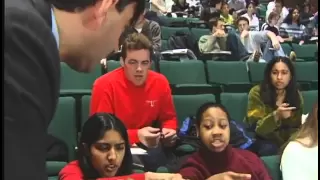
I asked them to read the book before coming to class not after class and in class I teach by questioning so I'll talk a few minutes I'll ask a question the student think about it and then I have them vote on the answer we actually use technology to do that so they commit to an answer and then I tell them find somebody with a different answer around you and try to convince that person complete chaos they all start talking and arguing and and then you see these students go oh yes and different students help each
other understand the subject I have them vote again and usually many more students get a correct on the second try and then we wrap up with a discussion and I go to the next question I call this approach peer instruction because students teach teach each other at the same level rather than teacher student it's student student and I as the instructor facilitate it instead of being the sage on the stage delivering the wisdom which I now know I can't do I am their coach I'm the coach who guides them from the side I've shown with
this method that you can triple the learning gains and books have appeared of P instruction in chemistry and astronomy and mathematics there are people using it in many different disciplines and many many different educational settings the key point is this though it's not about the instructor in front of the class it's about the student and the student's mind you don't learn by listening you learn by doing and in a sense this brings the doing back in the classroom this technique can really be applied to just about any field that involves critical thinking and I would
say at a university everything involves critical thinking here's the reason why education in a sense is a two-step process one step is the transfer of information and we have many ways of transferring information one is books the other is video and of course in the University most transfer of information is done by lecturing the professor delivers information to the students however the crucial part of an education is for the student to make sense of that information to have the AHA moments oh I get it so that you can apply the knowledge embedded information in a
new context unfortunately when you listen to a lecture there's no time for that aha moment there's no time the only thing you can do is take the information down if you try to think you lose track of what the person says because you cannot think and talk at the same time so where for most people I've asked myself often where did that happen for me these aha moments where did I make sense of the information well that happened outside of the classroom so in the standard approach to teaching the information transfer is in the classroom
the sense making is out of the classroom if you ask yourself pragmatically which is the harder part I think we all agree it's a second part A sense making so why not flip this around and do the easy part outside of the classroom the transfer of information books video and then in class we think about it you can do this with art history you can do it with Biology you can do it with Quantum information you can do it with special relativity you can do it with finance and in fact believe it or not there
are people in all of these fields at universities not my own but many who are using it from Finance to mathematics to French drama [Music] [Music]