>> Rachel Evans: Hello, everyone. My name is Rachel Evans, and I'm a regulatory affairs specialist for the Office of Research Support and Compliance at the National Institutes of Health. So, I'm going to go over a little introduction to CGMP.
So, what is CGMP? So CGMP stands for current good manufacturing practices, and per the FDA, CGMP provides systems which assure proper design, monitoring, and control of manufacturing processes and facilities. So, the overall goal to have CGMP is to make sure any product, whether it's drug or biological, is safe for human or veterinary use.
And what makes CGMP unique is that it's a highly regulated industry, and it's typically regulated by different government agencies, such as FDA, EMA, even country-specific government agency as well. So, the regulatory aspect, who falls under CGMP? So, it's typically any facility manufacturing drug products and biological products for human and veterinary use, compounding pharmacies such as 503B, phase two products, and phase three products.
And even though they're not technically supposed to follow all of CGMP depending on what kind of products you make and if it's patient specific, 503A compounding pharmacies as well as phase ones are still recommended to meet CGMP wherever possible. And who's the regulatory authority? So, again, it depends, really, on your country.
So, for U. S. , it would be your local state as well as the FDA, or Food and Drg Administration.
For E. U. , it would be EMA, so European Medicines Agency.
And then Japan would also PMDA, or Pharmaceuticals and Medical Devices Agency. And another ting to consider with GMP is if your product is shipped internationally, whether it's coming from the United States and going to the E. U.
, you will be inspected by multiple government agencies. So what are these regulations? Each regulatory agency also has specific regulations and even provide guidance documents to kind of help you understand what the regulations are.
So, for GMP, the big one that everybody uses, whether it's Europe. Japan, or even the U. S.
, it's typically Annex One. And that one spells out a lot of the way to interpret the regulations, as well as give you guidance on where to start in building your processes as well as constructing your facilities and what requirements you need. Additional resources -- because in GMP, we don't ever just use one -- we also refer to USP, PDA, which is a great resource because they provide technical reports, ISO, PICS, and then ICH also provides good recommendations on GMP.
So, what kind of requirements are listed in these documents? It's actually focuses on a lot of different areas of aspect, so you typically would have a quality manual. And it goes into different things like what type of product you're manufacturing, facility design, including controls, how you're able to maintain those specific requirements to have and manufacture your product, the personnel and the gowning requirements, flow patterns to how people and materials are going to move through the different spaces, what kind of equipment and materials you need, your cleaning processes.
And cleaning processes can also include validated methods on your specific cleaning agents, routine cleaning, cleanings of equipment. Documentation is another big aspect that is highly regulated, which are records and reports. And then you have your different quality systems or of your environmental monitoring systems or your document systems are all part of the requirements and are regulated by regulatory agencies.
Another thing that we do pretty often in GMP is testing. So a lot of things to validate and also prove that your facility is in a state of control, you do a lot of different testing. And a lot of the ways that we come up with what kind of equipment we use, cleaning, how we document certain way is typically done via a risk-based approach.
So why would we even have all of these requirements? Well, the main goal is to protect the product and, in certain cases, some personnel from being contaminated or even harming a potential patient, because a lot of our product that we manufacture go directly to a patient, and a lot of patients have the understanding that what they're receiving, whether it's an IV or chemotherapy drugs or over-the-counter medicine, is safe for them to use. So how do GMP facilities meet regulatory requirements?
So the big one is quality assurance. So quality assurance actually reviews separate from the operational team to ensure that all SOPs, procedures, protocols, and requirements are met. They also overall monitor how the facility is behaving, how the personnel is behaving, as well as the overall operations and reviewing of all of the different batches.
And another tool that quality assurance uses is routine audits and inspections. So not only do CGMP facilities get inspected by different government agencies or state departments, they -- the quality assurance team, or even a third-party vendor, will come out and audit different systems within GMP on a frequent basis. And the whole point of all of these quality assurance inspections and audits are just to demonstrate control over the different processes and the facility.
So on the screen, I have a little bit of a facility organizational chart. This is very high level, but this kind of shows you how CGMP facilities are structured. So at the head, you have your manufacturing authorization holder, or the facility owner.
To the right of them, or directly underneath them, is the head of operations. And underneath them, you typically have your production manager, quality control. Depending on what kind of processes you have, you might have additional staff there.
And then of course, separate, which is by the dotted line, is quality assurance. So now they're more separate to, again, have a non-biased view, because they don't have direct interactions with operations, as well as they have the authority to stop the line in case there is a potential risk to the product. Documentation -- a big part of GMP is our documentation practices.
So if it was not documented, it didn't happen, which is our main slogan. It is highly important to have everything documented and documented appropriately since all of our documents for GMP become official records. We follow good documentation practices, or GDP for short, and this allows us to have all of our documents legible and allows someone years from now to be able to review.
In the United States, we tend to have some issues since we do month, date, then year. And if you have an inspector from, say, the United Kingdom, they may get confused on when the batch or the documentation happened. In order to prevent any confusion, we recommend doing the day, spelled out the three letters of the month, and then the year, as there's no confusion on when that event occurred.
Another thing that we practice in GDP is the 24-hour time, and, again, it prevents any type of confusion whether -- if you have a 24-hour facility to make sure that if something was done at 6:00 a. m. , it's documented at 6:00 a.
m. and not, potentially, 6:00 p. m.
by mistake. Now outside of GDP, we also use a lot of different tools for our documentation, and we do a lot of different risk assessments to evaluate our different methods. Our procedures, standing operating procedures, is one of them, are very highly -- are very regulated as well as to make sure that everything can be followed easily.
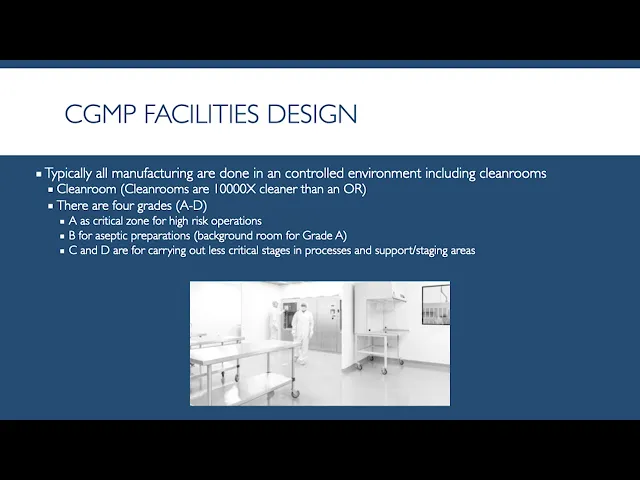
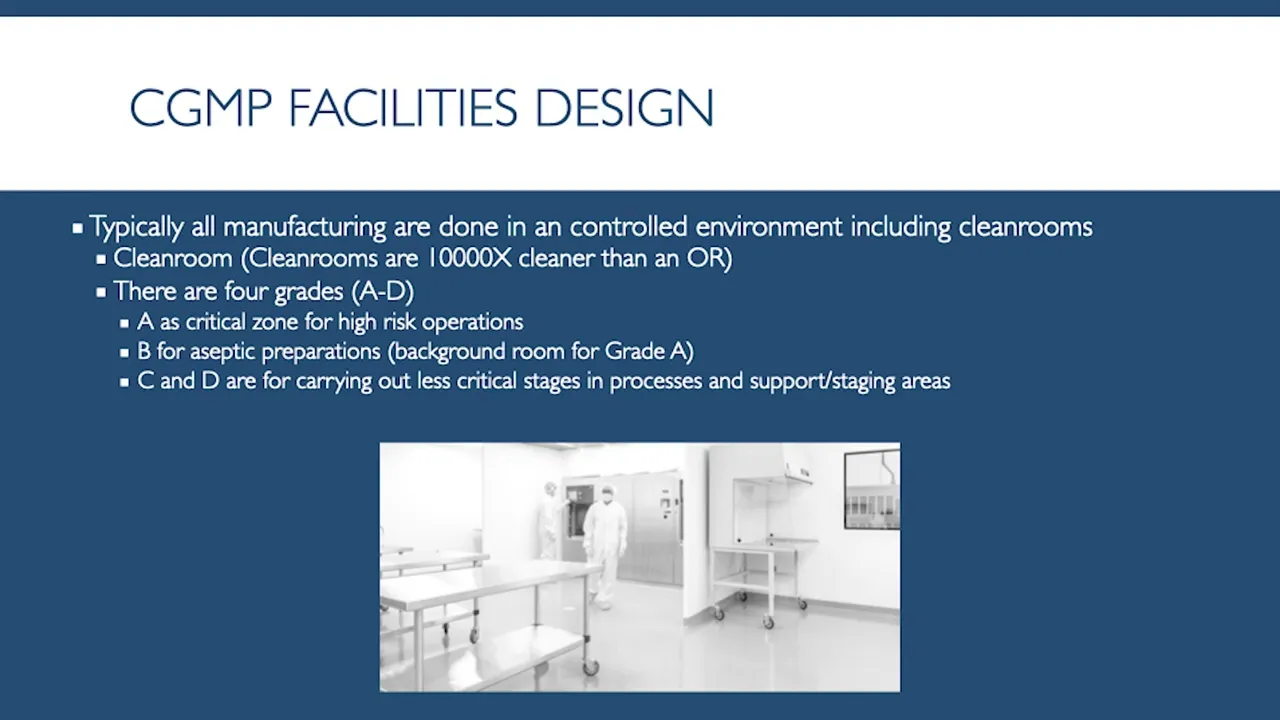
So besides documentation, we go into kind of how the facilities are designed, because this is a big thing about cleanrooms. So, all of our manufacturing are done in controlled environments, which is, again, cleanrooms are typically what we use. And a fun fact about cleanrooms is that they're about 10,000 times cleaner than an operating room, or OR.
And we have different grades for the different levels of the cleanrooms based on the risk to the product. So, grade A is considered critical zone for high-risk operations, and in the picture below, it's actually that biosafety cabinet to the right. Grade B for aseptic preparations, which is typically the background room for grade A space, and that is actually the whole room pictured below.
And then you also have grades C and D, which are typically used to carry out less critical stages and the processes, as well as are used for either supporting rooms or staging areas. So, what kind of criteria goes into making a facility or a cleanroom? Well, the overall goal is to prevent any type of contamination.
You have your different grades, which as you start with grade D, you slowly work your way up to a grade A space. You have different pressures, which the room could be either positive pressure, which is typically blowing air out of the space, or negative, which is sucking air in, and that's typically used for any kind of infectious product. You have a lot of HEPA filters in the -- and specific placement for the exhaust.
So, in the image, you see the blue arrows, which are HEPA filters blowing air in. And you make sure that the exhaust, when building a cleanroom, is towards the bottom of the floor, so that way air can go completely down and across the room, and it allows to make sure that there's proper air changes in the space. Another thing to consider about building a cleanroom is the flow patterns, so how are your personnel going to move from space to space, room to room, and also, how are materials getting in and out?
Are you going to use a passthrough? Do you have a special room? Do you have a current passthrough?
And, again, the big thing is what kind of product you're manufacturing, because a lot of your specifications, depending on what kind of products you can make in the space, you might be limited on what kind of room you have and you designed. Another thing when you're building a cleanroom is to think about the cleaning. So how are you going to be able to maintain the space?
Are you able to keep it sterile and clean of any potential particulates? And the location of equipment, especially larger equipment, because if you have a large biosafety cabinet, you have to make sure it's not blocking any air flow and it doesn't prevent any kind of, as we like to call it, like, dead zones in the space where air flow just can't reach it, because you don't want to have any open manipulation products there, because there is no clean air blowing on where you're manufacturing. So how can you make -- maintain this cleanroom?
Typically, it's done by routine testing, and this can include environmental monitoring as well as your cleaning program. So cleaning is actually one of the biggest areas that we like to focus in a cleanroom. And the biggest thing to have is a robust cleaning program, because without a good cleaning program, you're not preventing any potential contamination of your products.
So, like the previous slide, designing the facility actually considers how you're going to clean the space. So, you don't have any right angles from the wall to the floors. Typically, it is a rounded edge to prevent any kind of dust or lint from creating a film.
You make sure that your high-risk areas have no water sources that can potentially contaminate the room. You make sure that all of the materials are being able to be cleaned and can withstand any cleaning agents. And a good rule of thumb of how we clean the space is we tend to clean from cleanest space to dirtiest, so that would be your highest-risk space, like your grade As, all the way through -- you essentially clean yourself out through -- to a grade C or D.
And depending on your manufacturing properties, cleaning may be performed with specific reagents. So, you may have to have a bleach reagent. You may be able to use a different [unintelligible].
It really depends on what you're manufacturing and what risk you have to your staff as well as the space. And to determine what kind of reagents you use, you do a lot of testing. So we typically do a disinfection efficacy study to make sure that the cleaning agents you selected are effective on the microorganisms that you are concerned about.
Another thing we do is validation of specific cleaning processes. Typically, this is done when you have centralized lines or equipment and there's a risk of potential cross-contamination from batch to batch or different products. So you want to make sure that whatever cycles you use and whatever cleaning process you use -- you develop for sanitizing in between your batches or your different products, they are effective.
So that leads us to personnel. Personnel are the major contaminants in a cleanroom. Just sitting alone in a room, you shed 10,000 particles a second.
So it is very important for all of our staff to be highly trained on all of the different SOPs, how the facility operates and how to move about the space, to understand what kind of equipment and the cleaning requirements that there are. And overall, you just want to make sure that your personnel understands what they're going to walk into, because a lot of movement and the way you have to move in a cleanroom is very specific, and it's very unnatural. So, it takes a lot of training and different courses to really train yourself on how to move in these spaces appropriately, as well as wear the potential gowning, which to the image on the screen, is a typical, as we like to call it, bunny suit, which really only shows your eyes.
And you have to put this on a specific way to prevent any potential contamination or from you contaminating the actual bunny suit before you enter the cleanroom space. Another thing that's very unique about GMP is we have specific hygiene requirements to no fresh tattoos or open wounds, no nail polish. No jewelry or earphones or Air Pods are prohibited, no fake eyelashes, no makeup, perfume, scented lotion.
A lot of cleaners also have a requirement on no smoking within the last 30 minutes. And you're not allowed to even, typically, enter the cleanroom, let alone sometimes come to work, if you have a respiratory infection or a known skin condition such as psoriasis. But why does this even matter?
This actually makes you shed even more, and the whole goal of the cleanroom is to limit how much you're impacting the environment. So other than personnel, you have materials to worry about. And this is typically one of the second most common contaminants in the -- inside the cleanroom.
All materials inside the cleanroom must be able to withstand routine cleanings and are able to be easily cleaned, such as stainless steel. Materials that are brought in are typically individually wrapped and consist of multiple bags to be removed at each different grade that you go into. So a lot of our materials are triple bagged, so every time you move into a different room, you're removing a layer from the packaging just to make sure that you're reducing any potential contaminants from entering inside the cleanroom.
Any cloth items inside, such as wipes or gowning materials, are typically low lint and low shedding, so there's no cotton or anything, or wool, that could potentially make you sweat or shed any little, tiny fibers. Excess items that are not required or dedicated to the cleanroom are removed, and only in certain procedures or circumstances, extra items may be brought in on an as needed basis. So after understanding kind of the basics about a cleanroom, we typically get a lot of questions about GMP.
So the first one is, why are GMPs so important? And these GMPs are to ensure a product is safe for use. So, again, our end users or patients take these products with the confidence that they are safe for them to ingest, or potentially, if they're an IV or chemotherapy drug, can be injected inside their veins.
How do agencies determine if a GMP facility is compliant with these -- all of these rules? And they do frequent inspections, as well as industry is required to report any type of potential contaminants to the regulatory agencies. Now if the manufacturer is not following GMP, what does that mean for the product?
Well, in the U. S. , the FDA defines it as adulterated under the law, and they have to be labeled as such.
And typically, after a product is known to be contaminated, a recall is noted to the public and all of those products are pulled from the shelves. And how do we learn more about GMP, since this is a very new concept for a lot of people? Well, I have some references for you.
The best one I can recommend is the E. U. GMP Annex One.
But definitely look at your local government authority and see what kind of regulations that all GMP facilities are required to follow. But thank you so much for your time.