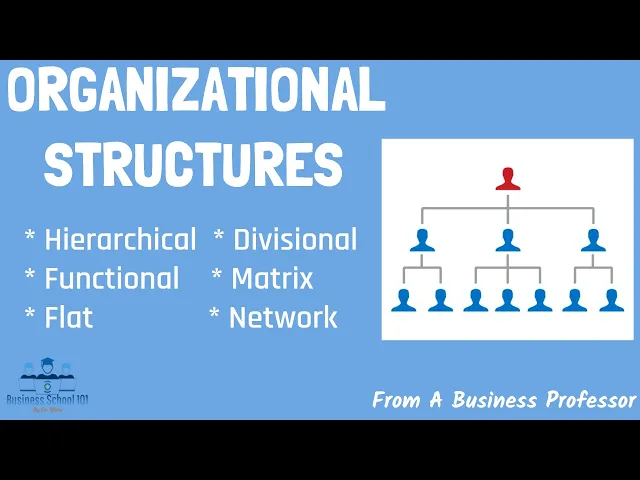
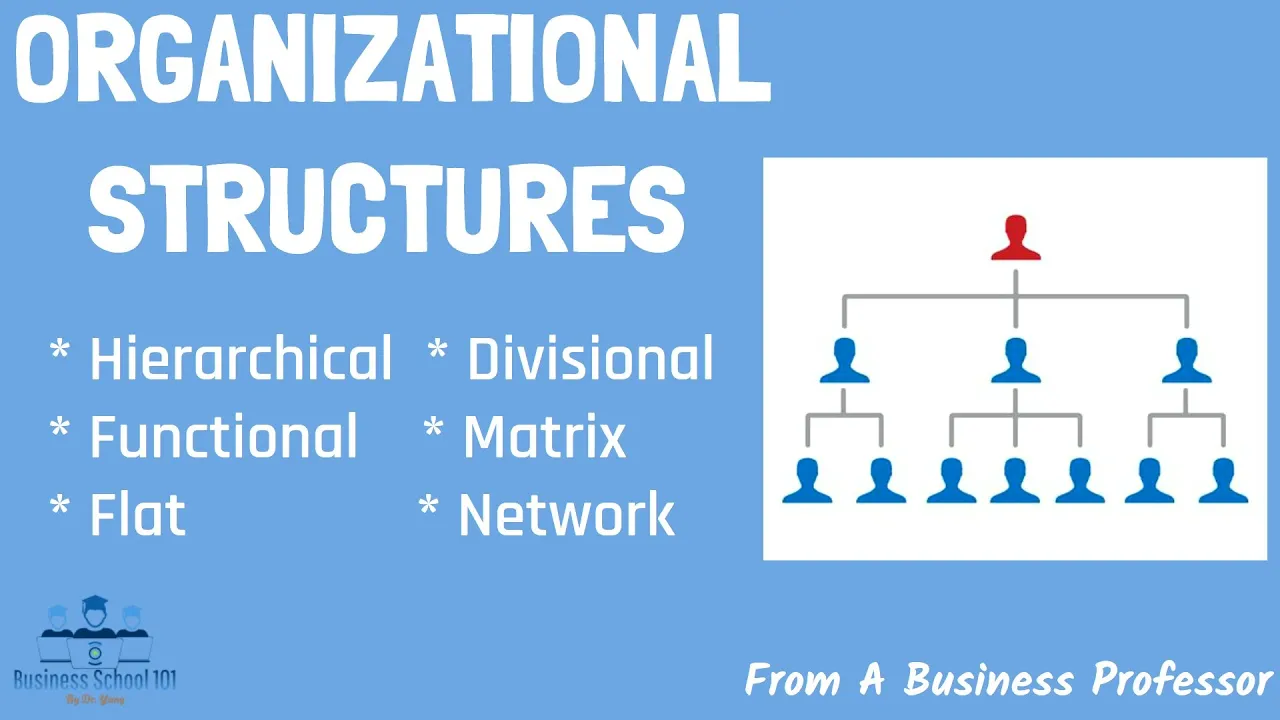
hello everyone welcome to business school 101 the organizational structure of some traditional companies could look like this however some technology companies structures might look like this in the real business World depending on the industry size and Stage companies could have significantly different types of organizational structures organizational structure is the backbone of all the operating procedures and workflows at any company it determines the place and the role of each employee in the business and is key to organizational development in this video I will introduce the six most common types of organizational structures which include hierarchical structure functional structure flat structure divisional structure Matrix structure and network structure within each one I will also discuss its advantages and disadvantages type 1 hierarchical structure a hierarchical organizational structure contains a direct chain of command from the top of the organization to the bottom Senior Management makes all critical decisions which are then passed down through subsidiary levels of management if someone at the bottom of this organizational pyramid wants to make a decision they pass the request up through the chain of command for approval the hierarchical structure has the following advantages one control orientation having a hierarchical structure helps employees understand the various levels of leadership this is because management roles are clearly defined in this pyramid structure 2. clear career and promotion path there is a clear career path through this type of organization with employees gradually advancing through the various levels of management over a number of years 3. clearly defined Authority companies with a hierarchical structure have different levels of authority and power this means employees will have direct supervisors they can report to this eases the flow of communication and ensures employees know from whom their Direction and working orders are coming disadvantages of the hierarchical structure include the following one poor communication dividing employees into different departments and levels can lead to a lack of communication this is because there are so many supervisors you'll need to get in contact with rather than one sole executive 2.
slow decision making the hierarchical system takes time for management decisions to percolate down through the various levels of management if a company operates in a swiftly changing environment this can mean that the business is slow to react to competitive and environmental pressures three added costs a hierarchical system requires a considerable amount of corporate overhead to support the Senior Management Group including extra layers of management and control departments this can be an excessive burden on profits when the bureaucracy is especially bloated type 2 functional structure a functional organizational structure is a business structure that groups employees by specialty skill or related roles it is based on levels of hierarchy that include different departments under the direction of designated leaders businesses commonly operate under a functional structure because it groups people who have similar knowledge and when used in a team environment helps companies achieve their goals the functional organizational structure works best for larger companies that employ multiple people with similar roles and smaller companies there may not be enough employees with related skills to justify grouping them into separate departments there are many advantages to employing a functional structure in your business one increased productivity people in a functional structure setting have specialized skills that allow them to work more quickly and efficiently than those who may be unfamiliar with specific subjects which leads to Greater productivity 2. skill development companies following a functional organizational structure have multiple departments compost of small teams within each team experienced managers have the chance to teach their team members the same skills they possess resulting in an enhanced skill set for all involved 3. Clarity when companies bring people of the same specialty together it creates an environment of clarity anytime someone within the company needs high level information related to marketing Human Resources customer service or operations they know where to go 4.
minimized cost of operation by organizing employees according to business functions departments can reduce the chance for multiple departments to complete similar work giving tasks to individuals with the right skills also saves money because work gets performed more efficiently some of the disadvantages of functional organizational structures include 1. hinder decision making for companies that thrive on greater flexibility and creativity the functional organizational structure may impact their ability to operate efficiently when management is unavailable for feedback during time-sensitive projects it may hinder the team's overall progress 2. competition between departments as employees within each department work together they begin to operate as a team with a focus on achieving specific goals this goal-oriented mindset while typically positive may prompt competition between departments three narrow scope without extra guidance and information from managers employees within departments may work with limited knowledge of how their roles relate to the company's objectives they may also not understand how their work relates to other departments type 3 divisional structure a divisional organizational structure is a system in which a company segments its employees based on products markets or territories as opposed to their job roles let's discuss them in detail number one market-based divisional structure divisions are separated by market industry or customer type a large consumer goods company like Target Walmart or Costco might separate its durable goods such as clothing electronics and furniture from its food or Logistics divisions number two product-based divisional structure divisions are separated by product line for example a tech company might have a division dedicated to its Cloud offerings while the rest of the division's focus on the different software offerings such as Adobe and its Creative Suite of illustrator Photoshop indusim Etc number three Geographic divisional structure divisions are separated by region territories for districts offering more effective localization and logistics companies might establish satellite offices across the country or the globe to stay close to their customers this structure can be found in many large multinational companies here are some advantages of using a divisional structure one accountability and transparency because divisions have their own management groups to lead them it's easier to hold individuals accountable for their actions you can track which actions led to which results and assign responsibility accordingly each division works in their own best interest which also means there's more transparency in who deserves credit for positive outcomes 2.
gains local competitive Advantage a divisional structure can bring company a competitive advantage in local markets by giving managers the autonomy to make business decisions within their scope they can quickly change direction in response to localized changes 3. improves company culture using a divisional organization May improve company Culture by allowing for Unique perspectives at different levels senior managers may also feel more capable of modeling expected behavior when they're setting an example for a smaller group 4. increases offerings efficiently companies that want to increase their market share through more product options or greater Geographic availability may find it more efficient to use a divisional structure that can accommodate expansion disadvantages of using a divisional structure include the following one costs more to operate while your overall Revenue may eventually benefit from a divisional structure there are also higher operating costs unlike a functional organizational structure you also likely need a centralized corporate division to oversee the rest of the company which can lead to higher overhead costs 2.
economies of scale the economies of scale are the cost savings when an organization produces goods or services in a large quantity the divisional structure prevents organizations from getting the most out of economies of scale as a single division does not produce enough to take great benefits out of the economies of scale three encourages rivalries separate divisions may feel encouraged to treat each other as competitive Rivals instead of part of the same company having independent goals can lead to increased office politics and management groups attempting to gain advantages 4. Foster's Silo mentality divisions often develop their own strategic focus and agenda which may cause a resistance to change your reluctance to collaborate or a silo mentality The Silo mentality may make employees feel more isolated both physically and psychologically and in still a sense of exclusivity within them Type 4 flat structure flat organizational structure is an organizational model with relatively fewer no levels of middle management between the executives and the Frontline employees its goal is to have as little hierarchy as possible this organizational structure is common in the tech industry which is home to many small startups with flexible work Arrangements some examples of companies that have adopted a flat organizational structure or Google Amazon and HubSpot these companies share a common value in employee empowerment and satisfaction they also operate in extremely fast-moving industries that require quick adaptation to succeed in their respective markets advantages 1. lower operating costs when employees are given more freedom to make decisions there is little need for mid-level management this saves the business a significant amount of money on wages that can be directed elsewhere 2.
improved communication in a flatter structure communication does not need to go through several intermediaries and becomes more efficient as a result the quality of communication also increases because there is less potential for facts to be distorted or misinterpreted 3. increased employee motivation and satisfaction autonomous employees tend to be more motivated to produce desirable results for the company this increases morale and productivity while also decreasing employee turnover disadvantages 1. difficult for large organizations the flat structure is most suited to startups and smaller businesses with a manageable number of employees and larger organizations the ratio of employees to managers can become disproportionate management may be unaware of unmotivated or poorly behaving employees they may also lack the required support to affect important decisions 2.
low employee retention while some employees will be content to work under a flat structure indefinitely others will want to climb the corporate ladder given that there is little scope for promotion aspiring employees May seek work elsewhere 3. creates power struggles when employees do not have the overarching presence of a superior power struggles can develop this creates confusion and disharmony and also causes a loss of productivity type 5 Matrix structure The Matrix organizational structure is a combination of two or more different kinds of organizational structures such as project management or functional management these two are more managerial systems intersect on a greater Matrix in 1970 Phillips started using the Matrix structure for the first time it became so successful that other multinational organizations such as General Motors and Caterpillar tractors adopted the same structure advantages 1. encourage collaboration perhaps the biggest advantage of a matrix structure is that it brings together highly skilled team members from different departments allowing the organization to capitalize on the resources it already has rather than seeking expertise in recruiting project team members from outside of the organization 2.
increase efficiency The Matrix structure combines the project management structure with the functional management structure to increase efficiency adapt to changing markets and respond more quickly to market demand 3. develop new skill sets working outside of a traditional or hierarchal structure can benefit employees by helping them develop new skill sets and gain valuable experience from working with different departments disadvantages one unclear managerial and team roles since the power dynamics between the functional manager and the project manager may not be as clearly defined within the Matrix confusion about the specific managerial roles and team member roles may arise 2. slow decision making process because of the nature of the Matrix involving more than one manager decisions that may be required to pass through both managers can sometimes take longer to process than in a traditional structure 3.
too much work can cause overload The Matrix organization structure can also sometimes lead to work overload on team members since their project workload is often in addition to their regular functional duties employees might suffer burnout or Overlook or fail to complete tasks or have their quality of work suffer due to time constraints 4. difficult to measure performance oftentimes when implementing a matrix structure it may be difficult to gauge employee performance when working on a project this is in part because team members may be essentially performing more than one role both functionally and the tasks within the project type 6 Network structure a network structure is one in which more than one organization combines to produce a good or provide a service these organizations can either get into a partnership for a particular venture or one organization can hire others to handle one or more of its functions such as marketing production sales and so on an organization that has been using a network structure is H and M a multinational clothing company based in Sweden h m has outsourced the production and processing of its goods to different Asian countries advantages 1. clearer Focus if a firm drops other functions except its core competency it can have a clearer focus on what it does best two lower costs using a network organizational structure work can be outsourced to other firms which specialize in that particular work this way the firm will not only face lower costs but will also receive a better quality service than if it had done it by itself 3.
flexibility by Outsourcing work an organization is in a flexible position this allows them to change their production techniques quantity and designs or stop production completely without facing any major problems disadvantages 1. lack of reliability and consistency when a firm indulges in a network structure it gets more spread out as the network of an organization grows it gets more and more difficult to control such a widespread Network 2. lack of secrecy when you Outsource some work to another firm that firm may also be doing work for your competitors your firm's secret information may get leaked to your competitors by The Firm working for you 3.
loss of control when you Outsource important work to external firms you lose significant control over your operations this way you get dependent on the outside entities who can have significant power over you 4.