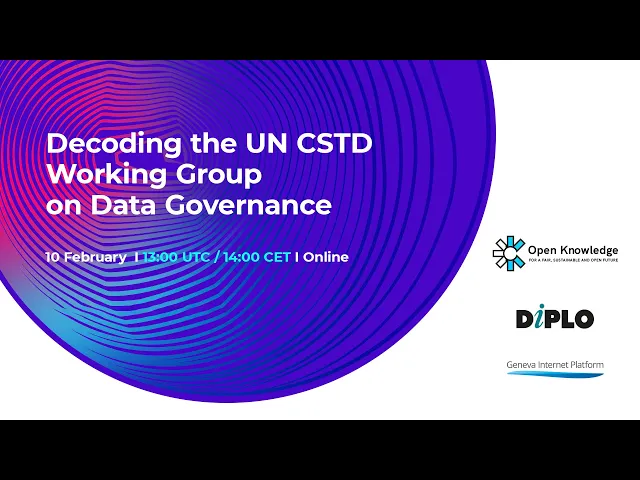
My name is Marilia Masier. I am director of digital trade and economic security at DIPLO. And it's my pleasure to moderate this session which is being jointly organized by Diplo, Open Knowledge Foundation and the Geneva Internet Platform. And this is actually the third uh event of an online event series that is dedicated to follow the discussions and the progress that has been made by the United Nations uh working group on data governance under the CSTD in order to strengthen transparency, understanding and participation in this uh important process. So I know that some of us are
uh new to following this group. So just provide just a very brief uh recap to those that may be joining us today for the first time. As uh most of us know at the United Nations summit for the future which took place in 2024 the United Nations General Assembly has adopted the pact for the future which includes uh the global digital compact or the GDC as its annex uh one and one of the GDC's central pillars is exactly data governance to be uh more precise it is under objective number four of TDC which calls for
the advancement of responsible, equitable and interoperable data governance approaches. So in order to fulfill uh this goal, paragraph 48 of the GDC has requested the commission on science and technology for development or CSC for short to establish a dedicated multistakeholder uh working group to engage in a dialogue uh on data governance uh for uh development. This group has been formed. We have some of its members uh here today and it has been holding hybrid meetings which allow face-to-face participation and also online participation since uh May last year and the next hybrid meeting has been scheduled
to take place um now in March in Geneva but we can also follow it online as an observer. Um but the group has also made progress intersectionally in between sessions and we're going to hear more um about that very soon u because the group has been um uh organized in working tracks. So we have four working tracks uh in operating now. The first dedicated to principles on data governance uh the second dedicated to interoperability uh between national, regional and international uh data systems and we have the two co-f facilitators of this working track here with
us. We're very lucky to have them. Um we have a working track dedicated to uh sharing the benefits of data and finally one dedicated to uh facilitation of safe secure data flows including crossber data flows. So in this event today uh we have decided to adopt a more clear development oriented angle uh and we invited members of the working group um from developing countries who advocate for development perspective in the working group uh to be with us. Uh let me just uh briefly um introduce them. U we have Hata Aila. Um Hinata is uh a
CEO of open knowledge u u foundation and he she's also one of the members of the working group and a co-f facilitator. We have Anita Gurumi. He's also a member she's also a member of the working group um and she's from IT for change. And we will have Sophia uh Anuru who represents the government of Indonesia here with us. If she's not here yet she'll be coming. Unfortunately, we will not have uh ambassador Gile Patriot with us today. Uh he was very keen to participate and very committed, but he's also the representative uh of Brazil
um to the WTO besides being uh the entering co-chair of the working group. So, he was pulled uh in the meeting last minute. We have the WTO ministerial happening next month. So the agenda is pretty full and difficult to manage at this particular moment in time, but he sends his apology and there will be someone um from the Brazilian delegation to follow the meeting and I'm sure um he will take notes of the conversations that we have and convey the most important points um to the ambassador. I would like to pass the floor directly to
Hanata. So as an insider perhaps you can share with us uh the overall picture of where we stand in terms of this working group now. Hata. >> Yes. So thank you everybody for joining us. Um I am part of the working group as an expert uh from the non-governmental group and I will say that uh so far the non-governmental group has been the most active and and the the level of engagement so far has varied uh among the governments. I will say that we have been working together for almost a year. It has been uh
irregular work because we have some initial as you might have known if you have been following the discussion some initial um bumps in the road agreeing what we were supposed to do and then we had the tragic uh departure of our church that passed away. Uh but I will say that from the end of last year it feels that the the work is finally taking off. I think that that is uh thanks to um the good leadership uh that has been and and the delegation of responsibilities uh that have been um and and also the
autonomy that has been given uh uh to the track co- facilitators and also the incredible support of the secretariat. I want to highlight that um the the secretariat even with limited resources, even with limited staff has done an amazing work in connecting with um all members of the working group and making us be very proactive and very creative on how we conduct the work um that we are mandated to conduct. We could be like, you know, very formal and very close and just discuss in the limited time that the u meetings that we scheduled um
um uh the formal meetings that we committed to attend. But instead I think that the group the the working group now has a very dynamic approach uh holding um intersectional meetings also holding meet practical meetings to organize better the the work stream and we are like you know set for success at this point. something that I uh to update on the on the process. Uh Maria pointed at uh the division of the work uh for gathering the initial input and for analyzing the initial contributions in four uh separate uh tracks. As uh the work unfolded,
we realized and it was something that was already clear from the beginning, but um it is very difficult to discuss in isolation each track and um now that the um the call for input closed on the 31st, even in the submissions when you read them um and by the way will be like accessible uh to everyone to analyze and to read, you can see how interlin and interwoven the the issues are that's why and I guess the Sophia will expand on that at least uh the track two related to interoperability and the track four related
to data flows uh we have adopted a joint um dynamic of work to coordinate and to discuss better like you know how how we uh um how we make our best effort to make it this um um um not a silos But uh some integrated reading on on on the state of the situation and the needs within uh within our thematic frames the needs um highlight the needs and the gaps for develop developing countries. H if you have followed the process you have seen that we have scheduled different intersectional meetings and these intersectional meetings um
have uh have become a very good um base for not only uh concerning the report but also an an additional opportunity for developing country teams to learn about the topic. uh for international organization to explain what they have done internationally around the topic and the challenges that they have faced. for governments with a more sophisticated, you know, data governance uh structure and and infrastructure to share good practices and and then uh to establish priorities because um something that is very important to remember is that the final product let's say that we are going to deliver
to the UN General Assembly is a very short report. So the phase that we are entering is is the one of making a hard decisions as a group on we what what will make this report um not only relevant but uh to resist the pass of time because from the moment that we produce it to the moment that the assembly adopts it to the moment that it arrives to the table to who who should really like you know relearn from it and implement a lot of time can pass and technology as we know moves at
a speed that is faster than what we can cope with uh even with the entire like you know policy teams. So um in this phase and and that's uh what we are going to discuss in the upcoming meeting will be like what do we live in and why what should we emphasize and why and what should you know like be a matter of just agenda or just additional notes that we want to provide to for people to understand better the topic and so on. Um although the round of gathering input from different governments and civil
society organizations and companies and so on already passed that does not mean that we will not hear and that we will not seek input uh when there is like you know where there is need for input. Um but of course um it means that the initial phase of gathering all the information that we we need uh to start preparing the report and to listen to all the relevant parties has passed. I have to note that at the very last minute, it was very good to receive input from um some developing countries uh that have that
those are of course available to observers, to members of the working group. Um that highlight the the differentiation on the general needs on data governance and the specific needs for developing countries is starting to emerge. and that that uh in in the latest um intersectional meeting that we had we also heard from developing countries and the practical experience in implementing um data governance uh efforts. uh what comes next is again the structure of the report the prioritization of the information the coordination across tracks so to make a comprehensive whole and the discussions in the topics
that uh in the in the topics that we might have you know different opinions I'm really looking forward to active participation from the side of civil society and from um other actors outside the working group and I am really looking forward for uh the interdependence and how we are going to uh solve the issue of interdependence between this uh the work that this working group is doing and the work that the AI expert group is going to do because because I think that they need to come up with a similar report and apart from that
and I'm sorry it was a little bit dispersed just to summarize my intervention there's a lot of excitement high engagement, practical learning and I would say that um even if we never agree on a report which I hope that will not be the case, the learning process and and the p the the public um engagement and the transparency and openness around the around these almost year have been um have been um sorry I I'm having promoters connectivity. So the process has been a a good learning experience and a good exchange of um good practices that
could help other countries h implement rights preserving u peoplecentric data governance frames that could build the foundation they need for the what comes next with AI and so on. Um that said um over to you Maria. Thank you. Thank you so much uh Hinata for this very insightful and brief overview of where the group stands. And I think I need to publicly recognize you and Sophia for being very fundamental for the group to get into the practical aspect of the work. We're always proposing different dynamics, case studies, exercises. So I think it has really grounded
the work of the group into something very tangible and it has been very good to the discussions. Um it strikes me what you said about the next steps that it's time for prioritization of topics to understand what should be included and and why. And perhaps to answer this question is interesting to take a step uh back and and and reflect on why this group has been created. What are the data governance gaps that exist out there in the world that this group has been uh tasked to bridge? So what are um the gaps that exist
in global data governance discussions uh and the realities the priorities for developing countries that are not really included in the conversation and that should be essential for this group and and to reflect a little bit on this question I'm going to call Anita and then then Sophia Anita over to you. >> Thank you very much. Uh it's a pleasure to be here and always with diplau as many participants have said. um also lovely uh to work with uh the the civil society group and it's really been a pleasure also to collaborate with uh extremely open
and far-sighted uh country representatives like Sophia and I concur entirely uh with Renata's assessment of the way in which the secretariat despite the challenges to the multilateral system at this moment uh has functioned uh in order to make this a space that is open and inclusive. So on that note, I think without ado, I'd really like to get into the questions that you have posed for me which of course does not have direct answers because it's so complex. But what I'd like to do is that uh with my colleagues at IT for change, we've been
really coding and looking at different submissions that have been made to the groups um made to the secretariat by various uh members. So this includes member states of course but it also includes other participants as you all perhaps know and uh all these up to December 31st of 2025 are available on the website of the UNCCSTD. So these submissions of course pertain to four key tracks but they also carry country positions um that somehow sometimes straddle um all those all the four four tracks. And just quickly to recap, these four tracks that come back from
par 48 of the UN global digital compact are about fundamental principles of data governance, proposals to support interoperability between national, regional and international data systems, considerations of sharing the benefits of data and finally options to facilitate safe, secure and trusted data flows including crossber data flows. What we have found during the coding is that there are three themes pertaining to development that keep coming up and these represent divergent viewpoints and this is a submission that we made recently on the 31st of January and um I don't really know that you know it has been made
public but soon it will be but I'm happy to also uh put out the link to uh the summary as well as the elaborate analysis with anuras that we have prepared which really goes back to you know uh systematic coding without the use of AI uh to really um delve into perspectives. So there are three divergences. The first is about individualist versus societal frameworks to data governance. The second is about technical standards for data interoperability versus pluralistic visions of data governance. And the third tension is between data free flows versus data sovereignty. So I'm going
to take us through each of these. Um and I'd really like to uh underscore that there are broadly um submissions arguments that frame two kinds of categories. one is approaches that treat privacy and personal data protection as sufficient to safeguard rights. So this you see in the positions of uh the government of Canada, the international chamber of commerce, the government of Finland and on the other hand are approaches that recognize the societal and collective ethics of data and the strategic development interests of people over their aggregate data resources. So you have submissions from data chos
digitalis the etc group that works on ecology and food systems. So in some sense the development upshot for data governance in this kind of attention between individualist and societal frameworks is actually twofold. The first is that a data governance approach based on personal data protection alone in the free market of data flows cannot address the limits to data commodification. The enclosure of the societal data commons by first movers, the claims of source communities from where data arises and public interest questions in guiding innovation towards the socialization of data value. And therefore at some level I
think societal and collective rights in data need to be recognized. The second is the tension between technical standards for data interoperability and legal pluralism. Right? So some submissions view data interoperability as a critical infrastructural feature for public value creation. uh for instance this is a submission from UNESCO and other submissions also talk about citizens digital set determination. This is a submission from the government of Switzerland. On the other camp, you actually have others who caution that interoperability if pursued as an end in itself without strategic clarity on where the data flows, what kind of data
flows, to whom, under what conditions, where is the benefit acrewing, who is gaining, who is losing. Without this consideration, we are bound to see an entrenchment of data extractivism and market concentration. So you have submissions from professor Lin Taylor and others who's making this argument. So the interoperability of technical data standards with its economic and non-economic benefits I think should not lead to coercive harmonization where select few will benefit. So the conclusion it for change would like to make is that data interoperability it is not an intrinsic public good. So in and of itself we
cannot see data interoperability as a public good because it is situated in a context where there are other kinds of values. The third and final tension we see and this is really important for development is this whole question of data sovereignity and data free flows. So one set of submissions uh that we have coded frames crossber data flows as a precondition for integration into global innovation markets that localization measures and differentiated national approaches would undermine. So this is uh a position taken by the entity data group, the international chamber of commerce and others. The other
camp which submits a cautious approach talks about how crossber data flows do not automatically open up pathways to equitable development for all countries because as we all know the global digital economy is characterized by deep asymmetries in digital infrastructure in capital bargaining power etc. So these submissions have been made by the government of Indonesia, the government of Iran and others. So um what we kind of infer from this is there is a concern from developing countries around data sovereignty or in other words uh the regulatory or policy autonomy of states to govern data flows in
line with their development priorities and public interest objectives which seems to be a non-negotiable in the international system because of the sovereign equality of all states. So global data solidarity in some sense I think hinges on looking at a broader approach where not just privacy rights but also second and third generation rights right economic cultural and developmental questions can be accommodated. So I will stop here because I just wanted to say that the flavor of the discussions really is at a point where a lot of articulation uh needs to be made. Um from the standpoint
of developing countries and that still remains a gap which Rena was pointing out. Yes. uh I think the last meeting did seem like things are gathering steam but I I would say that from the the positions that developing countries have taken in many other multilateral rule making spaces including intellectual property or trade or other spaces we do not see this kind of um assertive articulations uh that come from uh I think priorities and perspectives on development um more in the next round. Thank you very much. >> Thank you very much Anita and thanks it for
change for working on this. I think this is an extremely relevant study and uh and summary of different positions and the tensions that you have identified. Sometimes it's uh hard to extract everything in a very condensed way from the summaries that have been produced by the secretariat which are excellent summaries but I think that you really capture in a nutshell the core of the tensions that the members of the group will have to deal with and that is very important from any strategic perspective and also for the broader community as well to understand what is
at stake uh in the conversation. So thank you very much for that. I would like to turn um to Sophia Ste with a first question about um what do you think the gaps that this group are trying to close are but if you want to react to what Anita has been mentioning as well in terms of this attentions feel free to Sophia over to you thank you very much for being here I know it's a very busy time uh in Geneva for for you all thank you >> you thank you so much um uh the
the benefit of uh becoming the third speaker is Because like the other before me has uh spoken a lot and then I like the way uh Anita what do you call it describe all the input that has come so far to the working group. I think it's really capture what is there and then thank you Reata as well for highlighting uh how's the process so far and then uh what is going to be next. uh from my perspective I want to go to the basic like why we need this uh discussions of this data governance
and why the working group uh exists. We know at the multilateral forum and then we know as well as the result of the global digital compact mandate this working group but uh we also uh know that there is some um publication that has been made by some international organization highlighting the important of data governance. We could see the Antat publications and then ITU and then I think UNESCO as well talking about this uh why we need this why uh the d that the governance is needed. uh this could be some of the things that could
be highlighted as well at the report that uh in the declining of multilateralism is more about working together than uh developing countries that could be uh at the loss. uh but when we discussing about this data governance we could uh work uh with each other in order to uh make benefit of this data that is a fuel for AI the going to be uh more and more important uh in the recent year uh how the data could uh create uh public value how it could benefit us in achieving the SDGs and How could uh we
work together to reduce the systemic risk about this um maluse of uh data breach and then other things and then how we could uh bring up together to uh helpmemes uh digital trade increasing uh productivity and then also fair fair value uh cap capture what it's uh missing I think the discussion about this fair value capture about the inclusivity about how to incorporate me uh more developing countries in the g global value chains that it's uh now uh being um enhanced by digital uh infrastructures and then uh I think before it's also uh based what's
already being mentioned by reinata between a private and public. Uh how how we uh uh get this um this thing into the benefit of the public or society or the community as a whole. And then the second it's about how about the principles. uh this is one of the topic that is mandated to the working group to talk about the fundamental principle of data governance at all level as relevant for developments. Uh in in discussing about this principle, we know about the important about the free flow with trust about the important of the technical interoperability
about the need to create standard uh within and among countries. about the principle about the rights based uh developments and about the need of security and the protection especially for the private data protections. what is missing or what it's needed more to be discussed or to be incorporated for uh developing countries is about the fairness in value creations um as Anita before mentions and not only in the value creation but also the value distributions and then uh we need also for um the principle about this public interest access how uh data sharing for uh public
goods uh could be enhanced. How about the principle of inclusions? Uh because when you talk about the data about standard about interoperability, you create the standard of the language that is used. Uh and then uh how to make sure that the local language the language that is not uh universally uh used still could uh could be um incorporated and then uh not u in loss of this uh global accumulation of knowledge. And then how about the inclusion of the vulnerable group about the informal economic realities not only about the big datas or big uh companies
uh this is something that is also need uh to be uh make sure uh in the discussions uh the global uh debate uh mostly about the free flow and localizations about sovereignity uh but And now uh we also need to encourage discussion about the strategic uh reliance about the inquirations about uh uh bring up uh these things as a common goods uh together and cooperations and then when we talk about uh the next is about what uh what is needed to be addressed and supported for developing countries uh discussions about the support in a way
for capacity building in order for developing countries for example like to uh create their own interoperability system in order to uh create resilience in the data flow and to make use of it the capacity buildings the institutions and the enforcements are needed. Uh how about also to uh support uh the infrastructure development in developing countries uh to to create more uh skills uh that enable them to capture the good value of the uh data economy and everything. And then uh also about the inclusions uh cultural uh cultural right uh local language and this is uh
some of the things that uh need to be uh discussed more in in the future uh especially for developing countries. I think that's the addition from me. Thank you. Thank you very much Sophia for this very comprehensive and and thoughtful overview of what are the priorities for developing countries and what is still missing. And I think that we started to tackle the the second question that I had for you actually which is uh um the contributions have been very rich. The reports from the secretariat show that and listening to Anita have been thinking as well
that people who participated in the public consultation have put a great deal of thought in terms of their contributions but do you still see gaps in terms of things that are relevant from a development perspective? Are there issues that you wished someone had talked about or more people had talked about to create a little bit more a mass in terms of the contributions but were not really there and I will complement this question with the opposite view. Is there something that you feel that has emerged perhaps as a growing consensus? It was not very clear
in the beginning but that from the contributions you can see that discussions are moving um in one direction. Can you identify that already? Um perhaps I'll start with Hanata and then I I'll move to Anita. >> Yes. So um and the emerging and growing consensus that I see among the members of the working group is the capacity building aspect. It is a high demand of capacity people in the from the country know capacity building is a big issue which is not only which is a multi-layer technical capacity building h policy capacity shared practice how you
know like sharing cases how how have you solved this these issues because you know governments have to this um interoperability needs to be delivered for the government to function and many are struggling And you can see the appetite uh north south er from all the political spectrum countries have manifested the the the the need on capacities on the research gaps. I have said that is very limited original research on um the benefits of data and and you know like we need more economists on board on this. You know we need better analysis and more granular
analysis on a different way of seeing things because most of the literature and most of um the contributions are a hing away. Okay. Erh the the way that western countries with more resources have done it is the only way and so developing countries have to catch up uh somehow you know and and it is it it we accept some contributions we haven't gone deeper into other forms of govern data more bottom up communitydriven is either like you know like a a the way Europe manages or the way that some successful Asian examples manage it and
and and we need more um models in the menu. Uh and the more tested experience in the menu where value that is not only economic value has been the result of novel models of of data governance. I think that that lack of um examples is is something that we are struggling with and there's starting to emerge starting to come to come up at the intersectional meetings at least for the area of responsibility of the track two and the track four h but there's still uh a missing aspect there. The other missing aspect uh that it
is it has been um mentioned uh both in contributions and in discussions with the working group is how do we link this report uh with the efforts around AI and and it is not explicit in the mandate but uh in my opinion uh the list of topics was h was just descriptive not prescriptive. So I think that h it would be a great contribution um if this report even in a paragraph of two addresses why data governance and not any data governance but a fair data governance is fundamental for what comes next when a country
decides to you know include AI in their industrial policy in the government infrastructure and so on. I just want to highlight also that we had invited but it it didn't it didn't it didn't happen. We will do it for a future meeting the government of Cuba. government of Cuba prepared an excellent submission and um and I I will share it in the link in the in the chat link because it's worth reading because it reflects many of the things that Anita mentioned most of the things that Anita mentioned and it is uh one of the
new submissions that also captures the feeling of many countries in the global south that's all >> thank you thank you very much Hatal Let me pass straight to Anita. >> Thank you so much and uh I couldn't agree more. I think that it would be very very important for us to be able to make a connection uh that Renita just asked to and many of the points that Sophia made uh about the AI economy. Basically we're talking about uh rebooted global value chains which uh cannot be treated as business as usual and therefore this entire
connection between the AI economy and what may be adequate in terms of uh the development futures and what would be equitable and just you know so fair yes but fairness is um uh I think economistic we should actually go beyond and really look at inclusion which is equity and look at just which is really about looking at ethical aspects really of data and in that regard I think uh I would really um flag that the UNSG's report on financing mechanisms for AI which was released in July of 2025 talks about minimum irreducible data and AI
capacity the fact that we really need to pull data uh in a way that allows um and create a CERN for AI which allows compute capacity to be accessible to many many countries is possible only if we kind of act in a way that the AI uh data and AI um uh issues are fused completely together because I don't see how we can have fora where we talk about data governance as if it is only about privacy rights and an adequacy clause. Uh Jacqueline has posed a question here about Brazil and EU and their you
know crossber data flows and we've been made to believe that uh data flows with trust and the trust here is pretty much uh a kind of a a standin for the idea of personal data protection and so data will flow if there is personal data protection and and the confidence that somehow uh you know data will be safe in terms of data privacy but Even that it's possible today really to deanonymize and what we are looking at is not that kind of minimum floor where only civil political rights and data maintained. I think we're really
talking about economic justice, cultural questions in the epoch of LLMs. We're really looking at indigenous people's rights and we're looking at very very fundamental ideas of a global training data framework which the UN HLAB argues is really to be geared towards public benefit. If we cannot bring in ideas of common standards around training data provenence looking at model agreements to facilitate international data access and interoperability. I mean for instance you know climate data uh small island nations will need access you know to kind of prediction models and all of this is really contingent on data
sharing in critical domains right and I feel that the dots between financing for AI and the AI economy the entire idea of global training data data provenence um as well as you know global data value chains all of this has have to be addressed this together. I want to also reiterate I'll just take uh 30 seconds the points that I've already made which are present in the analysis that comes out of submissions. The first really is that we should really get together and developing countries really need to come together and ask themselves what do they
need at the end of these discussions? What kind of report do they need? Right? And I feel that the assumption that the rising tide of data interoperability will lift all boats and somehow magically and miraculously we are going to really have uh development uh you know in the AI age. This is not going to happen and I do think that there is a very big difference between data interoperability in the x-road case of Estonia or in the egovernment experiments of uh Indonesia or for instance the agree stack initiative of India or the national level infrastructures
that Peru is building for enabling industry. what how data flows within a country and how data exchanges are programmed is extremely different from interoperability in the international context. International context interoperability is really a political question. It's a technopolitical question and we should not reduce it to this kind of polarized um shrill rhetoric of oh my god this is fragmentation. I mean uh that is uh that kind of emotionalizes the debate in the room against the spirit of the sovereign equality of countries in the room. The pluralism about uh legal frameworks has to be maintained because
all peoples all nations have different kinds of value systems. And I also want to underline that health data that flows across borders is not only uh about you know sensitive personal data definitions. It's also about values values the the public and social value of data that acrru today to big pharma. And I think that this is really important. And the final point I really want to make is about the principles of data governance group. I think from a development perspective should recognize that the societal and collective rights and data are very very vital and we
have seen extremely sharp debates last week in the WH in the WHO which is now discussing AI governance and many countries took together and said till you talk about data governance of health health data we cannot talk about AI governance and I think that these are really about multiple generations of rights And I would really like to make the point that a lot remains to be done otherwise we're likely to have a report um which pretty much talks about trust and you know all of these uh warm and fuzzy concepts which really do not address
the political economy of uh AI futures. Thank you. >> Thank you very much Anita. Um I think we we're starting uh to go to the last part of our session. Um but in the interest of time I think I will drop the questions that have been asked by participants as well. So while you reflect on our last question which is about the future of the group let me also voice the questions that have been asked in the chat. Uh the first has been mentioned by Anita. It was a question from my colleague Jacqueline from Brazil.
um she she uses uh the context of uh the agreement the adequacy decision that has been celebrated between Brazil and the European Union and in a nutshell her question is about uh is this a stepping stone? Does it help to move beyond an individualistic view of personal data protection towards a more purpose-driven approach to data oriented uh to public policies and collective protection? Could this be a first step uh in this uh regard? Um and there's another question or two questions from Zultan. He asks uh to what extent does the working group deal with data
digital infrastructure aspects such as data centers, submarine cables etc. And what about the environmental impact of data flows? What are the main positions in the group if the group has been discussing this? Let me start with Renata, Sophia and then Anita. Ranata >> we haven't discussed to to quickly respond. we haven't discussed in that deep you know environmental the you know exp we have been very focused on the core topics and to answer the the question to the question about uh the that the colleagues from Brazil asked I think that and I was also listening
to all the participants I think the main tension that we have now is that the this individual approach to data governance that you know that is included in the data pro European uh GDP PR and so on give us leave even the most powerful countries in the world unequipped to deal with the concentration of power of corporations. So we I think that I think that um um the we have tried to tame um to you know to by taking this individualistic approach but now I think that countries and especially developing countries have to come up
with a different um government governance arrangement where they can at least leverage or challenge the concentrated power of the as as as it was expressed, you know, the those who provide the infrastructure that powers the data flows around the world and that and the the um dictate uh in in and basically draft and dictate the standards and the technology that is being used to to to work with data in any jurisdiction. So I I think that it is um the the multi multilateral efforts are extremely useful h the what GDPR did at the individual level
is completely different from what we need uh to change the game on data governance and that's where and it's not the it is not the job of the report to come up with something new what is the job of the report is to hide highlight why it is needed, why what why we cannot copy paste or extrapolate the data governance system as it is now for developing countries. Uh because even the most powerful countries in the world uh not the most powerful I mean that we that do not concentrate that do not hold the all
the industry and all the keys to data infrastructure are suffering and cannot fight back. So uh we need a we need absolutely different um governance ecosystem for what's what comes next if we want to uh survive as economies and societies basically. >> Thank you Hanata. Let me take the opportunity to ask Sophia about your expectations for the working group moving forward including about the outcomes. what what how do you think these outcomes can be valuable for developing countries in your opinion? >> Uh thank you thank you for the questions. I think the one of the
fundamental issues that need to be discussed also within the working group members is about how deep is the report would be and then to what extent the recommendations would be because like some of the members still doesn't want this report to provide recommendations because the I think some of the member also uh like the the condition as it is. So uh and doesn't want this uh working group to provide like a more recommendation or implementation road map or something they need to follow up in the future. Uh the uh the criteria is now discussing about
the structure of the report itself. some of the things that are important uh for developing countries uh uh the the first one is about the principles. I think the the recommendations or the guiding about the principles already uh being captured at uh other report including if I'm not mistaken DEC or uh UNISCO uh the the the other things that is this report it's going to um provide is about the options or the recommendation to facilitate safe secure your entrusted uh data flow including the crossborder data flow as relevant for developments and then as being uh
discussed in track two there's many examples about their interoperability within the countries or among the regions or about at the international level so I believe uh this uh will be captured as well in the report how this uh multi-layer interoperability between like the technical semantic uh legal that Anita has been mentioned about the inter uh the institutional and governance challenge within the countries or uh regional or or international and this is maybe also uh could also uh capture of the some sectoral interoperability because we already I think got the uh in one of our sessions
we got the example from FRO and then WHO. So maybe this could also being captured for example as one of the uh example how interoperability uh uh that is um beneficial for developing countries used and then about the sharing uh benefit of data uh especially at the economic uh benefit regarding the questions about the environment. is we haven't like really discussed about it but we do discuss more about the economic and then uh social uh public sector benefit of this uh data governance. Thank you. >> Thank you very much Sophia. Let me move to Anita
but maybe add one more question to the pile. We already have the questions from the chat. Your views about the future but it uh it um puzzles me um how the report will actually look like. We know that the body will be very concise because you have a word limitation which is very strict. Um but there has been so much uh information in case studies that have been shared. I wonder how you are going to deal with first of all views that cannot be brought together. If I understand correctly there will be a chair summary
together with a report which is supposed to collect these diverging views. Uh but in terms of the concrete examples, the good practice share, do you intend to have some sort of a appendex in which you're going to preserve it for the future in a more coherent way so perhaps countries can take inspiration from what has been shared. Over to you Anita and and Adena will give you the chance to have some final remarks as well. Hata Sophia because we're approaching the end. >> Thank you. Um I as far as I recall um yes there is
probably going to be documentation of uh the submissions but the report will be uh slim. the the initial discussions uh and you know the decisions made at the working group also affirm that we will capture the report will capture divergences in views without prioritizing majority views. This is I think really really important because uh simply because there are few voices to talk about certain perspectives we cannot really uh somehow overshadow those perspectives as if they are minority views. So I think that the principles uh that really uh shape uh this go back to certain precedents
that have have been noted in the working groups of the CSTD uh prior you know in in in the earlier context which I think really illuminate the need to capture divergences as they are regardless of the number of voices behind any position. So I think there is no one majoritarian view that's supposed to be treated as legitimate. So I think this is uh the first thing and it's of course completely up to us and uh some of us uh who are also here for us to really hold that line. I think it's really important to
watch and hold that line. Um that said I uh I also really hope that this slim report that doesn't uh end up with um over broad motherhood kind of uh you know statements. I think it's really important uh we have very sharp views including on issues that have been submitted but not really discussed and here is where I really wanted to say that about data centers or infrastructures etc the submissions uh of groups like the etc group of by observers by you know this is really important because while they may not have had a chance
to sit in the room in Geneva or participate online uh the debate is adequately I I think complicated and complemented by perspectives on the ecological harm of the current data and AI uh model in the world or the paradigm in the world. I have also noticed uh groups like rethink trade uh you know uh group in the US you know who have uh uh who are observers who've been in the room who've raised issues about uh digital infrastructure and autonomy of digital infrastructure pointing to the fact that there are double standards in the position of
certain countries so-called developed countries who do resort to protectionism in their context for certain purposes while denying other countries their right to actually govern in strategic national interests. So there have been very very sharp remarks and these remarks I hope will be recorded. Of course, the secretariat has is limited by its own uh capacities, but I do hope that the sharp fault lines that really talk about u a neoc coloniality of for developing countries is reflected in the report. And lastly with to Jacqueline's question, I just want to uh comment in the passing that um
indeed um uh I think what I find unique about the Brazil mutual adequacy arrangement is the fact that there is a very strong reference to public sector cooperation and um certainly of course uh the whole uh level of protection that is essentially equivalent to the EU's GDPR while talking about purpose-driven public outcomes. My knowledge about the Brazilian legal framework is limited. But what I see is that here is a unique opportunity for us to see and evaluate at the end of one or two years what kinds of social and public value outcomes were actually generated
because of this cooperation above and beyond mere market access. So I think that's a task that organizations like yourselves Jacqueline should you know uh set and we are of course happy to assist you in that regard but indeed I think here is an opportunity and under the leadership of Brazil that there is a certain uh identification for specific public sectors and the idea of boosting purpose-driven initiatives in health tech edtech and government digital services. So I'll stop there. >> Thank you. very very useful comment Anita Sophia maybe you have some final remarks and then the
same to Hanata we have about one minute and a half each um I think what would happen uh with the uh report itself it's going to um be uh um to enhance further discussion about the data governance uh which is uh getting more important especially at the era of AI. Thank you. short and sweet and concrete. Thank you very much. >> And just stay stay with us. Please follow the process. Please uh give visibility to the process across your networks. Have opinions, external opinions of course count a lot. Even if you know like the the
submission period pass past articles that you publish events that you host all of these influences you know like how we are going to draft this report hold your country accountable make sure that your country is representing your views they should they must and and also hold all of us accountable you know like uh if we are like you know messing up if we are not uh delivering the right messages Um and or if you have examples and and pressing issues that we want uh that you want us to bring up uh you have uh I
mean you can reach out to other organizations. We are more than happy to to to include your voices and your views in this report to make it useful and to make it as I I mentioned at the beginning longlasting so it can guide efforts uh beyond just its publication for hopefully the next uh 25 to 50 years very ambitious and and thank you for your attendance. I know that for many it's very early for many it's like you know lunchtime uh but I hope that this continuous nudging that deeplo and open knowledge foundation are are
doing helps to keep this process alive and impactful. >> Thank you so much. Thank you for the partnership Hata. Thank you Anita Sophia for being with us uh today and thanks to all participants who have been following the discussions asking questions until the the next event of this event series. Thank you very much. by everyone. >> Thank you. Thank you so much.