Well, welcome to everyone um to this um conversation with uh Ambassador Petru Deitriu and um really a great showing. A lot of people who have connected through various media. Welcome to you all.
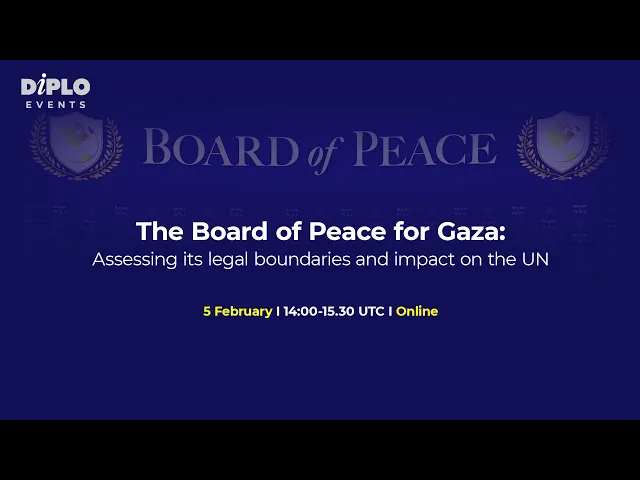
Um Pedru welcome to this uh webinar discussion uh within our common diploma foundation. It's also diplomacy light podcast uh that will be uh later on released as well uh as a as a recording. Uh the topic of our discussion is uh the newly formed board of peace.
Uh something that was just announced in Davos and um it draws its roots from uh UN resolution. But first of all, Petru, uh, welcome uh, to this conversation and thank you very much, uh, for coming and for starting this conversation with an excellent uh, blog post that you had it. Petra, welcome.
>> Thank you very much, Lubso, for uh, the invitation and I thank everybody for the interest. Of course I I see the interest is on the issue not not on necessarily on my article or my presentation but still it's good to have a a collegial discussion on uh on this issue which is quite important and raised a lot of uh uh discussion around around the world >> absolutely Petra you are a diplomat a Romanian diplomat um you were director general of u the department for multilateral affairs you've been focused on the UN for a very long time and in multilateral uh in general you were inspector of the joint inspection unit uh of the United Nations which for which you were elected by the UN general assembly. Your PhD is on UN reform and I'm and I'm sure that uh in writing it you didn't think that perhaps this will be the ways that they might uh be inclined to reform did you?
Well, uh to be honest, when I started my PhD thesis, I was in my first years as a diplomat in New York and I thought I have a magic solution for the problems of the UN and after six years of work of work, I realized that you know I was back to square one and I was trying to develop a different perspective on on what it means uh United Nations reform. Well, uh, taking us that there in what it might mean in today's day age. I mean, it seems that, you know, to draw on well, Lenin, but I think it's it's relevant.
You know, he said at one point, I think, uh, there are decades when nothing much happens and then, you know, well, I'm paraphrasing months when uh, decades worth of historical material is happening. We're we're, you know, in Prime Minister, Canadian Prime Minister Mark Carney's words, it's a rupture of the international system. It truly is.
Uh and this is one element that we're discussing right now. But it's important for uh diplomats like us, others like us to maintain a degree of objectivity and to maintain degree uh you know a prism that is uh legal uh in in this sense and our our the root of the framework of of our discussion will be such a legal uh analysis of of the board of peace. Before doing that, uh let's just briefly show why it is a hard job to do.
Um I will share just briefly the logo of the board of peace. Uh I don't know if everybody can see it. Uh it's uh this is the logo as it was formed.
It is a uh well an image uh created by someone of uh of the western hemisphere and really North America. But it's not a map of North America that I know of at least. I don't know.
there's this line that is going and the the base and uh and although is uh slightly uh transmuted if I can say diplomatically the the great lakes are some we're below this this line I don't know what exactly it presents so this is just to give us an idea that this is u a hard uh balance to keep uh when when analyzing these kinds of things and maintaining that objectivity but uh we need to we need to do that exactly that. So w with that uh let me let me kind of ask you because your analysis really of the proposed board deliberately brackets uh the political motivations uh and and the personalities. Why did you think it was important to begin with from this strictly legal standpoint?
>> Thank you. That's a that's a very important question. And I'm I'm glad to explain it because uh there have been more than one reason uh to do that to prefer that approach.
First of all, the public opinion is more divided divided at present than ever before. The power is personalized. We are less talking about countries.
We are talking more about personalities. And that is from the perspective of uh of a diplomat or international lawyer is not is not something very good because that may may change uh and alter the objective judgment. Of course I have to say it I I do not challenge the role of political leaders in history although history overemphasize the role of some important statesmen either by glorifying them or by demonizing them.
But again the assessment that we may need to make good decision may be disturbed or altered by this kind of emotion. I'm a supporter of X or I'm not a supporter and that's that's a alter the the objectivity. Also the media the media is contaminated with fake news with propaganda or or bias.
we we put that on the shoulder of the the technology but but I think I think it's not fair because behind technology there are people uh the point with media is that then can push the decision of political leaders in the in the wrong directions uh we remember the early '9s where we talk about the CNN factor in in the decision making of the security council then I do not challenge the role of masses in history either but people are called to vote only every four years at the best. So in the meantime, as you said, many things can happen and the masses and the people and the democracies they don't have uh a voice uh uh uh and they are just witness of important events. The issue of the board of peace in Gaza is a hot issue.
It follows a long series of hot issues originating from the same uh uh source. Against this background, I did not want to venture myself into the slippery slope of political speculation. Everybody does that.
I we we could we could make a political speculation for hours, but I wanted to avoid that. We we you remember politics is the art of the possible as Bismar put it at at his time. The corollary of this maxim is that everything is possible in politics.
So again this is one more argument to abstain from political speculations and I focus my analysis on only three legally relevant documents only and to be honest I didn't know the this logo you showed uh to us at the beginning because that would have influenced a little bit my own judgment on the issue. So uh relevant documents the rest is not silence the rest is noise which which should not be seen as that my analysis is blind from the political perspective. I I will use I will use another uh famous maxim law is the concentrated expression of politics.
So even if we are talking about law we talking about political will as well. Yeah. And um to maintain still an era of framework, we're talking about international law here because I mean we can even you mentioned every four years uh that speaking of democracies and political systems but our our focus necessarily is on international law which will be important as well when we get below and into an a slight analysis of of both the security council resolution which is the the the frame out of which um the the board of peace comes.
from but as well looking at the the charter itself um uh of the board. So you're right that the board of peace is compatible in principle with international law. Where can we draw the line the legal line between what an autonomous organization under international law is and a delegated enforcement mechanism?
>> Um you know what I will express is my opinion. you know that uh uh one of the the the things related to law in general and to international law is the interpretation. Uh so in my opinion the board of peace as placed in the current context it is both autonomous and delegated.
It is an autonomous organization by its own charter which is drafted in the form of a treaty among states. So it can exist as such and in principle it can exert its mandate anytime anywhere as long as it acts in accordance with with international law. But it is also a delegated uh peacemaking peacekeeping peace building and even peace inform peace enforcement mechanism.
If we look at paragraph 7 of the resolution 2003, I I mentioned here all um categories of UN operations since they were defined in the uh agenda for peace of Butros gali in the early '9s. So because indeed what we have there it's a very rich uh package. Then the legal lines it's not just one legal line or uh the the legal lines are doublefolded.
First is the general obligation to act in accordance with the international law which included the United Nations charter and secondly it is the specific obligations to act in Gaza according to resolution 280 3 which as we know includes also um a deadline. So we we don't need necessarily to have a a a clear uh line because we have uh two options two two views to interpretation that makes the the the border of peace as such in itself a legal undertaking. So going directly into that charter uh article 6A um states that the board possesses uh and I quote possesses international legal personality end of quote.
This really echoes the operative paragraph of this treaty that you mentioned of uh UN Security Council resolution 2803 of of there being an international legal personality. But should international legal personality in this case be understood as original or derivative? And if derivative, what is the proper legal route?
The board of peace charter, the security council resolution 2803, recognition by states. And finally, if I can add one more to that is if recognition of states is a factor, was the photo up of signing ceremony in Davos a performative act to demonstrate recognition by other states? Um yes uh uh good question and u um I don't want to be suspective of using in excess uh what we called what we call we the diplomats call uh quite uh uh with some pride um constructive ambiguity but indeed I I would say that the reasoning I use for to respond to the previous question is also uh adequate for this one.
The international legal personality of the board of peace is in my opinion first of all original. Why? Because it satisfied the legal requirements to be seen as an international organization with legal personality.
It is constituted by the collective will of a number of sovereign member states and implicitly recognized as such. uh the the the border piece could have had legal personality even without the recognition and authorization of his mandate in Gaza by the security council. We we know uh uh a lot of uh uh let's say I I'm stretching overstretching a little bit the analogy but there are so many uh NOS's that they do have a legal personality they they go in some countries to solve to contribute to the settlement of some uh uh conflicts between let's say uh uh tribal or ethnic groups and they they do not need the authorization or a mandate issued by the security council simply because they they serve a good cause and they respect international law.
The resolution has uh double effects uh on the one hand strengthen the bord of peace by taking it at the umbrella of the United Nations. That's that's uh clear and that is the most important thing that uh resulted from the analysis of the document. On the other hand, we we should see that the resolution uh limits the mandate and power of the board territorially and chronologically.
So it resolution is one for one specific territory and there is a deadline uh for the for the the exertion of of the mandate. Now so that is uh the originality the the the fact that it's original. On the other hand, if we go deeper into the complex nature of the border of peace, we may say that its legal status is equally derivative.
Why? Because it is rooted in the recognition of of the states who have adhered or will adhere to its charter and derivative from that recognition because after all without other member states the board would not have been an international organization. So again I think uh uh both uh perspective you describe are valid in the case of the of the board.
>> The thing is that uh the security council resolution focuses on Gaza and there's no mention of the word Gaza basically in the in the charter of uh the the board of peace. So security council resolution 2803 really is central in your text. And if we're talking about derivative that would be the logic that the focus is on Gaza.
So from that point of view, do you see it as a strong act of constitutional authority by the security council or as kind of a minimalist endorsement that leaves too much undefined including I mean if if if it draws its uh authority from the security council resolution which focuses on Gaza, you have a charter and a board of peace that really at the moment is not necessarily focused just on Gaza. >> Yes. That is not an easy question and uh because the whole perspective on this particular uh uh board of peace as a new entity is related to the resolution 2803.
uh we don't have to repeat it that it's essential from the point of view of indicating the the legal status of this uh board but we should go further and see that it contains a detailed mandate for the board of peace in the implementation of the comprehensive plan of peace. So we we do have something that the United Nations is doing you know as trying to use all means to to uh uh maintain peace and security at international level it describe a mandate of the border of peace even if there is no there is no uh let's say equivalent of language in the charter of the board but let us uh make this analogy between the charter of the United Nations and uh the constitution of a country. So uh I I don't think in in many constitution of democratic countries there is a uh a reference a direct reference to the United Nations charter but there is an assumption that uh uh as a member of the United Nations those countries will observe the the stipulation of the the charter.
So uh this is why the resolution is more important than a minimalist endorsement. Then also uh a resolution is a resolution is a text. We know the resolution are negotiated.
There are compromises. I don't know to uh what extent this resolution was really uh uh negotiated among diplomats or it was uh presented as a sort of excedra document. But some member of the security council said that the language of the resolution could not could have been more explicit.
It is true but those objections do not make the resolution a minimalist endorsement. The resolution keeps its uh entire entire power. And then there is I I it is the occasion to to say something that I didn't say in in my article.
Uh it is the preamble of the charter of the board of peace. This preamble brings a strong statement that a strong argument that justifies the usefulness and the legitimacy of a new initiative of peace whether it comes from one country or from a group of country. It is important to have uh to have a a peace initiative in Middle East.
the the charter does not name indeed the Palestinian Israeli conflict. But if you if you see the preamble, you realize that this is a long series of uh of uh uh notes on the past failures of all peace initiatives uh in in in Middle East. So uh it it is the the answer to your question is that it is essentially is not just a minimalist endorsement.
I I think it will really depend on how it it goes from from now on because uh the the resolution relies on periodic reporting. Uh and I think that this is one of one of the key things is there going to be periodic reporting and how what form they're going to take to the security council from the board of peace. But is this in your opinion a sufficient safeguard to pres preserve the security council's central role in this and broader?
Yeah, I I remember and I think it is the case for all students that are uh you know uh are taught about international law. The first question that is debated by all distinguished author is the question is international law really law. So uh uh given the differences from the enforcement means that the state might have and the international community or the international organization does not have it.
But let's let's uh look at the at the facts and the facts as you say as we know they are stubborn. Periodical reporting is the usual is the standard formal request of the security council for all situations and topics on on its agenda. So if you have a look at the recurrent debates of the security council, you'll see that there is at least one report of the secretary general which is uh uh the description of the progress review in a certain situation in a certain conflict etc.
It is true that member states can use their own information which they can share including in the form of letters sent to the security council. So there is this report and there is the information originating from from member states. Uh if I want me to give an example, I remember I was in New York when the the genocide took place in in Rwanda.
So the overwhelming majority of the of the of the United Nations including the majority of the members of the s security council did not have information about what this really happened in the field and it was even worse because the government of Rwanda was a non-permanmanent member in the security council. So what what I'm saying here is the security council is having more more uh uh instruments uh to check the information to check the the the the progress in the field uh other than the the report of the board of uh of uh of peace. Uh so we we have to to take it that that the report produced by the board of peace should play the same role as the report uh um uh presented by secretary general despite the the fundamental difference of status between the secretary general which is is serving the entire international community and the sec the the border of peace which has a particularity in terms of uh who who Uh so um uh it is uh it is possible it is possible that uh uh even if the the reports are not very accurate if they are misleading I think nothing prevents the supply of impartial and object information to the security council by by everybody else member of the board member of the security council or uh simply members of the uh United Nations.
So uh the normal procedure that does not uh does not provide more as safeguard for the quality of the reports. >> I mean and and let me pause at the moment really to invite uh any comments or questions from our um our audience and participants. I think that we have a lot of knowledgeable people diplomats here uh as well.
So please if you do have any questions or comments type them in. I'm uh together with uh dipl colleagues are monitoring the chat so we can bring it into this conversation. But so let me let me let me challenge you Petra as well as well as our participants.
Should we be concerned about the Gaza case itself or about the precedence itself because some have argued that the border of peace could become a template for bypassing UN uh peacekeeping in future crisis. We can have again this process of uh plurilateral or unilateral uh instead of going through the regular channels of of multilateral diplomacy, you know, general assembly, security council certainly. Is this a precedent that is is the precedent perhaps itself more concerning uh that that that it sets or is it really concerning in of itself that the Gaza situation is not being perhaps properly uh addressed?
Um if we look back at the history of the United Nations uh we will see that uh it is marked by innovation and adjustment at the uh to the local to the regional and to political circumstances. United Nations underwent fundamental uh changes, geopolitical changes like the decolonization uh process, the the cold war, the end of the cold war, uh the the advent of the technological era and without amending the charter, they managed to to just uh and use what they have uh for uh having in mind the same uh charter. And then peacekeeping operations themselves were an innovation in in the gamut of actions taken by the security council.
You know that uh that nickname that is given to peacekeeping operations article six and a half. It was a compromise. It was an innovation at that point.
And now we come to the Gaza. We we come closer to Gaza to the Gaza situation. The first such of peace operation uh the United Nations truth supervision organization was implemented in Middle East.
Uh and then the the first major peacekeeping operation as we understand it today uh the United Nations emergency force was established in 19656 following the second ArabIsraeli war. So the the the the these innovation were useful and they were inov implemented by by the countries with some some conviction that they are doing the the right thing. The the the concept of peacekeeping has evolved in itself has evolved constantly from mere buffer zone supervision like the the the uh force in Cyprus.
they just uh stay at the border between uh uh the two division of the island and they went to complex operation involving transition administration the reconstruction demobilization organization of elections etc. So it was a whole history of innovation and then we are getting even closer to to Gaza. The conflict is still there.
the Palestinian uh problem has not been solved 78 years after the partition of Palestine. So the the the usual method used by the United Nation did not work. And one major reason is that uh actually uh Israel after seeing the state of Israel saw uh the birth certificate of that state signed by the United Nations in 1948.
then later on declined uh to cooperate with the United Nations and refuse authority of the United Nations and in Palestine with each year that goes by the problems are gravity. So definitely in my opinion the diplomats should be more concerned about the Gaza case than fearing possible consequences of uh a president of an unusual move. uh one should frankly put the question what can be worse for the Gazawi people after what has happened in in recent years.
So in other words, any attempt uh seeking uh to settle the situation is a positive one whether or or not we like the the circumstances. But we have so many uh uh governments and distinguished statesmen that try to do something and we have Nobel Prize uh uh bestowed to people who tried to advance the peace process in in Palestine. Didn't work.
So why not trying something new? >> You you emphasize I think is does the the the security council resolution 2803 that any international administration must be temporary uh and oriented toward Palestinian self-ruule. Uh what concrete benchmarks then should be used to assess whether this principle is being respected in in in exactly this this way that you mentioned if it if it really is u an attempt to to solve the situation in in Gaza.
How do we try to u evaluate its success? For instance, even let's say a future noble uh uh committee. >> Yeah.
Well, we know very well that uh at the horizon somebody also is looking uh uh at such a perspective. But again, I'm back on earth. I'm back with the two uh documents with two documents in in in front of me.
Resolution 2803. not only welcomes the comprehensive plan to end the Gaza conflict but includes the plan. And if you look at the plan, the plan in itself is a combination of benchmarks in terms of security stabilization, humanitarian assistance delivery, institutional reforms of the of the Palestinian Authority and other other Palestinian institutions and uh the red redevelopment.
If you look at operative paragraphs four and seven of the resolution 2803 or uh paragraph 9 and 15 of the comprehensive plan uh you will see a fair description of concrete benchmarks. Of course, other paragraphs uh in particular those referring to the future of economic of economic development of Gaza Strip might be as they are aspirational and over optimistic. But the institutional objective of the plan could be achieved if indeed the commitment of all parties remains firm.
And when I say all parties, I I say uh not not only the United States but also the other members of the board, Israel and Egypt with the particular uh uh interest given their proximity and the Palestinian Authority itself. So there are benchmarks in in our opinion. If if everybody acts in in good faith, we have reasons to hope.
We we are not sure about the success but we have a reasons to hope. >> Thank you. And well there is hope and there we need to be uh uh optimistic as as much as we can be.
We need to be objective as well. You do express concern in in your article in our conversations uh that really the concentration of powers in the chairman of the board of peace who in this charter has final authority on interpretation uh of uh of of of its administration of holds unilateral powers over membership dissolution uh subsidiary organs vetos uh this may seat uneasily with principles of accountability of due diligence of due process of collective responsibility uh From international law perspective, again, this is our our perspective. Where do you see the line between acceptable executive discretion in exceptional trai transitional settings and a concentration of authority that begins to pose legal more institutional risks?
Well, uh here I have to of course as I hope I I convey that message. I'm not trying to defend some positions, but I'm trying to defend uh you know the the formal aspect of the the situation and I'm trying to defend anyway uh this uh resolution which was a courageous resolution in the sense that at the time of such uh tension among the the great powers. We still have a substantial uh resolution of the security council on a very sensitive issue.
But indeed, this concentration of powers in the hands of the of the chairman is the most problematic part of the charter of the board of peace. It is its Achilles heel. But that is less from a legal perspective, more from a political one.
But in international law uh we cannot presume abuse of power in advance. We the presumption of innocence is valid also in international law. The presumptions of uh good faith.
It is a peace initiative and should be considered with the presumption of good faith. And the means to reach uh such possible peace is not you know by threatening with the use of force uh by displaying uh uh military equipment around around a certain area or certain country. the the the the benchmarks and the description of the mandate indeed you know justified uh what I say the hope and the diplomats should be they are uh optimistic by by by profession.
The risk is there the risk is there it is real but one cannot dismiss the whole plan for such reason we should not throw away the baby with the dirty water in the and the tab. So uh and there is also we are talking about uh you know the risk to accountability, due process and collective responsibility. But speaking about collective responsibility, it would be unfair to believe that the the other members uh of the board of beasts other than the main initiator will indulge themselves in the role of silent background actors in cases of breach of international law.
In addition, again coming back to the security council, the security council will examine the matter every six months and it is not uh just a formalistic uh uh moment. The security council can take action. Uh there is also the specific time limit for possible further reauthorization.
But the security council we know at the end of 2027 but the security council can in principle withdraw the authorization at any time. they can meet in a uh emergency meeting and say okay uh uh guys we withdraw uh I I'm speaking about purely theoretical uh um uh option but it's there is there in in the chart that the the security council can decide okay stop uh you don't have our blessing for this operations you you abuse it it's not what we meant uh but I I will insist not just on the let's say the equip equivalent of check and balances. Uh but also the collective responsibility uh the the there there will be uh there are already a number of uh uh members of the board uh countries that expressed or even signed the charter.
There will be more I guess in in the end. So we should trust also those countries that they are not there just to align to a nice initiative. they are there to contribute to to the peace process and I'm sure they will not play uh uh uh they will not simulate their role as as a real protagonist in in that that world.
So that would be my my uh impression. It's not it's not I I mean I cannot I cannot be a prophet. I cannot grant that uh this will happen according to the rules approved by the security council but we still have uh um reasons to believe that uh the the the machinery that will be put in place will try to uh do the best for Gaza.
So I if there are violations though where should then responsibility be attributed to the board itself to participating states to the security council that authorized it? Uh does international law offer a pathway of responsibility and accountability in this sense? Well, uh yes uh that is something that is is difficult to to establish because uh u you know uh let's I'm I'm thinking now of example in the past the first time that the the notion of uh uh responsibility to protect was approved by the general assembly and it was considered one of the possible instruments uh of intervention by the international community.
the responsibility to protect meant that you can go in in in some countries without having necessarily the the uh consent of the host government because the host government is is part of the problem. It's not having a an interest to to solve a particular situation of of conflict. So in the case of Libya, the security council for the first and the the only time uh uh they invoked the responsibility to protecting the justification of the resolution on the intervention in Libya.
And then it was one actors, one of the of the member states that actually went beyond the lines and beyond the terms of reference for responsibility to protect operation and that was overthrowing the the the government of the of the country and and that was uh that was seen and the security council of discussed the issue and established that uh I mean did not establish anything uh uh Sorry for the expression. They just they just noted that the the terms of reference of uh responsibility to protect they were not observed and the consequence and they indicated who what country was in particular uh um uh guilty for for doing that trespassing. And the result was not that you know that country was uh other than um uh being uh been criticized in security council uh uh did not suffer any sort of uh penalty.
But uh but it was clear that somebody broke the rules and the the consequence was that there was no more operations under responsibility to protect uh because of the risk uh which was manifest in the case of Libya of doing more than it was required. So, so the uh uh let's say the responsibility uh we we we cannot find the special uh way to deal with responsibility with the uh deviation from the from the mandate of of an operation because there are not too many means in in in the international law. But we we have we we we could we could uh use the existing information uh to see uh to what extent and where and who was guilty for that.
And then it is what the international public opinion can can offer. no enforcement options, no uh sanctions uh imposed is just disappointed and just the the the insatisfaction and the criticism to that country. So I I I wouldn't have a sort of special uh uh response to to that question and there is also I'm talking about about the responsibility of states.
If we have to talk about individual responsibility, of course we have the uh the the international criminal courts if the case is to use them. But we know how difficult is also working with those kind of international tribunals and and I I see you gave me one one more second. uh I I I could uh I could say that um uh whether yes it is true that we don't have um a way to respond to to violation of the rules of engagement but then we we have uh what it is um called the the omnous obligation under international law.
For instance, if somebody uh uh violates in the course of the operation the uh international humanitarian law, whether they are in the board or not in the board or just neighbors, they they uh uh the the obligation provided in the in international humanitarian law are considered validness. And uh that brings me to to something more specific for Gaza in the sense that um we uh the international court of justice even uh in 20 2024 identified violation of certain obligations in its advisory opinion on the legal consequences arising from the policies and practices of Israel in the occupied Palestinian territory including East Jerusalem. So uh not only we have the international law in general but we we have u we have also uh uh you know specific advisory opinion of international court of justice referring to Gaza not to any other area in Geneva >> given the special status of the special situation of Gaza.
>> Thank you. >> I hope I I responded somehow to to your u >> Yeah. Yeah.
and and as we start uh winding down and and we advertise this is an hour and a half but I think that in today's age an hour is is enough so I aim to to finish uh at at the the hour. So last question for me and perhaps we turn to a few questions from uh other participants uh before we close but for me basically we've been looking at this continuity and you just brought in another aspect of international law uh but we've been looking at this uh kind of delegated authority from the security council but there is another relevant aspect of international law it draws from international humanitarian law uh particularly the law of occupation because we're talking about an occupied territory uh and there are obligations on international humanitarian law, specifically an occupation that impose what are some constraints. Uh and so my question is to what degree is that the case?
Are there clear lines of responsibility if authority is exercised through such a delegated structure and specifically looking at it as an occupied territory uh drawing on international humanitarian law and what it says about uh occupations? So uh in terms of international humanitarian laws and uh we have the uh long history of application of the Geneva conventions. I think uh I think more than anything the Geneva conventions and the international humanitarian law uh draw a clear distinction between uh evil and good between wrong action and between uh disintegration.
I think we live at a time where you know uh human civilization reached a certain degree of let's say uh respectability and of respect for international law in whatever form even if uh there are no um let's say police means you know to to to correct the behavior of a certain country uh unless it is by a decision of the the security council. What I can say about about Gaza is that this new peace initiative does not imply a special ramification of international law. We we have the international law as it is.
we uh we u there is okay there is a need to let's say improve the the core or of um uh international treaties that are dealing with that uh issue of behavior in occupied territories. But I I I think that everything was said in in the Geneva conventions and I think there was there were uh in the history cases when the most ferocious armies uh they tried to observe at least in appearance the the provision of the international uh humanitarian law. So what I would say if there are violation uh the current institutional uh framework is already available uh including as I said international c criminal courts which can be seized but there is there is nothing that should you know um should be inspired by the specific case of uh the work the future work of the board office in Gaza >> and I think this is a key distinction as well like one of one of the aspects that you mentioned is to keep at least an appearance and we've seen that before that even in some sub some situations in the past at least the appearance of legality has been tried to be to be kept we may be entering into a field where that is less necessarily the case but hopefully uh that is not we we go into some uh right away some touchy touchy and hot subjects we have a a question um in our chat I'll read it out and I'll partially uh answer it providing some buffer to you Petru because we're Good friends.
Uh the question is how are we from Claudia? How are we to square the fact that a sitting board member Netanyahu is wanted by the ICC for war crimes and crimes against humanity committed specifically in Gaza? Now um I will share from uh basically the structure that I have seen latest.
This is from the European Council on on foreign relations. Uh the structure of the board of peace. So you have uh the board of peace that is there.
seniors advisers to it. Then you have an executive board and then you have a Gaza executive board. So these are two kind of separate uh bodies.
Uh Nikol Ladenov plays a key role on both but to my knowledge at least uh Netanyahu is not a part of the structure. I may be corrected maybe somebody else know knows better but uh this is the last that I know of of the structure of of the board of of peace. Petro, do you want to you want to add something or?
>> So, so uh then here we are we are to that particular situation where we use names of personalities instead of name of countries. So I would avoid uh uh naming the prime minister of Israel. I would name Israel as a part of the conflict.
So what is diplomacy? Diplomacy it's about engaging all parties that can bring a solution to a conflict. So engaging the main protagonist is essential.
We cannot we cannot uh uh make uh peace without engaging with the party that is uh uh involved in a conflict. Peace means a compromise between the interests of two parties. In that case, we are following the so two-state solution in in in Palestine.
So, we have to talk about the state of Palestine. Uh we have to talk with the with the uh state of Israel. Uh of course, we know how complex is that situation.
We we know that uh uh the the resolution of the security council on Middle East are no longer necessarily u uh uh receive welcome by by by Israel. But again uh to make peace we need to engage uh Israel. We need to engage irrespective of the situation we need to engage all parties involved in in the process.
in in in in our case of course now we distinguish between two uh different uh let's say um um um two different political faction in the Palestinian uh uh in the Palestinian territories uh elected by by the people and one of them proved not to be not to be uh following uh um the peace but uh we have a sort of collective endeavor where the Palestinian Authority accepts the dialogue with everyone else to reach the objectives of peace. So it it it is a difficult issue. Uh and at the same time uh we we okay if there is a case at the international criminal court the presumption of innocence works in all legal systems.
Uh so until we come to that uh uh point of uh proving uh that a certain statesman is guilty of something we are dealing with the states and that's my perspective we have to deal with Israel whether uh uh there is a prime minister or another it doesn't matter it is Israel we cannot make peace without Israel and also when we speak about uh major power like the United States or like Russia or like chi China in the United Nations in international law the protagonist are the the countries not not their leaders the leaders they form a different category >> no you're absolutely right and that is the reason why we started this conversation in such a manner uh to begin with because it it allows us for really an objective discussion uh and I mean that we can all uh enter this with a lot of emotions but so uh I see that Claudia has put a link uh about the acceptance but again this is you're right Petru this is an an acceptance of Israel it's not u a personal even though the the chairman makes it very personal um at that level but really the the main actors here are states and Israel uh is uh a part of the board of peace as a state not uh the individuals in it so um I'll wait perhaps if somebody else wants to jump in with a question in the chat. Uh but u I I think that we've really uh I think this is the way to to to be able to discuss these things. Uh um the this rupture in the international system.
Um we can all be aed by it and really I think uh anyone who turns on whatever news source uh they they get I think on a daily basis there are things that are of a tectonic nature uh in the system. But we have to have frames of discussing it and analyzing it. Uh and I think that today's discussion Petru uh has been in such a manner.
So uh thank you very much for for participating and for having this discussion. Thank you very much for providing a framework that allows uh it Petro. >> Thank you.
Thank you for for your interest and uh I think uh this is the way in particular I I don't know how many diplomats are among those who follow that that conversation but diplomats should take on board all options of action if they it is meant to to serve the the public good. Diplomats should be optimistic. Diplomats should listen to everyone.
Diplomats should study international law, know exactly what they are talking about. It does they shouldn't necessarily follow the the headlines which are hasty. They are sometimes very misleading and for most of the public opinion they they they can have a negative impact.
But the diplomat should stay a little bit connected to documents connected to facts and in particular connected with the with the mission of of a diplomat and in our case of multilateral diplomacy because after all this board of peace it's yet another form of multilateral diplomacy. Thank you. Thank you for the invitation.
>> Thank you very much Petra and thank you to all our participants. Thank you to Diplo colleagues who uh were in the background and I really want to thank them because they make it possible for us just to have this conversation and focus on that and not focus on other things. Uh we should do these kinds of things more often and I look forward to them uh including with you Petro.
So thank you very much again. Uh with that let's sign it off and until the next time. Ciao.
Bye.