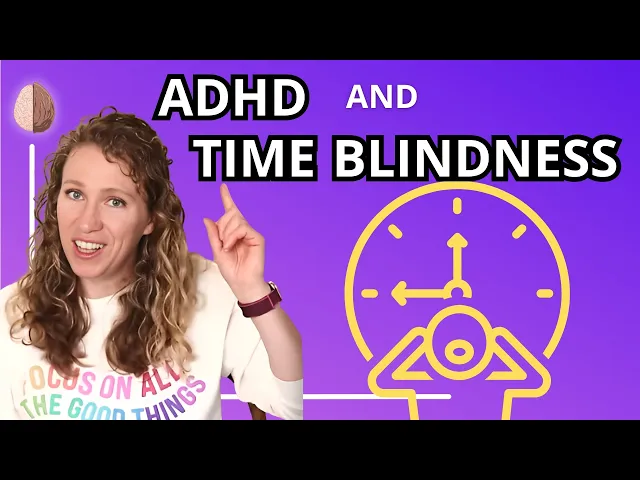
If you lose track of time, can't estimate time, or if you struggle to be on time, you may be experiencing something called time blindness. So in this video, you'll learn what is time blindness and 10 strategies to manage it. And if you think you've heard them all, the last two are pretty creative.
So real quick, time blindness is a symptom really common in people with ADHD or other forms of neur neurodiversity, and it includes trouble estimating the time a task will take, chronic lateness to important things, procrastination, getting overwhelmed by tasks or deadlines, um difficulty waiting. So because someone with time blindness doesn't feel the passage of time, waiting can feel like an eternity even if it's only a few minutes. And this can lead to being easily distracted or um impulsive behavior.
So for example, they might blurt out answers before a question is finished, or they might start another task while cooking and burn their pancakes. Uh this literally happens to me every time I cook pancakes. Um okay.
Going back to the list: difficulty task switching, um and probably one of the most damaging characteristics of having symptoms of time blindness is not being able to sense the future. Uh so for example, let's imagine that you're standing at a dock watching a ship come to port. And in the distance you can see a huge ship on the horizon, and it's slowly approaching.
You can sense that it's far off, and you have time before it arrives at the dock, so you go about preparing for its arrival as well as getting some other tasks done. As it gets closer, you sense some anticipation as you start to go about your work to receive the ship. And then it gets even closer, and you sense like you need to focus because it's about to arrive.
And then the shadow of the ship covers you, and now you sense like it's time to take action. You've already observed and prepared, and now you need to help the ship come up to the dock. So you see how the word "sense" is used to describe this impending event of the ship coming into dock?
You "sense" the future event, and it prompts you to take action ahead of time and make plans so that this big thing doesn't just come crashing in on you all at once. Well, for people with time blindness, that crash is exactly what happens. It's like they're on the docks with us too, but they don't really see the ship until the shadow is already cast over them.
Or perhaps they do see it, but they just can't sense its slow movement towards them like others can. So this inability to sense the future makes it difficult or sometimes even impossible for people within the time-blind group to plan for the future. Uh they don't sense the future until it's happening right now in the present, and then by then it's too late.
Now, almost everyone struggles with losing track of time occasionally, but there is evidence that the brands of people with ADHD who often experience time blindness may show altered activity in the brain's frontal lobes. So for people with more neurotypical brains, if they do lose track of time they can usually say, "Oh, I'll just pay more attention next time," and usually that personal little pep talk will solve the problem. But for a person with time blindness, just trying harder doesn't work for them.
So for a person experiencing time blindness, the ability to follow a schedule and to estimate the amount of time a task will take to do something, it feels beyond their control, and it often leads to feeling overwhelmed and ashamed. And that's simply because their brains work differently, so you need different strategies. But before we talk about that, let's look at a fascinating study, uh the light bulb experiment.
So Dr Russell Barkley, a leading expert on ADHD, conducted an experiment to explore time perception in individuals with and without ADHD. He put participants in a room and showed them a light bulb. And he would turn it on for a time and then off again.
And he'd asked them to estimate how long it had been on. And he found something interesting: both the ADHD and the non-ADHD participants were able to estimate the amount of time the light was on in about the same range of accuracy. But here's where things fell apart.
For the participants with ADHD, when Dr Barkley gave them the light switch and asked them to reproduce the time intervals themselves, the ADHDers were not able to reliably reproduce the same time interval with the light as the group with no ADHD symptoms. And so ADHDers were less capable of using their mind to govern their actions around time sensitive tasks. They could perceive time to a varying degree, but they could not judge or effectively estimate the amount of time an event or task would take for them to complete.
So the time blind have more difficulty with managing the time related task that others find simple. I think it's also important to recognize that the the world at large confuses timed blindness with being lazy or not caring, and in most in most cases, the opposite is true: they care very much, and they're very hard on themselves when they constantly show up late to an appointment or they let someone someone down again. And they constantly ask themselves like, "Why can't I do this?
Why am I always late? Why can't I get things done? How come everyone else just seems to be able to do this?
" And there's this real sense of shame for many people who experience time blindness, and it's made worse when others don't understand this issue. Now, children are often unaware of time. That's normal.
But as we transition into adults it becomes our responsibility to manage our time well, to be dependable, and to be productive. And when people struggle to manage their time, they often fail to meet their goals. So time blindness is a neurological difference, it's really impairing, and it's not just magically going to go away.
So let's talk about some strategies to manage it. The first step for anyone is to make time visible. So start with a clock in every room.
And yes, that includes the bathroom. You need to be able to look and see what time it is wherever you are in your home. Um one clock is plenty.
You don't have to go all Doc Brown on you, but you do need to make time easy to see. [Clocks chiming] Are those my clocks I hear? Yeah.
And the next thing you'll need is timers. So even the digital clocks or even the ridiculous mental math of an analog clock work for a bunch of neurotypicals. A visual timer can help you feel how much time is left for a task.
So instead of having to use the numbers and math, you can get the sense of, "Oh, I've used half my time" or "I've only got a sliver of time left. " Okay. I would also recommend adding audio or vibrating timers to your toolkit.
Um getting lost in a task means that your eyes may be busy writing, reading, or focused on some project. So in that case you'll want something that can give you a tap on the shoulder, so to speak. Uh you already know that most smart watches can do this, and that's a great option.
But if you need something a little more intense, you could try alarm clocks like this that jump up and run around until you turn them off or a wristband that electrically shocks you when a timer is up. Uh there are some great apps that can help with tasks and routines. One that me and my husband really like is a routine-type app that uh sequences events and tasks together, and each task has a time limit and a progress circle that goes down over time of the task.
And what I like about it is the timer intervals have multiple chimes that go off during a single task to help you get focused on the task if you get distracted. Okay. Finally, one of the best ways to make time visible for tasks or routines is to record them.
So especially with tasks where you're chronically late, rushed, or taking too long to do something, get out your stopwatch and record the actual time it took to complete the task. If you do this a handful of times for the same task, you'll eventually be able to estimate the actual time it takes to get them done. So for example, if you're chronically uh showing up late to drop your kids off at school, time how long it takes for them to get ready, dressed, shoes on, and in the car with their seat belts on.
Um I would even include how long it takes you to get down your driveway. So maybe you used to think that it takes 5 minutes for your kids to put their shoes on, but after timing it you've learned that it actually takes 17. Now you have a much more realistic idea that to get them out of the door by 8:00 they have to start putting their shoes on at 7:43.
So put this number on a post-it note on your fridge, set an Alexa reminder, whatever it is that's going to help you get the actual task done. Okay. Shorten your wait times.
Make it now. So people with time blindness don't feel the coming future. They only feel the present.
And because waiting is very uncomfortable, they distract themselves, or they move on to some other project to escape that discomfort. So then from their perspective, that far off ambiguous future deadline suddenly arrives, and they didn't - uh they become overwhelmed because they didn't prepare for it. So the way we fix this - and this comes from Dr Barkley again - is to lessen the amount of time a person has to wait between now and future events.
And that's done by breaking the future event into smaller events that can be chained together so that it feels like the person has something to work on in the very near future. So for a student with time blindness, a project that's due in 3 months might as well not even exist. But breaking that project up into subtasks and milestones will give them something that they can continuously work on now and in the near future.
Uh it could be really helpful for teachers to add a grade to each milestone to add an extra sense of urgency to help motivate that student. Um it isn't just about breaking the task down, but it's actually about bringing actionable parts of that uh task into the perceivable present of the person with time blind. Okay.
Here's another one: prepare early and leave early. So I think Jessica McCabe from the channel How to ADHD put it best. She says, "I try to finish my morning routine half an hour before I leave for work, and that way I can run late without actually being late.
" Now, of course you can also bring stuff to fill the time when you're there early, but be sure to set alarms to let you know when it's time to stop. So one time my husband who is uh in the time blind category went on a trip to China. He arrived at the airport several hours early, so he decided to put on a pair of headphones and watch a movie.
And he missed his plane because he had nothing to pull him out of the time blindness void and tell him to get in line to board his plane. So he ended up spending the whole night at the airport, taking a longer flight to China, riding the train, and basically he was totally exhausted when he got there. So be sure to set your timers and your buzzers, and maybe don't wear headphones like my husband did.
Okay. Um there is also evidence that medication can help with ADHD and time blindness, so you can talk with your doctor about this. All right.
So now let's talk about two lesser-known strategies for dealing with time blindness. Uh number one: try using playlists to help you manage time. So let's say you only have uh 5 minutes before you need to leave the house.
Instead of a timer, try playing a couple of songs back to back. When the first song ends and the second one starts, you'll know that you're halfway through your time. Um if you have a morning routine like you need to get through or a study session that needs to be a specific amount of time, use a playlist instead of an alarm.
So it does take a little bit of preparation, but it's a fun way to keep yourself on track. And that can also be like really good with workouts and stuff. Okay.
Number 10: uh check out this clip by ADHD Love. So Roxanne has ADHD and time blindness. Cuz my five minutes is five minutes.
It's 300 seconds. It's like there's a limited amount of things to do in 300 seconds. Is that all it is?
Yeah. Wait. No no no no.
Yeah. Just wait one - no, stop. Stop.
Is 5 minutes 300 seconds? Yeah. Cuz that's nothing.
I could count to that. I won't - I won't do it now. but like - Well, it'd take 5 minutes.
Oh my God. So if you said to me, "You've got 300 seconds to leave the house," that would be like stop what she's going, I've got barely any time, I need to get downstairs, get my shoes on, and get ready. Have we just fix ADHD time blindness?
I'm going to now just talk to you in seconds, even if it's like something next week. I'm going to do that. Yeah, but I can - right.
That's 177,000 seconds away. I can - I can - You'll be like what? so only 17,000?
Like 10 minutes is only 600 seconds. That's not a lot. If you said, "You've got 600 seconds," I would not try and get in the shower.
Lovely. If you say, "You got 10 minutes," I'm like posh. I have time for tea.
So ADHD and time problems solved. Roxanne literally had no concept of 5 minutes. You can see her realization light up.
And those with time blindness don't perceive the future. They live in the now. So reframing 5 minutes into seconds allowed Roxanne to perceive 5 minutes as if it were the present because she already understands how long seconds are.
And so now, because she could feel the 5 minutes in terms of the present, she was able to envision all of the activities that she could realistically accomplish in that time frame as opposed to her previous concept of 5 minutes, which did not work for her. So how can you reframe time? How can you alter your perception to make these time intervals feel more immediate?
Um here's an example that works for my husband. There is a little convenience store not far from here, and when he craves a quick snack he'll drive there and back. It doesn't take very long, but he's timed it and it seems to take 15 minutes round trip.
So if he couldn't grasp the concept of 15 minutes on its own, he would use this, you know, familiar use of 15 minutes to really understand what he could get done in 15 minutes. Could I take a shower in the time it takes to go to the store and back? Yeah.
Could I paint the walls of the room? Uh probably not. So um you can see how reframing time in that way can help someone who doesn't naturally sense it to gain a grasp of it.
Okay. So that's it for this episode. I hope that you found this information helpful.
Be sure to share this video with a friend or family member who might be struggling to be on time or manage their deadlines. Um if you have any questions about this or other topics, go ahead and leave them in the comments below, and be sure to check out some of my other uh neurodiversity, ADHD related videos. Uh the playlist is linked in the description.
Okay. Thanks for watching, and take care.