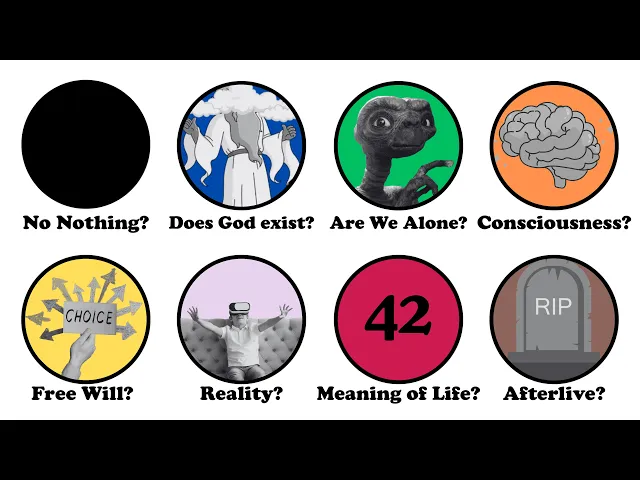
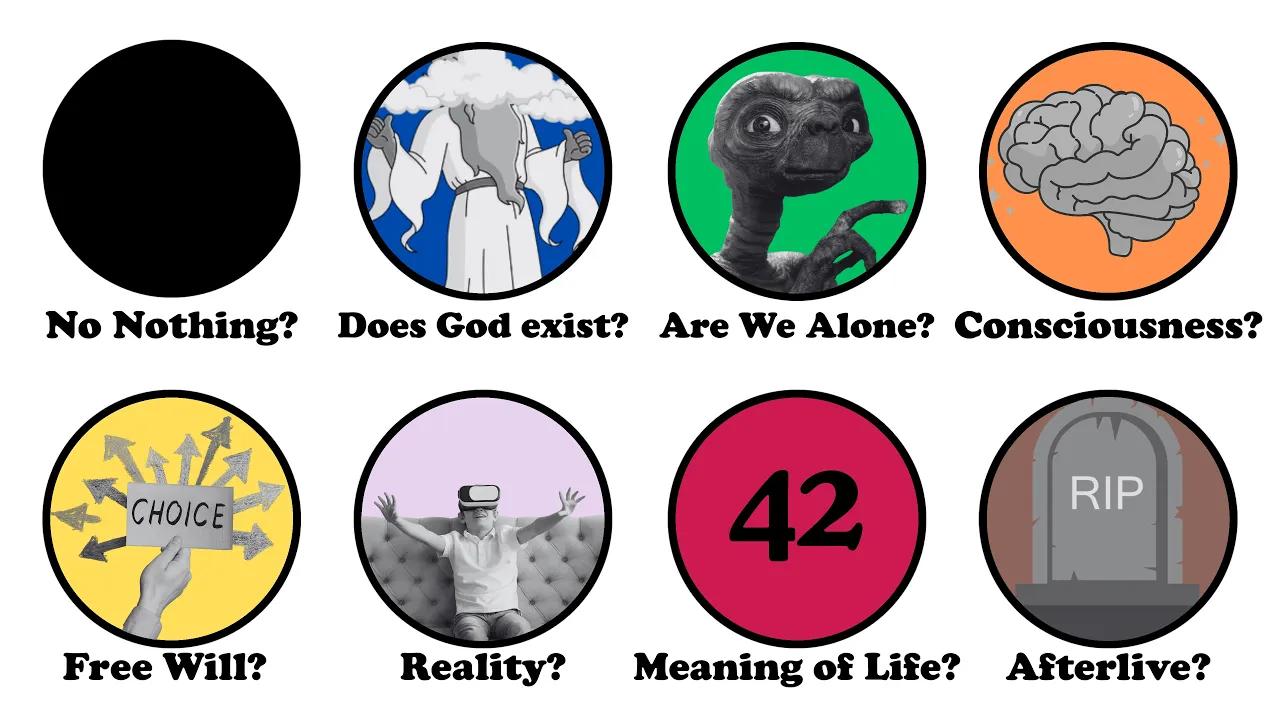
why is there something rather than nothing of all the questions Humanity has ever asked this might be the most profound why does anything exist at all why is there a universe a reality rather than absolute nothingness why doesn't it all look like this H hello hello the German philosopher gotfried liit famously asked this very question concluding that there must be a necessary being something that exists by its own nature Many religious Traditions take this as an argument for God but not everyone agrees bertran Russell dismissed it outright saying the universe simply is and there's no
further explanation needed which is a quite boring and unimaginative answer if you ask me modern physics however offers other possibilities The Big Bang Theory suggests our universe had a beginning but what came before it some physicists argue that quantum mechanics allows for something something to emerge from nothing an unstable vacuum state that inevitably produces existence others propose that our universe is just one of many in an infinite Multiverse removing the need for a singular cause still these explanations only push the question further why do these laws of physics exist in the first place why not
nothing perhaps as Martin heiger suggested this is simply the fundamental question of existence one we may never TR truly answer but one thing is clear there is something rather than nothing so now that you are here you might as well get the best out of it does God exist if there is something rather than nothing does that imply a creator for centuries this question has fueled debate between philosophers theologians and scientists alike the cosmological argument famously put forth by aquinus asserts that everything in existence must have a common Trace those causes back far enough and
there must be an uncaused first cause something that exists by necessity rather than contingency often identified as God the teleological argument or the watchmaker analogy suggests that the universe's complexity and Order hint at intelligent design even modern physics with its precise fundamental constants has led some scientists to believe the universe is fine-tuned for life suggesting a Creator but Skeptics argue that science provides natural explanations Evolution explains the diversity of life without divine intervention the problem of evil challenges the notion of an all powerful all good God if he is good and sentient why allow suffering
some argue that belief in God is a product of human psychology a way to find meaning in a chaotic world the debate continues science hasn't proven God God's existence but it hasn't disproven it either personally I'm agnostic I don't know and I don't think anyone does or ever will some see God as the answer to existence others see no need for one in the end it might be a question we're simply not meant to answer are we alone in the universe the vastness of the universe suggests that life should be abundant so why haven't we
found any physicist enrio fairy famously posed the question where is everybody his observation now known as fy's Paradox points out that if intelligent life is common we should have seen some evidence by now signals spacecraft Mega structures something instead the universe remains eerily silent one way to estimate the number of extraterrestrial civilizations is through Drake's equation a formula developed by astrophysicist Frank Drake it factors in things like the number of habitable planets the probability of Life developing and how long civilizations might survive the math suggests that intelligent life should be common but where is it
one possibility we may be alone intelligent life could be extremely rare another civilizations self-destruct before reaching Interstellar travel or they could be actively avoiding us some believe that civilizations exist but choose to to stay quiet out of fear this idea known as the Dark Forest Theory suggests that shouting into the void is dangerous because if intelligent species compete for survival it might be best to remain hidden if the Dark Forest theory is true it is a bit awkward for us oops but if that theory is wrong then why the silence are we the first are
we the last or are we simply not listening proper lay I don't know which is more terrifying the idea that we are truly alone or that other intelligent beings exist ones that might see us in the same way as we once saw lesser developed civilizations here on Earth if history is any guide first Contact doesn't always end well what is consciousness Consciousness is the core of Human Experience the awareness of self thoughts and Sensations yet science and philosophy still struggle to Define what it truly is philosopher David Chalmers differentiates between the easy problems explaining how
the brain processes information and the hard problem why does brain activity create subjective experience why does it feel like something to be conscious most scientists take a materialist view arguing that Consciousness emerges from neural interactions some believe it's just Advanced information processing While others see it as an illusion Neuroscience ties Consciousness to activity in the cerebral cortex and Thalamus brain scans has identified brain activity associated with awareness suggesting that Consciousness only happens in the brain however not everyone agrees in contrast dualists following deart suggests that Consciousness exists separately from the physical body a view shared
by Many religious Traditions that link it to the Soul some theories go even further pans psychism suggests that Consciousness is a universal property of matter while quantum theories like those of Roger Penrose propose that Consciousness arises from Quantum processes in neurons if materialists are right and Consciousness arises purely from physical processes could artificial intelligence ever become truly conscious some argue it can only mimic awareness While others believe a sufficiently ADV Advanced AI might develop subjective experience if robots can gain awareness does that mean that we are just biological machines or is awareness something deeper perhaps
even fundamental to existence itself do we have free will the question of Free Will whether we truly make choices or merely follow predetermined paths has been a philosophical Battleground for centuries some argue that we are The Architects of our own actions While others claim our sense of control is Just an Illusion many believe in libertarian free will the idea that human beings can make genuine choices unconstrained by past events this view underpins our sense of moral responsibility punishment and reward only make sense if people have the capacity to choose between right and wrong religious Traditions
often affirm this belief seeing Free Will as essential to Divine Justice determinists argue that everything including human decisions is the result of Prior causes our biology upbringing and the laws of physics According to some findings in Neuroscience brain activity linked to decision making occurs before we consciously decide suggesting our choices are predetermined rather than freely made if your brain activity precedes your awareness of a choice that has already been made then do you have free will some like David Hume and Daniel dennet propose compatibilism the idea that Free Will and determinism can coexist they argue
that as long as we act in accordance with our own desires without coercion we are free in a meaningful sense even if those desires are shaped by forces beyond our control what is the nature of reality do we experience the world as it truly is or is our perception merely a filtered illusion materialism the dominant scientific view holds that reality consists solely of physical matter governed by natural laws everything space time Consciousness emerges from interactions of particles and forces but quantum mechanics challenges this assumption experiments suggest that observation affects reality and particles exist in multiple
States until measured philosophers have long questioned the reliability of our senses Plato's allegory of the cave argued that we perceive only Shadows of a deeper truth can suggested that reality as it exists is unknowable filtered through the limitations of human perception idealists like Berkeley went further claiming that reality is purely mental existing only as experience some interpretations of simulation theory suggest that our universe could be an artificial construct whether reality is material mental or something beyond our understanding the question remains do we shape reality or does reality shape us one what is the meaning of
life few questions have captivated Humanity more than the search for meaning is there a grand purpose or is existence simply an accident religious Traditions often provide purpose through Divine will Christianity Islam and Judaism suggest life is a test with moral choices determining an afterlife Hinduism and Buddhism see life as part of a cycle with Enlightenment as the ultimate goal these perspectives offer meaning through faith but are they inherent truths or human constructs existentialists like SRA and Camu reject pre-ordained purpose arguing that meaning must be created by the individual nihilists take a darker view claiming life
is inherently meaningless while humanists propose that meaning arises through relationships creativity and the pursuit of knowledge science rooted in evolution suggests that life has no intrinsic purpose Beyond survival and reproduction yet the study of Consciousness the universe and the nature of reality leaves room for deeper inquiry is meaning subjective or is there a hidden order to existence ultimately the answer may be whatever we choose to make of it is there life after death few questions have haunted Humanity as deeply as what happens after we die every culture religion and philosophy has grappled with the mystery
yet no definitive answer exists does Consciousness continue in some form or is death simply the end Many religious Traditions claim that an afterlife awaits in Christianity Islam and Judaism souls are believed to persist in heaven hell or other spiritual Realms Hinduism and Buddhism teach reincarnation where the soul is reborn in a cycle of karmic Justice until reaching enlightenment these beliefs offer comfort and guidelines on how to obtain the best outcome but are they more than wishful thinking from a scientific standpoint the dominant view is materialism the idea that Consciousness is a product of the brain
and when the brain dies so does the Mind near-death experiences challenge this notion people who have clinically died and been revived often report floating above their bodies seeing bright lights or encounter ing deceased loved ones some claim to have recalled events they couldn't have physically witnessed leading some researchers to question whether Consciousness might exist separately from the brain one Theory we've already touched on Roger penrose's quantum theories suggest that Consciousness might be more than just a product of the brain If true this raises the possibility that it doesn't simply vanish when we die but without
empirical proof the question lingers does something await us on the other side or is death truly the end all right so those were some of the biggest philosophical questions we human's face which one keeps you up at night let me know in the comments below thanks for watching cheers