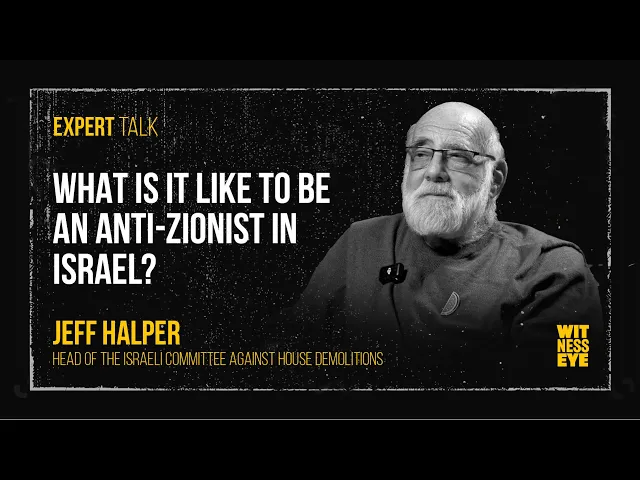
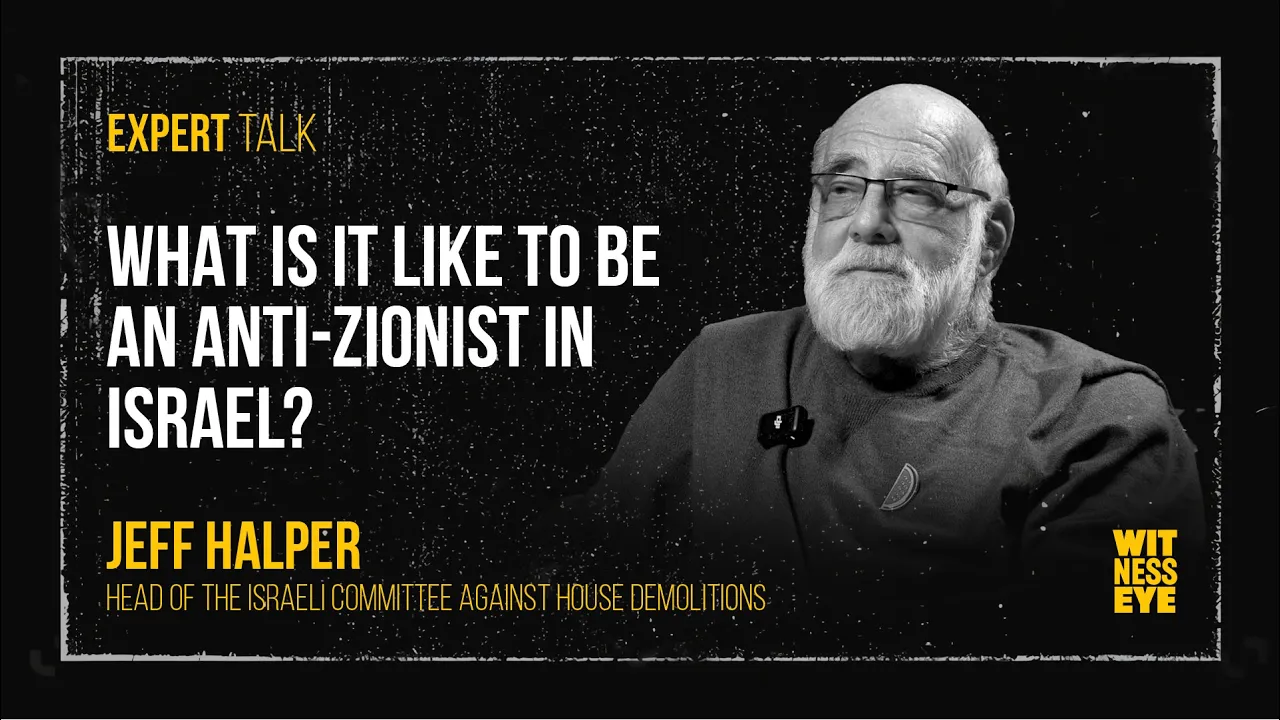
[Music] Welcome to witness eye. Today with us is Jeff Hulper. He's a Israeli politic political activist um anthropologist and a lecturer and he's a head of a very important comedy uh in Israel.
Jeff hello and thank you very much for your time. Thanks for having me. I would like to start with this comedy.
Uh, I would like you to tell me more about it and what makes it so important. Well, I'm the head of the Israeli Committee Against House Demolitions. Why House Demolitions?
You know, we began in 1997 as just an activist group, Israeli activists. Uh, and uh, this is as the Oslo peace process is collapsing. Natana was elected the first time in 1996 and we saw the occupation was coming back and especially house demolitions.
So with our Palestinian colleagues, we decided to set up the Israeli committee against house demolitions because we said Israeli because we're responsible for the demolitions. we take responsibility, you know, and we're talking about um as of today from 1948 about a half a million Palestinian homes and schools and mosques and churches and other buildings being demolished. So, we began as an activist group.
You know, some groups deal with settlements, some groups deal with the walls, some groups we're going to deal with the with, you know, just with house demolitions. But we found out over time that this is really the essence of of the Zionist enterprise because Zionism is a settler colonial enterprise. The Zionists came to Palestine with the idea of taking it over in a violent way because it has to be violent.
The indigenous population is not going to say yes, please come into my country and I'm leaving. There has to be resistance. It has to be violent and repressive.
genocide is built into it. But part of the genocide is also to clear the country of the indigenous population. You want to replace them with your own population.
You want to transform an Arab country into a Jewish country. Well, house demolitions, it turns out, because we didn't always appreciate this when we began as activists, is the expression of that. I mean, if you deny people a place to live, human beings can't live without a home.
It's it's an extension. You know, we talk about mother, father, family, home is a part of that. So, when you deny people a home and Israel's denied the Palestinians homes now for uh you know since 1948 um and demolished them and then took take took their land.
That is the essence of the ethnic cleansing. That's the basis of the settler colonial enterprise. So that what we've done is we on the one hand, yes, we resist the demolitions on the ground.
We work with Palestinians and if we can get there in time, um we I get in front of bulldozers, we resist the demolitions, we call journalists and activists to try to come and you know, maybe the armies come to demolish 10 homes in a particular village. Well, if we can show up and make it a whole thing, um they'll retreat. Maybe we've saved three or four homes in that way, but it's resistance with the Palestinians and we rebuilt homes as well.
Uh we've built almost 200 homes. Now, if you think of 200 out of a half a million that in humanitarian terms, that's not much, but we're not humanitarian. We're political.
So if you think about it as 200 joint acts of resistance of Palestinians in the communities with Israeli activists like me, that's that's a significant that's significant. And then of course again we take the house demolition issue because that is the essence of the settler colonial enterprise and we use that as a way for people to understand what Israel is doing where Israel is going what is the whole nature of the Zionist takeover of the country. So house demolitions it turns out we didn't appreciate this at the beginning turns out to be really the best window for understanding you know what's going on between Israel and Palestine.
um taking over or demolishing someone's home or house is like a violation of basic human rights. And how do you um as an Israeli American anthropologist and a longtime activist, um how did your academic and political paths converge in the cause of uh Palestinian rights in general? Well, I'm an anthropologist and I couldn't do my work without anthropology.
This is going to be a commercial for anthropology. uh because anthropology is rooted with people on the ground. So I'm not I used to be an academic.
I mean I taught at universities and I wrote my books and articles. I did all that. But I always saw myself as what we call an engaged anthropologist.
Someone that takes his training and the concepts and the theories that I know how to you know how to analyze and and and applies it. So I think what where has contributed to me is I can go in and look at a family and we have I have all kinds of PowerPoint presentations documenting the demolition what's happening to them to the kids the fear the the the the anger you know the uh the trauma and everything what's the soldiers coming in the house but then I can take that one particular family story and put it within of context. See, most activists can't do that because activists don't have theory.
They're they're there and they they fight the army, which is good, but then they go home. But I can I can explain why the army is doing this, what why Israel is demolishing homes again in this wider settler colonial framework. So I'm good at that as an academic.
Now, there's other academics that can do that can do that that write about settler colon, but they're not on the ground. So they don't they have no idea what's happening to this Palestinian family. So I try to bridge the academic uh with the activist on the ground and and I think that's you know you know one contribution I made that I think is significant.
Yes. And what responsibilities do you believe Israeli intellectuals and academics bear in the face of state sponsored violence and upward hate? Uh Edward say asked that question years ago.
What is the responsibility of intellectuals? I mean there are some academics that speak out um you know in Israel. I mean maybe the most prominent is Elon Pap among others.
Uh but there there are a handful and actually Elon was forced to leave Hifer University because of his political activism. So in in many ways I mean I I don't think academics are intellectuals but uh you know there there's a difference but the intellectuals and academics in Israel have really I think betrayed um their intellectual responsibilities because they don't speak out and they might be critical here. I mean they're critical because it's a right-wing government but they're Zionists and and and they're in the box.
they they support the whole Zionist enterprise. Um so they're critical but in a very kind of a safe way. Uh and uh and they haven't contributed very much.
So so uh so we're lacking that. I think in general I think academics have to get out of the ivory tower and become more more engaged. And um what about Israeli society?
What is their role in this situation? You know, Israelis live in what we call kind of a bubble. Uh again, settler colonialism, I keep coming back to that because that's without understanding that you don't really understand uh the society and and and what's going on.
You know, every settler movement makes up a story, a narrative about why the country belongs to them. I mean, how can a Jew come from Ukraine to Palestine and say, "This country is mine and you Palestinians have no place here. " You can't.
I mean, if you didn't have a story to ex to to to tell, you'd just be a criminal. You'd be some guy coming in and stealing somebody else's land. Well, I I don't want to be that.
So, to justify what you're doing and explain what you're doing, you develop a whole narrative. God gave us this land and this is the ancient Israel and uh we were driven out by the Romans and now we're you know a whole story like that. The point of it is to allow people to live within that story in a normal way.
So now Israelis don't have to feel guilty. They're not expelling Palestinians. Um they're coming back to their land.
the Palestinians are. Now, we wouldn't say resisting because that gives too much legitimacy, you know, because we don't recognize the Palestinians as a people. There's just a collection of Arabs there.
So, what every colonial movement does is it criminalizes the indigenous population. So, we're normal. We're average, normal, peaceloving Israeli Jews that simply want to live in our country.
This is the whole story of October 7th that you hear. And here are these criminal terrorists. So here's where terrorism feeds into all of that.
That are simply attacking us. Why? Because we're Jews.
They're anti-semmites. They're human animals. As you know, Galant, the Israeli defense minister said, all kinds of things like that.
The point is you create a space for yourself that's normal, safe. So Israelis are living, you know, like in Saro, a normal life. They don't have any issues.
and and uh they uh and so they have that narrative and in so in addition to that narrative, what's really crucial is the idea of security. You see, once you criminalize the indigenous population, you solve the problem. We're right, we're good.
We're just defending ourselves, right? And and the Arabs are attacking us. So now there's no more issue.
You know, 94%, this is scary, 94% of Israelis, you talk about intellectuals and academics, including them, supported the Israeli invasion of Gaza. 94% of Israeli Jews supported the genocide in Gaza. So, how could that possibly be?
It is because again they've been so dehumanized and uh and and uh and so criminalized as terrorists that we're that that there's no issue. Of course, we're just defending ourselves and that's a story. So, Israel Israelis are are very upset about the hostages.
They're upset with Netanyahu because he's not releasing the hostages. Um but they're not upset over what's happening in Gaza. They don't see the images and there's no interest in what's happening in Gaza.
Well, do you think that that would be the same issue and the same picture if it wasn't uh such a big support of the West uh particularly United States? Well, you know, uh uh you know, you can ask the question, why is Israel supported by the United States and Europe? And that can be said too.
and uh you know in and other countries and I think uh you know uh Israel is um I I wrote a book called war against the people in which I I start the book how does Israel get away with this genocide and and everything else and I think you know Israel in a sense uh has been has been smart zionism always knew that it couldn't succeed unless it had a powerful sponsor so Herzel The founder of Zionism first went to the Sultan in Istanbul and wanted to buy Palestine or he wanted a charter on Palestine and the Sultan said no. Next Herzel went to the German Kaiser Kaiser Wilhelm Wilhelm who was a key ally of the of the Ottomans came to Jerusalem in 19 1898 and Herzel went from Austria to Jerusalem to meet the Kaiser to get German approval for settling Palestine. you know, um, uh, after World War I, the British became the sponsors with the mandate.
And the British mandate said, the mandate from the League of Nations said, "Your responsibility, your mandate as Britain is to help the Jews establish a national home. " And it and it didn't relate to the Arab population at all. The word in the League of Nations mandate, the word Arab isn't mentioned.
the the 90% of the Palestinians of the population who are Palestinians, the indigenous population were called in the League of Nations mandate the existing non-Jewish population. That's what they were called. So, so Israel had that support.
Then after 1948, Israel had the support of France. After 1967 of the United States. So, Israel's always aligned itself with a powerful partner.
That's one thing. But the other thing that I write about in the war against the people is that Israel has carved out a niche in the capitalist system we live in of uh war against the people. You know that as the capitalist system becomes more and more repressive, less young people are able to access jobs uh get a house even you know even marry you know and they're getting more and more insecure.
there's more and more unrest uh and uh governments have to become more repressive uh so that Israel has the Palestinian laboratory here. Israel's been at a war against the Palestinian people for 100 years. It knows how to fight a war against not against another army that too, but other countries know that.
What Israel knows is how to fight against a people. And you could you can imagine you you can't imagine all the new weapon systems being experimented on, tested in Gaza today, AI targeting systems and drones and surveillance devices. So that then they apply and they they give to other sell to other governments.
So Israel's support um come the support for Israel I think comes from the fact that Israel is delivering. Uh it isn't that you have to love Israel, but you do love the technologies of repression that Israel is uh selling you and and and and helping you use and so on. How do you understand the transformation of Israeli aparth into a global model of control and counterinsurgency?
Well, that's all right. That's good question. That fits right into what I was just saying because because uh rather than convincing countries to support Israel, what Israel is doing is saying we are the archetype of where you're going.
We're fighting terrorism. You know, because again, Palestinians have all been criminalized as terrorists, but terrorism is a global phenomenon, and you're all fighting terrorism. So uh so you the countries of the world especially the west you shouldn't be criticizing us you should be copying us we are the model because we've been look we're we're a a a little country you know we're we're in the middle of a of an Arab Middle East in the middle of a country with a majority Arab population.
Um and yet we're living fairly quietly. I mean, Gaza, we're doing Gaza, but that's over there. It's not really affecting us.
We're living normal lives. So, you know, we succeeded in in in in doing that. We can show you how.
And the answer that Israel has, the model Israel has is a security state. You know, you can be a democracy, you can be anything you want to be, but first and foremost, a security state. You have to give power not so much to the army because that's outside.
inside your security services, your police forces that Israel trains all over the world and you have to give law, you know, create laws like the Patriot Act in the United States, for example, um that uh that were basically security concerns trump, you know, over over uh over overact um democracy. That's the o that's what you have to do. So the danger of Israel isn't only that it's exporting these technologies of repression to police forces all over the world uh in its war against everybody in the world, but it's even taking the states and making the states into a copy of what Israel is.
So what I say is uh as Israel is Israelizing your police force, right? It's turning you into Palestinians. It's Israelizing your police forces and it's Palestinianizing the people.
So now your own governments are going to be a part of Israel's war against the people. And um as a co-founder of the one democratic state campaign. Um what vision does this initiative purpose uh propose sorry for a just future um for a just right future for Palestinians?
Well, you know, I'm involved. I mean, politically the only way I mean resistance is great, protest is great. Um, BDSing, doing BDS is important and so on, but in the end, there has to be a political resolution of this.
Uh, and uh um and the and the only resolution of a colonial situation is to decolonize. you have to end the colonial enterprise, the colonial entity, and create something new that's inclusive and equal for everyone. So, um, I'm a part of a of a Palestinian-led organization called the One Democratic State Campaign, and we've developed a 10-point political program.
Palestinians have always supported one state from the very be even from before 48. That's always been their idea. And they've always welcomed Jews, you know.
So, it's this isn't against Jews in any way, but it's saying there should be one democratic state in all of historic Palestine in which everyone has equal rights and the refugees are then able to return. Um, that's the that's the and and we replace Israel and the occupation with that one democratic state. There can't be a Jewish state anymore.
It has to be a state over the whole country, a civil state of equal rights for all its citizens. The the big difference here is they're citizens. They're not Jews and Palestinians and they're they're there's equal citizens and then you can be whatever you want to be.
So So the importance of that is that it it it gives a a way out of, you know, the genocide and the colonization. um but a way out that not only serves the Palestinian interests of their own national self-determination but it also allows Jews to continue to live in the country even as Israeli Jews in the country but as equal citizens not as the rulers of the country and you as someone who lives in Israel and you do oppose to the regime and everything that's being done um how do you engage with these critics that come to your account and to account of all the other people also living in Israel and being Jews and being against the oppression and everything that's being done. You know, I don't I don't engage with Israelis.
Okay? You know, it's like it's like kind of like South Africa. You know, the whites in South Africa were never going to dismantle the aparate regime.
So, Mandela and the ANC didn't bother. Mandela didn't go around knocking on the doors of white people explaining why apartate is bad. knew they were never going to cooperate.
So he bypassed them. They had their idea of one democratic state, one person, one vote in South Africa. And then they went to the international community to us, you know, all over the world that supported the anti-apartate movement.
And we created a pincher movement from below and and from internationally. And we and we made the South African regime collapse. It became unsustainable.
And the whites had no choice but to go through the transition to democracy. You didn't make your liberation dependent on whether they agree or not. The Palestinians can't make their liberation depend on whether Israel is going to agree.
Israel will never agree that Israel become Palestine or that, you know, Israelis give up control and become equal. They'll never agree to that. So why waste your time?
So our idea is um we're working with the Palestinians to develop this political program, one person, one vote basically. And then we're going to the international community like the ANC did and we want to create a situation in which Israeli apartate becomes unsustainable. That's kind of the So in this you can't talk you can't talk to the you can't talk to the colonists and and as a matter of fact you can't just talk to them because uh because they feel threatened.
I mean, you're, you know, when you say to somebody, you have to give up power and the people you've all, you've been educated to believe are terrorists that just want to kill you. You know, the the the term in South Africa was a blood bath. The whites said there's going to be a blood bath after a partate.
It never happened. But that's the same thing in Israel. There'll be a blood bath as these terrorists take over.
So, it's threatening. But in addition to that, again, Israelis don't see they don't see the issue. They don't see Palestinian rights at all.
They don't see Palestinians. So, it's it's simply a waste of time to to try to engage with Israel. All you're going to get back is security.
That's all you're going to hear from them. And so, or the Bible or something like that. And so, I think we have to replicate what the ANC did in South Africa.
Uh, are you a target with the critics and maybe threats or something? I'm invisible. I tell you, it's it's it's interesting.
Uh the people that are targets that are really hated uh are are the are the liberal left Zionists. Let's say the Labor Party. There used to be a party called Merits peace the peace movement in Israel.
These are people that are that are Israeli activists. In other words, they I don't know they don't have a political program, but they're in favor of Palestinian rights as ending the occupation. basically ending the occupation uh and so on.
But they want Israel as a Jewish state never nevertheless. So those are the people that are targeted. If you're within the Zionist box on the left, you get targeted from the right because you're a threat to them.
I'm outside of the box. I'm anti-Zionist. I'm anti-colonial.
Israelis don't know what in the hell that means. It's like I'm an alien from outer space. What is an anti-Zionist?
One state. what equal citizenship. I I it just it makes no sense to Israelis.
So they don't even engage. They have no idea who I am, what I what I'm talking about at all. So in a sense, I enjoy an invisibility in Israel that a left that a left activist Zionist doesn't have.
Yes, you are very visible in Gaza Tribunal. Um and as a participant um how do you see uh its role in challenging official silences and um uh affirmating or affirming moral clarity around the genocide in Gaza? What's the role that you can actually have?
Well, I think Richard Faulk, who's the international lawyer and expert that really convened the Gaza tribunal, said it really very well today. He said, "You're really calling uh into account the hypocrisy of the international system. " In other words, the system is there.
The the rules were created by these states. I mean, you know, the international law was codified through the United Nations by all these states. It's their laws.
This isn't like some left-wing conspiracy and we're trying to impose some liberal international human rights things on states. It's their they're the ones that said that's what the world order we want a rulesbased international order, right? We want a UN we want that's what they say all the time.
But at the same time, as Richard says underneath, they don't want to give up power. I mean, they have the veto power in the UN. Um, the International Court of Justice can rule whatever it wants to rule in terms of genocide in Gaza, but there's no sanctions on Israel because it can only be enforced through the Security Council and the US won't allow it.
So, in other words, you create this nice world of international law and human rights and all that stuff, but underneath you create mechanisms of control in which state interests really are still what dominate. I mean, there's international law has really no meaning whatsoever. in my in in my view.
So I think the the usefulness of this is first of all to point out the the injustice and the genocide but also to call to call into account the hypocrisy to say to these governments you know why are you talking about you know human rights and and international law if you don't intend to uh to uh to apply them in any way. You know, let's be honest. This is a world of power and of interests and you support the genocide because for some reason somehow that's in your interest.
Let's at least be honest about it and then we know what we're going to fight. But if you try to present yourselves as uh guardians of international law, the rules-based international order, and you're allowing a genocide to happen, something's wrong in the world. So, I think that's really the usefulness of the of the Gaza Tribunal.
It really shows that basic hypocrisy that we're living in internationally. Do you think that um these conscience tribunals like this one um or how important do you think they are um in shaping public discourse and uh uh resisting historical eraser? Look, I'm a part of the guys tribunal.
I don't want to say anything critical to my thing. I it's a good thing to do and I think they they do play a certain role certainly uh the Gaza Tribunal from the point of view of not only exposing Israel's crimes and what's happening to Palestinians but but really highlighting international law and human rights gives legitimacy to the Palestinian struggle because everybody's trying to including the media but everybody's trying to reduce Palestinians to terrorists. They're all Hamas.
They're all, you know, and you look at American universities, you can't even teach about Palestine anymore in universities or in the UK and other places. So, this is a counterweight to that. It gives legitimacy to Palestinian claims and rights and and it allows you it gives it allows you to criticize Israel because it's it's it's working against this international system.
But again, there's no enforcement. So, you know, we're lacking the political component. That's why we're really working to try to get this one state idea in in the if you look at the whole uh movement worldwide for Palestine, the international law human rights component is very strong actually as as the Gaza tribunal shows but other tribunals and the international court of justice that that's trying Israel for genocide or or the international criminal court that you know that issued arrest warrants for uh for Natao.
That's strong. BDS is strong. I mean, there really is a movement that's affecting the Israeli economy.
The protest movements are strong. The encampments all over the world, the students, people. You know, last week 600,000 people went out in the streets of London for Palestinian.
That's strong. The missing piece is the political. There is no political program that the Palestinians have come behind that we can support right now.
So, we're limited to protest, tribunals, uh, resistance, educational campaigns, lobbying for Palestinian rights, but but we we we can't advocate for one state because the Palestinians haven't articulated that yet as their as their program. So, I I would love to see I mean, I appreciate the Gaza Tribunal. I wish you could get an organization, you know, to fund uh exactly this kind of a thing, but bring in 50 Palestinians from different parts of the Palestinian world that can't meet today.
bring in us some Israelis like me and let us sit down for four or five days like we are here in Sievo and really block out and talk about a political program, get to know each other, begin to build a political movement that so funding always goes to safe things. I mean Gazil is very important but it's also safe. It's human rights.
It's international law and and all of that and and and so you can fund that. funding does not come through political organizing and so as a political organizer. Um, you know, that's what we're trying to we have no resources.
So, it's very hard for us and especially for the Palestinians to to to come together behind a a program that infrastructure is missing for us. And it's too bad that resources are going towards what are kind of symbolic projects rather than to real political projects that could really begin to to make a difference. Considering all said, um do you think that the world um when it comes to Palestine is kind of in a turning point?
Um, considering everything that is happening in Palestine right now and the strength of everything that is going on and li a number of lives that have been lost, um, do you think that we're at a turning point and how do you think justice would look like for Palestinians and for Palestinian refugees and for all of them, but not in theory, but in real life? Well, we're at a we could be at a turning point. Again, this is the same frustration that I'm political frustration I've been expressing and that is this is the Palestinians moment, you know, where not only the peoples but even some governments are starting to and you know governments are for the two-state but they know the two-state is nonsense.
So if there was a strong voice from Palestinian civil society saying this is what we want one state Israelis remain equal citizens they're secure but we have pal our rights as Palestinians and our country and our refugees can come home again and so on that to give that leadership this is the moment when I think they could break through with that that's exactly what people are waiting for what do the Palestinians want and This is a positive, you know, vision of a future that's inclusive of of everybody, but they're not there yet. And I'm not criticizing them by any means because they're living under not only are they scattered all over the world, or they've been scattered, but they're living under tremendous repression of Israel and of the Palestinian Authority. Any young leader from the age of 12 up that emerges, Palestinians going to get killed or put in jail.
People say, "Where's the Palestinian Mandela? " I'll tell you where he or she is dead or Marwan Baruti, you know, in prison for 20ome years. That's where they are.
They're not, you know, and so they have a, you know, that's what's really holding things up. It isn't that they can't come together behind a program or they don't have a vision. They simply can't actually meet and come together.
And and that safe space, that protection is something that the international community should provide them. see this kind of Gaza tribunal if it was more political and had the support of governments and and it said we're we're going to make create a a safe space at this university in Sievo and we're going to bring Palestinians and Israelis that can't meet in Palestine here and we're going to help create a political momentum that can't be done there. That would be a tremendous contribution but we don't have that.
And so the danger is that this moment's going to pass. It's ephemeral. It could be a turning point.
But you know what? In three, four, five months, Trump and MBS in Saudi Arabia are going to complete the Abraham Accords. They're going to normalize relations with Israel and its settlement thing.
The aparate is going to be in place because it has to be a two-state solution. the Arab world can't accept anybody if it's not two states but two states merely means apartate two state apartate you know uh and uh and uh and that's kind of the end for the Palestinians normalization is a closure there is no political space once it's normalized and the Israel a greater Israel over all of Palestine has diplomatic relations with the Arab world and the rest of the world basically Okay, Palestinians come and say, "Hey, we're stuck in this prison on 15% of our country in little islands. We have no economy.
We have no sovereignty. We have no What about us? " The world's going to say, "Sorry, but we've normalized.
We've moved on. You know, we got Sudan to deal with. We got Ukraine to deal with.
" And and that's the danger that this potential that we have today of a breakthrough in three, four, five months could could actually just go away and Israel could succeed. I think we're looking at this in a in the wrong kind of a way. you know, everybody's saying, well, you know, you know, is Trump's going to force Natala out of Gaza and you know, he's losing Gaza and you know, you look at but if you look at the bigger picture, um, Israel doesn't care about Gaza.
Gaza is always in marginal. Israel cares about the West Bank. That's where the settlements are, you see.
And and once it's normalized, Israel wins. That's the end. I mean, settler colonialism has an end.
It doesn't go on forever. And that's the danger. Uh and uh you know that's the frustration is I mean I mean I love the Gaza tribunal don't get me wrong.
every it's very important and so on but I just wish the urgency and the resources and the initiatives would be would be in a political way that you could have a god you know not the gods of tribunal but the uh u you know a political meeting here of saying this is what Gaza has given birth to a new political and and we're going to support you financially because you can't do it back in Palestine but but we don't have that right So we struggle on. That's why we call it a struggle. Yes.
It's a hard battle, but I guess we just have to move on because silence is not an option. We have to move on. Jeff, thank you very much for your time.
Thanks for having me. Jeff Hulper was with us and you stay tuned with with Missai.