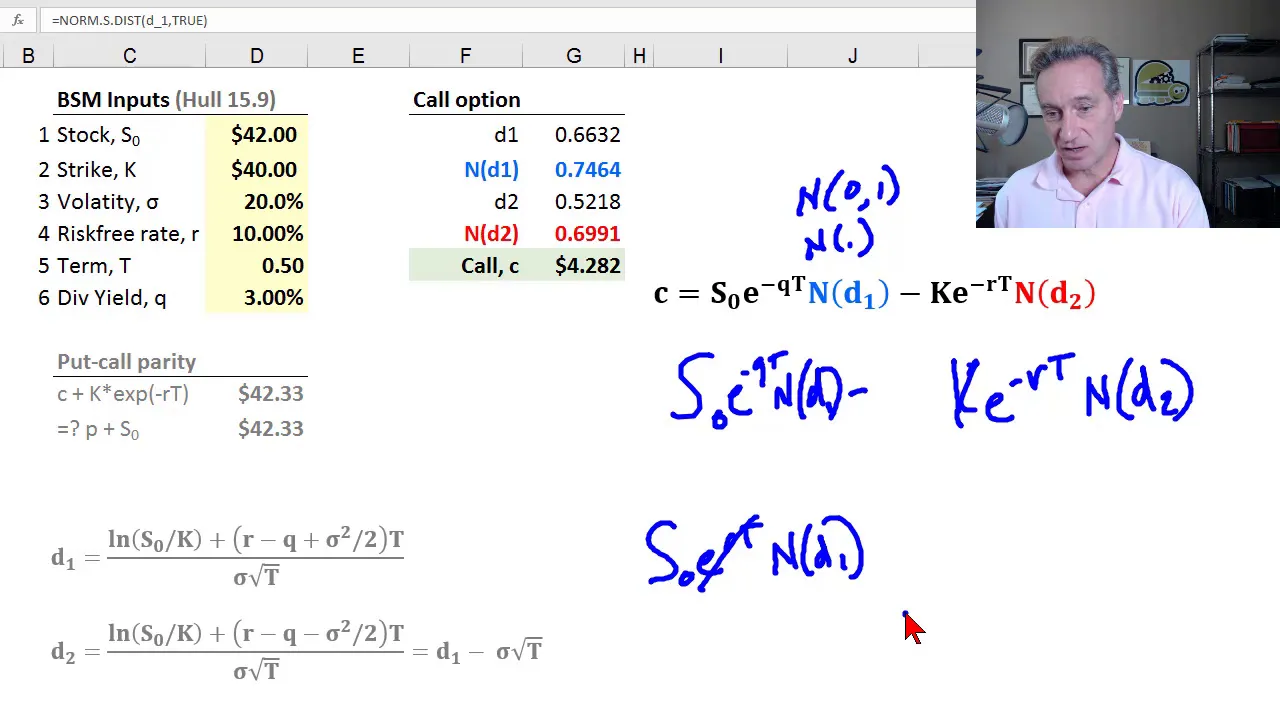
my previous video walked through the details of my black Scholes Merton option pricing model in this video I just want to specifically address a question that I think we get every year from candidates about the black Scholes Merton option pricing model and that is you can see I've colored them here can we interpret n of D 1 and n of D 2 and the answer is yes we can especially n of D 2 and we'll start by noticing that these are cumulative normal distribution functions that means these are probabilities they range from 0 to 100%
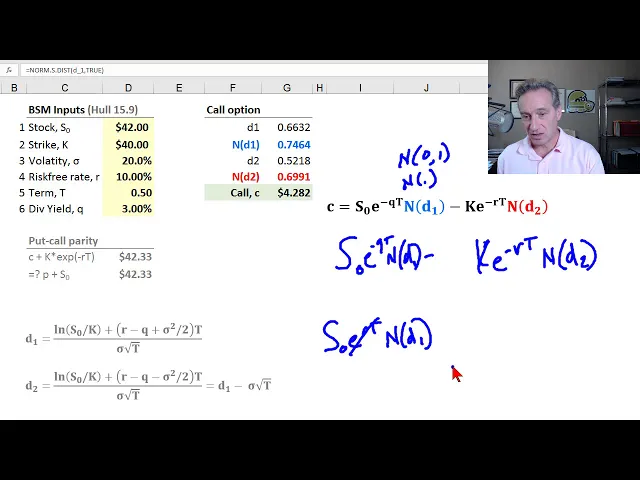
in all cases so my yellow cells in the worksheet as usual these are inputs into the black Scholes Merton BSM as black Scholes Merton there are 6 inputs I'm including the form of the model that incorporates dividend yields sometimes we first see the the more basic form that does not include dividends I'm also de-emphasizing the put-call parity on this sheet you may recall previous video I've mentioned that I'd like to include put-call parity just as a reality check on the number after all black Scholes Merton spits out for us in sort of a black box
fashion with the price of the call in the put R and put-call parity just a nice reality check to make sure that they're correct right it says that the call plus discounted cash needs to equal the price the price of a protective put and you can see that's true here I'm also de-emphasizing d1 and d2 which is are tedious although we can access an intuition on the d2 that's discussed in my forum I think I've written a post in my forum where I show that it's actually not difficult to access the intuition of d2 in
particular so here for the price of the call option I've unpacked some of the variables here that go into the input you can see here for these values which I think match John whole 10th edition problem or example 15-point not exactly sure but I think they match and you can see the call price here for these assumptions is four dollars and 28 cents you can always do a gut check right we know the call price needs to be less than the stock price that stock price is an upper bound but it's going to be significantly
less as a and we can look at it as a percentage right you can see I have about 10% the price of the call is about 10% on the stock and strike price and for a six month option that's an important input here six months it's about right which sounds about right and the most important determinant here is going to be volatility okay so what I have here is for the formula black Scholes n of D - n of D 1 and n of D - and I've colored them to match and I'm addressing here
a question that we get frequently which is can we interpret the n of D 1 and n of D 2 in black Scholes Merton and I think you sort of can the n of D 2 is easier than the end of D 1 but I've said before that my style just in memorizing the formula if you're going to sit for an exam frm or CFA I like to start I like to think of this as the lower bound and then we wrap in these probability functions right the lower bound of the call option is this
current stock price - the discounted strike price some have that memorized some do not why is that well we're in a risk neutral world you want to us keep that in mind a lot of theory behind that but we're in a risk neutral whirl which means that we expect the stock to grow at the risk-free rate among other things and if the stock were to grow at the risk-free rate right we compound continuously at the risk-free rate over the maturity that's our continuous compounding and then we would pay this Detroit price the strike price does
not grow it's $40 here it's constant or fixed right we would pay that and you can hopefully this makes sense is the future gain on this call option if the grows at the risk-free rate but we're in the risk-neutral world so that's the reasonable assumption that's the future gain we would we're computing a present price which is a present value right price her value usually means present value so we take that future gain and discount it at the risk-free rate as you might expect you see if you distribute that how these cancel and we're back
to right here if I distribute the minimum value so that's the minimum value or that was math wanted to give you intuition on of the minimum value as stock price might too - discounted strike price I sometimes call this discounted cash because that's what this is fixed so we can think of it as cash that we're gonna pay the minimum value and then we wrap in these probability functions why did I call them probability functions well these this n notation is we could just say generically that signifies the cumulative normal distribution function or specifically the
standard normal cumulative distribution function so right here you can see on the upper left I'm using excels standard normal cumulative distribution function by standard normal I mean a normal with zero mean and variance and therefore also of all at standard deviation of one and what that means is we're getting a probability by definition this is a probability so I I've taken to calling it a probability function it needs to lie between 0 and 1 as these values always will when the options get vary in or out of the money they will these will tend asymptotically
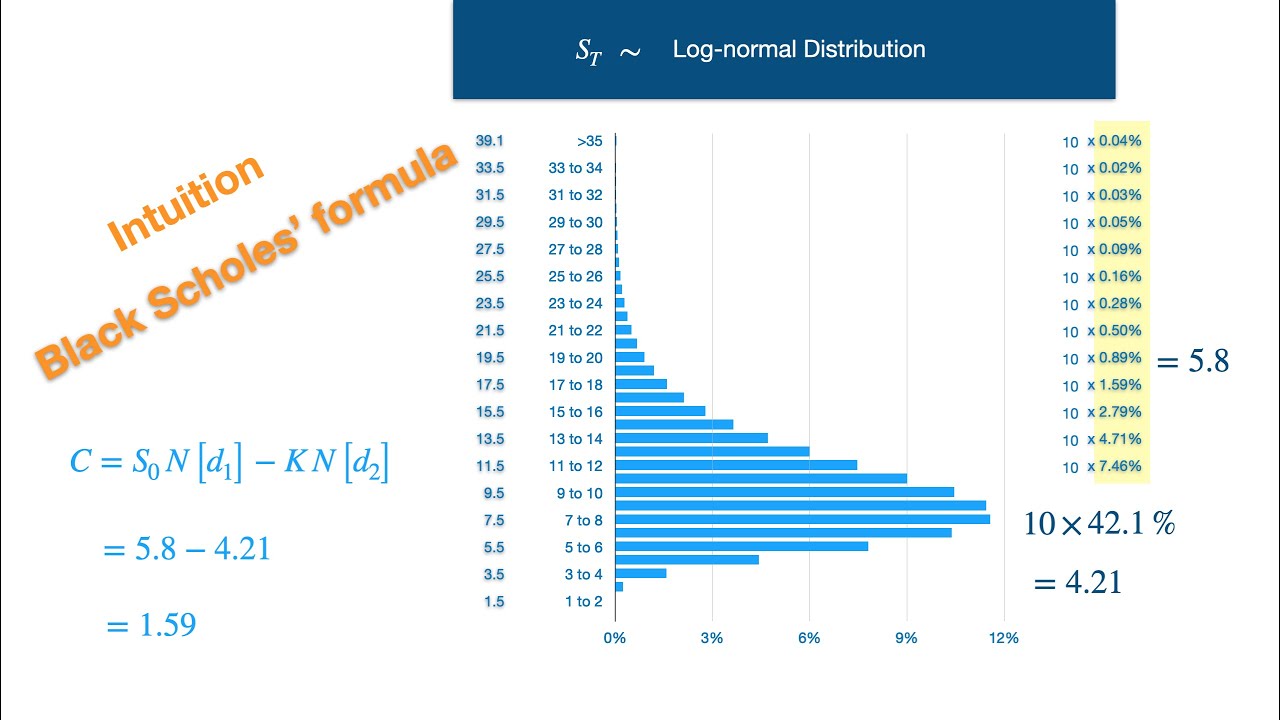
to 0 and 1 but they are probabilities so the less intuitive one is the N of d1 and it turns out that if we take this stock price and grow it at the risk-free rate in the risk-neutral world this is the expected future stock price is it not however this is a call option such that underwater outcomes will be worth zero so it turns out that if we multiply and of this by n of D 1 what we get is an expected future stock price if the outcomes that are underwater are counted as zero so
it's a kind of average and so that's my first term here well again that's future so it'd be discounted back and so this drops out that's my first term here stock price times n of d1 to adjust for that probability but I've also inserted the dividend haircut right the dividend haircut you wouldn't see it in all forms but as I've also covered in previous videos in general in option pricing a dividend or dividend yield has the effect of reducing the current stock price that's because an option holder for goes the dividends they miss out on
those and for a given assumption about total shareholder return if there's more dividend we would expect less capital a capital or price appreciation so you can see here that's that's the more difficult one but we can view this here as a function of the expected future stock price we're underwater outcomes are counted as 0 because this n of D one introduces a probability multiplier the more intuitive one is n FD 2 remember I mentioned that the d2 itself has a very intuitive way we can access it but I'm not going to go into that now
just to say that I'm just gonna say at the end of d2 itself is the probability that this option will be exercised it's that straightforward if we think about the stock price starting here there is a future probability distribution and then here is the strike price let's say NFD - right well stock prices up here for this call option will be exercised if it expires in-the-money and will not be exercised if it expires worthless Lior out of the money end of d2 here literally is the probability that this dot price will end up in the
money so it's the area under this curve as a percentage of the entire probability which is a hundred percent so you can see here and again again this is easy to miss or forget or just gloss over when studying all the numbers around the black Scholes again I remind NF D 1 and n FD 2 are probabilities so when we see here n FD 2 is well very close to 70% there's a very intuitive interpretation of this it is that again here's the caveat in the risk-neutral world where we've made this assumption about the expected
growth of risk-free rate among other things given the caveat a risk neutral world n FD - as is 0.7 is 70% probability that this stock price will finish above the strike price the OP that the option will be in the money that the option will be exercised very intuitive right so that means this K is the fixed price that we that's fixed it doesn't change we either pay that or we do not we're multiplying that by the probability that we pay it so this is the probability adjusted expected strike price payment in fact very intuitive
so you'd seen this way we've taken the minimum value which I started with a sub zero subtract the discounted cash and we've just wrapped in the probability functions to account for the fact we don't know what's going to happen both of these terms are probability adjusted to account for what's the probability the stock price will be in the money in the case of this call so obviously the higher the stock price starts the greater that probability as the stock price goes up and of d2 which is directly as the probability they'll be in the money
will go up as well so I hope that is a helpful I have on the second page in the in the sheet that all make up make available for download I add the put option here and logic is actually just very similar if we consider starting at the stock price here we do have positive drift and then not a very good distribution and but then I'll just assume a fixed strike price here right in the case of a put now higher outcomes to the stock price that implies that the options out of the money right
in the case of the put it's only going to be in the money or exercised for these outcomes where the future stock price is lower that's S sub t right these are out of the money these are in the money for the put and so I have the same parameters here no recall we said n fd2 was a 70% probability that this call option will be exercised meaning a 70% probability that will be up here these are probabilities it's one of the other above or below that means what we have here for n of negative
d2 is 100% minus one minus 0.7 or 100% minus the 70% you can see we do in fact have here 30% right if all the other assumptions the same if we had a 70% chance of the call option being exercised we have a 30% chance right here of the put option being exercised so an of negative d2 going to the symmetry the normal here has also an intuitive explanation the N of negative d1 is 0.25 and you can see it's here a function of the end of d1 don't think I mentioned the previous video that
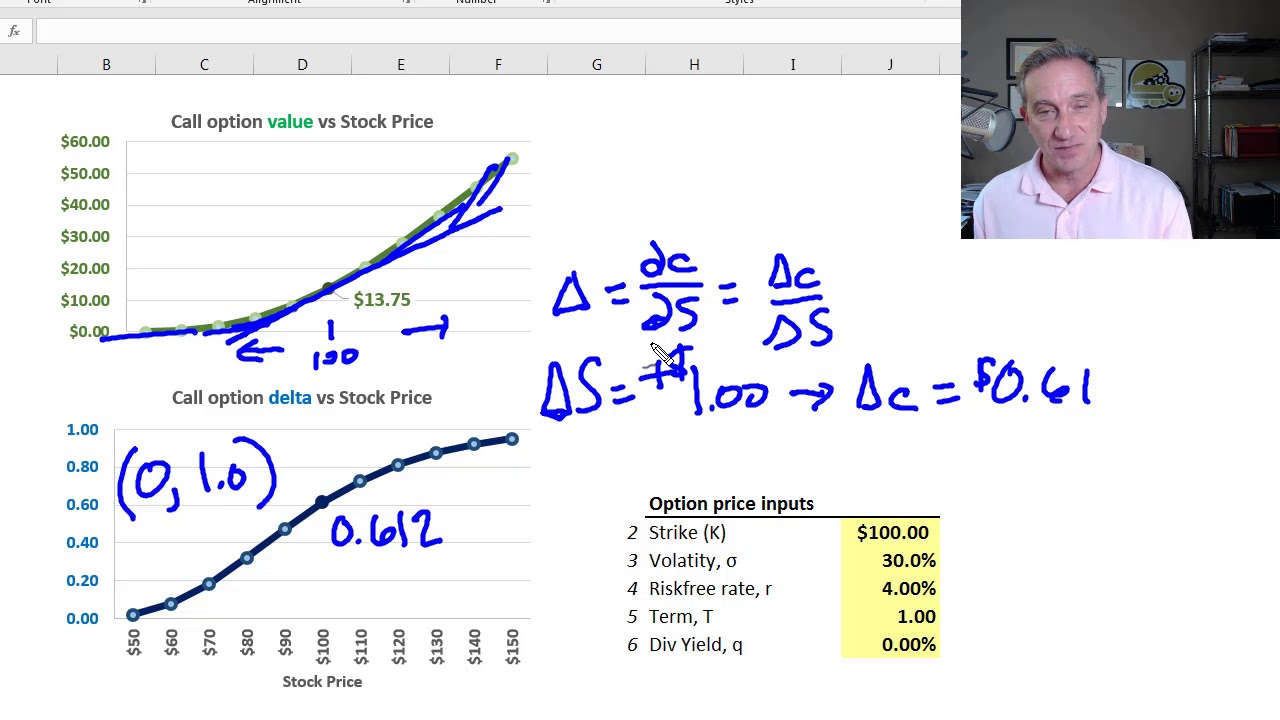
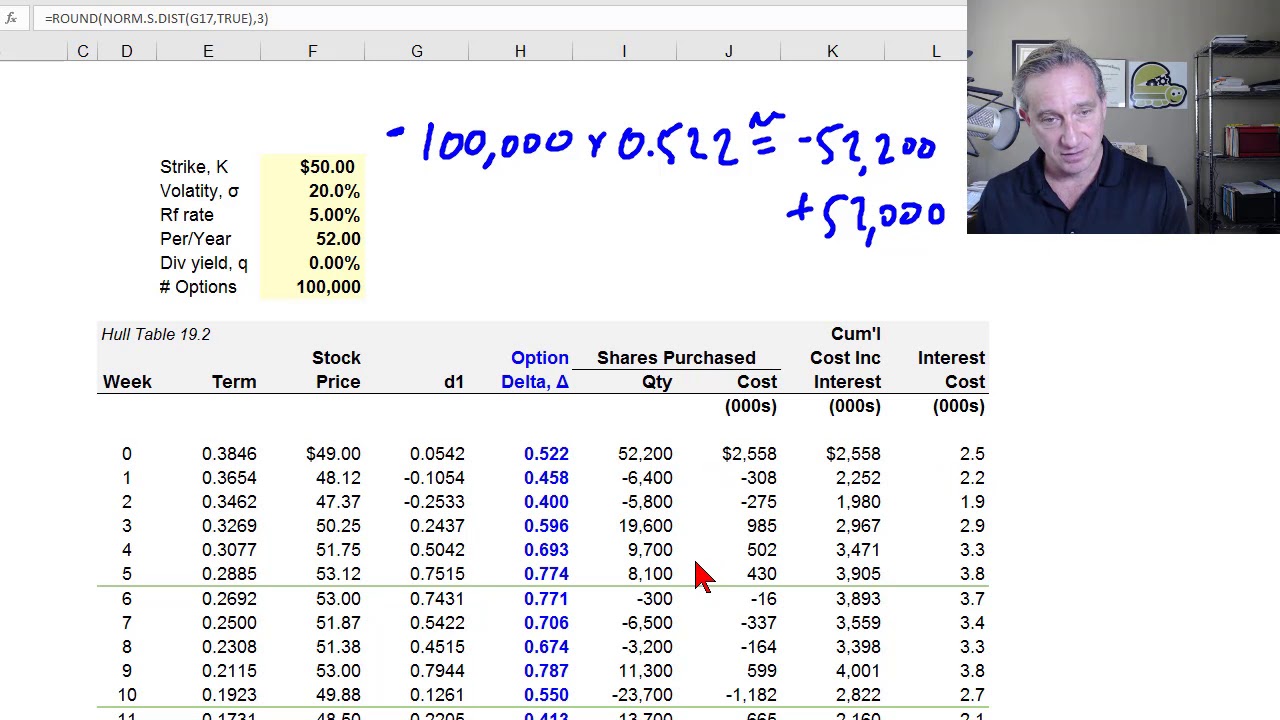
NF d1 is also the options Delta so we say Delta right that's change in the call price as a function of changing the stock price well the put options Delta is n of D 1 minus 1 and in this case it equal that means it equals negative 0.25 3 6 so the put options Delta here is just this value that goes in the black Scholes but with a negative so a little more little more difficult on the in a the end of negative d1 input but this is these are still probabilities so I hope that's
helpful if you did like this video subscribe to the channel and we'll update you because I'm pretty much recording 2 videos a week thank you