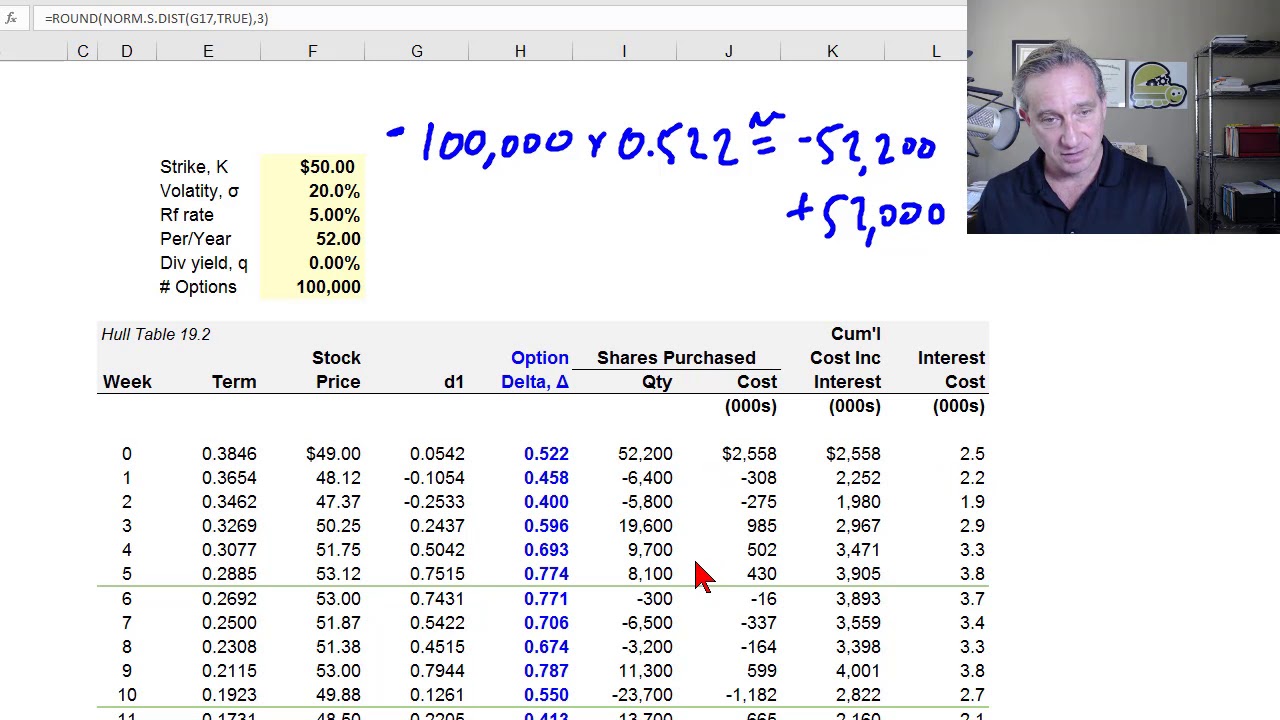
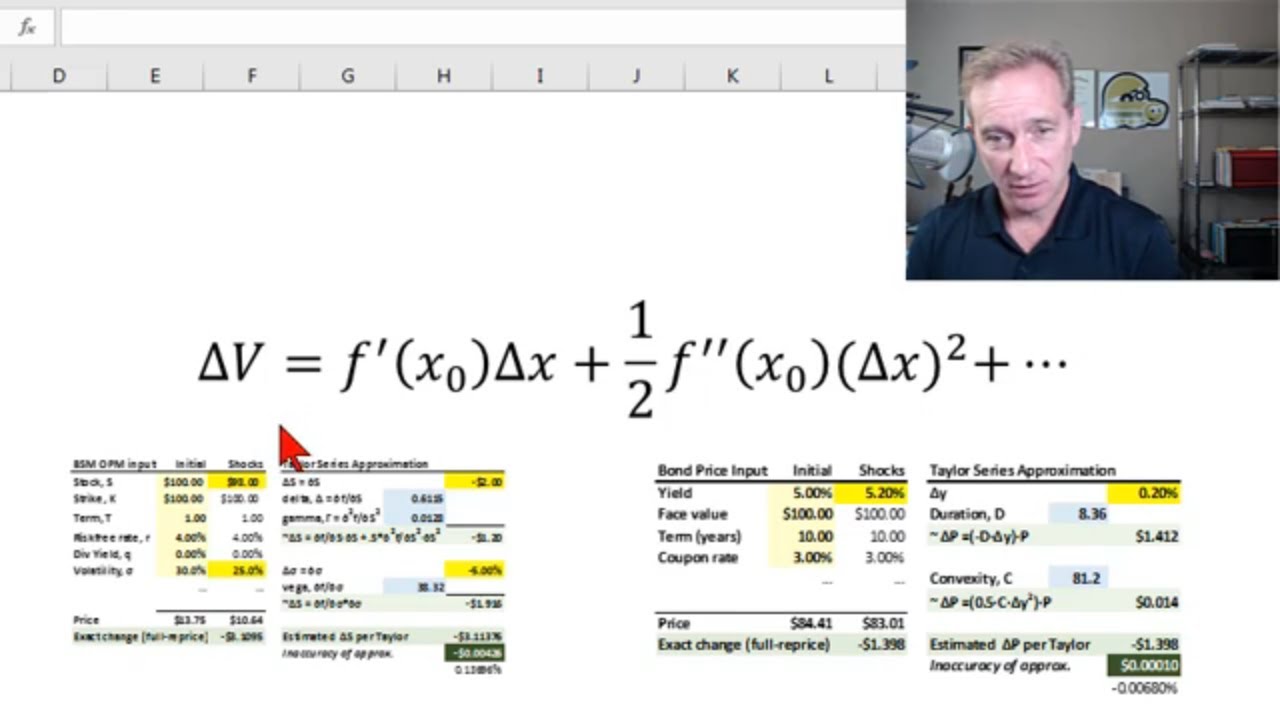
so next twelve minutes I'd like to give you a brief tour of my black-scholes option pricing model and I'll highlight three of the questions that we get often about this famous model so that would be first how our dividends exactly treated secondly can we interpret n of D 1 and n of D 2 and third is there any way to get an intuition about how this black Scholes works short of going all the way back to the differential equation so here's my relatively simple one-page option price or it returns the price of a call and
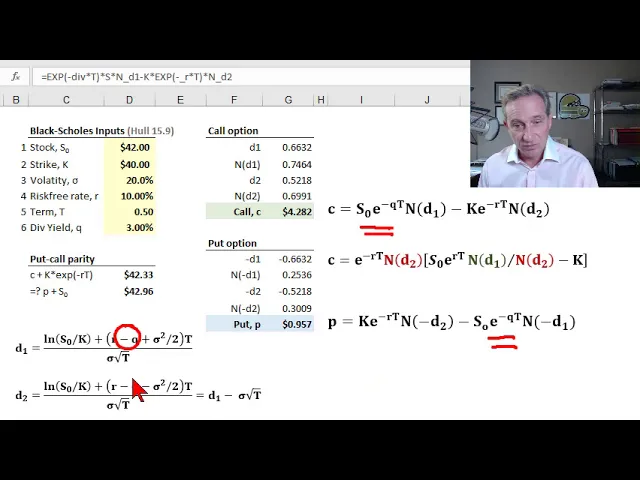
a put for a european-style option according to the classic black Scholes Merton and you can see here in yellow I have the input assumptions the values that I have in here originally or initially to seed them help in a match John holes 15.9 example so that's chapter 15 if you're following along and you'll see that they do return the call and put prices that match his in the text so that's the point of the model to take these input assumptions for the option and return for us a price for the European call and the European
put right we want to keep in mind small sneaky small p that denotes European this is an option that can be exercised only a maturity if there is positive intrinsic value and so we're getting four dollars and 80 cents for the call and about 81 cents for the put my model has the put-call parity in here you don't need this you could delete this without any impact I just like to include it when I'm writing questions or answering questions or doing exercises as a gut-check or just to make sure that I'm comfortable on getting correct
numbers because for European options here put-call parity should apply so I should get a match here between on the one hand let's say the left hand side of the equation right we have what I call call plus discounted cash discounted cash is the strike price discounted continuously at the risk-free rate over the term notice in this set of assumptions it's a six-month option so on that side of the put/call pair I'm getting $42 and 81 cents for my call plus discounted cash and then I compared it to what can be easily called a protective put
right the price of the put plus the initial stock price you see how easy that is put 81 cents plus initial stock price 42 is 42 81 and these need to match I include that to give me comfort that my numbers are incorrect are correct and you'll see that they are correct whoops if I just change the volatility for example a 30% you'll see they match put-call parity applies my formulas correct I do have here also I've teased out specifically the dreaded d1 and d2 I think the I think of these is the inner black
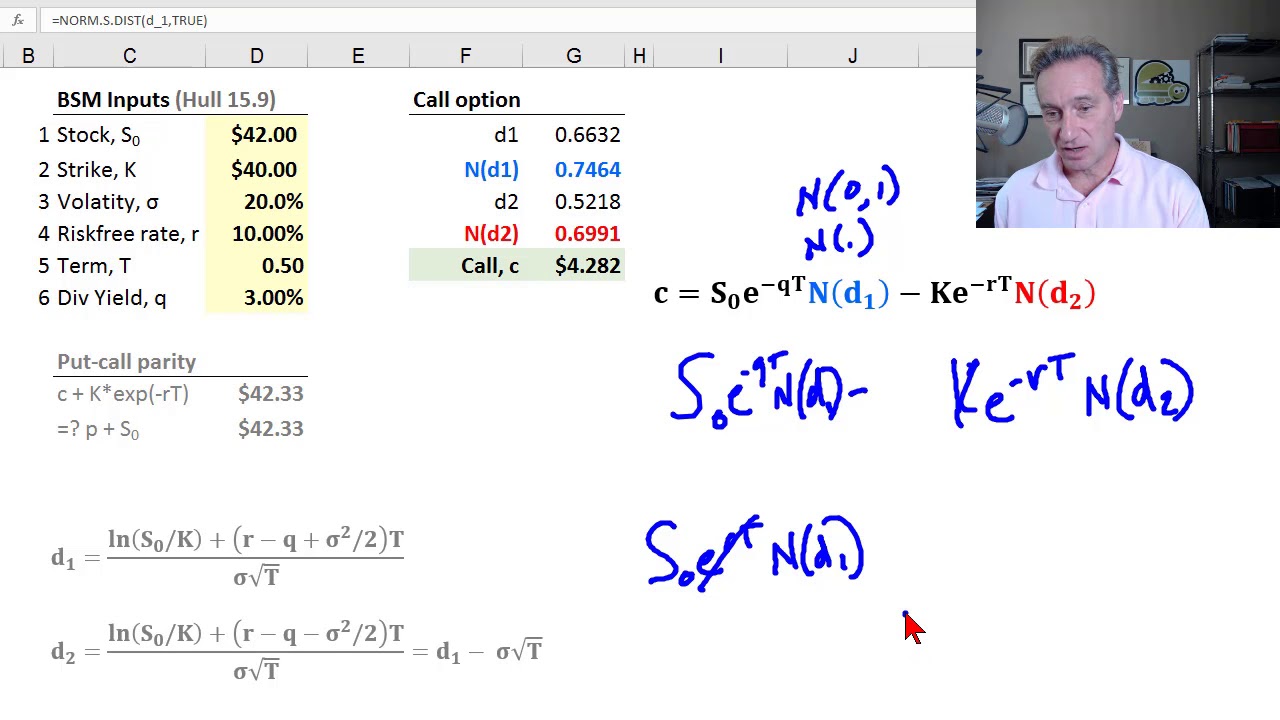
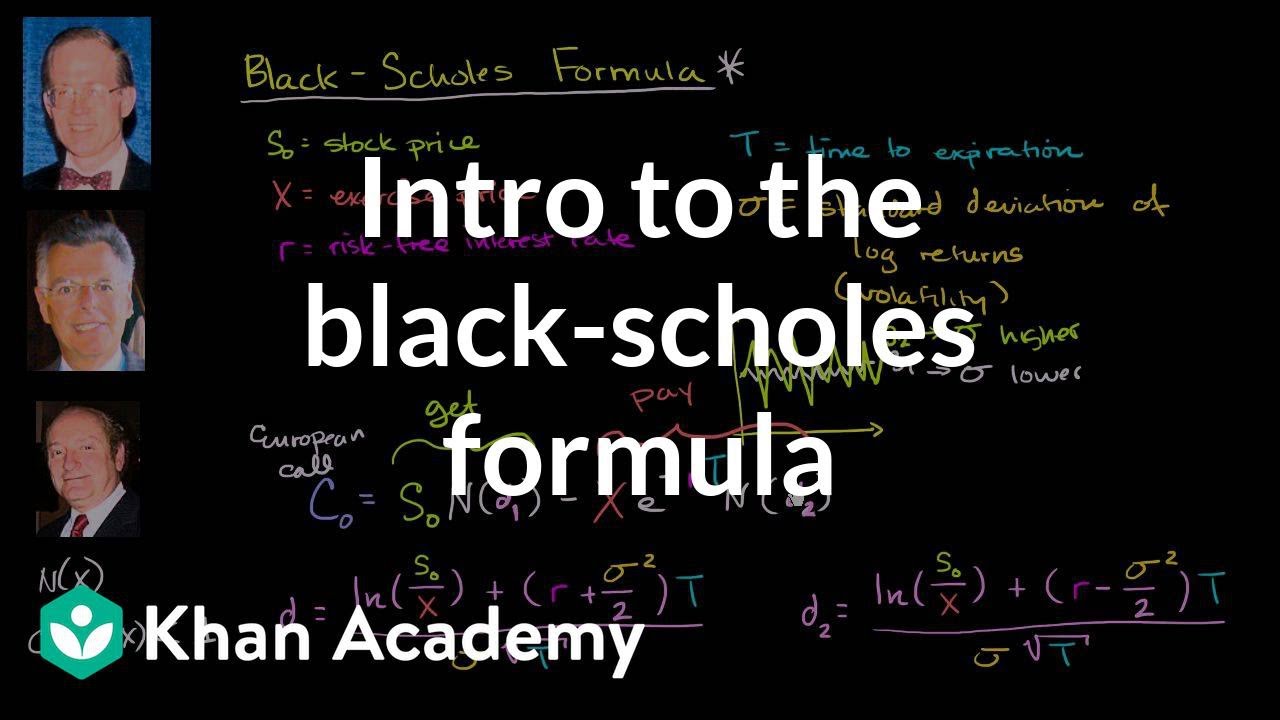
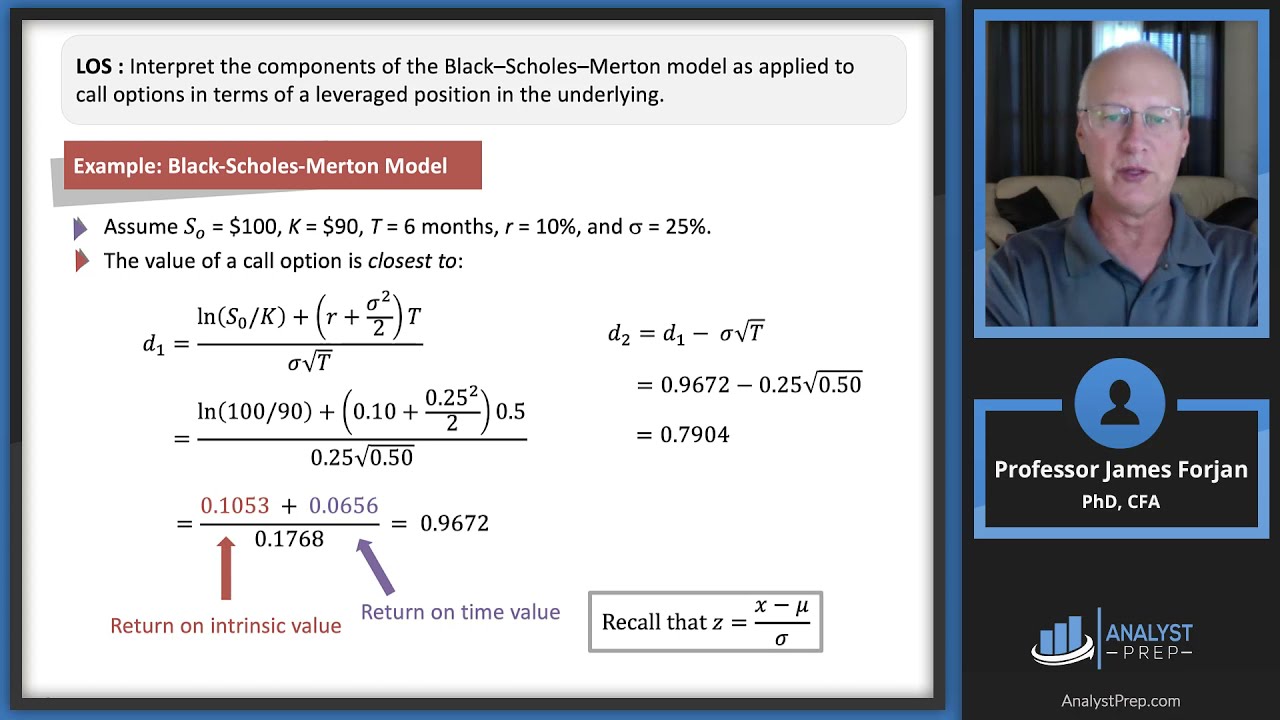
Scholes because you can see they are inside the black Scholes right here's the black Scholes formula for the European call and a d1 and d2 are inside these n functions which are it's a handful cumin standard cumulative normal distribution functions or cumulative standard normal distribution functions really what they are is they are returning for us a probability based on being given a quantile that's all they do and then in this case more specifically the quantile is the quantile of a standard normal distribution and we typically denote that as a special case of the quantile with
a Z so standard normal cumulative distribution function is just taking a quantile and returning for us a probability and so then we have the formula for a call and you can see I implement that here same formula we see here and then for a put really the terms are just reversed we start with a strike price and we subtract the adjusted stock price so to speak but you can see the cumulative standard normal cumulative distribution functions taking negative d ones negative D to D one instead of positive D 1 D 2 quick note about the
divot because this sheet does you'll see incorporate a dividend so just for example I'm gonna now go from a non dividend paying stock to a stock that's paste let's say three percent dividend what do we expect well we expect the call price to be reduced and we expect the put price to be increased actually so I'll do three percent and that is the outcome so about that dividend I'll tell you the most common question that I've gotten over the years is don't we doing it in both places so to speak and the answer is yes
or put another way we do it consistently you'll notice here in the d1 and d2 this isn't in whole chapter 15 he saves us for later for some reason to add the dividends back in but you'll notice in d1 and d2 this continuous dividend yield it is subtracting in both of them so it's part of the inner what I call the inner black Scholes and the d1 d2 answer is yes you subtract the dividend and then also notice it also is part of the out at what I call the outer black Scholes in other words
it is as usual bring that back out as usual the dividend is effectively reducing the stock price right here and right here so that must the answer that most common question is yes we do it consistently both inside the inner d1 and d2 and and we discount in the outer black Scholes as well and so finally you can see my model and on this page goes to the trouble of building out the d1 right manually and then using excels function here to compute the standard and standard normal cumulative distribution function here as a function of
the d1 and the d2 here taking the shortcut d2 is a function of d1 just subtracting volatility scale by the square root rule and then taking a and standard normal distribution function to go back in and finally to roll that all up into the call option is there any way to in to have an intuition about this well I think there's a couple ways to approach and intuition about this without going all the way into the theory my favorite way to do it which doesn't really isn't really supported by the science behind it my favorite
way to memorize or to think about this intuitively if not to memorize it is to just think about the minimum value what we call the minimum value of a call option and if you're studying this as part of the app from the frm or CFA this would have come before and it's much easier to access the intuition of the fact that this must be the minimum value of a European call option it's the stock price minus the discounted strike price not too hard to get to that intuition and then I'm gonna leave the dividends out
right now and then the way that I just think about this is then we're just wrapping in those cumulative normal distribution functions and they adjust this up for volatility that's how I think about this we take a minima or memorize it anyway we take a minimum value it's intuitive and then we're adding N and D 1 and D 2 is multipliers we're wrapping them to to juice this up to increase this value as a function of volatility not very scientific but maybe it's helpful in terms of memorizing another way to go at it is what
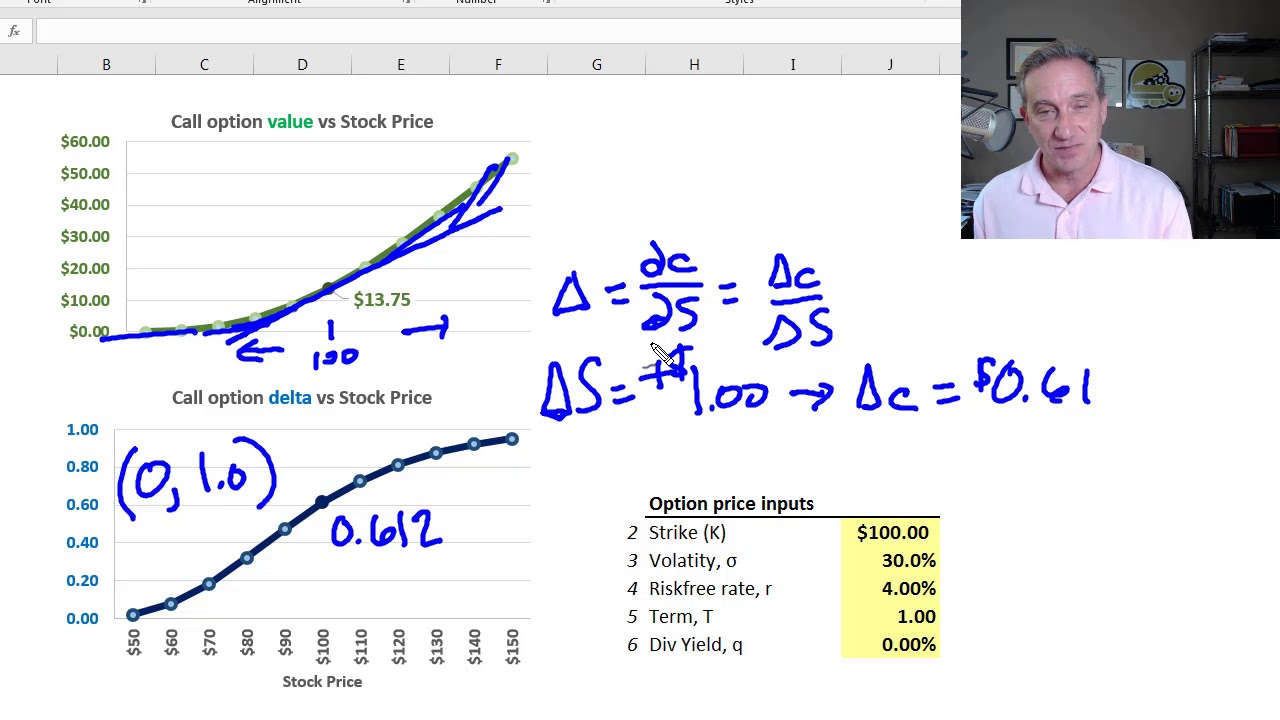
hole has introduced in or more recent additions is this formula here using n n of D 1 and n of D 2 after all what do they mean well n of D 1 as we go study later with the Greeks we'll see n of D 1 is the call is the Delta of the call option that is to say write the change in the call piece with respect to a change in the stock price is option Delta and for a call it's N d 1 NF d 1 is the call options Delta and of D
2 is actually very much easier to get at or to just summarize this is the probability of exercising a call option so put another way this is the probability that at maturity adoption the stock price will be greater than the strike price so you can see how it truly is a probability with that understood if we go to this expression here which after all is a rearrangement really then we can isolate on this quantity here I'm not doing that very well and this is the expected future stock price in a risk neutral world when the
stock price lower than a strike price is counted as a 0 so it's sort of unconditional and then divided by n of D 2 which we said is the probability of exercise makes this quantity here something of a conditional probability it is the expected feature stock price if the option is exercised so it's a conditional future value of the stock price and we can there then just subtract the strike price giving us a conditional future value of this option really a conditional estimate of its future intrinsic value by itself and we can multiply that by
the end of D 2 which produce which accounts for the fact that if it doesn't get exercised its worth 0 so what's the weighted average value if we we want to include the zeros we would need to multiply by the probability in other words we're giving a 0 to every outcome where the stock is less than the strike price so we take that conditional and go back out to an unconditional future value of the call or intrinsic value and then count it back to today so a little harder there but I thought an elegant way
for help for Hall to approach an intuition around the call option but if nothing else I would remember that n of D 1 is the call option Delta for a call and NF D 2 is the probability that the future stock price will be greater than the future stock price will be greater than the strike price so hopefully that's helpful and if you like this video please subscribe to the channel and so you can be notified of our future updates thank you