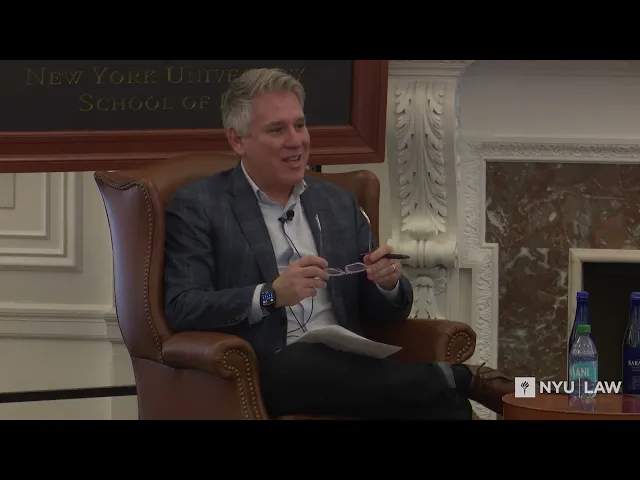
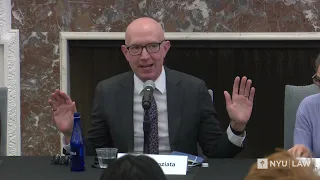
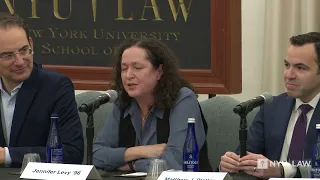
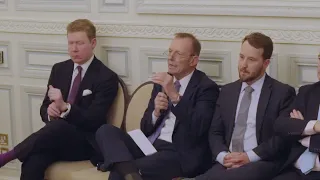
- All right, let me introduce myself, I'm Jeanne Fromer. I'm a professor here. I'm Vice Dean for Intellectual Life, and this is our first installment this semester of the "Respectfully Dissent" series where you get to hear your own professors disagreeing, hopefully civilly, but pointedly about important issues. And one of... There are many important issues going on right now, but I have to say one of the liveliest, Timeliest issues is the one that Chris Sprigman and Andrew Weissmann are going to be discussing and debating, which is the TikTok ban. So Chris, why don't I turn to
you to open things up with some of your views. Then Andrew, we'll turn to you and we'll just let it go from there. - Well, I'm gonna, actually, Andrew and I have part of respectfully disagreeing is figuring out what we think in advance a little bit. I'm gonna let Andrew start with an overview of the actual law we'll be talking about. I'm gonna then talk about the Supreme Court decision a bit. So, Andrew, why don't you go ahead? - Sure. So just, you know how we've organized this, so I'm gonna give a quick overview about
what the congressional statute is. Chris will talk about and give a quick overview of the Supreme Court decision, just to put on my advocate's hat unanimously in my favor. But we actually will then talk about things that we think we agree on so that we can try and narrow where we have disagreements. And then we'll have that debate and discussion about why we think the Supreme Court got it wrong, why we think the Supreme Court got it right, and then turn it over to you for questions. So that's sort of the basic structure. So in
thinking about this, so much has happened since the so-called TikTok ban that this now seems like the sort of halcyon days of the TikTok ban. And there's a whole lot since then that I think we probably would be in violent agreement on. So we're gonna go back to - Undoubtedly. - the days of the TikTok ban. So here, for the uninitiated, is the nature of the congressional statute at issue. So the congressional statute has the unwieldy name of the "Protect Americans from Foreign Adversary Controlled Applications". So it trippenly comes to the tongue. And what that
does, it prohibits the distributing, maintaining, and updating of an app that is controlled by a foreign adversary. And while that can be applied sort of generally, the statute specifically calls out The parent company of TikTok, TikTok being an American subsidiary. There is a Chinese parent company that is determined by Congress to fit the foreign adversary definition. And what the statute does is, it's a civil enforcement mechanism and if you want to comply with that statute, one way you can do it is simply divest. So you sever the tie between the American subsidiary and the foreign
adversary parent. So here, as we all know, That is a statute that was supposed to go into effect on January 19th, and absent there being a divestiture and a severance of that tie between the American sub and the parent. So that's the nature of the congressional statute at issue. - Okay. So Andrew mentioned that the opinion was nine to zero. And you know, from my perspective, that can go one of two ways. One is, before you start criticizing it, you should think hard, right? Because nine people, in all likelihood are not crazy at the same
time. Or what might be going on is that nine people are reacting to a moral panic and people who would typically disagree about something, find ways to agree if they're caught in the grip of that kind of feeling. So let me talk a little bit about the opinion. I'm gonna try to keep it as straight as I can because later I'll talk about what I think is wrong with it. But, okay, so the petitioners here, TikTok said that strict scrutiny should apply. Strict scrutiny, what is that? That's the highest level of scrutiny under the First
Amendment that gets applied to content-based restrictions on speech. So restrictions that discriminate on the basis of a particular type of content. So TikTok said this TikTok ban was, in fact, a content-based restriction and that the government neither offered a sufficient justification or explained, as they had to, why a narrower remedy, such as the so-called Project Texas data quarantine plan, Which we can talk about a little later, was insufficient. The government, on the other hand, the respondents, said that no First Amendment scrutiny was necessary at all because this wasn't a speech regulation, but an ownership regulation.
Now, the court, for what it's worth, didn't take up the government suggestion on that. It stated, although it was far from clear that the First Amendment interests were at stake, it would assume for the purposes of analysis that they were, I'll talk about that a little later. But strict scrutiny, the court said, didn't apply Because the regulation was not content-based. In fact, it said it was content neutral. Now, I'm gonna get into this, but I'll note that the government itself had said in its own brief before the Supreme Court, that one of the reasons the
law was passed was to prevent pro-China speech on the platform, which is for sure a content-based regulation of speech. So we'll get back to that. The court waived that away saying that the other justification for the law, that is the desire to prevent the Chinese government From getting its hands on Americans' data, would have been a sufficient reason standing alone for Congress to have passed the law, even without the content-based restriction. Now, you may have noticed a skeptical look on my face, that skeptical look is because I have no idea how the Supreme Court could
possibly have known that. Right? As far as I'm aware, although they have life tenure, the Constitution does not grant them the power to read minds. So whatever, intermediate scrutiny applies. Intermediate scrutiny means a lower level of scrutiny, the government has to offer simply an important interest rather than a compelling one. The government doesn't have to pick the narrowest possible way of pursuing that interest. It can pick one that's reasonably tailored to the interest at stake. The most important part of the opinion then follows, this is just a couple of paragraphs, it's a short opinion to
begin with by modern standards, and the meat of it is actually just a couple of paragraphs And wrapped in a whole bunch of fluff. The court says that TikTok collects a lot of data and that platform's relationship with the Chinese government, that is it's owned by a Chinese company, that Chinese company is subject to Chinese laws requiring data sharing with the government on demand, that this situation poses a unique privacy risk. So that's enough, the court says, to pass intermediate scrutiny. Now note, and this is important, That the court said that it was not relying
on any confidential material the government had offered regarding privacy dangers. The court said, admirably in my view, with some limitations that Andrew and I will discuss, but in general admirably, that it would not rely on government evidence that the other side could not see. So the court affirms nine to zero. There's a very interesting concurrence by Justice Gorsuch where he expresses some reservations about the rushed nature of the decision, Expresses some reservations about whether this law is in fact content neutral. But he goes along with it and the law goes into effect on January 19th
or went into effect on January 19th, 2025. So I think with that capsule summary, we can talk about some things first that we agree on. And so that way you'll understand the nature of our disagreement by understanding first things that we don't disagree about. So Andrew, you wanna start? - So just taking you behind the scenes. So when we were preparing for this, one of the things we did was this part that we're now gonna talk about was something that we are going to play out in front of you, but we actually thought about, which
is, well, are there areas that we agree on? Are there things in the opinion or are there things about what Congress did that we don't have a disagreement on? And so it helped sort of narrow where we had friction, where we saw things differently. And it was really, I thought, very useful, Both in helping think through the problem and to sort of make our disagreements and what we saw differently more accurate and pointed. So it just was, I thought, a very useful process. And it might be in terms of how you approach an issue, it
might be a useful process also to figure out like what is it that you truly disagree on. So the first thing that we talked about is something that Chris spoke about. There's sort of two ways in which there was ex parte evidence, that there was evidence that was not seen By TikTok or the public. One way to think about that is, as Chris said, is that the Supreme Court was saying, "We're doing this all based on the public record and we'll turn to that because we're sort of, I think, largely in agreement about sort of
that process." But a step before that is the record before Congress, because here you're dealing with a congressional statute. You're not dealing with something that's certainly being litigated now and we're gonna see a lot more of, which is just unilateral executive action. This is legislative action and there's a record that we don't know. And so one of the things that we were talking about, and I think we're in agreement, you'll confirm this, is one of the things that makes it hard in just evaluating not the Supreme Court decision, but what Congress did, and both legality
but also the wisdom of it in trying to decide is this a good thing or a bad thing is there's sort of an unknown here, which is we know the public record, but we don't know what was presented to Congress. And you know, in my former life, I was at the FBI and part of the intelligence community and there was a lot of times that you would present evidence to oversight committees. That's sort of a quaint thing that I'm not sure will exist anymore after the presidential immunity decision. But it used to be the case
that executive action was something that you felt you had an obligation to go to Congress and talk to them about. But part of that, when you're dealing With intelligence issues would be in a private setting and it could be classified material and you could provide lots of information, hopefully and supposedly accurate information. And so what we're missing here is knowing exactly what was presented to Congress about what gave the executive the concern here. And obviously ex parte evidence is fraught with peril. And that's one I think also where we have agreement where that is an
apolitical issue regardless of party, just when you have one side presenting evidence, it's not terribly healthy. - So another thing we we agree about is that people, reasonable people can disagree about the wisdom of what Congress voted on here. Leave aside for a moment the constitutionality of what they did, or maybe put it another way, we can think about the constitutionality of what they did as an element of whether this was wise policy or unwise policy. But just to be clear, I have friends who I would say are on the left who love this law,
and I have friends who are on the right who hate it, and vice versa. So this is not, at least in my mind, an intensely partisan issue. This is an issue that divides people according to their instincts about free speech and about data privacy. That's what's really going on here. And people's instincts on those things differ and they differ for good reasons. - So one of the things that I guess I wanna ask you about, - Yeah. - Is this issue of what has happened since the Supreme Court's decision Sort of post January 19th and
how the executive has treated congressional law. And I thought it would be a useful question for you, Chris, because you disagree with the Supreme Court's decision and you know, this is one, it's clear that reasonable minds can just... I made my catty comment about nine zero, but like there are lots of nine zero decisions I've disagreed with, so. What's your view, even disagreeing with the Supreme Court about how the administration has sort of handled itself In light of the fact that you have a congressional statute and the Supreme Court saying it's constitutional. - So I
think the answer to this question is really important for those of us in a law school because it says something about what it means to live in a society that supposedly maintains the rule of law. Congress voted on a law, which if you agree with it or disagree with it, is kind of immaterial. The law was upheld nine to zero against constitutional challenge. I don't like that opinion. That doesn't really matter so much to me. What matters to me is there's a validly enacted law that has been upheld against a constitutional challenge that requires TikTok
to be divested on a schedule. The president acting outside of anything that the law provides, basically said that he would not enforce this law. He then directed his new Attorney General, Pam Bondi, to write letters to Apple and to Google. These are the owners of the platforms, Android and iPhone on which TikTok is distributed. And Pam Bondi wrote a letter to them saying, "You can put TikTok back on your platform. There'll be no consequences for that." Now the law actually provides for what would be absolutely crushing civil penalties for distributing this app. There is nothing
in the law that allows the president to waive those civil penalties. So I am concerned with what, to me appears to be, a lawless assertion of authority by the President through the Attorney General to essentially just waive the consequences of this law. But I'm also concerned that the lawyers at Apple And Google have made a decision. Now, they didn't put actually TikTok back on their app stores right away, they waited a while, but at a certain point they made a decision. And Andrew and I have talked about like, what must be going through their minds?
But without trying to read their minds, they have made a decision that the law can essentially be canceled by executive action. Now this isn't to say that the president doesn't have prosecutorial discretion. There is prosecutorial discretion, but the idea that the president can simply waive the consequences of a law is a somewhat broader assertion than prosecutorial discretion. I have felt from the beginning of this saga right up to the moment that we're sitting here now, that a kind of lawlessness has attended this entire process. And it's working its way out to my mind now. -
And that's when we're, again, we're in violent agreement on this. And I think to take it out of this context And to sort of put a fine point on it, as a lawyer you don't have the discretion to say, "Well, I don't think we'll get caught. And I don't think that there'll be an enforcement action and thus you can do it." Maybe a businessperson wants to make that decision but if they come to you in-house and someone says, "Can I do this?" You're a lawyer. And especially if you're in the public sector where you've taken
an oath of office, the issue's just, if there's a congressional statute That says you cannot do it, you cannot do it, period. It's fine to litigate it, it's fine to have really more than a good faith argument. - Yeah - a really good argument for why this is a violation of the First Amendment. But if you litigate that all the way up to the Supreme Court and you lose, you don't have, you're in a straitjacket at that point if you believe in the rule of law. Which I think in a law school seems like a
good thing. - Yeah. So I gotta say as someone who practiced law for a long time And advised companies on issues sometimes involving criminal law with antitrust, I am in just disbelief that the Apple and Google lawyers advised their clients this way because Donald Trump one day may decide that he's angry at Tim Apple, whatever he calls him, and he may decide that he's going to un-un-enforce the TikTok ban. The civil penalties are $5,000 for every copy of TikTok that any platform distributes. So that could be billions of dollars actually in civil liability. I mean,
the Apple lawyers will go into court and they'll say, "Hey, wee got a excuse from the teacher." Right? And if they're in front of some judge who's unsympathetic, and that judge might be unsympathetic because they're a Trump judge, or they may be unsympathetic because they're a judge who believes that no lawyer should have believed in the first place that the president could give them a hall pass on this one. Apple's potentially sticking their head into one hell of a noose, and so is Google. And I just literally can't believe it. And it seems to me
that this is a signal that we should all be paying attention to that some lawyers have concluded that we have transited from a nation where there is the rule of law to the nation where there is not. That's what I worry about. - And the idea that you're, and you and I are having that discussion today of all days where in a few moments Judge Ho in the Southern District of New York is going to have a hearing on What I have described as a choke collar that the Department of Justice has put on the
mayor of the City of New York to enforce. And this is in writing from the Department of Justice, federal immigration law is a sign of why what you flagged is so important. But okay, enough of, we have been agreeing way too much. - [Chris] Yeah. (audience laughing) - So one of the areas where we have, I guess maybe some slight disagreement is this issue of, but I think... is this issue of content or not content. - [Chris] Yes. - And in terms of, I agree with you with respect to what the Supreme Court tried to
make a factoid and say, "We're gonna just ignore the sort of content-based part." But there's a way if that... And it's a big if, but if you took that part out, I look at this statute and put on my sort of former intelligence community hat and think, look, this is a content neutral statute in this sense. The statute isn't saying, "If you wanna put this content on TikTok in support Of Ukraine, that's out. But if you wanna put on this content in support of Russia, that's in." Or vice versa. I'm not trying to make it
political. Either one of those would be content-based. This is about foreign adversary connections and ownership regardless of content. And so I think with respect to that aspect of how you look at the statute, it falls within a sort of content neutral bucket in terms of legal analysis. So that's sort of my take on that. - Yeah, so I am not a First Amendment skeptic. I'm someone who strongly supports First Amendment values. I am a skeptic of the methodologies we have developed for analyzing First Amendment issues. One of the methodologies I'm really skeptical of are these
levels of review and the kind of buckets of content neutrality and content-based restrictions. Why am I skeptical of this? So the court basically says, "This is content neutral 'cause it's really about protecting Americans' data. It doesn't matter if you're posting on TikTok about Ukraine Or if you're posting on TikTok about Tiananmen Square, it doesn't matter, it all produces data. That data can be shared with the Chinese government." The problem with that is the legislative history. If you look at the debates around the TikTok law, a fair amount of the debate was actually about the Chinese
government basically getting into our heads and sending us messages about how great China is. And the truth is, given the First Amendment law that we, at least until recently have existed under, they're perfectly entitled to do that in America, right? Foreign adversaries are entitled To send their messages to Americans, and Americans are entitled to hear them. We once upon a time believed that our society, our democracy was robust enough where those messages could be absorbed and they could be critically assessed and America would go on about its business. We are now a relatively timorous, un-self-confident
country, and that's why we're afraid of these messages. Now it's in the legislative history, it's also, it bears saying, an entire section of the government's brief in front of the Supreme Court, Which I mentioned before, but it's kind of astonishing that the court can look at the government's own brief and basically say, "Well this is a make way." Right? The real thing that was going on here as if they understood the mind of every member of Congress who voted on for this, the real thing that was going on was data protection. So maybe we should
segue into what I think is wrong with the opinion because I think we'll disagree a lot about that. - By the way, just to be clear, I don't really have a sort of strong opposition to the idea that if there's sort of two reasons being advanced, the court should not on its own be saying, "Well I make a determination that it would've done this on the valid reason," as opposed to now we're gonna send it back. And if it turns out you are gonna repass it under a valid resume, then we'll consider it. But you
may not be doing that because it may have been integral and until there's a clear record of it. So that's not one where we have a huge amount of disagreement. - I think this is a tough problem because you know, I mean, I agree with you that the court should send it back, but of course the court sends it back with a message like, "Shut up about the Chinese government's messages to Americans." And Congress, even this Congress will probably get the message and shut up. So it's a little artificial. Right? - [Andrew] Right. - But
in terms of the opinion, let me just start With the court's refusal, at least on the surface, to take up the government's suggestion that the TikTok ban isn't a speech restriction because it doesn't restrict speech directly, but only mandates an ownership change. Now the idea that, let's say for example, decapitating the ownership of the New York Times, telling the Sulzbergers that they have to sell the New York Times wouldn't be a speech regulation, I think that would be incredibly hard to swallow, That we wouldn't see that obviously as a speech restriction. And the idea that
the TikTok law isn't a speech restriction is at odds with the Supreme Court's own decision in Citizens United. So you might remember that's a case in which the Supreme Court holds that the First Amendment protects the ability of individuals to give basically unlimited money to political campaigns because they're saying preventing people from giving money is essentially restricting speech. So if money, which isn't literally speech, is protected By the First Amendment because it's adjacent to important speech interests, one would think that ownership of a speech platform, which is not literally speech like money isn't literally speech,
but is intimately related to the kind of content that appears on that speech platform would be worthy of the solicitude of the First Amendment. Now the court, again, does not take up the government's suggestion, but it's nonetheless worrisome, at least to me, that the per curiam opinion badmouths the idea That the TikTok law should be regulated by the First Amendment. It frames the First Amendment's application to this law as doubtful, and surely at a legal realism level, this colors the First Amendment analysis that follows. So the First Amendment analysis that follows. The court's decision that
intermediate scrutiny applies rather than strict scrutiny is just bizarre to me. The legislative history mentions, as I said, as one reason for passing the law, the concern that the Chinese government Would use the platform to spread pro-China propaganda. So the removal of Chinese ownership was meant, at least in part, as a way of preventing that. The idea that US law can or should prevent foreigners from speaking in the US is not consistent, as I said, with current First Amendment laws. Such a law would be clearly content-based and strict scrutiny, which applies to those types of
laws is almost always fatal. The court gets around it by relying on the data security justification, which it says is content neutral. But that takes us to the key couple of paragraphs in the opinion, the paragraph in which the court explains that TikTok collects a lot of data and that it shares it with the Chinese government or that it could share it with the Chinese government. I have to say, as someone who thinks a little bit about data privacy in his real job, the court comes across to me as dangerously naive. A lot of actors
on the internet collect lots and lots of your data. A lot of that data is available for sale Or is held insecurely and subject to data breaches. All of this data is collected, or most of this data is collected with your supposed consent. But your consent is a figment because I can guarantee you, unless you're very strange, you never read the privacy notices that they give you. And while you check yes, you have no idea what you're checking yes to. Florencia Marotta-Wurgler, my dear colleague, taught us all that a while ago. And so the world
that we live in is a world Where there is tons of information about you available, the same kind of information that TikTok collects, your cell phone company collects, right? Google collects, Facebook collects, they share it with intermediaries, these intermediaries sell it or they hold it insecurely and it gets stolen. And for all these reasons, there is no real case that TikTok is special. And although I don't think that Congress has to solve the entire problem of data privacy at once, It does raise questions for me about why TikTok was singled out. The US has a
long and particularly sordid history of anti-Chinese racism. I mean, some of the most important milestones in our immigration law come from that. And some of it was on display at the TikTok hearings. Some of you may have seen, for example, Senator Tom Cotton's interrogation of the TikTok CEO. Could you roll that? (audience chuckling) - Of what nation are you a citizen? - [Chew] Singapore. - Are you a citizen of any other nation? - [Chew] No, Senator. - Have you ever applied for Chinese citizenship? - Senator, I serve my nation in Singapore. - I asked, I...
- No, I did not. - Have you ever been a member of the Chinese Communist Party? - [Chew] Senator, I'm Singaporean, no. - Have you ever been associated or affiliated with the Chinese Communist Party? - [Chew] No, Senator. Again, I'm Singaporean. - Okay. Let me ask... (audience chuckling) - Okay. I mean, Tom Cotton is a particular form of creature. (Andrew laughing) That is not surprising. - That's another thing we agree on. - Yeah, yeah. That is, he's a Harvard graduate, that's not surprising coming from him- - I went to law school with him. - Yeah.
(audience laughing) - He was a classmate. - Right. Some of our worst elites are in the Senate. He's not... That coming from him isn't too surprising. But it leads to the final thing I wanna say, which is about the politics of this. Donald Trump started this during his first presidency. He issued an executive order and then very much like Donald Trump in his first presidency, he got a little bit of pushback From the courts and he basically gave up. It's Joe Biden who did this. Joe Biden picked up where Donald Trump left off. Joe Biden
urged the Democratic leadership to whip the Democratic party in support of this bill. Joe Biden signed this bill. Joe Biden advocated for it. Joe Biden, I'm just gonna control my anger, gave Donald Trump a sizable political gift in doing so. Because what actually happened when Donald Trump got elected is he swooped in to "save" TikTok, which actually my 13-year-old stepdaughter perceived as a great act of magnanimity From a man she wasn't expecting it from. I'm sure she's not alone in this perception. Biden gave Trump a gift not only of appearing to be able to save
TikTok, but also allowing it to be used as a bobble that he could hand to a friend. So I wouldn't be surprised if in the end, TikTok ends up in the hands of one of the billionaires who associate themselves with Donald Trump. Maybe Elon Musk, maybe the head of Oracle, Larry Ellison, who's been incredibly wrapped up in this from the beginning because Oracle provides a lot of the backend data services On which TikTok depends. This entire episode, as I said before, has been shot through with lawlessness. I think the idea Congress was lawless in passing
a restriction that was based in part on, from what I can see, a desire to restrict speech about China, that's pro-China. The Supreme Court I think was lawless, all nine of them, in pushing that very obvious reason for the law aside and masquerading their per curiam opinion as a content neutral regulation of speech, which this very definitely is not. And Donald Trump, who we didn't expect anything better from, has been lawless and will continue to be lawless in his disposition of this quite valuable asset. So that's where I end up. I think this is a
horrible idea that is gonna bear some pretty horrible fruit. - So there's so much of what you said that I agree with. And then I'm gonna, again, I'm gonna put my sort of intelligence community hat on for what I think the argument is for why the congressional determination should be upheld. I have no beef whatsoever with the fact That the Supreme Court could have sent it back. Justice O'Connor in the Illinois Lee Edmonds case did just that knowing full well that it's a Fourth Amendment roadblock case, which is that the legislature was gonna just sanitize
their reasons. But you know what, she had been a legislator. She knew that could happen. But also, why should you assume bad faith on the part of the legislator? The Supreme Court should be assuming good faith on their part and they could have done that. They also could have, to your point, they could have actually said, "We're going to address the part of this dec- what Congress did here that is content-based, and we're going to say essentially that is not a valid reason." I mean there are a bunch of things they could have done to
deal with that. And obviously no one in their right mind, which means, you know, we're now outside of where we are politically would endorse what Tom Cotton said. I mean it's sort of the worst forms of xenophobia. And so all of that's true. The issue though still remains about sort of legally what do you do with the narrower part or the narrower rationale for a congressional statute that says that we are concerned about foreign adversary control of information in this country. And it applies not just in TikTok, but there is a whole group that applies
CFIUS about when you have foreign control of assets in the United States for a whole variety of reasons. There's no question it can be abused. That's absolutely clear. And there should be legal challenges. And it is incredibly complicated, the issue of when you consider ex parte evidence. However, in a national security context, that is the strongest argument for coming up with a mechanism. And that's one where we probably agree that you should be able to do it, but there should be a whole lot better system for how it is presented, Whether it's in court or
in Congress, so that the person who is affected by it, there's some way for the court to hear from an adversary on that. - Yeah, I would note one thing, Justice Gorsuch in his concurrence calls for some congressional action to think through such a mechanism. And that is literally the only thing I walked away from this opinion feeling good about. - Yep. So it's also the case that it is true that there may be a problem in other areas, But that is, it is simply not the case that Congress has to tackle all problems at
all times and all at once, as opposed to saying this is a particular problem or particularly egregious problem and we understand that there may be a second best or third best way that this is a problem. That's where the classified portion of what was presented would be of particular interest to me in terms of imagine, and this is now pure hypothetical, Where the presentation, we're all now in a SCIF and we're all within the executive branch or we're now in Congress in the hipsy and sissy SCIF being told about what is the concern here. And
it's that, it's not just speculative that this is happening, and I'll get back to why speculative might be enough, but it's actually what's happening, which is that for, you know, hundreds of millions of people That a foreign adversary has significant data not just on you and everything you're doing, but on anybody, but is in your phone and device and is also then getting that data on everyone else in your device. So it spreads like beyond that one hop to other hops. And the ways in which that can be used and weaponized to identify weak links,
to develop compromising evident kompromat on somebody and to turn them. And there could be examples of that so that it's not just speculative, But even if it were just that speculation, one of the things post 9/11 that the public wants and deserves, and sitting here in New York we should want and deserve is for the intelligence community and law enforcement and Congress and the executive branch to be engaged in prevention, not just in prosecution after the fact. The sort of left of boom, meaning you want to be taking action before the bomb goes off. And
so my hypothetical, which I think served To sort of narrow our disagreement is the following. Imagine that there was a criminal case, and this comes, you know, I'm a criminal lawyer, you know, sort of my being. And so imagine a criminal case where the prosecution has charged TikTok and ByteDance, the American sub and the foreign parent, for espionage. And it's all after the fact and it's based on their use of the TikTok app. That means a grand jury has found probable cause and let's say it goes to trial and there was proof beyond a reasonable
doubt. Does Congress, does... And let's assume we all say, "Well that can't be done because of the First Amendment." Or we think no, that's a good and sufficient case and espionage is illegal and Congress had the power to criminalize that. Does Congress then have to be in a position where it says, "Oh yeah, we can only act after the fact." Or are they entitled to say, "You know what, we don't have to have the standard of proof beyond a reasonable doubt. We don't have to just criminalize this And then wait for it to happen. We
actually can get ahead of the problem." That is sort of what you want, you know, post 9/11 is you want to stay ahead of the problem in dealing with that particular issue. And so if the criminal case is something that you could support, why is it that Congress can't do this if, it's a big if, it had sufficient factual predication? And that's where I wonder if where our... I mean, our main disagreement is sort of really the factual predication. - Well I think our main disagreement is partly that. I think it's also partly how you
react to the current privacy environment that we're in generally. So the factual predication. I don't think that TikTok is able to gain any insight, any more insight into potential compromised information. For example, knowing all my connections, having access to my phone book. That Facebook has, right? There are lots of actors on the internet who ask for, and you give them access to the same kind of information that TikTok gets. So a few years ago in 2019 with a co-author, I wrote a paper about the porn industry and their use of information. So the porn industry
was one of the early industries to collect data about their users digitally in this two-way platform that we live on now. And they use it for a lot of things, including designing more appealing pornography, right? So this is an old phenomenon and a widespread phenomenon. Okay. So, the fact is that right now, If TikTok gets shut off, I'm actually not sure that the Chinese government is in a worse position with regard to the availability of valuable data to them about American citizens than they would be with TikTok still running. It might take them a little
bit more effort, they have to spend a little bit of money, they'd have to do a little bit of hacking, but they're good at both. They have plenty of money and they do plenty of hacking. So I'm not sure it really makes much of a difference. Now you're right, I think you're right, I agree with you that in most cases it is not necessary for the government to solve an entire problem. It's usually the case that we are comfortable with the government identifying a pressing area of a problem, a solvable part of a problem, and
addressing just that. Here though, I'm a little freaked out by that approach, in part because the problem is so enormous and we seem to have no political appetite to address it, except when that problem is attached to China, And then that political appetite seems to develop, along with some very inconvenient statements about, you know, that speech and how we don't want that speech. So I am, you know, again, I agree with you in general, but I think here, given the facts that we're facing, we have reasons to be uncomfortable about the approach that we've taken.
- So let me just press you there. Let's assume there were that criminal case. - Yeah. - And I understand that's an if, I mean it's not necessarily where we are because we don't know the sealed submission, but if there were that quantum of proof of espionage, would that... And not in any way taking away sort of, is it being equally applied to other nations? Which is a totally fair point. But would that go a long way to alleviating your concern about, well, look, Congress doesn't have to wait for that, they can actually take action.
Or is the only mechanism, Because it still would be executive action, it just would be a criminal prosecution. Why can Congress act as opposed to having to only do a criminal case? - So I'm not saying it's black and white, but I would offer a couple of data points. One, when the presentation was made to the congresspeople who had clearance to view this, there were polarized reactions to it. One coming from the people who voted for this bill was, "Well that was worrisome." The other coming from people who didn't vote for this bill Was, "That
was like a big nothing burger. And I was surprised at how little the government had to show us." So who do I trust? I don't know. I'm dismayed that it seems like everything else these days, your view of what the evidence is is colored by your preexisting beliefs about like the merits of the policy. So that, I don't feel like I gain any knowledge from that. The second thing that I think is, you know, relevant here and gets to your question about a criminal case is, It may be that we have to bite down hard
here on- - No pun intended. - Right. On what we really need to do, right? Which is we need to create an environment where American's data is treated differently than it's treated now. And we cannot rely in order to do that on the notice and consent system that we have now because no one really gets notice and so no one gives meaningful consent. If we were to take steps toward changing that, Then I would feel better about regulating some particular platform because we thought they posed a special danger, in part because the entire level of
danger for everyone at all times would be somewhat lowered, and in part because I would then feel like we had actually, we had a determination to create a secure environment and we would be in a better position to kind of pick out the malevolent actors from that new baseline. That is not what we've done. So, you know, from the privacy community's perspective, You know, opinions vary, but I think everyone basically agrees that what TikTok is doing is more or less in the mainstream of what platforms do. Maybe Apple's a little better, maybe Google's a little
worse, but it's in the mainstream of what platforms do. And it's a little confusing. - So where I agree with you is that there's no question that regulating platforms that have enormous power and increasing power on the executive is sorely needed And that this piecemeal approach is troublesome and can create sort of terrible effects in terms of who it gets applied to. - Right. - I do think that that there... I wouldn't write off the distinction between Apple and Google and Yahoo and Microsoft and a whole variety of companies that are not controlled by a
foreign adversary that has in its law that the information has to be shared with that country and there is known espionage. So again, doesn't mean that it is happening, It doesn't mean that we know exactly what the factual record is to justify what went on. But I do think that that is a distinction. There's no question it can be sold and there could be other ways that the information's used, but that to me is one where I think that the court, when you're dealing with a congressional statute, I think that in some ways the most
troublesome part of the decision is that the... and I think in some ways the weakest part Of the decision is when they said, "We're not relying on anything that is ex parte," because in some ways that makes the decision weaker because it's like, okay, well we can see what it's doing and it opens it up to your criticism. And my sort of point is that we don't know if there, in fact, in that submission is something that gives us a lot more reason to think that what was sought here was at the very least a
rational response by Congress to a known problem that wasn't... And yes, of course some people may be infected By terrible motives and reasons for it, but that there were good faith actors taking a responsible position that the court really should defer to. - Yeah. So I have to say that the line between ByteDance on the one hand, an American company that operates also in China, is less bright than people may wish it to be. So ByteDance has to comply with Chinese law. But you know, if an American platform is operating in China, they have to
comply with Chinese law too, including the Chinese law that forces them to respect, You know, China's firewall, and also the Chinese law that forces them to share certain data with the Chinese government. Most American companies long ago have gotten over their squeamishness about that. And so, you know, I'm not sure that we can be a hundred percent confident, for example, that Chinese dissidents living in the US, information about their associates in China isn't being hoovered up by American companies operating in China and turned over to the Chinese government. I think the problem really is that
in China, the law is written in order to give the Chinese government the information it wants. The American law does not forbid American companies from operating in China or complying with that law. And America in terms of data privacy is essentially lawless except for California, but California can't do the job for all 330 million of us, as valiantly as it tries. And even that law is, you know, is based in notice and consent to a great degree and so is largely ineffective, Although marginally better than what we have on the federal level, which is, except
for niche privacy laws that apply to banking or apply to healthcare, effectively nothing. - Should we take questions? - Yeah. - Yeah. Okay. - So why don't you line up at the microphones and I'll alternate between calling on people at different microphones. Go ahead. - [Xing] Thank you Professor for this. - Could you tell us who you are And whether you studied at law school or at the university or what year you are? - Sure. So I'm a 2L here. My name is Xing Ji and thank you for this talk. So I have a question
about is it possible to... Like, or should Congress at least consider, say a less restrictive measure than, like, ordering a total ban of TikTok? Because as you said, the key concern behind this legislature is the data privacy or data security concern. And as far as I know, TikTok once proposed a project called Project Texas. - [Chris] Yeah, yeah. - Where they proposed to localize all their US data, they proposed to put their algorithm in custody with Oracle to solve all those national security concerns. But it seems like Congress did not seriously consider this option and
nor did the Supreme Court. So in light of important right, like First Amendment right, do you think it's necessary for them to consider that? - Yeah. So thanks for that question. Let me just back up and give a little bit of background. So one of the ways in which TikTok's owners attempted to negotiate with the American government Is they came up with this thing they named Project Texas. I don't know why they named it that, but that did not go down well in Congress, which didn't just ignore Project Texas people. Some Congress people got offended
that they would name it after Texas. You know, the great State of Texas shouldn't be... that name should not be taken in vain, apparently. Okay. So, fair enough. So this proposal was essentially to put Oracle in charge. And Oracle, which provides database services for TikTok here in the United States, Oracle would set up a kind of data wall that would prevent the Chinese company from basically hoovering up the data of American TikTok users. And the TikTok algorithm would be essentially put in trust. Now that's a metaphor. What would actually happen is that Oracle would have
access to the algorithm, there'd be some kind of committee of algorithm scientists, and they would inspect the algorithm from time to time to try to detect if the Chinese government was privileging certain forms of pro-China content. Now, I got to note that that aspect of Project Texas was a direct response to what TikTok accurately understood, which was that a big part of this ban was an objection to pro-China speech. So a big part of this ban was content-based. That was written all over Project Texas. But with respect to both the data security part of it
and the algorithmic trust part of it, neither Congress nor the Supreme Court spent any time with it. And this even under intermediate scrutiny, and again, strict scrutiny, intermediate scrutiny, This whole form of thinking about the First Amendment is just shot through with difficulties and infirmities. But even under intermediate scrutiny, the government can't ignore some much less restrictive alternative that could be effective. And whether in fact Project Texas was that, we will never know because neither Congress nor the Supreme Court has told us. They just ignored it. Which is lawless. - I mean, to be fair,
I mean if the concern is control, right? That is the stated legitimate concern in my view, is foreign adversary control and thus access to data. But it's fine according to the statute, which is, you know, Congress says it's fine as long as TikTok is independent and not controlled by its Chinese parents. So any measures that are dealing with that control and access goes right to the heart of the concern. And so whether it's intermediate or strict scrutiny, that is something you have to wrestle with as to why does that not serve the same purpose? And
you know, in the corporate law And corporate criminal law, there's all sorts of provisions where you can have monitors in place, you can have regulations in place, you can criminalize, you know, the American company if it were to provide the information that would be against the law. Again, I'm not saying Congress has to wait for that to happen, but there are all sorts of ways to deal with the control aspect that is at the heart of what the statute's supposed to be aiming at, The one legitimate concern. - Other questions? - So how many of
you are using, here we have a question, how many of you are using TikTok now that it's back up and running? Wow. Really? - Wow. - That's shocking. - That's shocking. - Wow. - Shockingly low. - Hi, I'm Sarah. I'm a 3L. This is not the first time we've seen platforms Be regionally restricted. You know, Meta pulled out of Russia, India also has banned TikTok. And what we see in those regions is users just turn to VPNs to still access the services they wanna access. So if like espionage and national security really is the concern,
why did Congress take this path instead of, you know, this kind of looks to me like the Congress trying to flex their power over American tech companies as opposed to actually regulating American users' access to the service. - I actually think there's a more benign explanation, which is that Congress just doesn't know anything, that they are techno rubes in an extreme. And so, for example, I'm not gonna name names because some of these people are related to me and I don't want them ending up, you know, in trouble. But when TikTok got taken off of
the App Store, people who needed it just used a VPN and set it to Canada and that problem solved. So this incredibly weak "ban" isn't really much of a ban even when it was in effect. So what does that say? I mean, it says that Congress really doesn't understand what they're doing, and I think that's probably true, but it also says that they don't care all that much, right? That this is more expressive than anything else. And you know, if they cared, there would've been some investigation into how to make this ban actually work. -
Hi, I'm Michelle. I'm a 3L. My question kind of flows from Sarah's. So when we all thought TikTok was getting banned and there was pandemonium and madness, there was a trend where people were downloading- - [Andrew] Apparently not here though. - Well, not here. - No, no, no. (audience laughing) - Outside of the law school. - [Andrew] No one will admit to using TikTok here. I am sure that 95% of you use TikTok and you're lying. But anyway, go ahead. - [Chris] Wow. - [Andrew] Yeah. Okay. Well I disagree with that. This is, I'm not,
I won't even say I respectfully disagree. - [Chris] Yeah, yeah, yeah. (audience laughing) Fair enough. - Well, in any case, there was a trend where Americans were downloading this Chinese app called RedNote. - [Andrew] Yeah. - Which apparently was considered much more dangerous and, you know, China would be getting your data much more easily than it in fact would through TikTok. So is this the same kind of issue where this legislation just didn't have teeth or would RedNote have been affected in some way by the same legislation? - Can I just give you an analogy
from my former life? So if you think about the issues, think about good faith actors, it's so much easier when you think about like, are people acting in bad faith to sort of understand why there's a problem. Assuming good faith actor and good faith in the intelligence community and they're sitting there thinking, "I need to reduce a problem and I don't have a perfect solution and technology is evolving, and yes, there's VPN. But you know what? I can do something to reduce the problem and the risk here, even though it's not perfect, and far from
perfect. But I have identified a real issue." And this comes up all the time. And then it's a judgment call about the cost, real cost to it and also the real problems. And so you can imagine them saying, "Look, I can see that some people will go to an alternative, and sometimes the alternative will be worse." But trying to sort of figure out how likely does it happen? How many people will do it? Will there be a bigger effect that is helpful from a security perspective? I think that conversation and ideally that is the conversation
that you want to be happening both within the executive branch and then if Congress is gonna legislate having the same kind of conversation, but it's complicated. It usually isn't, "I've got a perfect answer." And there are all of these nuances and all of the nuances that Chris is raising And you actually want those people with a seat at the table raising all of them. - Yeah. And there's always this line, it's hard to tell. So I think anyone who has served in government knows that solving an entire problem, if that's the criterion, no problem ever
gets solved, right? So there has to be this ability to piecemeal a problem. It's just, government can't work otherwise. But there's always this problem that it creates, which is like, what is government doing? Is government trying to piecemeal a problem? You know, they're focused on the bigger problem, but they're solving one part of it, or do they only really care about this because of animus? I mean that's, you know, I can't tell you, the court thinks it can reads Congress's mind, I cannot. All I know is like what the legislative history says and what the
government actually said. That's all I know. And to me it seems like animus was a part of this. I'm not a hundred percent sure what that means, right? Like whether mixed motives, you know, how the court should handle mixed motives in this case Is a very difficult question. But I'm mortally certain that the court should have done something else other than say, "This isn't real." Right? Which is effectively what they said, - Am I right that they set up, Congress set up a mechanism in the statute to designate other businesses as well? - Yes. -
I mean there's a whack-a-mole issue still obviously. - Yep. - But yeah. They could have done that for RedNote. - Yeah. - Yeah. Yeah, RedNote wasn't big enough yet. - Yeah. - There's a user threshold, but one day it would be. - Yeah. - Okay. I think we're good. - Yeah. Well, thank you. - Okay, thank you. - Will you join me in thanking Chris and Andrew? (audience applauding) - Thanks, it was fun.