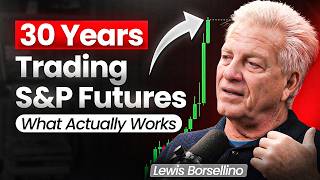
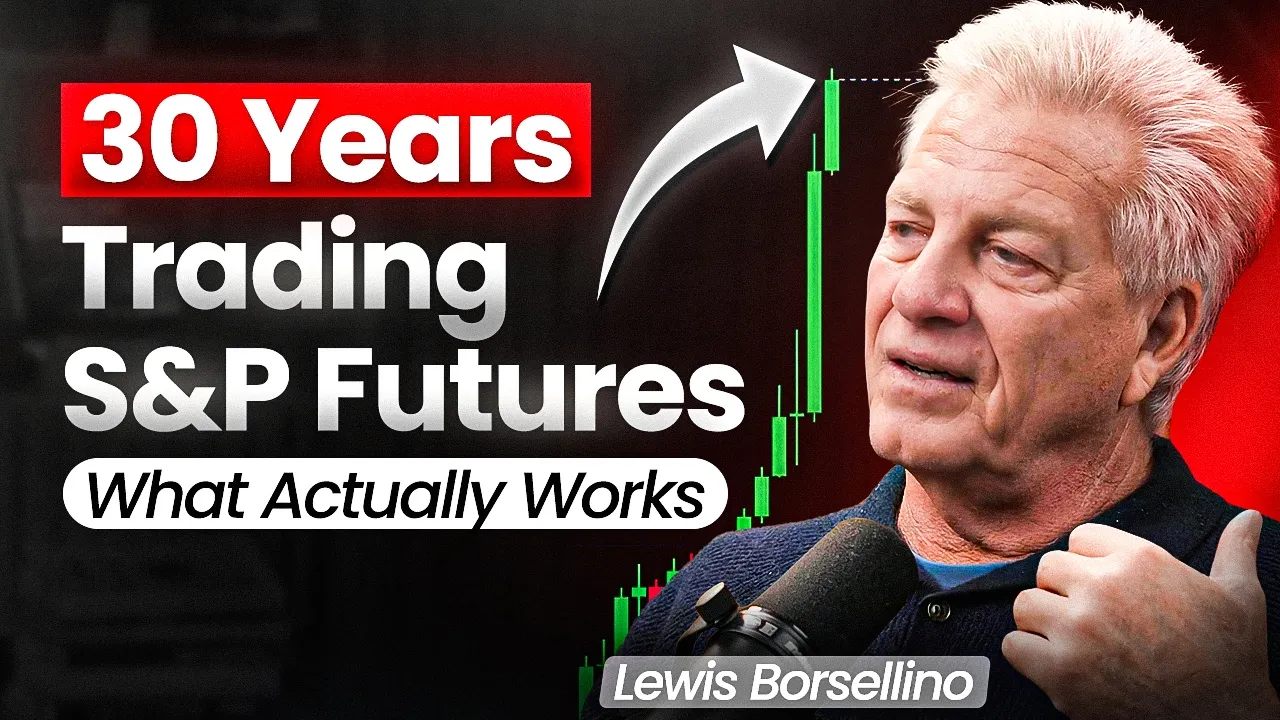
made $4. 7 million. USA Today wrote an article about I was the biggest trader of S&P futures in the country.
When you're trading, there is no practice day. It's game day every day. This guy was the world's best trader.
Welcoming back Lewis Orcelino. If people are being honest with themselves, they could sit down and say why they're not profitable. I could show a P&L 20 years of never having a losing year, maybe a dozen losing months.
I was never swinging for the fences every day. I was swinging for the I was talking to my exartner the other day. He said that with AI, what used to cost him $200,000 a year to gather all his information, come up with his trading signals is now costing him $5,000 cuz he can automate all this.
This AI is kind of exciting cuz it's going to make more millionaires than you could ever think about. But Lewis Borcelino ran the Chicago trading pits for the S&P having the largest portion of volume than anyone else on earth. All the biggest orders ran through Lewis.
There's no such thing as a bad trading program. you know that you can if you have a good trading program, it may go against you for a while and then maybe it'll turn around, but you got to have enough cash to be able to to survive that survive that draw down, right? You want to be where the action's at.
You want to be where the volatility is at. You want to be where the where there's the most order flow. The worst thing to do.
And in this episode, Lewis shares the exact principles to profitable trading. Exactly what he looks for to identify potential and what it takes to be a profitable full-time trader. Markets will humble you, right?
So you you think uh you make money every day for a month, you can't do no wrong. What happens is that a lot of traders their careers became shortened or became difficult because all this and more in this special episode with a true trading legend, Lewis Boral. Welcome everyone back to the words of wisdom podcast.
We are back once again and still the number one trading podcast in the world and the fastest growing thanks to all of you and our incredible guests. We're on our second US tour of the year and obviously our tours are thanks to our incredible sponsors, Trade Zella, the number one trading and journal in the space and back testing tool allin-one. So, huge thank you to them.
But our incredible guests, for the first time in a very long time, we have a guest returning to the show. And really, you know, I'm super super excited for this. And there's only one person to kick off our first part two in a very long time.
He is known as one of the greatest traders of all time, the largest trader in the S&P trading pit in Chicago. You already know who it is. It's the one and only Lewis Borcelina.
Lewis, thanks for coming back. Thanks for having me. It's my absolute pleasure.
Yeah, it was it was fun and we had such a huge impact last time. Uh, you know, the trailer I remember still to this day is pinned on my my Instagram page cuz it was just so amazing. I think we did over a million views just on that trailer.
Oh, really? Let alone the episode. But to start things off, as I said, this is a part two.
So I was always wondering about like what are we going to go into? How do we start it? So we had an incredible comment on our last podcast, a guy called Tom Hogard, who is a a very wellrespected trader of today and has a really famous book, The Best Loser Wins.
And he commented on our episode, and I'll just read it out to you. I I'll read most of it uh of what's relevant. I would love to hear your thoughts, but it's and really less so about your thoughts, more so just to show the impact that you actually had in your career and even to this day.
And he said, "Dear Riz," and it'll be on screen for everyone, but dear Riz, I think a thank you would be an understatement. You deserve a massive applause for bringing this interview to life. I can't begin to describe how important this podcast is for the world of trading.
For traders like me who every day show up to hustle up for a dollar or two, Lewis Borcelino was a trader that I tried to study when I started trading 26 years ago. There was not much information available like there is today. What I would have given for this information almost three decades ago is significant and it's still still like today.
It was the fewest who made it like Lewis Borcelino who made it. I don't believe we will study this podcast in the years to come trying to figure out what his strategy was. We will still study this podcast in the years to come to figure out who he was, what his belief system was, what his inner dialogue was, and how he handled setbacks.
You've created an interview of lasting legacy, and I'm truly grateful for it. Thank you, Tom. That's it's nice to hear.
All right. Exactly. And yeah, the reason I bring that up is just to really showcase, you know, we did a podcast last year, right?
And it's had such an impact for the traders today. But it just showcases how much of a massive trader you were cuz bear in mind back then there wasn't really social media, right? Uh which connected the whole world in this way.
But yet almost three decades ago, Tom Hogard knew exactly who you were, wanted to study you to be able to, you know, elevate his trading. And it really just shows the impact you had. Well, you know, it's funny because uh no one realizes when you're doing what you're doing, right?
Um how interested people were, right? I kind of figured out when um I got a call from um Ron and Sana, right? And so he worked for uh CNBC and he wanted he he called me up and he said, "Hey, can do me a favor?
Would you please do an interview um this Friday on the money supply when it comes out or unemployment number? " And I said, "Why me? " And he goes, "Well, I can't get anybody to do an interview.
you're the only name I really knew and everybody always talks about how you're the largest trader in the S&P pit. I said, "Why why isn't anybody else going to do this? " And they go, "Well, they're all worried about the FBI investigation from uh the early uh '9s, right?
" And I was like, "Well, I'm not worried about that. We're not killing people here. We're not stealing any money.
" Uh I said, "I'll do the interview. " And so then um I started doing the interview once a week and then within you know that that kind of coincided with me writing my book and then we um started a um we started a a a website called teachrade. com right and I became so fascinated with the internet I mean literally I was looking at the internet and I'm going you know within 6 months we had 20,000 people registered on the on this site and what I did was I put it together to be shorten the learning curve, right?
I wanted to shorten the learning curve for, you know, would be traders. And I kind of, you know, you remember the old saying in in um uh in the US it was everyone wants to be like Mike, right? So, Michael Jordan.
And so that's like I was going everybody wants to be a day trader. Everybody wants to be a trader. And then so many people I ran into, you know, doing uh the money show or doing anything in and any sort of uh trading environment and everybody wanted to be like the day traders.
They all wanted to, you know, you know, in Chicago Mhm. Um I think there were 6,000 traders and they were all in their 20s and they're all driving around in Porsches and Mercedes and have second houses and so on. And so I think in Chicago we saw that how the futures market grew up, right?
When I first went there, it was like a a club. I mean, literally, you know, they had um pork belly, cattle, uh wheat, but then the financial futures were born. You know, you had all the in the currencies, the euro dollars and so on and so forth.
So, in Chicago in the 80s and 90s, um you know, every single girl wanted to marry uh doctors and lawyers. Not anymore. They wanted to marry traders, right?
So um uh we used to joke they used to come down to the floor either for you know to get their degree or get their MRS degree right but uh yeah I mean it I saw that explosion and that's why I did the website and what we did with the website we literally did uh a website to you know I had the ten commandments of trading right and then we had introduction to technical analysis and then we had um I I created a psychological profile for, hey, take this quiz and see if you have this the psychology of being a good trader, right? Literally, it wasn't really about the psychology of being a good trader. It was about, can I get all your information?
Who are you? Where did you come from? How much money you make?
What school did you go to? And we were we're creating, you know, a database of people, right? Um, but it tell you how far ahead of we were really.
Yeah. I mean we were way ahead of the time because um I didn't even realize how you know uh important that information was the database of traders right and uh we were looking at it and the thing that fascinated me when I when I looked at the web trend report was we were getting people from 19 different countries and this is 1996 my the first website that I built it cost $150,000 you could do the same website now you know for free so true basically So, we were um we were kind of ahead of our time. And what I would I I met this gentleman who uh um well, he had a computer science major, but he worked for Baker's, right?
So, he was in the oil business and um he had developed some trading programs and he said, "Look, if if um" and I don't know if I we talked about this last time, but he said, "If you trade my trading program, I'll take care of your website and all your stuff and anything you need. " And um so he had this trading program. It was based on uh the open and uh the five-minute close.
So if the market closed above the five minute uh close and back then we had an opening range like so it was uh 30 to 60. So any orders filled within 30 and 60 were okay. So if we uh we uh we closed above the 5m minute range then it was going to be a bullish day.
Yeah. So, we would put a buy on and we would put a stop in at um 600 points below that entry point and then we had a target of a,000 points on the up and in about 6 months we made about $2 million with that with that program. Really?
Yeah. And then one day it just stopped working. Just classic program, right?
And and so um we were you know we were doing that and then you know we were looking at um uh when I was looking at I was I was looking at him and I said you know all these traders all these people that are on our website they have to keep going back and forth to the website right I said well what if it just popped up like what if you could just pop it up he go oh yeah there's this new language out there called Java he goes uh I can write that program in 48 hours he had a program that when we so what we were doing is we were literally typing ing in market updates all day long uh for um for the Nikkei for the S&PS bonds and and so on, right? And um we were in the what how we decided to move further into doing more updates was um when I went to the the web trend report, I'm going well, let's see where everybody's going. So you you know how a web trend report works, right?
You people go in there and say, well, are they going on our technical analysis? Yeah. Okay.
So many people would go there. How much time did they spend there? Are they going the psychological profile?
How many go there? Are they going to the ten commandments? So we were looking what everywhere was going and where everybody was going was our morning comment, our mid-after afternoon comment and our closing comment.
Right? So that's telling me that people human nature is they rather hear what the expert has to say than do the work themselves. Right?
And we were literally trying to to you know shorten the learning curve. people wanted to do this for a living, right? And so then when we saw that, we just started updating it uh home 15 20 times a day.
And then when we had the ability that you could just stay on the um on the website and just, you know, leave it minimized and it would pop up, right? So we're doing we were doing push information to in in 1997 96 we were pushing information out to people and um that took our our um website usage to 6,000 traders using it for six hours a day. Wow.
Right. And so we were still way ahead of our time because I was then going to FCMs and saying, "Hey, why don't you sponsor this pop-up window? " Mhm.
Right. So I go, I've got all these I got all these traders. They're on it for 6,000 a day.
there, you know, 6,000 uh 6 hours a day. If you guys, you know, and and you know, in this business, unfortunately, you know that the average uh retail trader lasts about 6 months, right? It's still true today.
Hey guys, before we get into this incredible episode, I want to say a massive thank you for all of your support so far on both Words of Wisdom and Chart Fanatics. We have grown immensely and are still the fastest growing channels in the trading industry. Now, a way to get back to every single one of you.
If you want profitable strategies completely for free, go to chart fanatics. com. The link's in the description.
Put your email in and every single week we will send you a free PDF with a profitable strategy of the guests that we host. As well as on the website, you can go straight there and you can go through the library of strategies completely for free. Just input your email.
On top of that, we launched a chart fanatics free Discord community that has already over 10,000 members of traders across the world. We have our live traders from Chart Fanatics live in there. I'm documenting every single one of my trades in there.
And we have exclusive discounts, massive giveaways, and so much more just to give back to every single one of you. Let's not forget updates on every episode and things that we are bringing to this industry that's going to change it forever. But for now, the links for that are in the description.
Let's get into this episode. Why do you think that is though? you really reflect, think about it as you say, you're ahead of your time because even that what you just mentioned there is like the original podcast sponsorship if anything, right?
Um but yeah, like you're ahead of your time, but as we've talked about even in the previous uh podcast, we even talked about what the the profitable traders do even as well like follow the money flow. That same principle is the same today. Why do you feel like even though technology has changed and access has changed and all of these changes have taken place yet the statistics for success in trading or failure has remained the exact same pretty much.
You know, I think that um you know, trading is one of those uh industries that people look at and it was funny because you know, in ' 87 when I made the $4 million and I was written up in USA Today, I had everybody calling me up saying, "Hey, with your money and my brains, right, we can make more money. " And I'm thinking, well, what's wrong with my brain? Right?
So I I think I think the problem or not the problem I think the way uh when successful traders are um given recognition or people become famous for being traders um I think at it is that, you know, um, you don't have to be very cerebral when you were standing in the pit. I mean, you had to take in a lot of information, but you had to be able to react fast. And if you can react fast, then you can train yourself.
Then it just becomes repetitive. Hey, I saw this guy buying. I have to do this.
Boom, boom, boom. The market moved up five ticks. I'm going to take my profit, get out, go to the next trade.
Right? And I think what happens a lot of times um when you're getting and out of day trading and scalping like that, what we call scalping, um you know, I I I said it last time, the quickest way to turn a day trader into a position trader is let the market go against them. Because when the market goes against them, it's so unnatural to say, "All right, I'm going to sell this and get out.
" Yeah. And take a loss. Right.
And then if you take a bunch of little losses in a row, is that affecting your psyche? Is that affecting your ability? Right?
I I I'd said last time there were times where I didn't make money for four or five days in a row and I wake up in the middle of the night, you know, in a cold sweat saying, "I've lost it. " Right? And down and they're going to get to the points where we were already identifying as either support or resistance or a reversal or whatever right uh that's what we you know we did and then we started developing like I said we started developing our own trading programs um not based on most mostly based on technical analysis we we didn't really do a lot of fundamental analysis like uh you know long-term market positions We were just basically daily technical analysis.
And so since we had all the information before there were the e- minis, all that information from around the world, anybody was manifesting itself in that pit, right? and be able to to to take that absorb all that information and make a buy or sell was based on something that you know it wasn't just a it wasn't it was a um it happened instantaneously but the work behind it was not instantaneous. Yeah.
So, su success. So trade for success not for money. I guess that one's self-explanatory right?
Pretty much right. I mean, um, I used to tell people that, you know, I try to buy and sell the market and I I respond to what's going on in in the pit and at the end of the day, if I was good at reading the market, I made a lot of money, right? So, but it wasn't it's hard to separate the two, but when you're in the pit and you're it's me against you, me against all the other guys in the pit, there's a there's a bit of uh you know, we're going to see who the tough guy is, right?
You know, so the, you know, it is a competition. It's you against the other traders. It's you against the market.
It's you against the institutional traders. And so you know individually but if you yeah I always had a I always had trouble with uh you know like with you know when they were talking um well why don't you invest in this if we're going to make 7% on our money and I'd be looking at it going I think I'll leave my money in my trading account make 100% on it but I still had 100% of my my effort right you know the goal is to what I think what Henry Ford said I want to make 1% of 100 people's efforts right but you know and so that's when I started backing traders became good. You know, you know, I once we put them through a process and you know, I was getting um I was getting money from other people trading, but I still had to manage that whole process, right?
Course I had to recruit the traders, train the traders, um you know, ascertain who was going to be good and who who was going to be bad. And it was funny. It's like uh uh multi-level marketing.
Yeah. You know, they tell you call everybody. You know, you never know who's going to say yes.
shoot their whole wad. " Right? So if you're not if you can't get back uh to trade the next day because you were stupid enough to risk everything you had in one trade, then you deserve to be out of there.
That's fair. That's fair. To be fair, it kind of ties on to to the next one perfectly in terms of the fourth commandment being lose your ego.
Yeah. Yeah. So, uh you know, markets will humble you, right?
So, you you think uh you know, you you make money every day for a month, you know, and and you can't do no wrong. There were days where, you know, before I even wrote the the trade down on my card, it was going my way and and it just kept going, right? And uh and you know it's just like anything else in life you know uh people think that you know you make a couple good decisions in your life and you think oh you know life is easy right and then you get a catastrophic event that reminds you that uh you know life's not easy and if you if you don't stick to the Throughout your life whether you're a trader or not you're going to come the peaks and valleys that you talk about.
You're going to make some bad decisions. you're going to make some really bad decisions, right? And you know, it's a cliche, but everybody, it's true, it's not the good decisions that really, you know, that that that hurt you.
Yeah. It's not coming back from the bad decisions, right? You know, what's the uh alternative?
You know, when I left uh when I left Merc, um I started a healthcare company. Oh, really? Right.
and I was uh buying nursing homes, okay? And I love the demographics. I put this company together and within um 03 we started 04 we started the company and we got up to about 2,000 beds.
We're doing about 30 million a year in revenue and I love the demographics. Baby boomers retiring, nursing homes, memory care, cut your losses quickly. Uh you know that's very self- advantage.
Okay. You know, and when I, like I said, if if if you put a trade in, like when we had that trading u algorithm that we built, um what we had was uh 600 point stop. Yeah.
And a,000 point profit. Yeah. Right.
And the only thing I was able to do because I was in the pit and we we put the trades on. Well, now I could see what was going on. And when the nine when I saw that the algorithm was right.
Yeah. Well, what do you mean when I saw the algorithm was right? Well, the market started moving higher, right?
But what made the market move higher? Oh my god, look at all this institutional buying coming in, right? And you could see that in an electronic trading if you had an algorithm that says, hey, there's our ent all all the buys coming in, right?
So, I was able to actually enhance that because in that program, do you think it removes an element of at least the risk side to a degree so that you can purely focus on process and getting that return versus when it's your own capital where you could lose it all and a lot of the time if it is your own capital you're trying to use that money to live as well and to further your lifestyle. Yeah. So yeah.
So, and after 87, um, they USA Today wrote an article about I was the biggest trader of S&P futures in the country. Um, you know, I made 4. 7 million and so on.
And so, um, I just said, well, let's just let's start a fund, right? And, um, so I started a fund, but in ' 87 after the crash, 88 was dismal. like literally I think in ' 88 I made 100,000 or 150,000 from 4.
7 million to 150,000 there was no market val market volatility um after 87 crash and the profits of this company are going to be for this week or this month or this quarter. Mhm. And somebody else goes in the chat uh PT or Glock and says, "Hey, what do you think the earnings on uh Microsoft is going to be this month?
" And somebody from Microsoft had already typed that into that. It's going to spit out exactly what people are think the earnings are going to be, right? And a and a better guess than you're gonna have.
Okay. So, this corporate governance around AI and how people are using it is really going to be um u a problem. It's going to be a problem um for a lot of companies, not just financial companies.
Any any company that has any sort of IP. Yeah. Right.
Because you're giving it away almost. Well, and and that's that's the whole um you know premise behind the artificial intelligence. Give me as much data as I can so I can crunch it all.
But when it doesn't have all the data, what does it do? It it gives you a best guess, right? So, fast.
But my point is, you learn you got to learn from your losers in life. Otherwise, you can't get lucky all the time. Exactly.
Yeah. Right. Look what they get you so far.
Right. And and so like you know a lot of times people will manufacture a trade Mhm. in their brain because they need the money instead of understanding you can't violate the process.
The money is just the byproduct of a good process. When you corrupt the process, you know what do they say? Uh uh information good information in is good information out.
Mhm. Bad in is bad out also, right? So, my point is that, you know, you it's it's a process, you know, and and I don't care what I don't care what um you know, what you do for a living, right?
There's a process that works. Yeah. Right.
And so, um emotions, let alone when you embed money which is just pure emotion. Uh especially in high amounts, especially in short periods of time as well. You combine those two things like of course with your you know your record trade that was in seconds.
Yeah. That must have like afterwards it must have felt insane. You know what is it's even worse is when people are blowing smoke up your ass.
Oh, you're the best, you're this, you're that. You're this. And you start believing that.
Yeah. Then there's something wrong with you. You know I was in the right spot at the right time and did the right thing.
Yeah. Right. it that doesn't mean that everything I touch is going to be gold.
Yeah. Right. So, you know, I I never I didn't have that, you know, when it come to laughing at myself.
I was the number one person who laughed at myself. I used to look at people go, I'm not that smart, you know, but you know, people get caught up in their in their success and think it's different things that you're successful at, right? Um like you know for me it's about my family.
Mhm. You know I you know I raised seven kids. They're all great kids.
They're they're all doing well in life. Um uh people ask me all the time, what is your uh where's your you know best place to visit? Yeah, you know, in the world, where would you go?
I go, wherever those 20 people that are part of my family now with the in-laws, I mean, the son-in-laws and the grandkids and so on. Wherever those 20 people are, that's my favorite place in the world. I don't care if it's in my house or in we're going to we're going to Italy in in May, you know, as a family.
But um yeah, so success is uh you know, just you know, a able to you know, get up and have peace of mind every day. Um so, uh and and and I don't care who we are. I don't care if you're a high school football coach or you're or whatever.
You know, you got to be happy at what you're doing. You got to be happy in life. If And that's mainly when I left, I wasn't happy.
Yeah.




![Gorgeous Lake Keowee South Carolina Home - Lake Living - Luxury Walkthrough Video [4K]](https://i.ytimg.com/vi/HMXaEWBJUwk/mqdefault.jpg)