Welcome back to our channel. Many people say I forget everything. I study but I don't remember.
I listen but it disappears from my mind. This problem is very common. And it is not because you are weak.
It is not because you are stupid. It is because no one taught you how memory works. Your brain is powerful.
It remembers what is important. It forgets what feels boring or confusing. The good news is this.
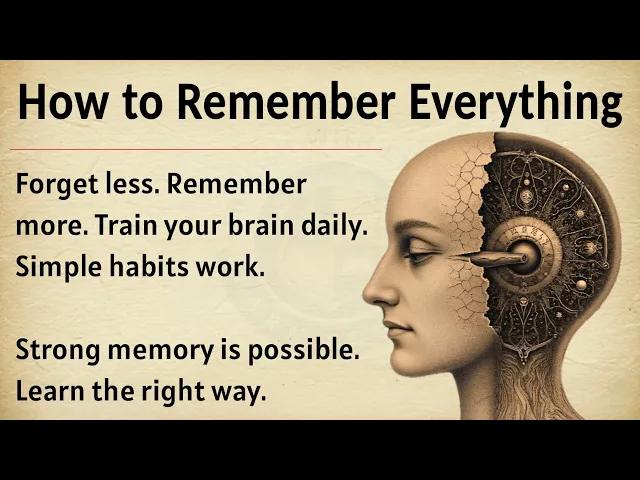
Memory can be trained. Just like muscles, the brain becomes stronger when we use it in the right way. Today we will learn simple and practical methods to remember names, lessons, ideas, and information without stress.
No complicated tricks, no heavy science, only simple habits that really work. If you want to improve your memory, your focus, and your learning power, stay with us because today we will learn how to remember everything. Part one, why we forget things so easily.
Before we learn how to remember everything, we must first understand why we forget. Forgetting is not a weakness. It is a natural brain process.
Our brain is not designed to remember everything. It is designed to remember what feels important. One, our brain deletes useless information.
Every day, our brain receives thousands of pieces of information, words, images, sounds, messages, thoughts. If the brain tried to store everything, it would overload. So the brain asks one question.
Is this important for survival or growth? If the answer is no, the brain deletes it. That is why we forget names quickly.
We forget what we studied yesterday. We forget instructions. It is not laziness.
It is filtering. Two, we forget because we do not pay attention. Memory starts with attention.
If attention is weak, memory will also be weak. Many times our body is present but our mind is somewhere else. We listen but we do not focus.
We read but we think about something else. The brain cannot remember what it never properly received. No attention equals no memory.
Strong memory always begins with deep focus. Three, we forget because we try to memorize not understand. Many people try to memorize words, facts, and lines without understanding them.
This creates weak memory. The brain loves meaning, not repetition. If we understand something, the brain connects it to existing knowledge.
If we only repeat, the brain gets bored and deletes it. Understanding creates connections. Connections create memory.
Four, we forget because of stress and overload. Stress is a big enemy of memory. When we are stressed, the mind becomes noisy.
Focus becomes weak. Memory stops working well. If we study with fear, pressure or tension, the brain goes into survival mode.
In survival mode, learning stops. That is why exams feel blank. Words disappear under pressure.
A calm mind remembers better. Five, we forget because we do not revise properly. The brain forgets naturally over time.
This is normal. But many people study once and never return to the information. Memory needs repetition over time, not repetition in one day.
If we do not revisit information, the brain thinks this is not needed anymore. and it deletes it. Six, we forget because of poor sleep.
Sleep is very important for memory. When we sleep, the brain organizes information. Important memories are saved.
Useless data is removed. If sleep is poor, memory becomes weak. Focus becomes low.
Learning becomes slow. Many people try to learn more by sleeping less. This destroys memory.
Sleep is not waste. Sleep is memory power. Seven, we forget because we do not use what we learn.
The brain remembers what we use. If we learn something but never apply it, the brain deletes it. Use creates importance.
Importance creates memory. That is why we remember daily skills. We forget unused information.
We do not forget because we are weak. We forget because we use the brain wrongly. Memory is not magic.
It is a system. If we understand how the brain works, we can train memory easily. And the good news is this.
Everyone can improve memory. No exception. Part two.
Attention is the foundation of memory. Before memory comes attention. If attention is weak, memory will always be weak.
No technique can help if we are not truly paying attention. So if we want to remember everything, we must first learn how to focus properly. One, memory starts the moment attention starts.
The brain does not remember what it does not notice. If we are reading while scrolling, listening while thinking about something else, studying while feeling bored, the brain never records the information. It is like trying to save a file that was never opened.
Attention is the door. Memory enters only through that door. Two, multitasking destroys memory.
Many people think multitasking is smart. But the brain cannot truly multitask. When we study and check phone, listen and think about replies, read and watch videos, attention breaks into pieces.
Broken attention creates broken memory. Strong memory needs single focus. One task, one moment, one clear mind.
If we focus on one thing, the brain says this is important and it remembers. Three, the brain remembers what feels interesting. The brain loves interest.
If something feels boring, the brain tries to escape. That is why we forget boring lessons but remember movies, stories, and conversations. So, how do we increase attention?
We must create interest. We ask why is this useful for me? How can this help my life?
Where can I use this knowledge? When the brain sees value, attention increases naturally. Four, curiosity makes memory strong.
Curiosity is a powerful memory tool. Instead of saying I must study this, we say let me understand this. Questions create curiosity.
For example, why does this work like this? What happens if it changes? How is this connected to what I know?
Curiosity keeps the brain awake. An awake brain remembers better. Five.
Short focused sessions work better than long tired sessions. Many people try to study for long hours, but tired focus creates weak memory. The brain works best in short focused sessions.
For example, 25 minutes full focus, 5 minutes break. During focus time, no phone, no distraction, full attention. Short focus with full attention is better than long study with tired mind.
Six, physical posture affects attention. The body affects the brain. If we lie down while studying, the brain thinks it is time to rest.
If we sit straight, the brain becomes alert. Simple habits help attention. Sit properly.
Keep eyes on the material. Breathe deeply. These small changes wake up the brain.
Seven. Remove distractions before they remove memory. Distractions are memory killers.
Phone notifications, noise, open tabs, random thoughts. Strong people prepare their environment. They keep phone away, study in quiet place, close unnecessary apps.
When distractions are removed, attention becomes natural. Eight, attention improves with practice. Focus is a skill.
If focus is weak today, it can be trained. Each time we focus deeply, the brain becomes better at it. Just like muscles grow with exercise, attention grows with practice.
Memory does not fail first. Attention fails first. If we train attention, memory improves.
Learning becomes faster. Forgetting reduces. Before using any memory trick, we must master attention.
Attention is the foundation. Memory is the result. Part three.
Understanding creates strong long-term memory. Many people believe memory means repeating again and again. [clears throat] But repetition alone creates weak memory.
The brain does not love repetition. The brain loves understanding. If we understand something deeply, we remember it naturally.
One, memorization fades. Understanding stays. When we only memorize words, lines, facts, the brain stores them for a short time.
After some days they disappear. But when we understand why something happens, how it works, how it connects, the brain creates meaning. Meaning creates strong memory.
That is why we remember stories. We remember real experiences. We remember lessons we truly understood.
Understanding is the key to long-term memory. Two, the brain remembers connections, not isolated facts. The brain works like a network.
It remembers things by connecting them to other things. If information is alone, the brain deletes it. But if information is connected, the brain keeps it.
So when we learn something new, we must ask, "What does this connect to? Where have I seen this before? How is this similar to something I know?
Connections act like glue. They hold memory together. Three, always ask why and how.
Strong memory learners always ask questions. They do not accept information blindly. They ask why does this work?
How does this happen? What is the reason behind this? Questions wake up the brain.
A sleeping brain forgets. An active brain remembers. When we ask questions, the brain becomes involved.
Involvement creates memory. Four, explain it in your own words. One of the best memory techniques is simple.
Explain what you learned in your own words. If we can explain something simply, it means we understand it. If we cannot explain it, we only memorized it.
After learning, we can speak it out loud. Write it in simple language. Teach it to someone else.
Teaching forces understanding. Understanding forces memory. Five.
Use examples from real life. The brain loves real life. Abstract information is hard to remember.
Real examples are easy. When we connect learning to daily life, personal experience, simple stories, the brain becomes interested. For example, instead of learning a rule, we see how it works in life.
Life examples turn information into experience. Experience creates strong memory. Six, break complex information into simple parts.
The brain gets tired when information feels heavy. So strong learners break big topics into small pieces learn step by step. Do not rush.
Simple parts are easier to understand. Easy understanding creates strong memory. One small clear idea is better than 10 confusing ideas.
Seven. Understanding reduces stress and fear. Many people forget because they are afraid of forgetting.
Fear creates stress. Stress blocks memory. Understanding removes fear.
When we understand something, we feel confident. Confidence relaxes the mind. A relaxed mind remembers better.
Eight. Understanding makes revision easier. When we understand, revision becomes fast.
We do not need to memorize again. We only need to refresh. That saves time and reduces mental pressure.
If we want to remember everything, we must stop forcing memory. We must focus on understanding. Understanding creates meaning, connection, confidence, and meaning, connection, and confidence create long-term memory.
Part four, simple memory techniques that really work. Memory is not about talent. It is about technique.
When we use the right techniques, remembering becomes easy. In this part, we will learn simple methods that anyone can use in daily life. One, visualization.
See it to remember it. The brain remembers images better than words. If we only read or hear something, it fades.
But if we see it in the mind, it stays longer. So when we learn something new, we create a picture in our mind. For example, if learning a word, imagine its meaning.
If learning a process, imagine each step. If learning a name, imagine the face. The more colorful and clear the image, the stronger the memory.
The brain loves pictures. Two, association. Connect new information to old information.
The brain remembers better when new information is connected to something familiar. This is called association. For example, connect a new name to someone you know.
Connect a new idea to a story. Connect a lesson to a real event. When we connect, the brain says, "I know this.
I can remember this. " Association makes memory faster. Three.
Story method. Turn information into a story. The brain loves stories.
That is why we remember movies and forget notes. So we turn information into a small story. For example, connect facts into a story.
Create a simple scene in your mind. Add emotion or action. A story gives flow to information.
Flow creates memory. Even boring information becomes memorable when it becomes a story. Four.
Chunking. Break information into small groups. The brain struggles with long lists, but it handles small groups easily.
Chunking means breaking information into parts. For example, phone numbers are grouped. Long topics are divided into sections.
Instead of remembering 20 points, remember four groups of five points. Small chunks are easier to recall. Five.
The Fineman technique. Teach to remember. One of the best memory techniques is teaching.
If we can teach something simply, we understand and remember it. Steps. One, learn a topic.
Two, explain it in simple words. Three, find what you cannot explain. Four, learn that part again.
Teaching shows gaps in understanding. Fixing gaps strengthens memory. Six, use your senses to strengthen memory.
The brain remembers better when multiple senses are involved. For example, read aloud, write by hand, speak the information, visualize it. More senses equals stronger memory.
Passive reading creates weak memory. Active learning creates strong memory. Seven, make memory emotional.
Emotion makes memory powerful. The brain remembers funny things, surprising things, emotional moments. So add emotion to learning.
Make it funny. Make it dramatic. Make it personal.
Emotion tells the brain this is important. Important things are remembered. Eight.
Practice recall not rereading. Most people reread notes again and again. Rereading feels safe but creates weak memory.
Strong memory comes from recall. After learning, close the book. Ask yourself questions.
Try to remember without looking. Recall strengthens memory much more than rereading. Memory improves when learning becomes active.
Visualization, association, stories, teaching, recall. These techniques turn memory into a skill, not a struggle. Part five, revision strategies that make memory permanent.
Learning something once is not enough. The brain forgets naturally. This is normal.
But forgetting does not mean failure. It only means we must revise the right way. If we revise correctly, memory becomes strong and permanent.
One, understand how forgetting works. The brain forgets information over time if it is not used. This is called the forgetting curve.
Right after learning, memory is strong. After some time, memory becomes weak. If we revise at the right moment, memory becomes stronger again.
Each correct revision tells the brain, "This is important. Keep it. " Two, use spaced repetition, not same day repetition.
Many people revise everything on the same day. This feels productive, but it is not effective. Strong memory comes from spaced repetition.
This means revise after one day, then after 3 days, then after 7 days, then after 15 days. Each gap forces the brain to recall information. Recall strengthens memory much more than repetition.
Three, revise actively, not passively. Passive revision, reading notes again, highlighting text, watching the same video. This feels easy but creates weak memory.
Active revision, closing the book, writing what we remember, explaining aloud, answering questions. Active revision challenges the brain. Challenge creates memory.
Four, test yourself regularly. Testing is not only for exams. Testing is a memory tool.
When we test ourselves, the brain searches for information. Connections become stronger. Simple self- tests.
Write key points from memory. Explain without notes. Ask yourself why questions.
Testing feels hard, but it is powerful. Hard learning equals strong memory. Five.
Mix topics during revision. Many people revise one topic fully, then move to the next. This creates short-term memory.
Strong learners mix topics. For example, revise topic A, then topic B, then come back to topic A. This forces the brain to think deeply.
Deep thinking strengthens memory. Six, revise in short focused sessions. Long revision sessions create tired memory.
Short focused sessions create sharp memory. For example, 20 to 30 minutes. Full focus, no distractions.
Quality matters more than quantity. Seven, use writing to lock memory. Writing by hand activates the brain deeply.
When we write, we slow down. We think, we process information. Writing important points locks them into memory.
Even short notes are powerful. Eight. Sleep after revision.
Sleep is memory's best friend. After revision, sleep helps the brain organize information, [clears throat] store important memories. Studying without sleep destroys memory.
Good sleep is part of learning. Nine, use what you learn in daily life. The brain remembers what it uses.
If we apply knowledge in conversation, in teaching, in practice, memory becomes natural. Use creates importance. Importance creates memory.
Memory does not become strong by learning once. It becomes strong by revising correctly. Spaced repetition, active recall, testing, short focus, good sleep.
These habits turn learning into permanent memory. Part six. Daily habits that make your memory strong.
Memory is not built in one day. It is built every day. If we want to remember everything, we must change small daily habits.
These habits look simple, but they are very powerful. One, start the day with a clear mind. Memory works best when the mind is calm.
If the day starts with stress, memory becomes weak. Strong memory learners wake up calmly. Avoid phone immediately.
Take a few deep breaths. A calm start creates a focused brain. Two, protect your focus during learning.
Learning with distractions destroys memory. So when we learn, we keep phone away. We close extra tabs.
We sit properly. Even 20 minutes of deep focus is enough. Focus tells the brain this matters and the brain remembers what matters.
Three, use active recall every day. Do not wait for exams to test memory. Every day we recall what we learned.
For example, write main points from memory. Explain aloud without notes. Ask yourself questions.
Recall strengthens memory pathways. The more we recall, the easier remembering becomes. Four, review yesterday's learning briefly.
Before learning something new, we revise old information. Just 5 to 10 minutes. This reminds the brain.
This is still important. Small daily revision prevents forgetting. Five.
Teach what you learn. Teaching is powerful. Even if no one is listening, we can teach.
The wall, a notebook, our own voice. When we teach, we organize information. Organized knowledge is remembered easily.
Six. Move your body to improve memory. The brain loves movement.
Light exercise, walking, stretching, simple activity improves blood flow to the brain. Better blood flow means better memory. We do not need heavy exercise.
Simple movement is enough. Seven, sleep well to lock memory. Sleep is not optional.
During sleep, the brain stores memories. The brain removes noise. Without sleep, learning disappears.
Strong memory needs regular sleep time. Enough rest. Sleep is memory power.
Eight. Reduce stress and overthinking. Stress blocks memory.
We must protect our mind. Simple habits. Deep breathing.
Silence for a few minutes. Reducing negative input. A relaxed brain remembers better.
Nine. Use what you learn daily. The brain remembers what it uses.
We try to speak new words, apply new ideas, practice skills, use creates importance. Importance creates memory. 10.
Be patient and consistent. Memory improvement is slow but sure. Some days we'll feel strong, some days will feel weak.
We do not stop. Consistency beats talent. Memory is not a gift.
It is a trainable skill. If we train attention, understand deeply, revise correctly and build daily habits, remembering becomes natural. You do not forget because you are weak.
You forget because you were never taught how to remember. Now you know. Use these habits daily and your memory will change your life.
Before we end this lesson, remember one important truth. You do not have a weak memory. You were just never taught how to use your brain correctly.
Memory is not magic. It is a skill. When you focus deeply, understand clearly, revise smartly, and practice daily, your memory improves naturally.
Do not rush, do not feel pressure. Small daily habits create strong memory over time. Believe in your brain.
Train it patiently. If this lesson helped you, like the video so more people can learn this skill. Share it with someone who struggles to remember and subscribe to the channel for more graded reader and learning lessons.
Remember this, when you learn the right way, forgetting becomes rare. Keep learning, keep practicing, and trust your brain.