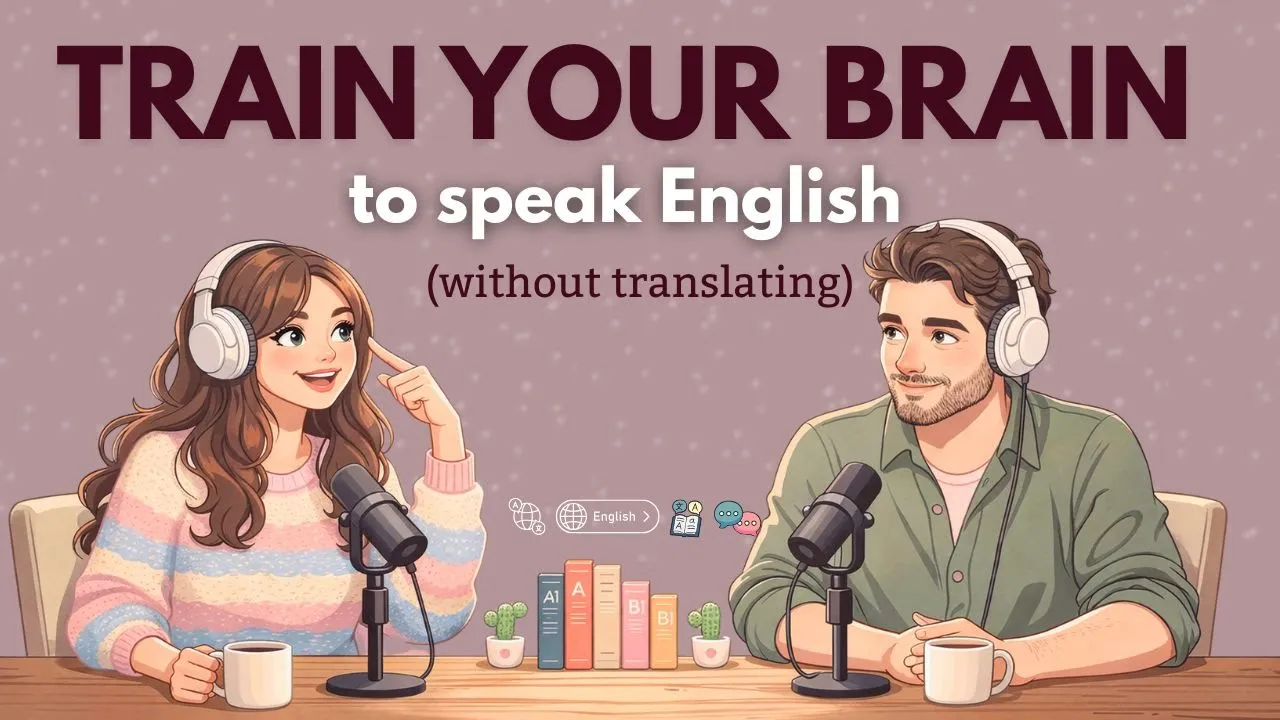
Hello everyone. Welcome back to English Conversation Podcast, the show that helps you improve your English in a natural and enjoyable way. I'm Sarah.
>> And I'm Mike. Hi Sarah. Hi everyone listening.
>> Hey Mike. How's your day going? >> It's been really productive actually.
I spent the morning reviewing some interesting language learning research, which is perfect timing because of today's topic. >> Oh, that's great. Yes.
Today we're diving into something that I think many of our listeners struggle with. >> Let me guess, thinking in English. >> Exactly.
Today's episode is all about how to train your brain to speak in English naturally without constantly translating in your head. >> This is such an important topic. I remember when I was learning my second language, I used to translate everything word by word in my mind.
It was exhausting, >> right? It's mentally draining and it really slows down your conversation. But here's the good news for everyone listening.
>> It doesn't have to be that way. >> Exactly. There are practical strategies you can use to retrain your brain.
>> Before we jump in though, we should mention something to our listeners. >> Yes. If you're enjoying this podcast and finding it helpful, please take a moment to like this episode and subscribe to our channel.
Subscribing really helps us reach more English learners like you and it means we can create more content to support your learning journey. >> Also, if you know someone who's learning English, share this episode with them. Learning is always better when you can discuss it with friends.
>> Absolutely. Okay, Sarah, I'm ready. Let's talk about training our brains.
>> Perfect. So, Mike, let me ask you this. When you were translating everything in your head, what was the biggest problem you noticed?
Hm. The biggest problem, I'd say it was the delay. Someone would ask me a question and there would be this awkward pause while I was processing.
>> Right. Because your brain was doing double work. >> Exactly.
First, I had to understand the English, then translate it to my native language, then think of my response in my native language, and then translate it back to English. >> That's four steps when it should just be two. Understand and respond.
It's no wonder conversations felt so challenging. >> And you know what's interesting? Many intermediate learners, even at B1 level, still do this sometimes without realizing it.
>> Really? Even when they already know a lot of English. >> Yes.
Because it's a habit. Their brain has been trained to use that translation pathway. So it automatically goes there, especially when they're nervous or tired.
>> So we need to create a new pathway in the brain. >> Exactly. We need to build what neuroscientists call neural pathways directly in English.
>> Neural pathways. That sounds very scientific. >> It does, but the concept is actually simple.
Think of it like this. Imagine your brain is a forest and you need to get from point A to point B. >> Okay, I'm imagining it.
>> At first, there's no clear path, so you have to push through the bushes and branches. It's slow and difficult. That's like when you're first learning English and everything feels hard, >> right?
But if you walk the same route every day, eventually you create a clear path through the forest. >> The grass gets worn down, the path becomes obvious, and soon you can walk it easily without thinking. >> Exactly.
That's what happens in your brain with language. The more you think directly in English, the stronger that pathway becomes >> until eventually it becomes automatic. >> Precisely.
So today we're going to give you practical strategies to build those English pathways in your brain. >> I'm excited about this. Where should we start?
>> Let's start with what I call mental substitution. >> Mental substitution. Tell me more.
>> Well, most people at B1 level already know a lot of English words and structures. The problem isn't knowledge. It's activation.
>> Activation. >> Yes. The words are stored in your brain, but they're not active.
They're like books on a shelf that you never take down and read. >> Ah, so we need to take those books off the shelf more often. >> Exactly.
And here's how you do it. Throughout your day, whenever you think something in your native language, pause for a moment and ask yourself, how would I say this in English? >> So, basically catching my thoughts and translating them.
>> Not exactly translating, more like expressing them. Let me give you an example. This morning I was making coffee and I thought to myself in my native language, I need more sugar.
>> A simple thought, >> very simple. But then I stopped and said in my mind, I need more sugar. But then I pushed myself further.
How else could I express this? >> Oh, I see what you mean. You could say, this coffee isn't sweet enough.
>> Or, I'd like to add some more sugar, or this needs to be sweeter. >> So, you're not just translating one sentence. You're exploring different ways to express the same idea.
>> Exactly. And this is crucial because it gets your brain thinking flexibly in English >> rather than thinking there's only one correct translation. >> Right.
Language isn't about finding the perfect word for word translation. It's about expressing meaning. >> This is really helpful.
So throughout the day, I should be catching my thoughts and rephrasing them in English. >> Yes. But here's the important part.
Don't just do it once. Try to come up with two or three different ways to say the same thing. >> That makes the neural pathways even stronger.
>> Exactly. And it also prepares you for real conversations because in real life, you often need to rephrase something if the other person doesn't understand. >> That's a great point.
I've definitely been in situations where I said something and the person looked confused and I had no idea how to say it differently >> because you only had one pathway to that idea. But if you practice creating multiple pathways, >> then I have options. I can rephrase easily.
>> Exactly. Let me give everyone listening a practical exercise for this week. >> Yes.
Homework time. >> Okay. Choose three daily activities.
Maybe making breakfast, commuting to work, and getting ready for bed. >> Okay. Three routine activities.
During each of these activities, narrate what you're doing in your head in English, but challenge yourself to say each action in at least two different ways. >> Can you give us an example? >> Sure.
Let's say you're brushing your teeth. You could think I'm brushing my teeth and then also I'm cleaning my teeth or I'm using my toothbrush. >> So, even simple actions get this double or triple expression.
>> Yes. And after a week of this, you'll notice that English starts to flow more naturally because your brain has more routes to access the language. >> I love this.
Okay, so that's our first major strategy. Mental substitution with multiple expressions, >> right? Now, let's talk about something that I think is often overlooked.
The power of inner monologue. >> Inner monologue? You mean like talking to yourself?
>> Exactly. And I know some people feel weird about this, but it's actually one of the most powerful tools for language learning. >> I have to admit, I do this sometimes when I'm walking alone.
Sometimes I have entire conversations in my head. >> And do you do it in English or your native language? >> Uh, usually my native language, but I guess I should be doing it in English.
>> Well, here's the thing. You don't have to do it all in English right away. That can be overwhelming.
>> So, what do you suggest? Start by having a bilingual inner monologue. Think of a sentence in your native language, then repeat it in English.
>> So, I'm still translating >> at first. Yes. But here's the key.
You're doing it in a low pressure environment. There's no one waiting for your answer, no one judging your grammar. >> So, it's a safe space to practice.
>> Exactly. And over time, you'll notice something interesting happening. >> What's that?
The English will start coming first. Sometimes you'll think of something directly in English without needing to translate it first. >> Really?
That just happens naturally. >> It does, but only if you practice. The brain is very efficient.
It learns to take shortcuts. >> So, if I keep using this English pathway, my brain will eventually realize, hey, this is faster than translating. >> Precisely.
your brain will start to prefer the direct English route because it's more efficient. >> That's fascinating. So, the inner monologue is like a training ground.
>> Yes. And here's another tip. Make it interesting.
Don't just narrate boring things. >> What do you mean? >> Well, a lot of people will practice by thinking, "I'm sitting.
I'm standing. I'm walking. " >> Which is useful but also pretty boring, >> right?
Instead, have actual thoughts, opinions, feelings, reactions. >> Can you give me an example? >> Sure.
Let's say you see someone wearing a really interesting jacket. Instead of just thinking, "That's a nice jacket. " Engage with it more.
>> How? >> Think something like, "Wow, that jacket is really stylish. I wonder where they bought it.
I'd love to have something like that, but in a darker color. Maybe I should look for something similar online. " >> Oh, I see.
You're having a real internal conversation, not just labeling things. >> Exactly. You're using complex sentences, hypothetical situations, expressing preferences.
This is much more valuable for your brain >> because this is how we actually use language in real life. >> Exactly. We don't just label things.
We have opinions, make plans, wonder about things. >> So, the inner monologue should reflect real thinking, not just vocabulary practice. Yes.
And here's something else that's really powerful. Use your emotions. >> My emotions?
>> Yes. When you feel frustrated, try to express that frustration in English in your head. This is so annoying.
Or, I can't believe this is happening. >> Oh, emotional language, >> right? When you feel happy about something, think this is wonderful.
Or, I'm so glad this worked out. >> I see what you're doing. You're connecting emotions with English expressions.
>> Exactly. And this creates very strong neural connections because emotions are processed in a deep part of the brain. >> So when language is connected to emotion, it sticks better.
>> Much better. This is why people often remember swear words very easily in a foreign language. >> That's true.
Even beginners seem to pick those up quickly >> because they're often said with strong emotion. But you can use this principle with positive emotions too. >> So express my joy, my frustration, my surprise, all in English in my inner monologue.
>> Yes. And over time, English becomes the language of your emotions, not just your intellect. >> That's really powerful.
Okay, so we've talked about mental substitution and inner monologue. What's next? >> Next, let's talk about something that many B1 learners overlook.
The importance of input quality. >> Input quality. You mean like listening and reading?
>> Yes. But not just any listening and reading. You need the right kind of input at the right level.
>> I think this is where a lot of people make mistakes. Right. >> Absolutely.
Many intermediate learners make one of two errors. >> What's the first error? >> They consume content that's too easy.
They stick with beginner level materials because they're comfortable. But they're not being challenged, >> right? Their brain isn't growing because it's not being pushed.
>> And what's the second error? >> The opposite. They jump to very advanced content like watching news programs or reading academic articles.
>> And they get overwhelmed and discouraged. >> Exactly. So, the key is finding what's called comprehensible input.
>> Comprehensible input. I've heard this term before. What does it mean exactly?
>> It means content that's slightly above your current level. You understand most of it, maybe 70 to 80%, but there are some new words and structures that challenge you. >> So, you're comfortable, but also learning.
>> Exactly. This is the sweet spot for brain training. >> How do people find content at the right level?
>> Great question. For B1 learners, I recommend a few strategies. >> I'm ready to take notes.
>> First, look for content that's designed for language learners at your level. There are podcasts, YouTube channels, and graded readers specifically made for intermediate learners. >> Like our podcast.
>> Exactly like our podcast. We design our content to be accessible but also challenging for B1 learners. >> What's the second strategy?
>> The second strategy is to use authentic content but with support. >> What do you mean by support? >> For example, watching a TV show or movie with English subtitles.
The audio is authentic, native level English, but you have the subtitles to help you follow along. >> Oh, that's clever. You're training your ear while having a safety net.
>> Exactly. And here's a pro tip. If you're watching with subtitles, try to read ahead slightly.
>> Read ahead. >> Yes. Glance at the next line of dialogue before it's spoken.
This way, your brain knows what to listen for. >> Oh, so you're priming your brain for the sounds you're about to hear. >> Exactly.
This is really effective for improving listening comprehension. >> What about reading? How should people approach reading at B1 level?
>> For reading, I recommend what I call the 70% rule. >> The 70% rule. >> If you're reading something and you don't understand more than 30% of the words, it's too difficult.
Put it aside and find something easier. >> So, you should understand at least 70% naturally. >> Right?
At that level, you can guess the meaning of new words from context, which is how native speakers naturally expand their vocabulary. >> That makes sense. If you're stopping every sentence to look up words, you're not really reading.
>> Exactly. You're just doing a translation exercise, which doesn't help your fluency. >> So, what kind of reading do you recommend?
>> For B1 level, I really like graded readers. These are novels or stories that have been adapted to use vocabulary and grammar at your level. Don't those feel a bit simplified though?
>> Some do, but there are really good ones that tell engaging stories. The important thing is that you can read them smoothly without constantly stopping >> because fluency is what we're after. >> Exactly.
You want your brain to experience the flow of English, not the stop and start of looking up every other word. >> What about more authentic reading like news articles or blogs? Those can be great, too.
Especially if you choose topics you're interested in. >> Why does interest matter? >> Because when you're interested in the content, your brain is more motivated to understand it.
You push through difficulties more easily. >> So, I should read about my hobbies and interests in English. >> Absolutely.
If you love cooking, read cooking blogs. If you're into technology, read tech articles. If you follow sports, read sports news.
Your brain will work harder to understand because it wants to know the information. >> Exactly. Motivation is key.
Okay, let's talk about one more crucial aspect of input. >> What's that? >> Repetition and review.
>> Oh, reading or listening to the same thing multiple times. >> Yes, but not in the way most people think. >> What do you mean?
>> Many people think repetition means reading the same article five times in a row until they understand every word. And that's not effective. >> It can be, but it's boring.
Instead, I recommend what I call spaced reexposure. >> Spaced reexposure. >> Yes.
Listen to a podcast episode today, then listen to it again 3 days later, then maybe once more a week after that. >> Why space it out like that? >> Because each time you return to it, your brain is in a slightly different state.
You've learned more. You've practiced more. So you understand it at a deeper level.
>> Oh, that's interesting. So the first time you might catch 70%, but the second time >> you might catch 85% and by the third time you're understanding nearly everything and it feels effortless >> and that feeling of improvement is really motivating. >> Exactly.
Plus you're reinforcing those neural pathways each time. >> The English patterns are getting stronger in your brain. >> Yes.
Okay, let's move on to what might be the most important part. Output. >> Output.
That's speaking and writing. Right. >> Right.
This is where you actively use the English that's being built in your brain. >> I think this is what scares people the most. >> You're absolutely right.
Many learners spend years consuming English, reading, listening, studying, but they're terrified to actually speak. >> Why is that? >> Fear of making mistakes mostly.
Fear of sounding stupid. Fear of not being understood. >> Those are legitimate fears.
>> They are. But here's the truth. You cannot train your brain to speak without actually speaking.
>> It's like learning to swim. You can't learn by just watching videos of people swimming. >> Exactly.
At some point, you have to get in the water. >> So, how should people start? Not everyone has English-speaking friends to practice with.
>> That's true. And that's okay. You can start by speaking to yourself.
We mentioned this earlier with inner monologue, but you mean actually speaking out loud? >> Yes, but let's go deeper. There are different ways to practice speaking alone, and some are more effective than others.
>> Tell me about the most effective methods. >> One of my favorites is what I call shadowing. >> Shadowing?
>> Yes. You listen to a native speaker, maybe a podcast or a video, and you repeat what they say, trying to match their rhythm, intonation, and pronunciation. So, you're mimicking them in real time.
>> Exactly. There are different levels of shadowing. At the basic level, you pause after each sentence and repeat it.
>> That seems manageable. >> At a more advanced level, you try to speak along with them in real time, like an echo. >> That sounds challenging.
>> It is, but it's incredibly effective because you're training your mouth muscles, your rhythm, and your fluency all at once, >> and you're using authentic native speech as your model. Exactly. Your brain starts to internalize the natural rhythm and flow of English.
>> What other solo practice techniques do you recommend? >> Another powerful one is recording yourself. >> Oh, I don't like the sound of my own voice.
>> Most people don't, but this is really valuable. Here's why. When you speak without recording, you don't really know what you sound like.
>> True. I might think I'm being clear, but I'm not sure. >> Right.
But when you record yourself and play it back, you can hear your mistakes. You become your own teacher. >> Exactly.
You might notice that you're speaking too fast or that you're dropping the endings of words or that your intonation sounds flat. >> And then you can work on fixing those things. >> Yes.
Here's a specific exercise. Choose a topic. Speak about it for 2 minutes while recording.
Then listen back and note three things you want to improve. >> Just three things. >> Yes.
If you try to fix everything at once, you'll get overwhelmed. Pick three specific things. Then record yourself again.
>> Yes. Speak about the same topic again, focusing on improving those three things. >> And you can compare the two recordings.
>> Exactly. You'll be amazed at how much you can improve in just one session. >> That's encouraging.
What about practicing with other people? >> That's the ultimate goal, of course, but I know not everyone has easy access to conversation partners, >> right? What if you live in a place where English isn't commonly spoken?
These days, there are lots of online options, language exchange apps, online tutoring platforms, conversation clubs. >> And what should people focus on during these conversations? >> Here's something important that many people get wrong.
They think the goal is to speak perfectly. >> And that's not the goal. >> No, the goal is to communicate effectively.
Mistakes are actually good. >> How can mistakes be good? >> Because mistakes show you where your knowledge gaps are.
Each mistake is an opportunity to learn something. >> So, we shouldn't be afraid of making mistakes. >> Not at all.
In fact, I'd argue that if you're not making mistakes, you're not pushing yourself enough. >> You're staying in your comfort zone. >> Exactly.
The goal is to push just beyond your comfort zone. >> Like with input, finding that sweet spot. >> Yes.
You want to be slightly uncomfortable, but not so uncomfortable that you freeze up. >> How do you find that balance? >> It takes practice and self-awareness.
You need to notice when you're feeling challenged in a good way versus feeling overwhelmed >> and adjust accordingly. >> Right? If you're in a conversation and you realize you're completely lost, it's okay to say, "I'm sorry.
Could you speak a bit slower? " Or, "I'm not familiar with that topic. Could we talk about something else?
" >> Taking control of the conversation. >> Exactly. This is a skill in itself.
Now, let me share one more powerful output technique. >> I'm listening. It's called self-t talk narrative.
>> Self-talk narrative. >> Yes. Throughout your day, narrate what you're doing, thinking, or feeling in English, but do it out loud.
>> So, like a documentary of my own life. >> Exactly. Now, I'm making lunch.
I'm going to have a sandwich. Let me see. What do I have in the fridge?
Oh, there's some cheese and tomatoes. That sounds good. I think I'll toast the bread.
>> This feels a bit silly. I have to admit >> it might feel silly at first, but it's incredibly effective. Do you know why?
>> Why? >> Because you're practicing real time English production. You're not thinking about what to say.
You're just saying what you're experiencing. >> So, it's very spontaneous. >> Yes.
And that's exactly what you need to do in real conversations. You need to be able to speak spontaneously without overthinking. >> So, this builds that spontaneous speaking muscle.
>> Exactly. And here's a tip. Do this when you're alone at home.
In the shower, while cooking, while cleaning, >> times when I'm doing something automatic with my hands. >> Yes, because then your brain is free to focus on the language. >> This is really practical advice, Sarah.
I feel like we've covered so much ground. >> We have. Let's take a moment to review the main strategies we've discussed.
We talked about mental substitution, >> right? Catching our thoughts and expressing them in multiple ways in English. We discussed inner monologue and the importance of connecting language with emotions.
>> Then we talked about input quality, finding content at the right level, the 70% rule, and spaced repetition. >> And finally, we covered output techniques, shadowing, recording yourself, and self-t talk narrative. >> But you know what I'm wondering, Sarah?
>> What's that? >> How long does it take? When will someone see results from all this?
>> That's the question everyone wants answered, isn't it? It is. People want to know, "If I do this every day, when will I be fluent?
" >> Here's the honest answer. It depends >> on what? >> On several factors.
How much time you practice each day, your current level, your native language, your learning environment. >> So, there's no magic number. >> No magic number, but I can give you some general expectations.
>> Please do. I think people need realistic expectations. If you're practicing these techniques for 15 to 30 minutes every day consistently, you'll start to notice small changes within two to three weeks.
>> What kind of changes? >> You might notice that some English words or phrases start popping into your head more naturally. You might find yourself thinking briefly in English without trying.
>> Small wins. >> Yes, small wins. After about 2 months, these moments become more frequent.
You might have entire thoughts in English without translating. >> And after 6 months, >> after 6 months of consistent practice, most people report that English starts to feel more natural. They're not constantly aware that they're speaking a foreign language.
>> It becomes more automatic. >> Exactly. But here's the important thing to remember.
Everyone's journey is different. >> Some people might progress faster, some slower, >> right? And that's okay.
The key is consistency, not speed. >> Better to practice a little bit every day than to cram once a week. >> Exactly.
Your brain needs regular exposure and practice to build those neural pathways. >> It's like going to the gym. You can't work out once a week and expect to get strong.
>> Perfect analogy. Language learning is a marathon, not a sprint. >> Speaking of challenges, what about mental blocks?
You know those moments when you just freeze up and can't think of anything to say? >> Oh, this is so common, especially for intermediate learners. >> Why does it happen?
>> Usually, it's anxiety. Your brain goes into stress mode. And when you're stressed, it's harder to access your language knowledge.
>> So, what can people do when this happens? >> First, recognize that it's normal and temporary. Everyone experiences this, even advanced speakers.
>> Okay? So, don't panic. >> Right.
Second, have some filler phrases ready. >> Filler phrases. >> Yes.
Phrases like, "Let me think about that for a moment. " Or, "That's an interesting question. " Or, "Hm, how should I put this?
" >> Oh, so you're buying yourself time to think. >> Exactly. And you're doing it in English, which keeps the conversation flowing.
>> Native speakers do this all the time, don't they? >> All the time. It's completely natural.
These phrases are like bridges that help you get from the question to your answer. >> What else can help with mental blocks? >> Another technique is to simplify what you're trying to say.
>> Simplify. >> Yes. Often we freeze because we're trying to express something complex and we can't find the right words.
>> So instead of giving up, >> you break it down into simpler ideas that you can express. >> Can you give me an example? >> Sure.
Let's say you want to say, "I'm considering whether to pursue a master's degree in engineering or to start working immediately after graduation. " >> That's a complex thought. >> Very complex.
If you can't express that exactly, you could simplify it to, "I'm thinking about my future. Should I study more or should I get a job? I'm not sure yet.
" >> Oh, that's much simpler, but still communicates the main idea. >> Exactly. You've communicated the essential meaning, and that's what matters.
And once you've said the simple version, you might find it easier to add more details. >> Yes. Often just getting started helps your brain relax and access more language.
>> It's like priming the pump. >> Exactly. Okay, we're getting close to the end of our time today, but I want to leave our listeners with one final important point.
>> What's that? >> The importance of patience and self-compassion. >> Ah, this is so important.
>> It really is. Many language learners are incredibly hard on themselves. >> They beat themselves up over every mistake.
>> Yes, they compare themselves to native speakers or to other learners who seem to be progressing faster. >> And that's discouraging. >> It's very discouraging.
So, here's what I want everyone listening to remember. Learning a language is one of the most complex things your brain will ever do. >> It involves memory, pattern recognition, muscle coordination, cultural understanding.
Exactly. It's enormous. So, be kind to yourself.
>> Celebrate the small victories. >> Yes. Did you understand a movie scene today that you wouldn't have understood last month?
That's progress. >> Did you have a conversation in English? Even if you made mistakes, that's progress.
>> Exactly. Every time you try, you're training your brain. Every mistake is a learning opportunity.
>> I think people need to hear this. Language learning can be frustrating, and it's easy to feel like you're not improving. Especially during what we call plateaus.
>> Plateaus. >> Yes. Those periods where you feel like you're not making progress.
You're practicing, but your English doesn't seem to be getting better. >> I've experienced this. It's so frustrating.
>> It is. But here's the thing. Your brain is still working during these plateaus.
You're consolidating knowledge, making connections. >> So, you are improving even if you can't see it. >> Exactly.
And then suddenly you'll have a breakthrough moment where everything clicks >> and you realize you've actually improved a lot. >> Yes. So during those plateau periods, don't give up.
Keep practicing. >> Trust the process. >> Trust the process.
Your brain is amazing and it's working even when you don't feel like you're making progress. >> This has been such a valuable conversation, Sarah. Let's recap the main points one more time for everyone listening.
>> Great idea. So we discussed mental substitution, expressing thoughts in multiple ways. >> Inner monologue, connecting language with emotions, >> input quality, finding content at the right level, the 70% rule, >> output techniques, shadowing, recording yourself, self-t talk, narrative, >> dealing with mental blocks, using filler phrases, and simplifying your message.
>> And finally, patience and self-compassion. Yes. Remember everyone, training your brain to speak English is a journey.
Enjoy the process. >> Before we wrap up, we want to ask our listeners to do something. >> Yes.
If you found this episode helpful, please subscribe to our channel. >> Subscribing helps us create more content like this for you >> and share this episode with anyone who's learning English. Learning is better when we support each other.
>> Also, we'd love to hear from you. Leave a comment below and tell us what's your biggest challenge when speaking English. >> Yes, we read all the comments and your questions help us create future episodes.
>> Thank you so much for listening everyone. >> Keep practicing, be patient with yourself and remember you're doing great. >> See you in the next episode.
>> Bye everyone.