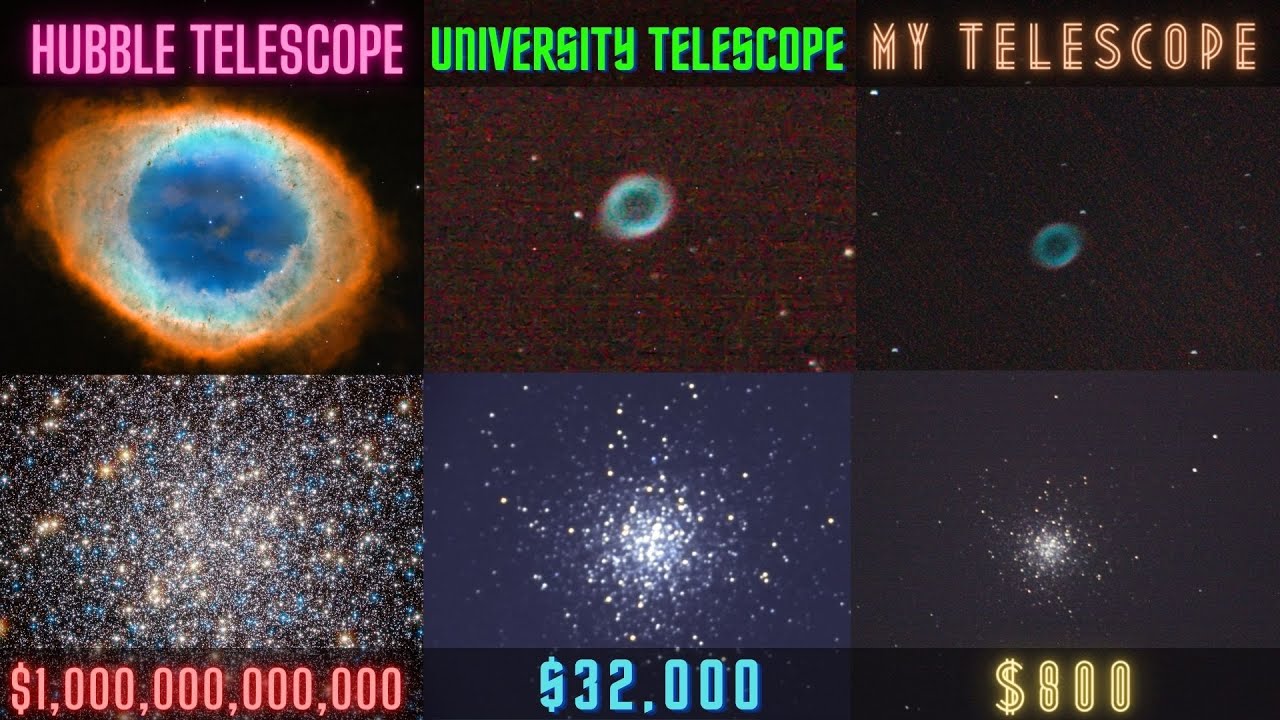
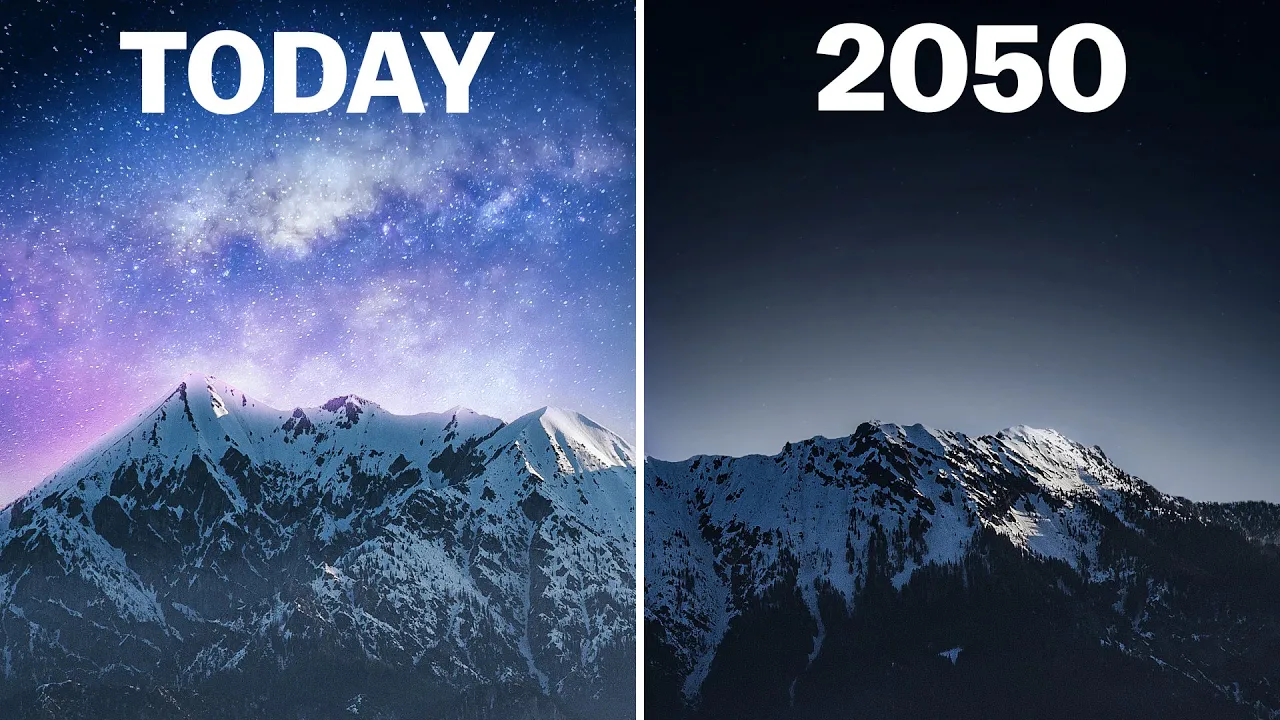
You have never seen a truly dark sky before. The sky that looks like this today looked like this 18 years ago, and by the year 2050, it will look like this. The culprit?
Light pollution. Every single year, Earth's skies are getting 10 % brighter, and this will only continue to get worse. This is obviously bad for astronomers, but it goes even deeper than that.
Light pollution has been linked to things like cancer, obesity, and even the deaths of millions of migrating animals. In the year 1994, an earthquake shook Los Angeles to its core at 4. 30am, in the process knocking the city's energy grid completely offline.
Residents who were awoken by the commotion stumbled outside, slightly drowsy, and looked up. They saw our universe, brightly twinkling stars, clustered galaxies, planets like Saturn and Jupiter, and most strikingly, the arm of the Milky Way. And what's strange is, they got scared.
The Griffith Observatory and 9-11 received countless calls from residents unable to comprehend what they were seeing. Was it aliens? A huge cloud?
What's going on? This is the sad reality of what we are facing as a result of light-polluted skies, and keep in mind, this was 30 years ago. Things have gotten far worse.
The light pollution that we have at night, it's one of the greatest tragedies about modern civilization is that we've blacked out one of the most spectacular things you could ever see. The thing that really centres us and humbles us. Before the Earth was illuminated with bright LED lights, we had fire.
Until the late 19th century, fire was very much synonymous with light. And then something marvellous happened. Public electric lighting in the form of incandescent light bulbs spread like wildfire across the world, illuminating our cities.
And so over the last 100-ish years, the Earth has come alive. Advancements in LED lighting has caused this rapid growth in public lighting to increase faster than ever before. And here's where the story takes a sad turn.
As of right now, nearly 85 % of the world's population live under light-polluted skies, and if you're in the US or Europe, that value is essentially 100%. At a global scale, light pollution is increasing at a rate of 10 % every single year, and this figure is projected to only keep increasing. More than one third of all humans on Earth have simply never seen the Milky Way.
And I am sorry to say, but if you're from one of the major population centres like London, New York, Singapore, I'm probably talking about you. you. If nothing is done about it, in around 100 years, life will look essentially unrecognisable.
Imagine a world where virtually all parts of the globe are impacted by light pollution. The Milky Way is no longer visible to stargazers, a forgotten mystery of the past. Virtually all constellations will be too dim to see.
Species of animals go extinct due to the impact of light pollution on their migration. A huge proportion of the population now struggles with sleep disorders, mental health problems and chronic conditions caused by their circadian rhythms being ruined. Before we continue with the story of light pollution, I just want to take a moment to thank the very fitting sponsor of today's video, BetterHelp.
BetterHelp is a platform for therapy, and if you're suffering from mental health issues Whether caused by light pollution or not, I truly believe that BetterHelp could genuinely help you. BetterHelp's mission is to ultimately make therapy more accessible and affordable. It can be really hard to find a therapist and find time to have regular sessions with how busy life can be, and that's where BetterHelp comes in.
BetterHelp is an online therapy platform that makes finding a therapist that fits you easier than ever before. You can chat with them on phone calls, video calls, or even just text them like a friend. Therapy has been shown time and time again to provide effective and valuable support for those of us in need.
So if you've been considering giving therapy a go, let this be your opportunity. It is so easy to sign up and be matched with a therapist. Use the link in the top of my description, betterhelp.
com forward slash astrocoby. You'll get 10 % off your first month, and I promise you won't regret it. Thank you again to BetterHelp for supporting the channel.
Astronomers use something called the Bortle Scale to measure the quality of a night sky at any given location. It is split up into nine distinct levels. Bortle Scale 1 skies are perfectly dark.
You should be able to spot around 5,000 stars in these locations. As you go up the urban area, your sky is likely Bortle scale 5 or worse. I currently live in the third biggest city in Australia, Brisbane, and here our night skies are a scale 8 to 9, as bad as it can get.
I can spot maybe 10 stars from my balcony and the sky is constantly as bright as twilight here. So to help me get a better understanding of what I'm missing out on, what better way than to go to the largest international dark sky reserve in the Southern Hemisphere. The Aoraki-Mackenzie Dark Sky Reserve spreads across nearly 4,400 square kilometres of Aotearoa, New Zealand's pristine South Island.
The reserve includes Lake Tekapo, where they are using some interesting techniques to protect their night skies. So to try and answer the question of how bad light pollution is really getting, I decided to visit the darkest skies on planet Earth. I am right now in the middle of the Aoraki Mackenzie International Dark Sky Reserve in New Zealand.
The skies here are like nothing I have ever seen. I grew up in rural Australia, and even I have never seen a sky like this. They are so dark in fact that people travel from all over the world just to get a glimpse of the dark skies here in New Zealand.
And I mean, it makes sense. 83 % of the entire human population live under light-polluted skies, many of which have simply never ventured out of a city to see what's actually above their head. So to figure out what makes this dark sky reserve so special and how the people of New Zealand have managed to keep their skies dark, I decided to visit the team at the Mount John Observatory here in Tekapo to get some answers.
Yeah, so my name's Daniel, I'm a senior astronomy guide here for the Dark Sky Project. So my name is Tu, I work at the Dark Sky Project. I am the team leader for our Dark Sky Experience.
So the Aoraki Mackenzie Dark Sky Reserve is the largest gold standard dark sky reserve in the Southern Hemisphere, and it is quite a special place in terms of going back in time. That's why I like to think about things, you know, thinking about how our ancestors saw the night sky and the land around them. And even though, you know, some of the land has changed, you know, the sky hasn't.
And basically what that means is that we control the light pollution. So we try as much as possible to reduce the amount of light pollution that we produce from the towns. so using lower sort of brightness lights like orange red sorts of sodium bulb type things and also pointing the light downwards to where it needs to be and this keeps the sky above us much darker and a dark sky is a good sky essentially.
Here in the Araki Mackenzie Dark Sky Reserve they have these cute little street lamps that help to prevent light pollution. They do it by being close to the ground and they have these cute little hats that help to point the light towards the ground instead of up into the sky. I'm sure you already understand that light pollution is obviously bad for astronomers.
We use these huge ground-based observatories to look out into the cosmos and learn about the universe. And you need to understand that these observatories are really important to astronomy. It is easy to think that the space-based telescopes like JWST and Hubble do all the big problem solving, but that's just not the case.
Edwin Hubble proved that the universe was expanding using the Mount Wilson Observatory by looking at far away galaxies and measuring how quickly they are moving away from us. Vera Rubin and Kent Ford found evidence for dark matter at the Lowell Observatory. Exoplanets were discovered here, black holes were discovered here, and the cosmic microwave background, well that was of course discovered here.
You get the point. Now imagine if the skies around these observatories were so light polluted that we simply couldn't make the observations required. That is a really sad thought, and one day that might become the God, I can't believe there's so many stars.
If you've never seen that before, it's really quite breathtaking. And the Milky Way overhead as well, just to actually observe that is a really powerful thing. I don't know, I think there's something in our nature.
There's something in our DNA. I can't really describe it, but reminding us who we are. Where are we?
What are we doing here? we're on a planet orbiting a star lost in space and I think when you look up you you realize that connection and again that's a good perspective to have. For thousands of years our body has evolved to understand the daily cycle night and day and then night again but now light pollution is seriously disrupting our circadian rhythms.
At nighttime your body produces the sleep hormone melatonin, and those of us who live in the cities have lower levels of melatonin production. This leads to sleep deprivation, fatigue, and other serious health problems. And perhaps scariest of all, recent studies have found a connection between this reduced melatonin level and various cancers.
And it's not just humans that are being affected. Animals all over the world are having their life cycles disrupted by light pollution for For the first time in hundreds of thousands of years, freshly hatched baby sea turtles will sometimes dig their way out of their nests at night. They instinctually should crawl towards the brightest direction.
Historically, this has of course been the open ocean, but light pollution and streetlamps can now cause them to head away from the ocean, further inland, where they risk being hit by cars, found by predators, or simply dying of dehydration. The shearwater is a seabird that leaves its nest in the darkness of night and uses the moon and stars to navigate their way across the seas. Young shearwaters become confused by the glow of city lights and tend to find themselves disorientated.
This causes them to circle the city lights, leading to exhaustion and starvation. The African dung beetles use the beautiful arm of the Milky Way to help guide their movements. Using the stars, they can orient themselves correctly in order to roll their dung balls in the perfect straight lines.
But now, light pollution makes it so they can't even see the Milky Way anymore. This disorients them and ultimately results in it being easier for predators to find them. For me, the reason this problem is so important is really because of the impact light pollution will have on our future generations.
I remember sitting outside when I was maybe 10 years old and looking out to the stars wondering what might be out there. What do these stars actually look like up close? How long have they been around?
Do they have planets around them? What do these planets actually look like? Do these planets actually have life?
That initial spark is ultimately what pushed me to study astronomy and pursue it. Now, imagine if I were a kid growing up in the year 2050. That kid might not actually be able to see the stars and feel those same emotions.
We are connected to every other human throughout history by the stars. Every time you see the moon at night, you are looking at the same moon that Galileo looked at through his makeshift telescope over 400 years ago. I want you to think about that the next time you see the moon.
It looks exactly the same to you as it did to Galileo back then. If that feeling of wonder doesn't make you want to protect the night skies that we have, I'm not sure what will. Light pollution isn't actually like any of the other types of pollution we have.
I mean, if everyone turned their lights off tomorrow, we would have the problem solved. The issue isn't actually using lights in our cities, it's all the light that is being wasted pointed out towards the stars. One of the easiest ways to fight light pollution is actually found here in New Zealand.
You can use these amber-coloured streetlights and point them at the ground instead of up in the sky. These kinds of bulbs last 50 times longer than the regular white-coloured LEDs and are much cheaper to run too. And even better, animals aren't attracted to them as much, so their migration and lives aren't as affected.
And humans, well, they just sleep better because their circadian rhythms aren't disrupted. And I mean, they just look cooler. In my opinion, this should really be an obvious fix for governments all around the world.
Outdoor lighting consumes 20 % of all global electricity. This is expected to rise to 30 % by the year 2040. Every single city on earth that is well developed is paying around half of its entire energy bill towards outdoor lighting.
We are really talking about billions or even trillions of dollars being wasted on illuminating the skies for no reason. If you've never seen the night sky in its true beauty, you have not existed on planet earth. You know, if you've never seen it, it's something that everybody should see in their lives.
It's on the, you know, the to-do list of your life. You know, swim with dolphins, do all that stuff, see the Milky Way in all its glory. I think everybody needs to see it because, as I said, it gives you that perspective of who you are.
You know, we are, first and foremost, in space. Maybe we're in Taipa here, maybe we're in New Zealand, maybe the States, maybe in Australia, but regardless of all of that, we are on a small little rock, a pale blue dot, if you will. Most of the beautiful Starlapse footage that you've seen in this video is taken using the long exposures, and it over-exaggerates really how bright the stars and Milky Way actually are even in a perfectly dark sky.
So I want to try my best to show you exactly what it looked like to me when I was in New Zealand looking at the stars under the darkest skies on planet Earth. This is exactly what my eyes saw during my time in New Zealand, and these jaw-dropping views of our universe are above your head every single night, no matter where you are on Earth. Light pollution has hidden this from you, and nearly everyone born today will simply never see a sky like this during their entire lifetime.
This dark sky is exactly what our ancestors have seen for millennia, and in just 100 years we have completely hidden it, and if things continue as they are, it's never coming back.


![Saving the Dark | Documentary | Light Pollution [HD]](https://img.youtube.com/vi/6fHxNn-FEnc/maxresdefault.jpg)