Hello um uh first of all uh thank you for being here uh your presentation was interesting I am giby and along with my colleagues patri and paranoi we are going to present you uh our work based on two papers provided and some literature that we found was interesting uh this is the structure of our paper uh we will briefly discuss main arguments and the main results uh of the two papers and then provide and Then this provide some critiques that we found was interesting and some gaps in literature and finally we are going to propose
some uh questions which might be interesting for the presentation okay first we start from concentration of critical mining assets and the geoeconomic fragmentation you already covered some of the stuff so I'm going to just jump maybe some of the parts so aim of the paper is to estimate the market concentration in critical Mineral production in the context of global energy transition and it's relevant due to the fact that uh until recently for example the global economic structures have been characterized by unprecedented interconnect through complex trade networks however we can uh see that in the last
year uh it has been changing for example due to the covid-19 crisis and due to Russia's Invasion Ukraine um and yeah we already like so this graph but I think one important Stuff is that uh there has been a um uh increasing trade restrictions is uh especially in the minerals and there has been a huge sge in 2022 uh okay and how can we uh actually evaluate the ownership you already covered but I think uh this chart from the santal paper it's pretty interesting it shows uh it visualizes how uh there is a uh basically
power drain from these Three different methods of evaluating it so first tool so um the mining location is a like a measure of geographical control which is Chile Australia and Argentina this is case of lithium then uh operator and Country affiliation uh affiliation is a legal origin control and shareholder and Country affiliation is a source of control so uh from which countries are the institutional shareholders from which are which is relocated uh okay and the measurements Of concentration is herfindal index and already covered this and I mean the main takeaways is that geographical conservation is
more or less in the power of the few countries same could be said in um legal ownership and um yeah us basically dominates the uh the the financial powers and most of the uh institutional uh institutional um um owners are from uh have headquarters in us and now going into Way critique what we found was uh um what we found was missing from the L from the paper is that it offerred the static view on mining concentration so if we assume that there is emergence of protectionist policies which result in establishing National ownership criteria to
reduce dependency on GE geopolitical competitors then we can say that there should also be change in the concentration structure of uh of critical Rare Minerals however this is Not presented in the paper whether it is more of a static view of a um one particular year uh but I think we think that it would be interesting to also see how did the mining concentration changing from time to time for example after covid crisis or after Russia's invasion of Ukraine and second uh critique which is um connected to first one relates to the importance of analysis
the critical ra minerals concentration in relationship with Technology in which they are used we thought that it would be also interesting to uh introduce techn introduce Technologies as a endogenous variable in the critical uh mineral concentration of debate because critical minerals themselves have no value unless they are using R Technologies so there is this paper which analyzes how do technology choices affects the demand for minerals and there is different scenarios so we could Assume that uh the article of maining concentration could fit in a fif scenario in which uh the demand on of minerals would
change um would change um and countries would change uh the demand of for minerals based on how accessible is it for them and what is the geopolitical uh distance from country to Country uh so yes and B is going to talk more about detail about uh further critique thanks youv thanks and um so uh another possible critique that we Identified in the paper uh comes from the main argument that like the low carbon transition is considered to depend on this uh development of green infrastructures and technologies that on their hand depend on a stable supply
of critical minerals and of course when we have an geoeconomic fragmentation of the supply controllers that could uh risk hinder the transition progress because this um this uh strangle on the supply or Supply shock of those sort of Minerals could represent one of the main obstacles to a low carbon transition some assumptions that this main argument is based upon uh that were not precisely uh approached in the paper uh so the first one would be that the low carbon transtion is actually relying on the increase of these uh intensive uh critical Min intensive Technologies instead
of for instance a reduction on a societal input output so instead of like diminishing the amount of materials and Energy that we need um to a low carbon transition we increase uh the research for those uh for those materials and a second assumption would be that the production distribution and consumption of green technologies is somewhat not concentrated so if it was not for um for a restrain on the supply chains we would have uh a broad uh spread or diffusion of those sort of Technologies uh and that's somewhat disregarding the idea That this this process
of production distribution and consumption is happening under highly unequal and political conditions uh characterized by some some some Dynamics uh among which the competition and Global value chains or the monetary power and currency asymmetries uh patent and intellectual property relations or the ano eological exchange um and if we think about uh the electric vehicle and the battery as an example I'm really glad that you also Show the same graph but um we have that those Technologies they have a specific need for some sort of minerals so copper Cobalt nickel lithium and rare Earths um when
we come to how the these minerals have been concentrated this is also an adaptation of uh the graph that we're there I'm not going to go super deeply in each one of them but basically as a chen explain the collors means different countries and the length of the bars is How Deeply concentrated those markets Are so when it comes to the specific minerals needed for the electric vehicle that is one of those Technologies maybe understood as relevant for the transition you see that from a geographical point of view we have a diverse but somewhat concentrated
uh dominance of those materals so you have Democratic Republic of Congo Australia Chile uh when it comes to who owns uh those mining assets it's also diverse but not that concentrated so spread Among some countries and when it comes to the financial ownership of them uh of course the US demonstrates a higher um concentration of it but when it comes to actually how these Technologies are being distributed around the globe so um despite having diverse concentration structures there's a precise selective diffusion of who are the countries being able to consume or specifically have a transition
uh so when we look for the number of electric uh new electric cards Sold in 20123 it's pretty clear that it is concentrated in Western Nations and China which is ciously uh the countries that were with a high geopolitical distance scores so um it comes to our mind that maybe there other factors are also taking part on how those Technologies are being consumed or how the transition is taking place so for instance the control value chain could play an important part as China becomes then a really uh Rel um a really Important I guess player
and also who are or what are the Nations that have the power to be the final consumer of those green technologies and then of course we go to the case maybe of Europe um because even though Europe was not completely representated on the distribution of who controls those minerals so we had first right Australia Republic Democratic of Congo and then a really spread and then the US um Europe is still one of the main locations in Which those electric vehicles are being consumed so here we have the global electric car stock uh that basically demonstrates
that even more than us who kind of like controls financially um how these minerals are being distributed we still have a bigger uh consumption here uh and I guess the point here is then is that like even if there were a stable Supply uh even if you could overcome this geoeconomic fragmentation or geopolitical conflicts that are kind of Like strangling the supply of those critical minerals uh that's not that does not mean that the rest of the trade processes happen in a way that will enable a plural transition so there's also a need to assess
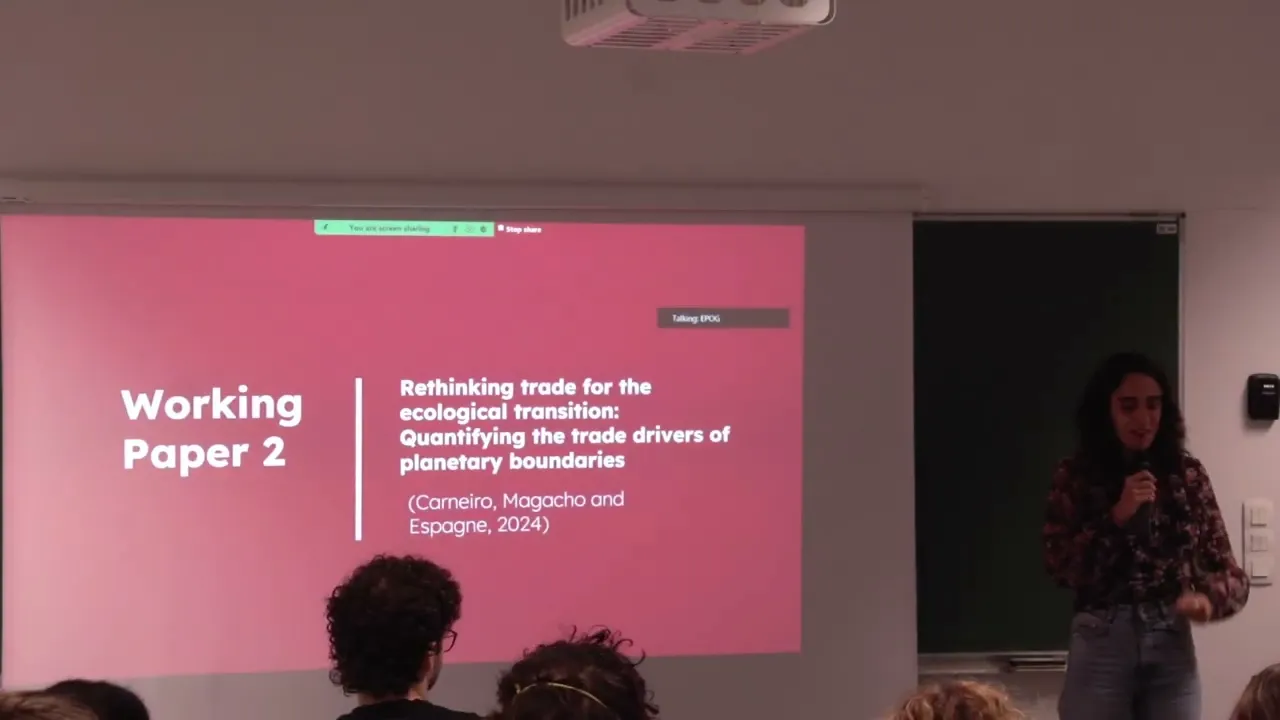
what are the underlying causes of this unequal trade relations and consumption patterns that might be overall hindering the global transition so how the trade Falls are and what are the technologies that we're pursuing in a Global scale and how it we might be selectively uh doing ecological modernization in specific parts of the globe um now changing of mindset I'm sorry for the pace but uh we're going to go for the second paper uh which is rethinking trade for the ecological transition quantifying trade drivers for planetary boundaries I guess the main argument was already um explained
in in like firsthand so I'm just going to briefly go through it But trade Dynamics are important because they influence production and consumption patterns therefore they're also responsible for the pressure on planetary boundaries they attempt on the paper to measure a little bit of the environmental fruit Ms that are embodied in trade relations in both final and intermediary Goods um and that enable them to identify what were the major pressure exporting and pressure importing regions and countries and also What were the main economic sectors leading to the pressure uh I'm glad that I was able
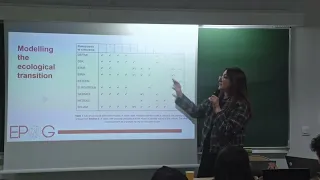
to changed this graph just a little bit before the presentation because it was the same one that you showed but one of the results is that like you can see this amazing um graphs showing the relations on how the what were regions that are exerting the pressure on export and import side on each one of the planetary boundaries this one here is novoo entities so like You can really see that Europe um High income countries from Europe are being really important in the share of it um so all of the results helped to understand how
uh among countries we have been sharing the pressures on each planetary boundary instead of just thinking about like this overshoot um and also how they are really related to uh how they reflect international division of labor being really sectoral and geographically specific and of Course that helps to uh direct international trade policies to reduce the pressure over those boundaries um and PLO is going to talk a little bit more about the critics yeah thanks batrice um before wasting much time on I'm just heading to the critiques so I would like to point out how the
paper correctly identified uh the global pressure over the planetary system happening due to the international value chains and the Existing pattern between the global now global North and the global South but one thing that we found lacking in the paper was that there were there there were like very less amount of uh explanation on how uh the international value chains played a role so there was just one mention like one mention of international value chains and that was done so I think it it needs much more importance and that's what the critique is So you
uh you have an um hypothesis or you can call it an hypothesis or an effect depending on how you look at it so if when you take when you take a look at Global value uh chain trade you will have you will see that uh High income countries will be on the clean stage of production and and the uh low-income countries say uh Vietnam India Bangladesh or any uh low-income or middle- income countries will be at the tail end of the dirty stage of Production so the middle or low income countries would be actually producing
the uh producing the most pollution intensive uh industry and to maybe to define the hypothesis uh call uh attributes differences in uh the stringency of Environmental regulations being the cause of this uh pollution Heaven effect and it's it's more of like an uh empirical uh overview of the same concept so you have your uh uh usual uh Smile curve and the others here added something called a crying curve of C CO2 so wherever you have very less value added you will see the uh pollution uh being the highest at that particular level of production um
like uh providing more evidence to the pollution Haven effect so you have uh the value chains that that is fragmented all over the world that causing a pollution Haven in global south or middle or low income countries and coming to the coming to The title of the paper uh rethinking trade for ecological transition quantifying the trade Travers of planetary boundaries so should we actually rethinking trade or should we bring more stronger environmental regulation which which would uh in turn create a pter effect it's like when you introduce stronger environmental regulations into a middle or low-income
country you it's it ends up spurring Innovation so you You can create a poter effect by having uh strong environmental regulation or is it more of an Institutional thing uh should the government step in and introduce uh climate subsidies carbon taxations and make sure that there is no uh path dependence or lock down towards polluting Industries or uh should the technology flow from Global North to Global South and coming to the second part of The critic I think we saw this graph before so I'm not going to wa waste that much time so my argument
or our our argument being that uh if you take a closer look you will see uh most of the most of the uh pressures on planetary B are actually caused by non-traded goods and this is like an um computation of all the um material or resource flow uh um in the starting from the period 1970 to 2024 we are only taking Look at the major four one so you will see all of the resources or materials are actually being produced for uh domestic extraction it's like domestic extraction is like if a country is producing a
material and it's staying within the country it's not going anywhere and they are using that in their own production so when you take your domestic extraction and add it with Imports you get the actual total volume of uh domestic consumption so but from This graph you can see like it's not the goods which are uh like the resources are not going to the goods which are being traded it's actually going to the goods which are being consumed or not traded Within in the country itself so that leads us to the question uh traded or non-traded
goods and um and it is this graph is like the uh same graph we saw before but uh we it's it's not like a snapshot like the The the early graph was like static it was like 2021 this is more of a Dynam we take the um uh uh the uh year year range is uh like from 99 to 2023 and it's not the same uh environment indicators actually like we were we could not access the same Gloria lab so we had to we ended up accessing another lab and creating it on our own and
so same story here if you see it's all non-traded like uh major pressure put on all these indicators are From um non-traded goods and maybe for an exception but uh in in in the major cases it's like non non-traded Goods uh um putting pressure and your traded Goods uh constitute a less uh amount proportionally and I'm I'm opening up um the stage uh with three questions and I think this concludes our presentation as well [Applause] oh thanks uh thanks very much for uh the Very good good points good summary and good good critics and please
send me the the slides after um I'll try to come back to um to the first paper yeah uh so on on critical minerals um so yeah Point completely well taken on the static view um actually we have a plan to move forward on the dynamic view um and and the modeling exercise but uh here we can still have a bit of a flavor of dynamic View by just looking at the different stages of the minor so in the SNP uh database that we're using uh you have I think five uh stages of the mine
um from uh like reserves so I don't remember the exact names but uh and and fully operating mine and so you you also have good indications of how much time it takes to move from one uh uh stage to another uh in the in the mining process at least in let's say five years to 10 10 years Horizon you have a good sense of uh where the bottlenecks uh will be by looking at the current evaluations uh on the in in this kind of static uh uh database um yeah then on the more like structural
uh uh critiques um well I I I fully agree um we have a very modest uh exercise here that's just to look into uh the the different definitions of ownership and cross that with a um some measure of um of geopolitical Distance and yeah implicitly I guess uh we're in a scenario where these Technologies would be uh uh heavily uh used uh but also implicitly we are saying that maybe we should consider other scenarios uh so it's all in the implicit but uh but I think this debate on sufficiency is is needs this kind of
uh empirical evidence to uh to strengthen the the case Um the question of uh yeah of who um who consumes the Green Technology uh is is uh is very um is very good very important uh and again here I guess we don't uh take that into account because we are focusing on just extraction and refining uh and looking at the whole supply chain and how the demand for uh the whole supply chain will evolve and will affect the the extraction and then we generate some inequalities between extracting Countries and and consuming countries this whole debate
is for the dynamic exercise that we're trying to do now uh but it's very important and you should have you should take into account indeed the the whole supply chain some other aspect as well is that um like without bringing this north south Dimension too much but just looking at the Technologies how uh depending on the how the price of the critical minerals will evolve uh you may Have shifts in in the technologies that happen as well and and there there could be a trap for countries investing heavily on a certain critical mineral uh and
then uh seeing some shift in the in the in the technology and suddenly the critical murals will not be used so much anymore uh and in that sense it's very different it's a a different world from the the fossil world right uh where Where Oil basically is is is used of of course you have different qualities of oil you have a different uh extraction cost but it's kind of still a uniform uh market and not too much uh um shift in the in the possibility to shift in the in the different uh use right um
in the in the world of critical minerals is it's kind of different and you already see that when the lithium was price of lithium was very high suddenly there there was much more Research on how to develop batteries without lithium and and then it's another path that is taken and then it's too late for the lithium and so if if you're a country that has invested heavily on lithium and then suddenly you you you you're facing a a new specific kind of uh trap in the in the transition so that's worth Al also looking in
a more Dynamic way um all right maybe moving to the the planetary boundaries uh Discussion so here again I mean we just touching the topic of trade and planetary B boundaries together and trying to make that World Bank paper I think is is is kind of important in a way uh and and and of course behind that you have international division of labor uh you have uh all the story about the the value chains and and unequality in in the in the international value chains and and very nice graph that you showed with the depending
on the Different stages in the in the the added value with a specialization of of of high income countries and low-income countries in different uh aspects of the value chain um but uh so so again we we are more modest than that in the sense that we're trying to put some uh empirical uh numbers there now what's your point about how how how trade is important or not so much in the in the picture that's that's I guess an important one uh my my view is that it's still important even if it's it represents the
20% more or less of the impact on on planetary boundaries uh because this this this determines a bit the ways uh people uh not only Just Produce but consume in the countries as well so I I can't have a proper uh uh way to to to represent it now but do the 20% have an impact on the 80% right uh and if you define then Policies uh to refin trade whatever the the policies the list you mentioned there are different options Etc uh uh this also has an impact on how you uh uh you consume
at the national level and uh probably it's not enough I'm not saying that this will cover the the the other 80% but um the hypothesis behind that is that the the the international division of labor has an impact on how also you uh produce and Consume for for for national uh for National objectives so that's why we focused uh very much on on trade it's also because I guess we uh um we are representing multi institutions and so so so have that kind of uh more Global approach uh I'm interested by the unep paper you
mentioned because uh uh I'm wondering what they've done really behind in terms of data Etc so if you can send it as well I'd be interested Thanks very much uh and yeah congratulations on the on the talk okay questions okay hello uh I'm Andrea from Brazil uh thank you for the presentation and I have two questions um the first one is uh if you think that the cun one of the cun effects is increasing the technological dependence uh from developing countries to cor core countries because uh one of the the Goals of the policy is
to push other countries to adopt Technologies to decarbonization of heavy industry but this Technologies are not produced locally so you need to uh import this and then um there are solutions like uh uh financing this this uh purchase of technology or um technological transfers Etc and my second question is how do you think that developing countries uh should react to the increasing demand for extraction of their critical uh Minerals like how uh could the developing countries react to the increasing demand uh for their critical minerals hello my name is Matilda I'm from Germany I I
just had a question kind of integrating insights from both papers uh the paper on planetary boundaries seem to highlight that nearly all planetary boundaries significantly affected by the sectors relating to Agriculture and if there's any studies looking at basically what a transition Of the Agricultural sector including forestry would have on terms of geopolitical implications sorry hello my who apologies um hello my name is Aron from Mexico and I I have a question regarding the transition risk on the macroeconomic trend of high inflation if you could just simply expand on that because I could imagine it's
going to be focused on some sectors and just the general if you have some Insights on how it could be managed um in the acceleration uh towards decarbonization okay the fourth and then uh I'm Isabella thanks for the presentation I'm from Brazil uh I would like to understand uh how like do legal Geographic and financial ownership like they relate to each other like which would Prevail um in yeah I would like to know your input on that yeah thanks a very good uh very Good question so let me start with the cam effect um uh
on technological dependence um yeah so we see that it's it's uh at least it's diverse between between the the sectors that are covered by Siam in the graph that I showed earlier some of some have uh some sectors have more or less the same uh technological uh um well distribution if you want uh between European countries non European countries so I guess that for for those Sectors the cam will not change uh too much the pre-existing technological dependence for some it's it's very uh different and then yes there will be two two ways so either
either some kind of technological catchup which can be endogeneous or exogenous to the country uh and so increase or not the technological dependence depending on how the country can manage to uh to develop the country uh uh uh itself or shift in trade uh from that Country because for now cam is just the the EU so now in Brazil I know that b ands for example is is promoting local local content requirements and and has this kind of industrial uh or technological development approach uh and um and this this is one question that that uh
Brazil is is currently asking what what will be the effect of seam on on brazilan how to react to it uh in other countries you see also a tendency to put in place an equivalent Carbon price or an equivalent uh ETS system um because then you don't pay the at least you you get the the proceeds of the cbam within the country don't pay to the European Union uh the the the price um so there are different kinds of also policy reaction to that I think um how AMD uh how emerging uh countries uh would
react or are reacting to increasing demand in critical minerals so depending on the their position in in the in the in the space of critical Minerals uh when you see different uh Trends but basically they're trying to uh take uh benefit of that to get a bit of the value uh the downstream value chain of the new sectors that's what Indonesia has uh um been trying to do um that's also I think what uh the lithium countries Chile and and neighboring countries in Latin America have have been trying to do and it's it's quite hard
in the in the in the current context and there is push back also from Developed countries against that so that's the big challenge uh and that comes back to the new green industrial policy narrative is it a green industrial policy narrative just for uh China and the the Western countries or is it something that could also apply uh to to developing and emerging countries and and under which conditions so of course that's how they react I can say much more than that um I think the the question agriculture is is is very good But I'm
I'm very very not an expert on that so I uh how uh how the the transition in agriculture would create a shift also in in geopol itical relation is uh is very interesting I guess the the most interesting case right now is the the EU law on on deforestation and how this would impact uh things in in Brazil or other um Forest reach uh um countries but yeah I don't have a good uh in well informed uh response on this Um yeah uh the trend risk uh on inflation and how um so it's focused on
some sectors can it create really macro effect on inflation and how can that be managed so I think we thought we saw that for critical minerals already we see some um some effects on prices uh and because it's certainly not uh it's not managed at the global level uh there will there can be this effect uh like prices uh going uh going Up uh maybe then the transition uh going going slower in in in in other countries and pressing going down and then up you could have all kinds of mechanisms like like this which would
not certainly not be efficient in terms of uh how you manage the the transition so there's a question of how you uh um you you create a stable price signal uh in this uh in this area which is kind of the the equivalent of stable oil price signal in the in the in the current situation and We know that the oil price is kind of managed in a way in in the current economy right so it's it's a there is no one entity that that fixes the price but but there is a it's not pure
market price and and I think for critical mirrors the question is will it be kind of managed in in in what way or will will it be purely erratic and and and and Market based um so then the last question was legal Geographic and financial ownership uh definitions and and uh yes that was your question right and and uh who wins in the end is that right yeah so that that's a very good one uh I don't have the answer I can just make maybe give a few elements I guess if if there is a
uh a us-based international order you could think that the the law of New York can win the argument in the end or or really create lots of troubles if a Country wants to uh uh to change uh um its uh its strategy in terms of uh using critical Minds if you are in a much more uh uh geopolitically fragmented fragmented world uh where there is it's less evident which which law has the has the has the power to dictate uh ownership situations then it might be more the geography or the legal origin that that wins
so that's basically the picture hello um thank you um I have two Question oh my name is marinel I'm from Germany I have two questions if I may uh the first one uh regards your slide that you had on um transition simulations and predictions on uh how much uh demand will be there for the uh critical minerals and it points into the direction of what Bea said um yeah what kind of different assumptions about consumption and in general what are the different assumptions of those scenarios are and um yeah the second question Regards uh the
current discussion about um import tariffs um on electrical vehicles and batteries and yeah uh I would like to hear your opinion about that and how that could shape uh yeah the trade patterns and also probably the uh pressure on planetary boundaries thanks hello my name is Oran from France and I wanted to ask you uh basically what we have seen over the past decades is uh a transformation of the modes of Regulation es especially in uh European countries where we shifted from uh mods of Regulation where the state was a dominant form and now it's
uh more dominated especially uh by the financial institutions and this is a two-fold move because at the same time the forms of the state itself has changed and um is has now lost a lot of capabilities in terms of uh intervention in the economy uh for example in the 70s 80s in France we were able to uh to implement a Nuclear transition in the in our electrical industry and uh since that shift of in mods of Regulation has occurred in a lot of European countries I wanted to ask you if that type of mod of
Regulation um makes it incompatible to uh Implement industrial policies the industrial policies that are necessary to uh achieve uh an energy or a green transition are are such uh institutions compatible or in yeah are these institution compatible or incompatible With um the green transition thank you okay yeah hi I'm arur from the Netherlands um and I had a question that sort of relates to the second question that Marin Noel also asked and with all these new policies by the US and Europe on uh like critical minerals I don't understand myself like what the net effect
of these policies are is it like an acceleration of the green transition or deceleration Because on the one hand you have like these these import taxes on uh batteries but on the other hand these local input requirements uh might accelerate the transition so I was wondering what your view on uh on this like geop politization of critical minerals is uh hi my name is nikil rampal I'm from India I want to ask on cbam so do you think developing countries are ready to be competing with the efficiency or Energy Efficiency of European countries Specifically for
the cement industry because that's where the tax are going to be like do you think that in two years they can achieve deficiency that European Union has taken years for and secondly um uh it's related to seam only so uh instead of putting exactly what Andrea said like instead of charging a heavy tax to equate the goods should developed countries focus on investing in green transition and just Transition because this is going to mean a lot of job losses and do developed countries have enough jobs uh or capacities to maybe construct or mine that much
cement that China does or India does as an opportunity cost like if you impose a tax their goods become uh more expensive but you still would have to import because you don't have much labor and resources to mine cement in your own tariff so how uh sustainable is Siam going to Be yeah thanks very much again very interesting questions um so start starting from the the beginning I think the again uh I won't develop that but the this story about the demand for critical minerals means that we have to look into sufficiency scenarios and I
know they're not uh well enough represented in most institutions and the ipcc in particular I mean it's just mentioned in the ipcc but in the terms of the models and the and the the the Projections uh ex exercise that exists there's needs to be much more U on that front um interesting question on the like institutionalist uh approach to the state capacity uh and uh to to do industrial policies I very much agree there as well so the state itself has changed it's kind of subordinated and at the same time it lost some uh um
some of its uh capabilities that it may have had In it had in the 60s and and 70s uh however we we see that there's a beginning of a shift now will it work or not will it create a new kind of regime new articulation between states and markets I I don't have the answer for that but we can only observe that uh there is much more of this uh kind of strategic uh thinking or at least talk uh and some some talk more some act more uh so we'll see what emerges out of this
but um I mean even uh even The the White House two years AG I I think said the the neoliberal order is over and now it's it's it's it's the new there's new Washington consensus right so uh so let let's see let's see what what it takes but it's it's clear uh that there is a fear of what China has accomplished and an attempt to catch up uh building on the institutions of the ne neoliberal era for for sure but they will be transformed in the Process um what's the net effect of these policies I
think that's great question um so if you have like kind of neoc classical uh mind you may you may consider this as just a zero some game and and not not so much progress uh on the way because uh uh the only action could come from uh uh pricing the externality and uh if as long as you don't price the externality you don't really change the Um the incentives and you don't change the system okay but if you if you have a more evolutionist uh approach uh not maybe pricing carbon can be uh can be
uh useful and important but you the most important thing is to transform the system and in a way that's kind of uh not uh irreversible right so in that context the more countries invest in those sectors uh the more adoption there is and the lower the cost of those Technologies and that's something that's kind of irreversible in a way independently of of the carbon price that you uh put in place so with all the caveats that I recognize about uh who consumes those Technologies this is really useful shouldn't we have sufficiency scenar Etc but but
at least that creates uh uh that that kind uh of of effect so it's not a zero some game and it's a dynamic uh uh irreversible irreversible process now how Irreversible is that right that's the the question uh I I guess it's kind of irreversible at least it defines a new uh a new uh say mode of production or a new phase uh when the institutions themselves are transformed or find find an new role in in in the in the in the system and that that's where it feeds back to the more institutionalist question um
yeah the question from um on India was I think is good I'm not Specialist of the cement uh industry um but I I I see your point and at the same time I can't I also see that that basically you're seeing that there's a uh kind of dependency relation between India and and Europe the European Union on the cement industry right India India's exports of total India's export 18% are SE goods and cement IR steel these five according to World Bank Expos are Critical for India exports we are depend yeah yeah I see the dependencies
on both sides for on on different different aspects but if if you want to promote a less uh dependent World in a way that then then the the question is how how you do it right I mean how you do it in a fair way that I fully I fully understand um so I I don't know if I will go beyond beyond beyond this but to me cbam was launched uh at the time I think Was even before the IRA was was kicked off uh and there was not so much I mean that was the
early early stage of this movement and it was maybe even still uh still Trump or the end of trump Administration so they laun they launched seam it was kind of an early mover thing right okay seeing that the rest of the world is not doing much or anything uh we can't uh we can't be keep being the the open uh open Gates uh uh Cons uh consumer of the world and at least for the the key uh most intensive carbon safy sectors uh let's let's do a Fair competition on the in relation to the carbon
content and then there was this move Ira uh also European Union reacting to this and then other countries announcing Net Zero pathway Etc so maybe cam could could become less relevant in a world where there there's a real Dynamic that's uh um that's embraced on on on The transition I guess and and actually IMF and uh very much against steam in the end they what they promote is a global carbon price but you don't see that happening anytime soon right so so there's a I think it's an to explain cban it's an early mover perspective
which creates tensions and by cany but also incentives to to to to build on it and do something right so that then it becomes less relevant for Uh for the for the European union now again on the cement uh aspect part in particular I'm I'm less uh less experienced yeah okay we take one here okay yeah uh Timon from Germany um actually there are one or two questions in the chat I don't think you can see them right now otherwise I will read them out um there's like the the rise of Renewables Technologies has been
enabled By the ability of existing fossil energy sources but what will be the cost once fossil energies have faded away and the follow up is like then the energy return or on energy invested or limiting factors will that lead to the necessity of degrowth okay I'm Nicholas from Canada um in your presentation you showed that the situation of climate and bio biodiversity crisis is also and by also showing the principal actors involved in This and the constraints for E ecological transition uh and the increasing need for critical minerals for example uh do you think we
can solve this crisis by um and achieve the transition by simp keeping economic growth and this rate of extraction of critical materals and simply by introducing green technologies and car carbon prices for example or do you think of other Solutions hi I'm Lou from France but um I studied in Canada and this is related to it um a lot of these critical minerals so we can talk about Cobalt in the Democratic Republic of Congo or leum in Argentina or Canada are on indigenous lands often unseeded indigenous lands and they are stren to death or forc
to displac right now threatened by mining companies often coming from the global North and um for example in Canada there next to where I was studying there emptying Lakes and logging everywhere to do leum mining um and I was at the cup recently for at the UN and some of their delegation from the indigenous communities were saying that about critical minerals that is just a another kind of transition for the nors at the cost of their community so how do we then justify such a transition as not just an accentuation of the Imperial mode of
living and green extractivism at the expense of these communities that Are the most exposed to climate change but also have suffered the most from colonialism already thanks yeah um I have a question that goes into another Direction um um yeah freder from Germany thanks for the presentation for the discussion um so you showed the the graphs on which countries have the most critical minerals and who owns them and so on and who owns the owners so if we Think about the current situation where there's like a dollar hegemony in some way and this can maybe
be historically understood as like an oilbased hegemony or like a fossil based uh currency do you think critical minerals change this picture when it comes to the financial side of things so if we see like there's a lots of uh bricks countries uh in those in those countries that control the critical minerals yeah I mean this this the like The bricks currency as a currency of critical minerals a bit of a possibility do you think or is it more of a pipe dream and are there many any indicators that this might be happening so do
you know for example what are the invoicing currencies for these uh critical minerals like is China using this as a push for renman B internationalization and so on um would be interested if you have anything on this thank you yeah good Uh good questions again uh let me start with the last one maybe uh I mean that's that's a good one and I love this type of debate no no seriously so the actually that's a very good question on on on What's the invoicing currency I don't know uh so I will look into that for
the most critical minerals I would guess still quite quite probably the dollar still uh and we were discussing at lunch about that uh and the bricks countries Uh uh and the currency plan and uh and and how how is is that uh tied to a new kind of energy mix or or critical resource uh um and it's not clear to be honest uh because China is of course one of the most heavily one of the country that that invest the most by far on on the uh the Renewables in the renewable sectors um but at
the same time it's also extremely cold uh dependent still so depending on uh how it moves forward uh we may face still a cold very much Cold driven China or CR minerals dependent CH China and then and then what it would imply for the ren Mimi and and the bricks currency will follow and then there is this new trend of of incorporating new countries in the in the bricks uh with Saudi Arabia joining so that's not very much a uh nonfossil player so um yeah it this is very very open I guess at this stage
and not necessarily going in the dire of A of a new key currency that would be U kind of green in any any way um right so question IND indigenous lands and in relation with the um the colonial uh period or the colonial foundations of uh of uh of fossil capitalism so that's a um I mean that I think that we have a whole group of questions which are which take different angles into the same kind of argument which is uh basically this transition as um and this this so-called New sectors or emerging Technologies are
very much Technologies for the North and uh they would be still produced either by the by the south or ex with critical resources extracted from the south and so just continuing this the the the historical trend of dependency uh from the colonial uh different Colonial periods um that may be the case but China is is kind of a a different story here um I know it was never fully uh col colonized in a Way but uh but the reemergence of China back from the the period where long perod where it was the the the major
power will will will will make this colonial period look look like a blip uh in the history right so I think this is the Mega Trend to to take into account as well uh and not just look into the past 200 years uh although they are very important to explain capitalism still um last Point uh which bit more technical on the fossil needed uh to uh Invest in Reen renewable energy and the the argument of the energy return on investment um yeah I know about this uh whole literature um I'm not I'm not too sure
about the the the the full empirical validation of that so uh that that that there is uh a need for energy and more energy to extract more resources to Build uh machines or things uh that are less energy efficient I understand that mechanism uh now how can we project that into a 2050 or 2100 in a in a decarbonized world and say we will still always need somehow fossils and that's where I'm not sure right uh yeah so I I would just say say that but um but I understand I understand the point um so
let's say that's the technical AR argument against uh uh Extraction and and uh and and and further mining uh and you have the more historical colon colonial version of of it which is about the different phases of capitalism um yeah so I stop here I think yeah I covered most thanks very much um I'm Enzo I'm from Brazil uh thanks for the presentation it was very interesting my question is about uh the Graphs that you showed about the difference between mine ownership and financial ownership where like M ownership was more Diversified or like arguably China
dominated and Fin Financial ownership was undoubtedly uh us dominated uh so my question is uh which one is more important when it comes to trade dominance and the energetical transition um once we can ALS we could also see from your presentation that uh when it comes to The processing of these uh critical minerals it was dominated by China and if you could please um incorporate the Bon Road initiative in in uh the infrastructure investments in in your answer that would be very nice thank you I'm um have another question here as well um mine goes
a little bit in uh in the possibilities of what other uh constraint to supply chains the GE economic fragmentation can take so I'm thinking of uh we've been seen like how It's possible that critical minerals would be hindered so like the supply be um hindered by this ge economic fragmentation but if you have seen something regarding uh the same effect un like the supply of fos fuels so it could be interesting uh if maybe there's a positive effect in terms of like the transition if you have um an increase on these geoeconomic uh fragmentation um
uh yeah and I guess maybe what for future studies as well Would be interesting to see like what sort of uh Global energy Supply could be more impacted by those sort of geopolitical distances if well yeah another question okay yes last one there and yeah just uh some technical questions I was wondering in the second stage of ownership um what tax Heavens uh or what role tax Heavens played and uh where com uh companies are located and also um when it comes to the third Um or the financial ownership um yeah what kind of data
did you use for the Chinese uh um yeah ownership question no no that a good question so on the the tax Heavens okay I guess they would appear more on the financial ownership side if they were covered right by the data so that's the restriction and also for China actually uh uh so we use this SNP Database which is is the most uh detailed in terms of the different uh um versions of ownership structure uh it has a kind of good coverage but you have like uh better data from the US or UK Geological Survey
but those data do not have the the ownership uh details uh so yeah there is an Arbitrage in terms of data sources here uh if you want to have a story ownership it's SNP uh but then of course uh with China you're never too sure who owns it who Owns what uh and for uh the tax Havens uh as well so yeah I I'm afraid this is a a bias in the in the study how much I I can't I I can't really say um yes some elements on the constraints uh story um maybe one
one point to uh to look into would be the long-term contracts that countries are trying to uh uh to um to fulfill right to either secure their uh U resources critical mineral Resources or uh or secure their exports in terms of fossil for fossil exporting countries so it there's a huge move on the critical mineral side to uh to secure uh your sources by by uh by um issuing contracts that that uh that ensure that in next 10 years 20 years 30 years you will buy anything that comes from uh a certain mine or certain
uh company and and that's very much buying the future uh extractions uh of things um so in order to have better maybe Scenarios uh or the constraints you would need to look into these kinds of data but they're not like very transparent so you would have to look deal by deal how how things are uh how things are done and and what what what what's the exact picture that arises from from there I don't I don't know if I answer the your question but that at least a new uh potential source of information uh on
on the potential constraints Ahead uh yeah I think on the first question I more or less answered was a bit related to what you you were asking right so who who uh who wins in the end between the final ownership uh and the geographical ownership and it it very much depends on I would say power relation in the in the Geo geopolitical Dimensions so be the the belan RO initiative plays a role in expanding this power relation from for China and at the same time there is the Us Le order or disorder that that's that's
still very much present uh uh as well and then that confrontation for now we can't we can't say there in the 70s you had this move of nationalizations of of fossil resources will we Face a move like this at some point again it's I would be uh prudent because it's it's very different still from the from oil uh it's less of a pivot uh sector uh for The transition than oil was in the fossil system so that's the the the difference that I can see thank you very much [Applause]