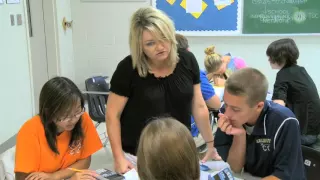
- All right, remember we talked about sponges? - Yes. - Who remembers what we said about the way sponges eat?
I'm going to get you guys to do this as a class. We know that the water goes . .
. - In through the pores, out through the Oscu lum. - I only see half of you doing it.
Let's do that. The water goes, . .
. - In through the pores, out through the Osculum. - Good job for you.
Okay, we also talked about Cnidarians. Okay. Remember Cnidarians ?
What did I teach you to remember Cnidarians? How do they act? How do polyps act?
Go ahead and do it. I know you remember. Tell us.
- Your tentacles are at the top. - And what else is in the middle of the tentacles? - The mouth.
- Let me see those polyps. Do I have to sing? Raise your hands in--where are your tentacles?
-- in the air and wave them like you just dont care and all the polyps in the room say, "Oh yeah! " - Oh yeah! - All right, you know.
Okay. Today we're going to talk about what? What's the next phylum we're going to talk about?
Who remembers? - Mollusks. - No, not mollusks.
I heard someone say it. - Cnidarians. - Not Cnidarians.
We talked about those already. Now, you're just grasping at straws. [class talking at the same time] We're going to talk about worms today.
We're going to talk about worms today. Say it nice and loud. - Worms.
- Okay. Raise your hand if you've ever held a worm in your hand. Okay.
Raise your hand if you've ever seen worms after the rain. Oh, you guys know all about worms. Raise your hand if you've ever eaten worms.
[class making disgusting sound] - You had worms? What kind? - I don't know.
I was two. - Okay. - Gummy worms?
- No, gummy worms don't count. All right, we are going to-- Remember when we did our group work and we did our little posters, whose turn is it to produce today? Who did flatworms?
I think it was-- Yes, would you guys go to your poster please and tell us a little bit about worms. All right, tell us about your flatworms. What's an example of a flatworm?
- Planarian, is that correct? - That is correct. Nice to know.
The planarian, and give me some facts about planarinas and other flatworms please. - Ummm, worms--flatworms are classified-- Worms are classified in many different phylum's. Worms have more complex structures than sponges.
The more well-known members of the phylum are the parasitic tapeworms and-- - Parasitic tapeworms. - And flukes which cause disease in humans. - Flukes which cause disease, okay.
- Flatworms range in size from one millimeter to several meters. - How big is one millimeter? - Like this.
- Right, it's real small. How big is a meter? Anybody remember?
This is one meter and they can do several meters long. So what I want you to do at your desk, do this and join hands with the next person. Let's see how long we can make our worms, okay?
Let's see how long your worm is. About two and a half meters. Guess what?
They get longer than that. Keep going. Let's see how long some worms get.
Let's see how many worms? one, two, three, four, five meters. Guess what?
Some worms get even longer than this, okay, but we're going to talk about those in a minute. Go on. - Flatworms are acoelomates.
- Acoelomates. - Sorry. - Go ahead, say it.
- Acoelomates. - Let's hear the class say that Acoelomates. - Acoelomates.
- Good job. Give them a-- What should we give them, a round of applause or is that boring? Okay, - No.
- Okay, give them a round of applause. Thank you very much. So let's talk about our flatworms.
Remember our chart that we started making, describ ing our different animals? So here we are on our flatworms, okay? And do you remember how to spell Platyhelmithes?
How do you spell Platyhelminthes, which is the name of the phylum? - P-L-A-T-- -Platy-- - T-Y-H-- - H-E-L - M-I-N-- - M-I-N - T-H-E-S. - T-H-E-S.
Platy-H-E-L-M-I-N-T-H-E-S. and we know that Platyhelminthes are what kind of worms? - Flatworms.
- Flatworms. okay? - Oops, I showed you everything.
Now, our first group that presented told us that we had three cell layers. So these are triploblastic. Everybody say triploblastic.
- Triploblastic. - Triploblastic. - Triploblastic.
- I'm going to try it one more time. You ready? Triplo.
. . .
blastic. You're not doing it. Do it and say it.
- Triplobastic. -You got to do it and say it. - Triploblastic.
- My man, there you go. Okay, three cell layers, and we said the inside cell layer was called what? The endoderm because endo means what?
- Inside. - Inside, okay. I'm going to give you some endoderm.
Each table gets some endoderm. Here, pass it around. Make sure each table gets some red endoderm, okay?
Here's some more. What did we say was the middle layer? The middle layer?
How about Nadia. what's the middle layer? - Triplo?
- The triplo means the three layers. What's the middle? Ask Samantha for some help.
I think she might know. - Mesoderm. - The mesoderm.
- Very good, Nadia, the mesoderm, which is middle. Guess what I'm going to give you? - The mesoderm.
- I'm going to give you some mesoderm's So everybody make sure that each table gets some mesoderm. Now, not everybody in the table needs the same kind. Just make sure one person has a piece of clay.
Now, what was the name of the layer inside, the? -- - Endo. - Endo.
And the middle was? - Meso. - Meso.
What do we call the outside layer? - The ecto. - The ectoderm.
Would you help me with this please? So we're going to make the ectoderm yellow and here's some more mesoderm if you guys need some more mesoderm and make sure each table has some ectoderm. Everybody has some ectoderm?
Okay, it's coming back. - This is what I want you to do, okay. Since we're making worms, what shape are worms usually in?
- Round. - Well, what kind of worms are we talking about today? Flatworms, but we're going to make worms.
We know they're long and cylindrical. So take your clay and roll it until you make a worm. Remember when you made the little Play-Doh worm?
Make them long and skinny. Roll it until you make a worm. Now, what's the inside layer called?
- Endo. - The endoderm. What color was that?
- Red. - That was red. That's going to be in the middle, okay?
Now, what was the middle layer called? - Meso. - The mesoderm.
Now, listen who has the mesoderm? Raise your han-- Hold up your mesoderm. - What color?
What color was the mesoderm? It was blue I believe. Hold up the mesoderm if you have mesoderm.
okay? The mesoderm is going to be around the endoderm. So once you guys roll it, you're going to have to flatten it on the table, okay?
So get it nice and flat. - And it might work better--Matt, hold up your worm. You might want to start with little worms so that everybody can make some worms, okay?
This is a good job. Get a little bit flatter that this. You want to flatten out your mesoderm.
So see if you can get it as wide as possible without breaking anything, okay? - Which one is your ectoderm? - Yellow.
- The yellow. You're going to do the same thing with the ectoderm, okay? You're going to flatten the ectoderm because what you're going to do is remember, you're going to roll up your layers.
We're going to make a worm burrito, and we're going to roll it up. You see how we have three layers? What about the outside?
- The ectoderm. - Ectoderm, but yours isn't blue; yours is-- - Yellow. - Yellow.
And what's in the middle? - Mesoderm - Mesoderm, and your mesoderm is what color? - Blue.
- Blue. and what on the inside? - Endoderm.
- The endoderm. okay? So let me see some of these endoderm's.
That's not endoderm. Hold up your endoderm. If you dont have one if your partner has one, that's okay.
Just one of you hold up the endoderm. Now, this is going to go in the middle. How do you think we're going to get the mesoderm to fit with the endoderm?
[students talking at the same time] We are going to-- Say that again, Turel. - Wrap it around. - Very good, you're going to wrap it around.
So now, that's why I told you make it nice and flat and I told you to make your worms nice and small. So go ahead, take your mesoderm, right, and wrap it around the endoderm and I'll let you do that. Okay, wrap your mesoderm around the endoderm so that it's completely covering.
Now, if you've got some left over, what can you do? - Fold it over. - You can just take this off and put it-- No, we're not eating our worm burritos today.
I'll bring some worms that you can eat later, okay? We'll fold it over. Got that?
- Yes. - Let me see. - This is what it should like.
Very nice worm, Samantha. So on the outside, all you should see is what? - Blue - What's it called?
- The mesoderm. - Mesoderm, but on the inside, what are you going to see? - Endoderm.
- Endoderm. What else are we going to do after this? - Ectoderm.
- We're going to make ectoderm, so flatten out your ectoderm and wrap your endoderm and mesoderm in your ectoderm. Now, I'm going to need one more thing. What are we missing up there?
- Digestive tract. - We need a digestive tract. How do you think we're going to make a digestive tract?
- Make a hole through the middle. - I'm going to give you a paper clip, straighten it out, Okay, because your digestive tract is just a hole. So take your paper clip, straighten it out like this and then what can you do with it?
- Stick it through the middle. - Stick it through the middle so that you get that hole through your worm. When you look through this, what do you see?
- All layers. - You see all three layers and we know that organisms with three cell layers are called? - Tri-- - Triploblastic.
Say it with me. - Triploblastic. - Say it with me again and do the motion.
- Triploblastic. - Very good, triploblastic. We said that these worms are in what phylum?
[inaudible] - No it's on the board--oh, it's not on the board anymore. Platyhelminthes, flatworms, right? So now that you have your worm-- Oh, I'm sorry did you give it a digestive system?
- No - You got to give it a digestive system. Hold your worms above your heads when you're ready with them. Hold your worms about your heads.
Now, what's the only thing our worm is missing since this is suppose to be a flatworm? - Flat - It has to be flat and I know you'll enjoy this. So on the count of three, we will flatten our worms, okay?
Don't stomp them. Don't permanently flatten them. Just take them and squish them between your hands.
Are you ready? - One, two--oh, one more thing. When we flat ten our worms, we're going to call out Platy helminthes.
You ready? Because that's what we're making. Are you ready?
Every body ready? - Yes. - One, two, three.
- Platyhelminthes. - Very good. Show me your flatworms.
Show me your flatworms. - Too big. - Very good.
Very good.