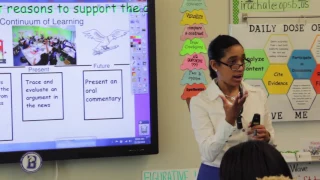
- Learning target, one, two, three, let's go. - I can identify similar or locate common themes in various texts. - Okay, we've already done our journal.
We know that we've read two nonfictional texts, not two non-fictional. We read two fictional texts, correct? Now, we're going to look at a speech.
So, everybody, the first sheet of paper we're looking at or the first sets of papers we're looking at is our speech. Now you know we normally do a timed type of routine to allow you all to discuss whatever you need to discuss. We're going to look at the following questions.
- Now that you got your sheets out, let's look at the board. Literature, the big question; can truth change? That's what we're looking at.
Overall, we learned that truth could change in the Girl Who Can, correct? - Yes. - All right.
So then we've got to look at can truth change in the Rules of the Game. right? And now we've got to look at can truth change in the speech that we've been kind of mulling over for past the two nights.
Then it says, if we scroll down, we're looking at all of these six topics in here to determine our theme. - We got questions that we need to answer. Number one; Identify Clinton's purpose for his speech.
You got your alphabet, explain how you came to this conclusion; determine how the title could have assisted you in the conclusion. So you can't just say, well this is my theme. What do you have to do?
What have we been talking about since day one? What do you got to provide? - Textual evidence.
- Textual evidence, because Ms. Jones won't believe you if you don't have evidence. Now, I need somebody to read B.
Not all at once. Come on, Melissa. - Okay.
Locate any direct statements and analyze how they create or suggest a certain town and explain how this town is appropriate. Does it create a necessary build and why or why not? - So what am I asking you?
- See if there's anything that kind of goes into the theme or what you're trying to look for like evidence. - Okay. All right.
Give me a few more words. When I'm saying tone, what am I really asking you for? What am I asking you to look at?
All right, Hannah M. - The word choice or how you direct the audience. - Okay, good.
All right, C. I need someone else to do C. No, let's try to get someone else-- preferably somebody in the far back of the classroom.
Yes, thank you, Shelby. - Detail and discuss what you learn about the roles of women. Explain how these roles could be solutions or casual conflict.
- Yeah, casual conflict. So what am I asking you? - Like, you can describe what the women do and also explain why that could be a problem or a solution.
- All right, that's what I'm looking for, exactly. D, I need somebody on this side. Yes, Eric, awesome - Just what you learned about the roles of women explaining how the-- - No, Eric, we just did that one.
You've got to do D. - Explaining how the Clinton structures the speech as one event idea greater that the other. What does it say?
If so, explain why or why not all of the idea points needed? Locate transition. If any, what type of tone does the usage of personal pronouns create?
- Walk and talk. Walk back to the desk and tell me what do you think I'm asking you. If you need some assistance, let me know.
- Yes, ma'am. I need some assistance. - Who can help out Eric?
Tristan. - Can you repeat what the question-- - I'll repeat it, I'll read it. Explain how she--she being Clinton--structures the speech.
Is one event or idea greater than the other? If so, explain, why or why not all of the ideas or points needed. Locate transitions if any.
What type of tone does her usage of personal pronouns create? - What you're asking is for us to point out main things in the speech and how they switch from one topic to another. - Sweetness, that's what I'm looking for.
All right, we got a couple more alphabets. Do you want me to read them or do you think that you can just go on and get started? - Go on.
- Go on and get started, all right. So we normally do about 20 to 25, 22 minutes, will that suffice? All right.
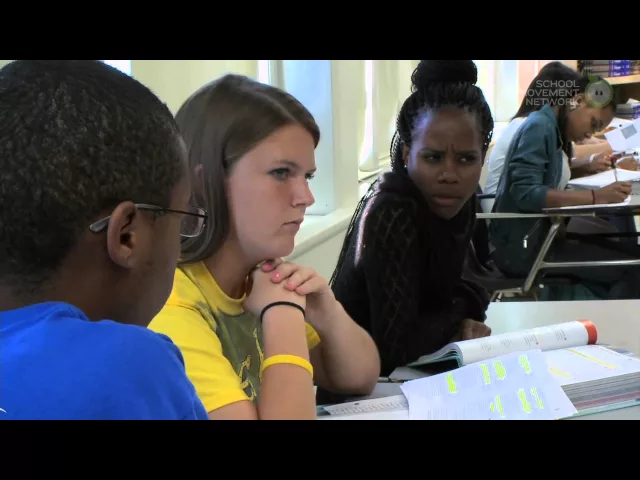
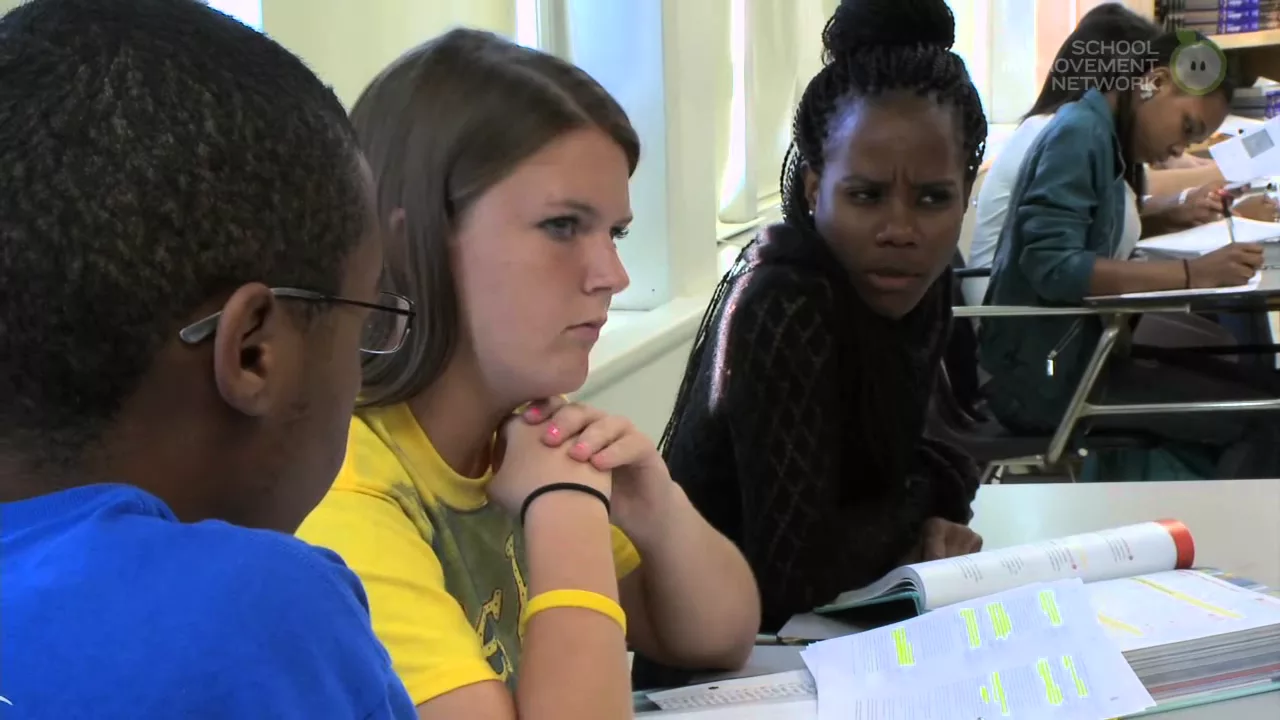
Take a look at these questions, talk to each other. I'm coming around to hear your feedback. Are you ready?
You got a theme already? - No, right we are still talking-- - We are still talking about-- - Okay, all right. You got your speech?
- Got it. - When I say theme, what am I saying? - What's the main message?
- The main message. Okay, - Underline-- - Ok, the central idea. Now, if you need some help with that, open up your Elements of Literature text to page 430.
We've been there so let's go back to refresh our memories. - The chart? - Exactly, the colorful chart.
That's what I'm talking about, Katie. So you're going to use these and be mindful, look at the board. Isn't it the same wording as right here?
All right, what I'm trying to do is make sure you connect what we did yesterday to what we're going to do today. So you've got to use all of these to come up with your theme so if I come back, you have something for me? - Yes.
- You will? I believe you, Katie. I believe you.
I believe you. What have you come up with? Or, with what have you come up?
- It is informative-- - So you think it's descriptive so it's two folds? - Yes. - Okay.
So how do you know that it's informative? - She is informing people about how everything in this like-- - Like, about the problem. - Yeah.
- Well, what is the problem? What's the problem? - Women are treated unfairly.
- Yeah. - How are they treated unfairly? Give me evidence.
What is she saying? What is she pointing out? - Every woman desires the chance to realize their own value and potential but we must recognize that women will never gain full dignity until their human rights are respected and protected.
- I had that highlighted, too. Okay. So how can it be descriptive?
- She's describing the problems. - She's describing the problems that woman are facing. - Yes.
- All right. What's the second part of this? How did you come up to--how did you come to that conclusion.
Adam, is that gum in your mouth? Find the trash can. All right, how did you come up with it?
- There's lots of statistics. - Okay. What are the statistics?
Take me to them. - Women compromise more than half the world's population, 70% of the world's poor and two-thirds of those are not taught to read and write. - Okay, all right.
That's one statistic. Now, here's my question. If that statistic was taken out, would this still have purpose, would the speech still do what it needs to do?
- Yes. - Okay. Move on to the next alphabet because I think you all have what you need to have.
All right. Wrap up your discussions. We got 15 minutes.
Now, here's what I'm going to suggest. Several of us have gotten to D, correct? - Yes.
- Yes. Okay, so If we've gotten to D, we really don't need to do too much discussion about that, correct? - Yes.
- All right. So the focus for the next 15 minutes is the graphic organizer, filling in the blank and the big objective summary that you're going to create. Ladies and gentlemen, I'm going to give each group a poster board.
On this poster board, you are going to summarize everything from The Girl Who Can, Rules of the Game to Hillary Clinton's speech and when I say summarize, what am I definitely asking for? You should know it by now. - Key details.
- Key details, - Textual evidence. - Textual evidence and academic vocabulary. I need definitely all of that.
So while I get the poster boards, start mulling over what you want to think about as far as your objective summary. I will provide the markers. - Can we split up the words like into sections?
Or is it just-- - One big thing. No splitting up. - Can we title it?
- Yeah, you can title it. [inaudible] - Sweet, that's what I'm talking about. - Okay.
- Do you want it like in a one bog sentence or--want it-- - I prefer it in one big summary, one big sentence so whoever is going to get up and say, "Ms. Jones, this is what we're doing yada yada yada," You need to put it in one big sentence. - You got me?
All right. You are correct. Thank you, Clara, for pointing that out.
What does that mean? - I dont know. - Yes, ma'am, truck.
I will. Here you go. I'm going to get the markers.
Hannah, I'm going to get the markers. Here you go. - We have a question.
- What's your question? - Do all three, like are all three stories need to-- Are they all in one summary? or so, like, we're connecting it all?
- Exactly. - Can we make this pretty? - Yes, Shelby, you can make it as pretty as you want.
All right, here's your marker. Here's your marker. - Yeah!
- Can I have orange? - Yes, Shelby. You can have orange.
- Can we have blue? - Here's blue. Someone had a question and I forget who it was.
Chuck, you had a question. All right, everybody received a marker? Did you all get a marker?
You got black and brown, you choose. All right, All right, Chuck, what's your question? Graphic organizer.
All right. Notice this says write the central idea so-- - The central idea like the main theme so what it is about, the main point. - Let me interject, let me interject.
The graphic organizer, let me interject. The very first one is going to be The Girl Who Can. If you've already started writing, make sure you have titled it.
All right? The second one is going to be Rules of the Game. And the very last one is going to be Hillary Clinton's speech.
Now be mindful for whatever theme you choose. it should be able to fit in each literature piece that we've read, okay? So once you filled out the graphic organizer, you're going to put your big summary on the poster board.
I'm setting the clock. Yes. - You want the main point and then the details-- - That lead to it, all right?
- And then on the poster board, summarize the whole story? - Everything put together. - Everything put together?
- So how it all relates to each other. - Did you want just one big-- - Yes, ma'am. One big one.
- Ohh! ! - Of all three of them?
- One big one. - Say it again? - Like a big paragraph?
- Yes, because you're going to have to get up and tell us. - Okay. - Okay.
- So how long do you want me to summarize? Like one or two sentences? - All right, Sidney raised a good question.
Sidney said so how long do you want it to be? Do you want it to be one sentence, two sentence or more? If you can sum it up in one sentence, I'm fine with that.
If it takes more information and you've got to go to two to three, once again, I'm fine with that, okay? Just do not give me a dissertation. Are we clear on that one?
- Yes, ma'am. - Okay, we don't have enough time to read your dissertations. Yes, ma'am.
- Do you want us to do a summary for each passage or just-- - One entire on commonality. One big one. - We found like a good sentence on the speech that kind of incorporate all of it, so can we write the sentence and write the evidence like our point of view of why we think that sentence describes it all?
- You just made me feel so much better because of what you just said. [inaudible] Yeah, Do what you need to do. [group laughing] - We are trying for one big sentence that sums it everything.
Its says our main point was discrimination. - Now, if you choose discrimination, remember you've got to have evidence. - We have evidence.
- You got evidence? - We have evidence. - So I would suggest that you write your sentence on paper.
Make sure you all agree with it and if you're ready to put in on that paper, let's roll with it. Make sure you have your evidence though, okay? - So we don't have to say in Rules of the Game or in-- - No.
It should be clear and apparent to everyone that's listening to you, all right? So what is Christine doing and what are Ashley and Sidney doing? - Well what are we going to try to do since we only have a little bit of time left, so we scan back over the stories so she has a speech, she has kind of have the Rules of the Game and then we're going to sort of write out a summary for each and then come together and correlate a theme.
- Don't forget, good wording. Don't forget to allow that graphic organizer to guide you; that's why is there to help you out, Okay?