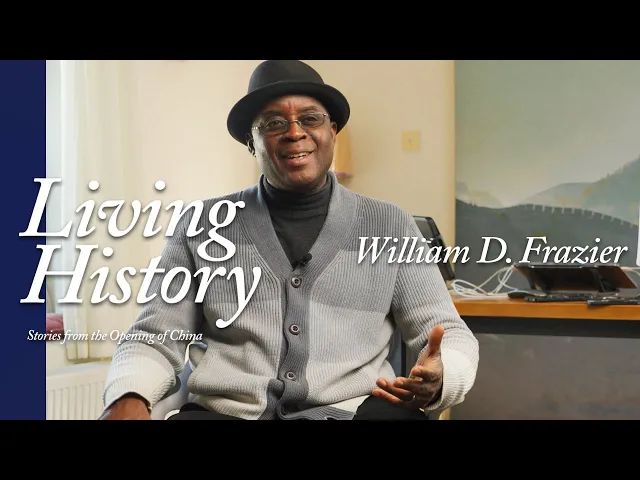
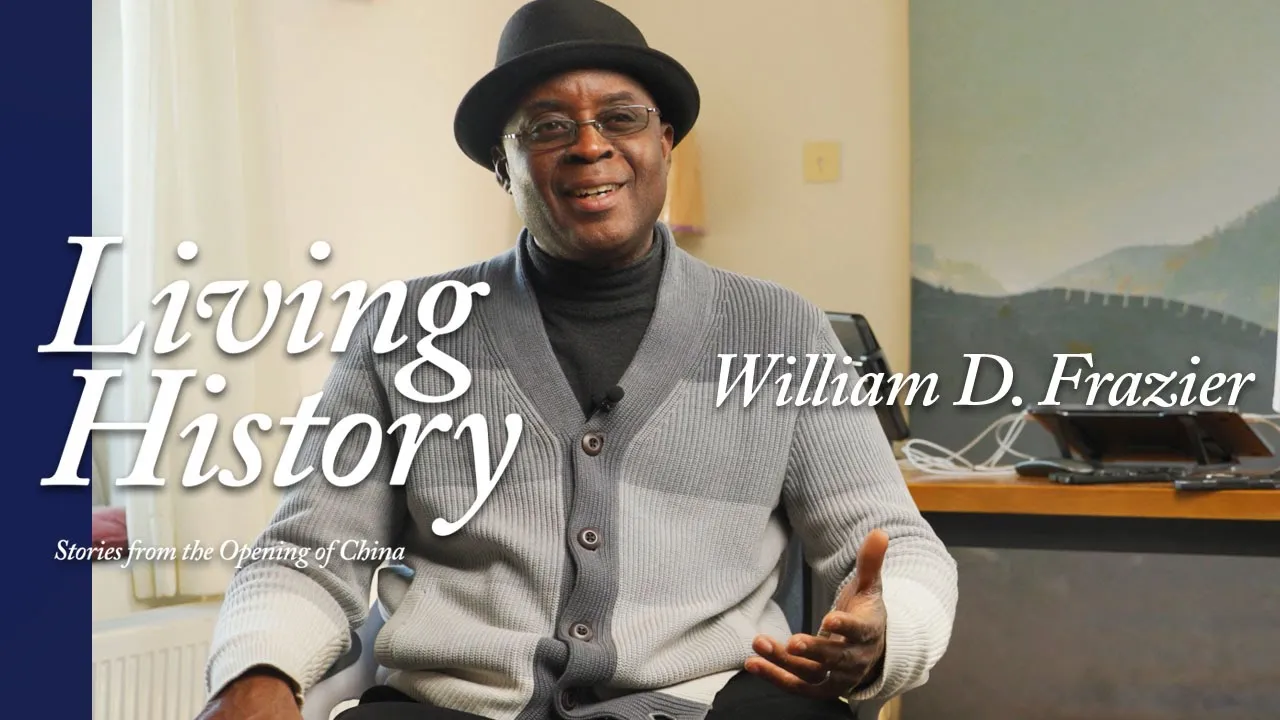
Today on Living History: We are speaking with William D Frazier: But at the same time it was, as for manufacturing, it was very noticeable that I didn't know what I was doing and the person in that company, a Chinese woman, mentored me and said “I will teach you how to do business in China" “if you teach me how to understand American markets" Today we're speaking with William D. Frazier, who came to China as a student in 2000, then became an employee and eventually struck out on his own. He's a foreigner who didn't smoke or drink at a time when that was just what everybody else did to break the ice in business.
And yet William still managed to build a successful import-export business in China. About cultural exchange when doing business in China, the great importance of Southern Chivalry and the many memories collected along the way we're hoping to talk about today. William Frazier, Welcome!
Ah, great to be here. That pretty much covers my beginning here. I came on study abroad-program back in 2000 and that was really the eye-opening experience, as far as coming to China for the very first time.
I come from a small south-east coastal town in Georgia named Brunswick and growing up as a kid, my only exposure to China, Chinese people, was either through a Bruce Lee-movie which is on the big screen, of course, and local restaurants. And that was it, that's my only exposure to Chinese people until I got to college That's my only interaction. but there's one part about China that I did not know, there's a lot of things about China I did not know.
When I first came and you mentioned that: the smoking, the drinking. But I didn't realize pork is the main meat here. And I don't eat pork, so there's a lot of adjustments I had to do for those three areas, because if not three at least one of those items is going to be in front of you on a daily basis.
So yeah, people ask me “Why are you here? " ”Why you live here? " What am I doing here after so many years?
Import-export was the business that came later on during my time here but the beginning was the study abroad-program and then going on to becoming a student, becoming one of their first foreign students in 2002. There were not many people like me here, honestly there were not. Everybody thought I was Michael Jordan because I had a bald head.
They thought I could play basketball. I mean, I play basketball but I cannot PLAY basketball. that's not that's not the issue.
it was always this interest of people looking at me which I really didn't understand at the time. From where I'm from, if you look at someone, you get eye contact and then you speak. I'm speaking but not knowing the language that well your next gesture is you wave, acknowledging that “I see you looking at me!
" So I acknowledge you as a person. And it was very rare that someone would respond back. And I just thought that was somewhat rude.
I mean “Why are you looking at me? " And I'm speaking to you and you're not speaking back. So I developed new mannerisms.
I figured “Okay, this is how things are done. " So you just you just sometimes give that stone-cold face. In a sense: you just look and I just started doing that.
So people look at me and I just look back. I'm mimicking you because I figured that's the way you're communicating. It wasn't an insult to them at all, just becoming more culturally-aware of what was going on over here.
and also: I had to immediately shed some of those western mannerisms. Like what? Thinking that there were a lot of gay people here.
How So? - Because you would see women walking arm in arm. And you didn't see that in the West unless they were intimate or had a personal relationship.
But that is a sign of friendship. I realized “Oh my God, these women are really into each other. " But I realized that's friendship.
That's the way people interact. I hate to say that part but that was one part. But I learned it because I asked the question “Are they lovers?
" “No, no, no! " ”Okay, fine. " But there was one incident that really made me get away from the Western Mentality of being here.
I think I was here maybe three weeks. I was walking, going to Shanghai Normal University 上海师范大学 Walking on the road. I heard these feet running behind me.
Somebody running behind me. So normally, if you hear people running, you look around to see if anybody else is running. And I didn't notice anybody running and this was within 10 seconds.
It's a very quick moment and I thought to myself “Oh my god, this is it! " “Somebody's gonna hit me in the head. " I'm a foreign black guy, walking down the street.
Somebody is going to come and attack me! Because I hear somebody running behind me. So I tensed up.
I'm walking but I'm getting very tense. I clenched my fist. And I'm thinking to myself “I'm going to turn around and I'm going to smack this person" “that's coming behind me.
" “I'm going to turn and I’m going to throw a punch. " And as I was getting ready to turn around this lady ran right past me and she ran to get on the bus! and I said to myself “Oh my god, I am not in the US anymore.
" “I'm in China and I'm safe. " And that was my wakeup-call, that I was actually in a safe environment and then I thought to myself “I better run to get on this bus, too" “because if I don't get on this bus I'm going to miss it. " I saw that a lot, people running to catch the bus.
Why are these people running to catch the bus? Because it was a long time until the next bus would take you where you need to go and there weren’t many Metro lines here and you didn't have many private cars, so you had to know how to do these things. So I started riding buses because I wanted to know how to move around the city.
I can walk, I can have a bicycle but that is going to take you so far. And by getting on the bus it has a beginning point, it has an ending point and you get to ride around and see what is where. That was me learning the layout of Shanghai.
So I would periodically get on a bus and just let it take me wherever you want to take me. and I’d just get off and remember the spot where I got off “Ok, I gotta remember this landmark, so when I get back on it take me somewhere else. " That's how I became very curious about the city, about this country.
The curiosity actually started when I came here. The plane is on the tarmac, flying into Pudong airport, there is only T1. You can just imagine me coming out of the plane, you're on the tarmac, you're on the top, coming out of the door and no idea why I said that it's just like I came out of the door like I'm some kind of royalty person or some famous whatever and I just stepped out, didn't go down, just stepped out and looked and said “I'm going to live here.
" And it just felt natural. Being here, it felt like maybe in the past a part of me is Chinese, I don't know! It’s just some people say “you have Chinese in you.
" I have no idea what that means. “Oh, you have Chinese in you, maybe you have been someone Chinese. " Okay, cool.
I always keep that student mentality because I came here as a student. And also about my upbringing: I know that I'm a guest here. This is someone else's home.
So I have to be respectful to how they run their home. This is not my home, this is your home. So I have to learn how you how you do things and adjust my ways, adjust to your lifestyle, not trying to get you to adjust to my life previous lifestyle.
Because that’s not going to work that way. And that was it. As I just continuously stayed here I treated it like a classroom.
Because I was always very curious about this place. I can remember my first spring festival here. I kept hearing about Spring Festival.
I kept hearing about this big celebration. It kind of reminded you of Thanksgiving and Christmas, all rolled up into one and all these things. I'm like “Wow, I’ve got to experience that.
" “I want to be here to experience that. " Man, that was the loneliest time of my life! I swear, everybody left, everybody went home.
Everybody I knew went home and I'm like “Oh my God, I'm stuck here. I have no idea what to do. " Then other people came from other places, came back to Shanghai.
So they're with their family. They’re all are doing their family thing, everybody's at home or going places, so they do it as a unit and I'm like “I have no idea what I am doing now. " That was lonely, it was rough because I had this image of what I thought it would be and initially, at that time period, it wasn’t.
But I was prepared for the second one. People had gotten to know me, so they would invite me to their home. Where did you go?
Where did I go for my first one. I think it was probably still in Shanghai. I’ve been to so many of them.
I don't know if I went to, I think it probably was in Shanghai, A lot of drinking going on, a lot of smoking going on and a lot of eating pork going on. I'm not trying to be disrespectful to the meals that people were preparing but at the same time please let them know I don't I don't eat pork. There was a little beef chicken but you had to watch because some of the vegetables that they had fried had pork in it.
So I ate a lot of bread and I obviously ate a lot of chicken and beef but it was obviously not what I was accustomed to because I never actually participated in a family event like that before. But the atmosphere was very nice, the fireworks were so pleasant and I was still wondering why everybody was sitting down watching TV? That blew my mind.
Everybody watching TV! And I have no idea what they're watching. I see it but I don't understand it!
I had to adjust to it but it was a training ground. I had to understand what was going on, to appreciate it more. I appreciate it more now after all the years of doing different Spring Festival activities but during that time period it was a lot of adjustments I had to do.
Being with friends was a challenge because I mainly surrounded myself with local people. When I say “local people" I mean Chinese people. I didn't know.
If you’re from Shanghai, fine. I don't care. If you’re from Hangzhou, fine.
If you’re from Suzhou, fine. I don't care. It was just because there were not that many foreigners over here at my level at what I was doing.
Even though you had a lot of “Executive level-foreigners," they had their own group. I am a guy that came over here on his own. I sponsored my own self.
I had to figure out a way to get a place to stay, make money, feed myself. And again: there were no foreigners with me to help guide me, mentor me in that that aspect. so I had to learn everything from local people and I was very grateful for that, to this very day.
I learned about this place from a lot of people. Tell me about the days when you started your business. You got your import-export license, tell me about how that came about?
Oh God, I wish I had it right here, I could show you the item that we made. I'm over here and people back in the States are asking me what they can get in China. And I'm like “What is it that you want in China?
" Don't ask what can you get in China, What do you want? And someone approached me to make some fraternity items. One of the first items I was making was a flag.
That was the time that having a flag, people going to homecoming American football games, going back to college, having a flag flying outside their car, having a flag inside your house of different organizations. So I found this company, it was in Pudong. That was really shocking to me because I didn't know anything about manufacturing, honestly.
I did not, at that point. Never done it a day in my life. But when I went there I saw the beginning of how manufacturing would be done, as far as when you come down to printing on textile.
They had this manual painting, the printout and they’d take the machine and go across not with a machine but manually, sliding across with the wooden plates and all that, and the conditions were really very bad compared to now, working conditions. Because you're dealing with a lot of environmental issues because you have that drainage, that dye that's coming off the paint, off the textile and it's just draining wherever it goes. There was no real drainage system to recycle that waste.
You had people that were breathing in that chemical all day long. They weren't wearing masks. We’re talking about the early 2000’s.
There were no masks, right. There were no ventilation systems inside the factories. You had old fans, back in the day we’d call these plow fans, big fans in the wall.
But there was no vent that is going to suck the air out of the location. So you going into these environments and you smell the chemicals coming in. I'm thinking myself “God, this is this really rough work!
" But at the same time, it was very noticeable that I didn't know what I was doing. As far as manufacturing, it was very noticeable. I didn't know what I was doing.
And the person that worked in that company, a Chinese woman, mentored me and said “This is how you should do business in China. " So you went to the factory and you tried to buy some flags and she figured out you didn't - Know what I'm doing. Tell me that story!
It was like this, you don't have a contract, you didn't stipulate the terms of how many flags you want, how soon they should be delivered, if they're not delivered at this time what happens you didn't specify how you want the flags to be packaged you didn't talk about how you wanted them to be labeled, the shipping marks on the cartons, how many pieces should be in a carton, how you want it shipped, you don't know about the codes, the HS codes, what the duty taxes are and all that basic stuff that you didn't know because all I said was “I want a flag, I have this picture and I want to make a flag. " That's all I had. A picture and said “I want to make flags.
" “What size flags you want? " ”Do you want eyes on it? " I'm like “Yeah, I have eyes right here.
" But: No, the eyes with the holes for connecting. And you want to pip on it? The trimming of it?
What weight of the material do you want? Do you want double sided print? Single sided print?
Well, do you want polyester? What percent polyester, nylon? All that type of stuff I have no concept at all about.
What's required when you start manufacturing. And she pretty much took me under her wing and said “I will teach you how to do business in China" “if you teach me how to understand American markets. " Oh, so you guys were able to help each other?
Yeah. -How old was she? Maybe two years out of college.
I started doing that maybe 2004 and I was already doing some crazy stuff that you couldn't do as a student back then that you are allowed to do now. But I had to hustle. I did that and was able to get the items shipped out.
So we decided to apply for our own export license and that was back in 2005 and they were just giving out export licenses like it was nothing. You want an export license? Just sign up for it, get it.
What items do you want to export? We went across the gamut on everything. One thing I say: no military equipment, no airplanes.
But pretty much everything else is on it. Pretty much everything else, you name it, I probably have the rights to export it. I didn't know that that was necessary, so we started doing that and then we opened up the business, opened the Shanghai-America direct import-export company.
We opened that and had a lot of employees. But that's when that part in me had to switch about to training because you had a lot of young people come because everybody's coming to Shanghai, everybody's going to major cities. but a lot of people were coming to Shanghai because the opportunities were here as far as getting a good job or going into business, whatever.
Everybody started coming here. So we found a lot of young people. You had a lot of people here bringing a lot of information a lot of technology on how to make things so if you got all of that in one area it's only common sense that somebody's going to be able to figure out they like this here, so we're going to make something that nobody else has made because we have the information, the technology and resources to create that because you actually trained people how to do that.
The world actually trained Chinese people to be very innovative. I’m not saying they were not innovative at that time but it's just that innovation, you could see that it was going to happen here. I can see it at that time, because you had everybody here.
A lot of cultures here, everybody here learning from everybody and you just had that stone face, and it's not being disrespectful but that face was just absorbing information. So I understood that look when I first got here. I waved but they wouldn't wave back.
So I understood: I'm just going to listen and learn and just listen and learn and listen and learn. To the point where we had employees that figured out what we were doing and they would start their own business. and I was like “I can't be mad at that!
" And the individuals that were doing this were females. The Chinese women, they would do that. And they have no more than maybe two years out of college.
They got in and start these very, very creative industries that are very sustainable right now to this very day and I'm like: “This is some wild stuff. " “This is some this is some really wild stuff" “That these women are actually creating their own identity" “Making their own pathways. " And I'm not just saying it just to be saying it but I witnessed it.
When I travel and go to factories It’s always you have the male boss or male husband, you may have that. but the person that's always making decisions is actually the woman. She has a very important role in how things are going to work, how things should go, as well as most of them spoke English.
And it's always very easy to keep communicating with them and they will understand William doesn't smoke, William doesn't drink. He's a good man. Okay, what does that mean, I'm a good man?
Oh, you're a good man. You don't go out and get drunk and you don't smoke, so we don't have to worry about you making poor decisions. I think that's what it meant.
I don't know! But also: remember I don't eat pork, I tell them that. Oh sure, no problem with pork.
But it was it was just this constant learning about life here And that’s no disrespect to men, okay? I don’t mean that. But I think men in a sense are pretty much the same across the board.
You told me about how women here in China were very good at understanding how you ticked, how to make you comfortable. But how did you make them comfortable? How did you make them want to do business with you?
How did you make them like you? I come from a large family. I'm the last of 14 children.
And I spend a good portion of my youth growing up on a farm. We learned to be respectful to women. That's the bottom line.
We just learned how to be respectful to women. If you're getting out of car: open the door for the woman or if you walk in a room, you don't sit down until the woman sits down. You don't do that.
You help a woman with a coat. These small things: don't hit a woman! All these small things I learned as a kid growing up and I just came here with that.
Like: when I go to the office they will open the door first but I was standing like: “You go in first. " “I'm going to hold the door for you. " Or they would stand up and a woman would come into the office and I would immediately get up.
I’d wait until she’d sit down or I’d say “thank you" and I just be just me. And I think that they were receptive to that. They said that I'm kind of funny, too/ I’d crack a joke every now and then.
I do humorous and silly stuff and then, out of habit by their culture they're covering their mouth like it was a bad habit to laugh but not to me. That was something that I saw and I was like “What, why do you cover your mouth? " “Oh, that's traditional culture.
" I'm like “Well, I think you have a very beautiful smile. " “Can I see your smile? " “Oh, I don't know!
" And that’s just it. Just making each other feel comfortable and appreciated. And I think we have to fight challenges, me being a foreigner and they being who they are we have different challenges we have to face when we're trying to prove ourselves in a male-dominated industry or in society.
And so we just keep going at it. What were the challenges that you saw them facing that you could identify with? Some of the challenges I saw them facing was convincing others that they could do the work.
It's just challenging, especially back then. It's probably still challenging right now, even more so. So it's very challenging for some of them because of their traditional values or ways in which they were raised that if they wanted to do their own thing at that time society kinda made it complicated for them to do it.
some succumbed to it but others, they own companies and are very successful at it but it's a lot of hard work for them as well because not only are they the general managers, they have to be the marketing person, they have to be the sales person, they have to be the spokesperson. and what I mean about that is they have to travel to other foreign countries because a lot of people weren’t traveling. At that time, you didn't have many Chinese people who had passports but as the industries, businesses started getting bigger and bigger and a lot of trade shows in other countries happened, naturally they had to travel to those other countries to promote their businesses.
So they had to go to a lot of countries do trade shows. And here they are, traveling over there, being the marketing person, being the sales person, being the spokesperson for their businesses. It is very demanding at that time period, especially when English is the fallback language.
Not as much as it is now but back then it's the fallback language when you're trying to negotiate and trying to get orders and trying to convince people that they should trust you and trust your business to deliver what you say you could deliver. So yes, that’s very challenging. Did you guys go together on trips like that?
Yes, I spent a lot of time traveling, oh my god. I think America probably was one of the most challenging, interesting places that I went to do a trade show. And it still is an interesting place for trade shows, especially coming from here.
It was at times that you could feel the resentment or not the resentment. That I am here, a black guy in America representing a Chinese company that's telling other people to do business with me. How is it possible that a black man that doesn't work for a corporation has a Chinese company, is working with a Chinese company that comes to America to tell other people to do business with them?
That's a very rare step and coming from the South I can see it. You can see it and you can feel it. And then you turn around and have a Chinese woman.
You don't have a Chinese male and you don't have a white male that represent this company to say “Come do business with us. " You don't have that, so that is the challenge in itself. We recognized that but it was not just like that in America, you had to go to other places, you had to go places like Southeast Asia, you had to go to places like Dubai.
You know, Dubai was really growing at that time period. those patriarchy-type countries. It's very hard to get that type of message across to them.
But it worked out and the longevity of it all is was what we were in for because we knew that this is going to be a very challenging process. But we didn't know how challenging it was is going to be. And to get through all of that!
Because when I when I finally moved over here in like 2002 the thing that happened in 2002 was SARS and I stayed. And at the same time I was riding the bus. Because this was when riding buses was not that filled up.
People would not, even though they were cleaning the buses. But everything was not shut down like when Covid happened. You could still move around, you still had masks but it wasn't totally shut down.
And so, when Covid happened, I was like “Okay, I seen this before. " “I’ve seen it on a smaller scale" So, going back to the SARS part, that's when people started “Oh, be careful in China" ”China has got SARS. " All the “be careful!
" ”don't do anything over there, It’s very bad. " People telling me “don't come back to America," “You got that SARS. " And all that stuff.
I really didn't have any intention to come back, whether SARS is here or not. For me, when I came it was like nobody believed it. No one believed it.
It had to be something that actually happened, that triggered me to say “okay, I had enough. " And again, I had a good job, I had a good local job, economic development planner for the city of Savannah, a good job. It was not like I didn't have a good job, a good career path.
And after coming to China for the Study Abroad-program in 2000, then I came back in 2001 and I attended the “the World Planning Congress" that was at Tongji University and I met his professor and he asked me What are you researching? What is your work? And prior to that decision I had told my faculty advisor that I did not want to write on anything about the US.
For some reason I said I don't want to write on anything about the US. I don't want to write no urban study, no economic development plans about the US, I just didn't want to do it because I felt like it was useless, everybody did that. but when I came and they asked me what I wanted to write about I said “I want to write about" “The role of migrant workers in the economic development of China.
" And they just looked at me. “What? " I said ”Yeah.
" “The role of migrant workers in the economic development of China. " And he said “Why that? " I said because of these migrant workers and what happened with The Great Migration.
The Great Migration is a time period in the US from the 1920s to the 1970s when a lot of black folks left the South and migrated to the North, to the industrial North to help build up the industrial revolution in the US, that phase. And I saw a lot of migrant workers coming from the countryside, coming to the city to build up China. I saw that comparison and it blew my mind.
And that's what I did my research on. That professor told me “Once you finish you should come back here" “and study for your PhD in China - and I did! " I did, I came back, I wrote at Tongji from 2002 to 2005 Crazy Story - I wrote my dissertation, did not defend it because the same person walked up to me said “William, want to do business in China?
" And boom, here I am doing business. forgot about my dissertation and that's the story of how I ended up here but I ended up here because of 9-11. I was going to work at the office The boss called and said “Turn on the TV!
" We turned on the television and we saw the second plane going into the tower I thought it was a movie, like this is crazy and for some reason I sat down I sent that professor an email, I said “Is that opportunity still available to study for my PhD in China? " He said yes and I was here in February. So from September to February, that's how fast I moved to China And while doing that whole process of moving here, people were like “You're not gonna do that!
" I started selling everything, everything I could possibly sell, getting rid of everything. “You're not gonna do that! " And boom!
Gone! First couple of years: “When you coming back home? " Now when I go back home “How long you gonna be here?
" The subject matter has changed. It’s not when are you coming back, it's about how long are you gonna be here because they know I'm not gonna stay. Back in America, prior to leaving, when I told him I was moving to China, they were asking me “Why are you moving to a poor country like China" “when you have a good job and career here in America?
" and my response was “That's a better opportunity out there for me" “then what's going on here in America.