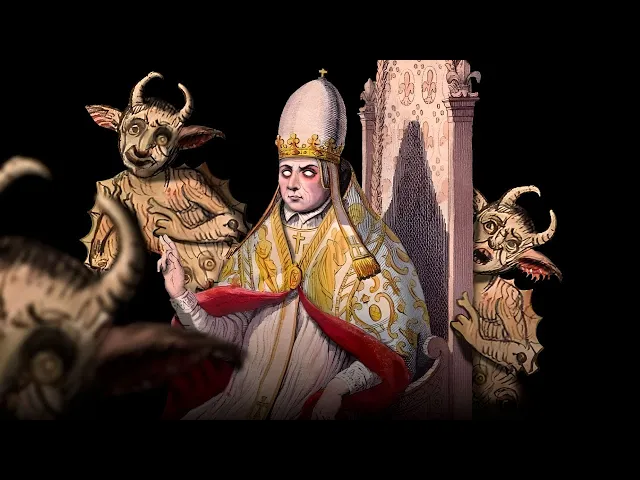
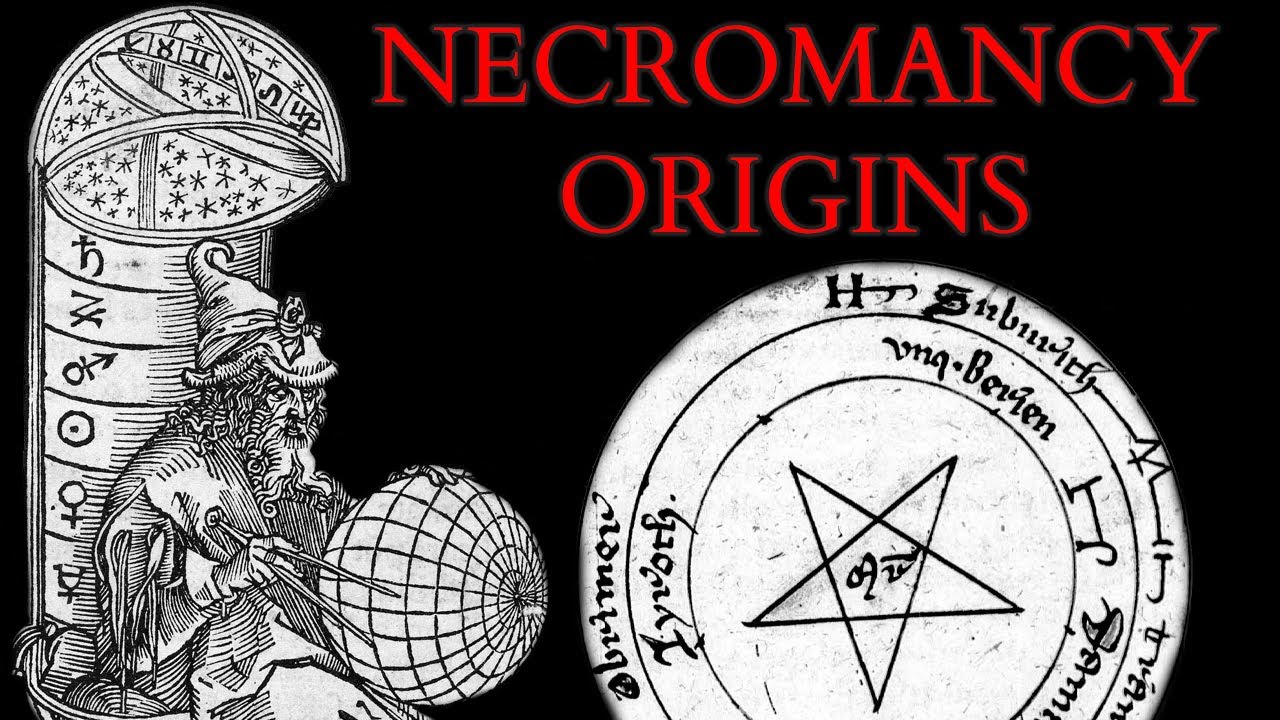
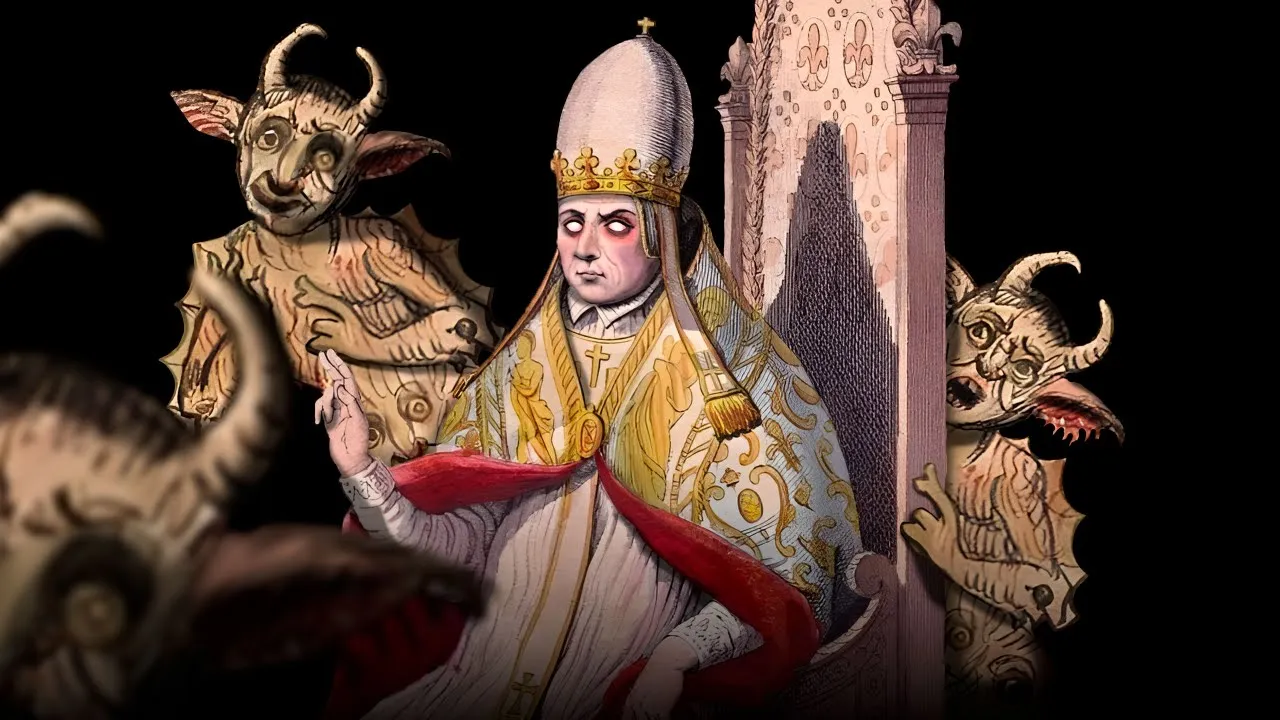
The black legend surrounding Pope Silvester II’s life began to emerge some seventy years after his death. The medieval mind conceived of him as a wizard, a magician, a necromancer, who made a pact with a demon, perhaps with Lucifer himself. How else to explain the bracing rise of this lowly monastic fugitive?
Who crossed the Pyrenees in search of secrets paynim and indecipherable. It was said that Sylvester stole these secrets from a Saracen philosopher, who kept a book of forbidden knowledge underneath his pillow. Seducing the Saracen’s daughter, Silvester conspired with her to get him drunk and then made off with the codex in the dead of night.
The stars nearly gave him away. With their guidance, the learned philosopher could track all things that crawled, walked, or swam. Silvester only eluded him by hanging from a bridge, suspended, between earth, air, and water.
When the coast was clear, he used the philosopher’s book to invoke the Devil, and exchanged his soul for a stygian passage across the Bay of Biscay. With this unholy alliance sealed, he charmed everyone he met on either side of the Alps, grew rich and famous, built infernal machines, and tinkered with contraptions with which he cracked the world’s riddles as if he were cracking an egg. At last, this chosen son of Lucifer crowned a lifetime of achievement by becoming pope and taking that infamous name: Silvester II.
Now, “. . .
some [of you] may regard all this as a fiction,” writes one medieval author, because “the man who excels in any admirable science,” is often accused of “[holding conversation] with the devil. ” But, he goes on, what then are we to make about the reports of this diabolical pope’s death? A death every bit as spectacular as his life.
You see, there had been a secret clause in Silvester’s contract with the Devil. A riddle he cracked by constructing and consulting a “brazen head” -- a mechanical answering machine that answered “yes” or “no” to any question posed to it. One imagines that it took an awfully long line of questioning to get there…but eventually this machine yielded the Devil’s clause: Silvester’s life would be forfeit, his soul confined to Hell…if…he held mass in Jerusalem.
This did not seem all that problematic. It simply ruled out a pilgrimage to the holy land. Yet unbeknownst to Silvester, there was a church far closer to home -- in the eternal city of Rome -- that was called the Santa Croce in Gerusalemme, the Holy Cross of Jerusalem.
After Silvester arrived in this church, which stands to this day, he realized his blunder only when it was too late. One version of the story holds that the Devil and his entourage appeared among the congregation and maimed and killed Silvester with their own bare and clawed and cloven hands. A more sober account suggests that Silvester fell ill shortly after the service, but that on his deathbed, he gave orders for his corpse to be dismembered, a last-ditch gambit to avoid eternal damnation by separating mind from body.
His dismembered remains were promptly interred, and the inscription on his tomb read: "This place will yield to the sound [of the last trumpet] the limbs of buried Silvester II…” Either because of a misreading of the inscription or because of the many other stories about his life, it has since been reported that the bones of Silvester II rattle each time a pope is about to die. As you might have surmised, historians have poked a few holes in this story, the most straightforward being that Silvester’s corpse was not actually dismembered but interred whole. Yet, the question remains: what kind of life, character, and genius could possibly have inspired a twisted legend such as this?
That is the riddle that we will attempt to crack today, unless of course you’d prefer to consult a brazen head. -- But first, a word from our sponsor. No, not OpenAI… For this video, I’ve partnered with MyHeritage.
Drwing on over 20 billion historical documents, MyHeritage is the leading global solution for family history research and DNA testing. After signing up, I was blown away by how easy it was to start building my family tree. All I had to do was enter my first and last name, which pulled up records for all my immediate family members.
After that, I invited my brother and some other relatives to join me on the platform, and immediately got access to Instant Discoveries. That’s when things got really interesting. In the blink of an eye, my family tree quadrupled in size, going back seven generations to the 19th century.
I got to see the faces of my great great grandparents, and their parents, for the first time in my life. On top of that, I was able to enhance and animate their photographs, an absolutely surreal experience. If, like me, you want to take it upon yourself to become your family’s court chronicler, consider signing up for a 14-day free trial using my link in the video description.
And now, back to the video. Thanks for watching, and remember to check out the link in the video description if you're interested in learning more about MyHeritage. -- Around the year 946 AD, Pope Silvester II was born Gerbert d’Aurillac.
The ancient French town associated with him was named after Marcus Aurelius, and almost 800 years after this emperor’s death, Aurillac still observed Roman law. Since Gerbert’s father was a “pastor,” he may have been well-versed in that subject. Nor would he have been prevented from fathering a son at a time when many of his ecclesiastical peers kept concubines.
That being said, it’s possible that Gerbert’s father was a simple pastor of sheep rather than souls. Neither a clergyman, nor a serf, but a free peasant. This being before the full-scale advent of serfdom and feudalism.
Regardless of his father’s profession, the teenaged Gerbert found himself at the monastery of Saint-Gerald after he impressed its abbot with his quick and precocious mind. Gerbert’s life at this Benedictine monastery can be summed up with the motto ora et labora (“pray and work”). He learned how to write with stylus and wax tablet, and then graduated to quill and parchment.
He learned how to read with the Book of Psalms, and the sacred hymns contained therein were chanted daily. At the end of every week, he and his monastic brothers would have sung their way through the entire book, thus beginning the cycle anew. Gradually, all one hundred and fifty psalms were committed to memory through rote repetition and, where necessary, the birching rod.
The threat of the rod and public humiliation also helped ensure that monks were in and out of bed at the right time, so that they slept, prayed, learned, ate, and worked in accord with the hours of Prime, Vespers, and so on. Self-sufficiency was expected of Benedictine monasteries, and they often had enough provisions to function as rest stops and hotels to weary pilgrims and travelers. This meant that each monk did his fair share of cleaning, cooking, and gardening, among other duties.
Whether at work or in prayer though, the mind of a monk was never to stray too far from God. To facilitate this perpetual conversation with the creator, a vow of silence was observed, broken only by brief spells of chatter in the morning and evening. For practical, noontide concerns -- like passing the salt or accusing someone of uttering a falsehood -- “the language of the fingers and eyes” was used.
A monastic sign language. Though some of these rules must have frustrated a personality as inquisitive and sociable as Gerbert’s, on the whole, he enjoyed his years at the monastery. The life of a monk was the most introverted mode of existence in the middle ages, but it also offered monks luxuries that would have been unknown to most peasants: a bed to call your own, plenty of food, regular music, comfortable clothes, and the means to study and learn new things.
A peasant tilling the fields had neither the time nor the learning necessary, to construct memory palaces with which to memorize the Bible or to harvest oak galls with which to make ink and write things down. In later years, Gerbert had only positive things to say of his time at the monastery, and he spoke and wrote movingly about both the abbot and his former instructor, Father Raymond: “To all of you together I render thanks for my installation [as archbishop], but more especially to Father Raymond whom, after God, I thank above all mortals for whatever knowledge I possess… Discipuli victoria, magistri est gloria. [The pupil’s victory is the master’s glory].
” -- In the year 967 AD, Gerbert -- now in his late teens or twenties -- left the monastery to continue his studies in Spain. This was not the hurried departure of a fugitive, but more like the honored commencement of a monastic alumnus, one who “shone with the double light of religion and science. ” Gerbert had been unanimously chosen by his brother-monks to accompany the Count of Barcelona on his homeward journey.
This would allow him to learn the quadrivium -- arithmetic, geometry, astronomy, and music -- from the very best. In the process, Gerbert would be building on his foundations in the trivium -- grammar, rhetoric, and logic -- placing him on a path to mastery in all seven liberal arts. Covering some twenty to thirty miles a day, Gerbert was no doubt a keen observer of the ancient aqueducts and bridges that he and the rest of the mounted party passed along the way.
When he arrived on Iberian soil, he found a land of distinctly Roman and Gothic heritage, with a law code, courts, and other remnants of antiquity, faithfully preserved by the Isidorian Renaissance. Yet, it was also a land on which a new civilization was leaving its imprint. One that boasted not only of aqueducts but of keyhole arches, water-powered papermills, silkworms, canals, paved roads, and street lighting.
Of dozens of varieties of minerals and fruits, hundreds of bathhouses, thousands of mosques, and tens, if not hundreds of thousands, of books. This civilization was called Al-Andalus, its name a nod to the bygone Vandals, or vándalos. Its rulers were the Umayyads, who had been chased west from the Arabian heartland, and their greatest city, Cordoba, was called the “ornament of the world” -- this from the mouth of a Christian, not a Muslim.
In actual fact, only half of Cordoba’s inhabitants practiced Islam, the other half consisting of Christians and Jews called dhimmis. It was a substantial segment of the population -- a cash cow that bought religious freedom by paying the jizya tax. Silver and gold were aplenty in this city, though its greatest treasures were those of the mind.
Cordoba’s “seven streams of wisdom” watered every corner of the Iberian peninsula, with advances in science, mathematics, and engineering percolating to the lands around Barcelona with a self-assured ease. That is why Gerbert’s time in Spain was animated by such colorful personalities as the abbot-polymath, Garin. Though a man of the cloth, Garin was also an aspiring engineer and mathematician, widely traveled and politically influential.
He brought the keyhole arch to one of his churches, and kept a book on multiplication and division by an Iberian scholar. He dreamed about the restoration of the Carolingian Empire, and in later life convinced a Venetian doge to become a hermit on the outskirts of one of his five monasteries. Gerbert’s main teacher, under whom he studied mathematics, was the Bishop Atto of Vic, another forceful political operator.
His goal? To have the diocese of Vic elevated to an archbishopric. Toward that end, master and pupil set off to Rome in the close of 970, seeking an audience with the pope.
Joined by the Count of Barcelona, they braved an Alpine winter crossing along with the usual hazards of travel: the Muslim slave-traders of Fraxinetum, the run-of-the-mill horse thieves, the greedy toll collectors, and the not-to-be-discounted peril of subpar customer service at the local tavern or monastery. In the end, though, it was all worth it. With the pope’s approval, the mission was a success, and Atto became an archbishop.
His neighbor, and former overlord, the archbishop of Narbonne, did not exactly take kindly to Atto’s emancipation. And it is probably by his order that Atto was assassinated on his way back home. Fortunately for Gerbert, he was far removed from the violence, still comfortably ensconced in Rome.
We can turn to the monk and historian Richer of Saint-Remy to explain why that was. -- “The pope did not fail to notice the youth’s diligence and will to learn. And because musica and astronomia were completely ignored in Italy at that time, the pope through a legate promptly informed Otto, king of Germany and Italy, that a young man of such quality had arrived, one who had perfectly mastered mathesis and who was capable of teaching it effectively.
” This Otto was none other than Otto the Great, who swiftly arranged for Gerbert to tutor his son and heir, the future emperor Otto II. Gerbert, still in his twenties, was not much older than the 16-year-old Ottonian princeling. It is possible that he taught the prince some Latin, as well as the Socratic method, but otherwise his tutelage seems not to have been particularly productive.
That is through no fault of Gerbert, but only the consequence of the short duration of their time together. Only the following year, on Easter Sunday, 972 AD, the future emperor was married to the Byzantine princess Theophanu, and Gerbert was without a job. But fortunately for him, he was now moving in the right circles.
It was at his former ward’s wedding that Gerbert met a man sent by the Archbishop of Reims to speak to him. Rheims was a center of learning, and the archbishop was a very important man in the Kingdom of the Franks. So when he offered Gerbert the post of canon at the local cathedral school, the offer was readily accepted.
Upon his arrival, he found a city worthy of its reputation: the ramparts made to defend against viking raids torn down with the pacification of that threat. The cathedral renovated with a new bell tower, and adorned with golden cross, stained glass windows, beautiful frescoes, and marble floors. It’s likely that the monks he met grumbled about their grueling work hours and their skin-tight breeches, which according to one account made their rear-ends “resemble those of prostitutes.
” But compared to the monks, Gerbert would enjoy a lot more freedom, both in terms of legwear and his work schedule. Cathedral schools, like the one at Rheims, were predecessors to the universities of the high middle ages. Like monks, canons sang sacred songs, collected relics, and took care of the poor, sick, and itinerant.
But canons could also wear linen, eat meat, and collect worldly wealth, including jewelry, slaves, homes, and books, with a single codex equivalent to roughly one hundred loaves of bread in those days. Except for one brief interlude, Gerbert spent the next two decades at the cathedral school in Rheims. During that time, he instructed anyone and everyone who came his way.
Frenchmen, Germans, Italians. The lowborn and the highborn. Thirteen future bishops and archbishops, six abbots, a chancellor to one emperor, a secretary to another, a future pope, and the future king of France, Robert the Pious.
Gerbert “expended quantities of sweat” teaching these many students how to exercise the mind and how to make it conscious of itself. In this effort, he hoped to prevent the powerful among them from needlessly expending quantities of blood. “For speaking effectively to persuade and restraining the minds of angry persons from violence by smooth speech are both of the greatest usefulness [to those busied in affairs of state].
For this activity, which must be prepared beforehand, I am diligently forming a library. ” Gerbert probably would have agreed with the saying that the greatest way to master a subject is to teach it. His personal research on the seven liberal arts guided the direction of his curriculum, and the exchange of letters with his pupils guided the direction of his personal research.
With a student named Constantine, he corresponded about topics as inscrutable as superparticular numbers and sesquiquartal numbers, about the rules of the abacus and the rules of the celestial sphere. His 233 extant letters were written in Latin, employed Carolingian miniscule, indulged the occasional pun, and glimmered with classical and biblical allusions. He regularly quotes Virgil, Terence, and Horace without attribution, draws deeply on the works of Boethius and to a lesser degree Cicero, and he makes reference to Cassiodorus, Isidore, Livy, Pliny, Ovid, Seneca, and Sallust.
“Gerbert… sends greetings to his Ayrard. We give assent to your requests, and we advise that you carry out our business as if it were your own. Have Pliny corrected…and have copied those books which are at Orbais and at Saint-Basle… Procure the Historia of Julius Caesar from Lord Adso, abbot of Montier-en-Der, to be copied again for us in order that you may have whichever [books] are ours at Reims, and may expect ones that we have since discovered, namely eight volumes: Boethius On Astrology, also some beautiful figures of geometry, and others no less worthy of being admired… You know with what zeal I am everywhere collecting copies of books.
” Yet the most striking thing about Gerbert’s correspondence is the warm and fraternal tone he often employs. And his unceasing declarations of friendship, fraternity, fealty, and fidelity belie the myth of a tenth century cold and aloof in character. “I do not know that divinity has given to mortals anything better than friends.
” But all that aside, Gerbert was not a writer. He was an orator and a teacher. His letters were written for practical reasons and his manuals and treatises were prepared for the benefit of his students.
To teach them grammar, rhetoric, and logic, Gerbert had his pupils study the corpus of the ancients, and he sometimes read these works aloud to them to explain the meaning of certain words or passages. Then he would bring one student up to play the part of sophist, and this student would defend an argument or point of view against the rest of the class. If the student had assembled the material necessary for a “memory palace,” then he would have plenty of rooms, hallways, and other markers to consult for the purpose of recalling winning aphorisms, references, and figures.
The remaining liberal arts -- astronomy, arithmetic, geometry, and music -- required additional methods of instruction. Namely, the use of visual aids, like the abacus, monochord, astrolabe, and armillary sphere. Of these various gizmos and gadgets, the abacus is the one most often associated with Gerbert, and his name lent itself to the term “gerbercist.
” A byword for “abacist,” or “abacus expert. ” This hide and horn-hewn instrument could be prepared by a shieldmaker, and was inscribed with nine of the ten Hindu-Arabic numerals. It probably enabled Gerbert to multiply and divide numbers faster than anybody else north of the Alps.
What the abacus was to mathematics, the single-stringed monochord was to music. Drwing on the theories of Boethius, for whom all was music, Gerbert and his students picked up on which ratios of notes pleased the ear, and these harmonies were taken to be sacred. In astronomy, the astrolabe, or “star-taker,” lit the way.
This instrument allowed its user to determine the position of the sun, moon, stars, and planets. It could be used to predict an eclipse and to tell the time, even in the middle of the night -- this, with a striking degree of accuracy, down to a quarter-hour. Later, it would be said that the astrolabe was a demonic inheritance, when in reality, Gerbert probably learned about it in Spain, after chancing on a book written by the Islamic scholar Al-Khwarizmi, whose name gave us the word ‘algorithm.
’ It may be that Gerbert also learned how to construct an armillary sphere during that time. But we don’t know much about what his particular models looked like, or how they functioned. The most advanced version was probably made of wood and hide and used iron and copper wires for its seven sighting tubes, one for each of the planet’s two poles and five climate circles.
Based on Gerbert’s writings and those pertaining to him, this instrument was useful for tracking the movement of heavenly bodies and plotting latitudes and longitudes, once again with a striking degree of accuracy. Taken all together, these instruments fostered an inchoate spirit of empiricism, deepening Gerbert and his students’ knowledge of the quadrivium, and inspiring countless thinkers and tinkerers in the centuries to come. -- By 981, the thirty-something Gerbert had played the part of wandering monk, imperial tutor, cathedral canon, and now he slowly began to assume a new role: political actor.
This was a logical move. He’d done well for himself in the past decade, continuing his devout pursuit of knowledge while accumulating a growing fortune and a rolodex of the most powerful figures in Europe. His future detractors attributed this good luck not to friends in high places, but to just one friend.
The one confined to the lowest place of all. Yet in the next two years, Gerbert would suffer a reversal of fortune, and with it, the true essence of his character comes to light. At the invitation of Otto II -- his former ward -- Gerbert left Rheims and came to Italy, becoming the abbot of Bobbio.
It was during his brief tenure as abbot that he began keeping copies of the letters he wrote, most likely for his own protection. The servants, books, and other possessions he brought with him, as well as his friendship with the emperor, inspired a fair degree of envy, earning him enemies near and far. Little wonder then that, with the premature death of Otto II, Gerbert was chased out of Bobbio, forced to leave behind “the best part of his household [treasures].
” What makes this episode interesting is not just the misfortune Gerbert met with, but also the aforementioned correspondence that he compiled. In these letters, he gives over-honest advice to the emperor, refuses to hand over a benefice to the empress mother’s favorite, and admonishes a corrupt and greedy cleric. He is not self-interested, sycophantic, or savvy, more the philosopher than the politician.
If Lucifer was watching from below, he would have been disappointed with his supposed acolyte. -- Though Gerbert was not as quick a study in politics as he was in science and mathematics, he was learning. After returning to Rheims in 984, he resumed his post as canon, but he also assumed two more roles: spy and siege engineer.
Throughout his life, Gerbert’s loyalties remained affixed to the Ottonian family, and his vantage point in France allowed him to gather intelligence on their behalf. Sensing which way the wind was blowing, he advised an alliance with Hugh Capet, the real power in that kingdom. Though that advice was disregarded, his efforts helped ensure that Lorraine, or Lotharingia, remained a part of the Holy Roman Empire.
And he also smoothed the ascent of Otto II’s wife, Theophanu, who would rule on behalf of her son with the acknowledgement of France. “Lorraine is witness that by my exhortations I have aroused as many persons as possible to aid him [Otto III], as you are aware. ” Yet, Gerbert received no immediate reward from the Ottonians for his assistance.
Nor would Hugh Capet reward him after becoming king. This despite the fact that Gerbert built siege weapons for him in addition to advocating his case with Theophanu. When it came time to elect a new archbishop of Rheims in 989, Hugh did not pick Gerbert, but instead opted for the illegitimate son of the last Carolingian king.
Within only two years, however, this archbishop betrayed Hugh, and he was summarily imprisoned, defrocked, and deposed. It was then that Gerbert became archbishop of Rheims. “I do not know, I repeat, I do not know, why I, destitute and an exile, aided neither by birth nor wealth, was preferred to many persons who were wealthy or conspicuous for the nobility of their parents, unless by Thy gift, good Jesus, who lifts up the poor out of the dunghill to sit with princes.
” The position was an exceptionally important one, the diocese the most important in France. That is why Gerbert’s installment was bitterly contested by the pope, who wanted the last archbishop reinstated -- the same one Hugh defrocked. Gerbert’s position was not to be envied.
He was excommunicated by the pope and shunned by those around him. A black mark that fed the black legend surrounding his memory. But such a politically motivated excommunication could be lifted with the stroke of a quill.
All Gerbert had to do was resign as archbishop, something he actually yearned to do so he could return to his studies. The only problem was that the king forbade him from doing that. For the newly enthroned Hugh, Gerbert’s resignation would mean conceding defeat to the pope and emperor, who were in league together.
Gerbert had no brazen head to guide him through this political labyrinth, so he waited unhappily for a development. Any kind of development. And in 996, he got it.
In that same year, both king and pope died, yet Gerbert was forced to abdicate all the same, and his baseborn Carolingian predecessor was reinstated. The whole experience left him sick in soul and in body, possibly with malaria, which is why he left France for Germany. Though his former pupil, Robert the Pious, now sat on the throne, the two had fallen out over the new king’s domestic drama, which involved an unhappy divorce, an unreturned dowry, and a mildly incestuous remarriage.
In other words, the usual kind of royal antics. But Gerbert was tired of all that. He knew that his destiny lay not with any king, but with an emperor.
More specifically, the emperor. To this imperial personage, Gerbert wrote the following: “For your safety have I exposed my person, however small, to raging kings and frenzied people. Through wilderness and solitude, beaten by the assaults and attacks of thieves, tortured by hunger and thirst, by cold and heat, in all disturbances I stood firm so that I chose death rather than not to see the son of Caesar, then a captive, on the throne.
I have seen him rule, and I have rejoiced. Would that I might rejoice to the end and finish my days with you in peace. ” In 997, the emperor’s fateful response finally came: “We wish to attach to our person the excellence of your very loving self.
Your philosophical knowledge has always been for Our Simplicity an authority not to be scorned. [You] may be zealous in correcting us, though not more than usual, unlearned and badly educated as we are, both in writing and speaking, and that -- with respect to the commonwealth -- you may offer advice of the highest trustworthiness. We desire you to show your aversion to Saxon ignorance by not refusing this suggestion of our wishes, but even more we desire you to stimulate Our Greek Subtlety to zeal for study, because if there is anyone who will arouse it, he will find some shred of the diligence of the Greeks in it… Postscript: Pray explain to us the book on arithmetic.
” Clearly, the teenaged Holy Roman Emperor, Otto III, was far more studious than his father or grandfather ever had been. But like them, he dreamed of ruling a unified Christian empire and joining the ranks of Constantine and Charlemagne. After Gerbert became Otto III’s tutor, he encouraged these notions in his young ward, who must have reminded him of his imperial father, but perhaps even more so of a certain wandering monk from Aurillac.
Years before Gerbert wrote a richly symbolic, ingenious poem, called a carmen figuratum, which -- for all its many themes and lessons -- revolved around the idea of a kosmokrator whose empire would spread across the cosmos. It had been a gift for Otto II, who died prematurely. Yet, now, the son showed even greater promise than the father.
Might he be the one to fulfill this awesome destiny? In Gerbert’s mind, there was no doubt. “Ours, ours is the Roman Empire.
Italy, fertile in fruits, Lorraine and Germany, fertile in men, offer their resources, and even the strong kingdoms of the Slavs are not lacking to us. Our august emperor of the Romans art thou, Caesar, who, sprung from the noblest blood of the Greeks, surpass the Greeks in empire and govern the Romans by hereditary right, but both you surpass in genius and eloquence. ” To cultivate this “genius and eloquence,” Gerbert drew on the curriculum he had prepared and perfected in Rheims.
He tutored the young emperor in astronomy, rhetoric, music, and arithmetic. But he also offered political advice, something he was now in a better position to do. In 998, Otto III had his cousin-pope lift Gerbert’s excommunication, and he was simultaneously made archbishop of Ravenna.
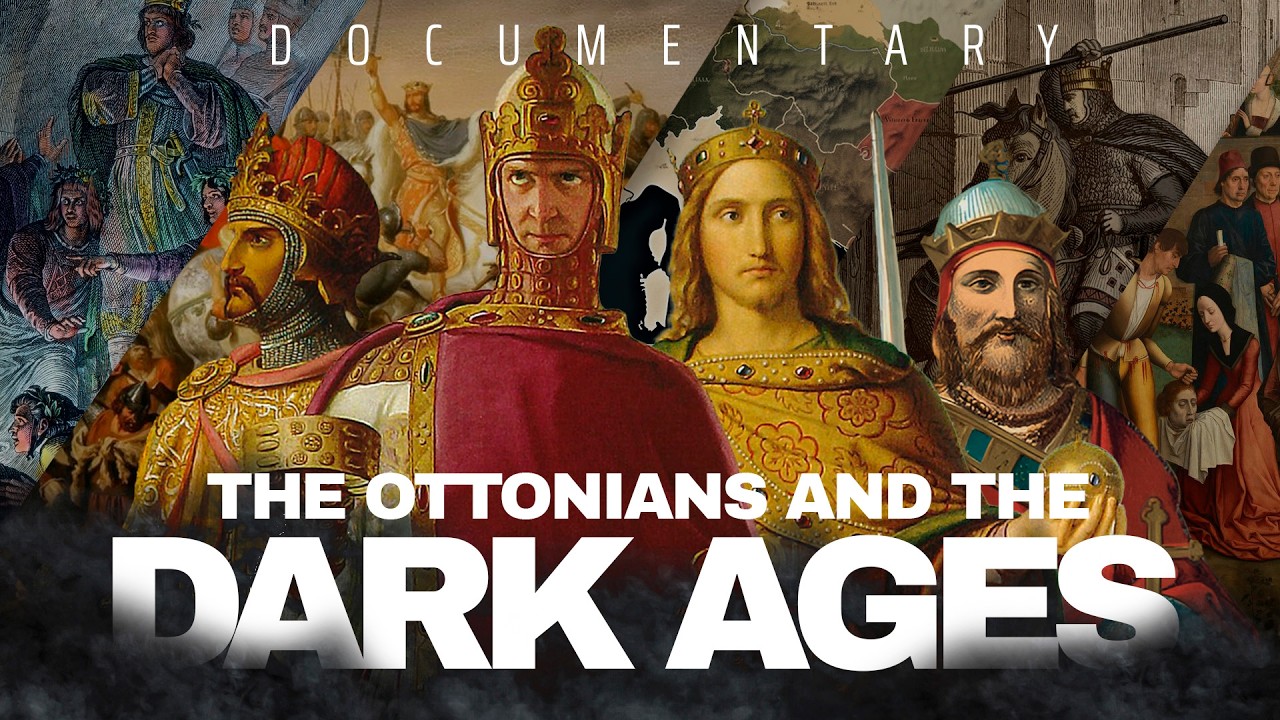
Yet only the following year, Otto’s hand-picked pope died, either because of an illness or poison. And it was then that Otto presented Gerbert as the logical successor to Saint Peter, and he consequently became Pope Sylvester II. A name that resounded with historical significance.
The new pope and emperor were effectively broadcasting their intention of recreating the Christian Empire of Constantine and the first Sylvester. But though they were equal to this task, they had precious little time to see to its completion. Within three years, Otto III died of malaria like his father had.
And the year after that, Pope Sylvester II died also, most likely to natural causes. In the intervening period, master and pupil had largely been preoccupied with wresting control of Rome from its factitious inhabitants. And one wonders whether the pope himself did not prepare the siege engines used against the city meant to be under his protection.
Gerbert’s tragedy was that he reached the summit of ecclesiastical power in the twilight of his life, when he neared the age of sixty. It was a tragedy compounded by the premature death of his two imperial patrons in their twenties. In the event, his papacy coincided with the end of one millennium and the beginning of another.
In this new millennium there would be no Christian empire, yet Christendom would expand not only to the outer reaches of Europe, but far beyond. To lands and places completely unknown to Gerbert and Otto. The story of those kings, emperors, popes, monks, and tinkerers is best saved for another time.
For now, it suffices to say that Gerbert would be remembered in these later centuries. A source of inspiration, but equally a cautionary tale, to the curious. Why this dichotomy emerged is not exactly clear.
The simple explanation is that Gerbert’s wide-ranging journeys, both in the literal and metaphysical sense, could not otherwise be compassed. At the hands of mystical, clever, and benighted storytellers, like Cardinal Beno and William of Malmesbury, a tale of illumination became a tale of damnation. later, their story would be useful to reformers fighting against an institution they believed to be rotten to its very foundations.
Today, in our new millennium, we’re supposed to know better, but we’re still suckers for a good story. That -- I think, more than anything else -- explains why Aurillac’s fresco of Gerbert’s life, commissioned in 2005, depicts a globe, an astrolabe, and in a discreet corner by the subject’s feet… a sly, little devil.