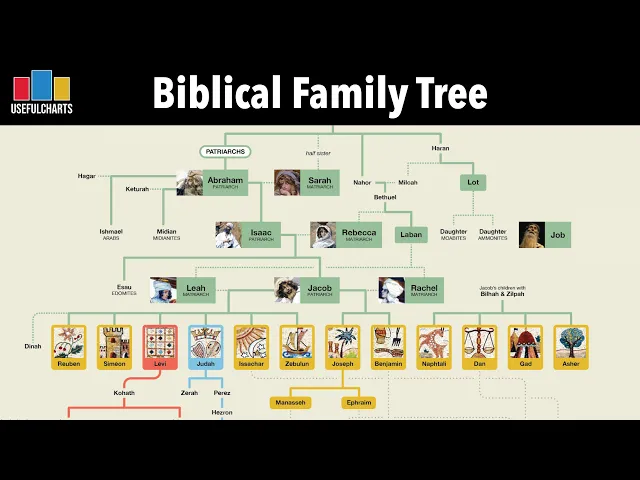
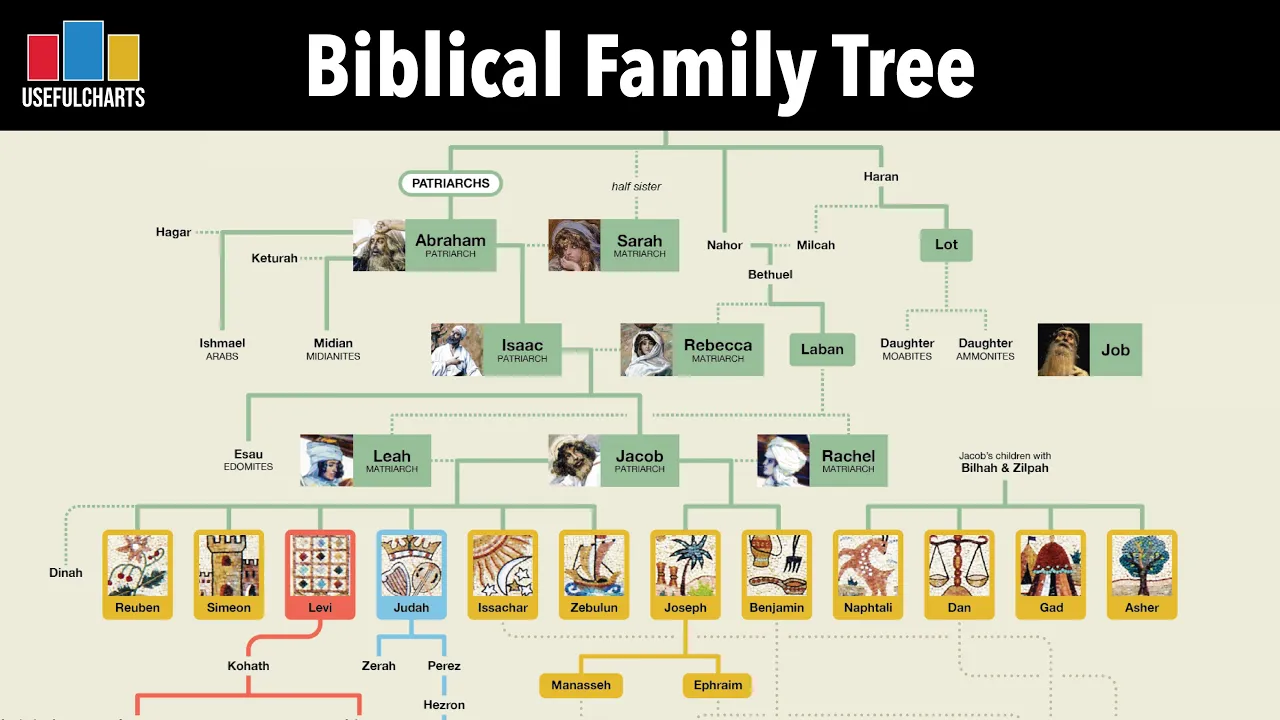
Hello, this is Matt Baker. Today, I'm going to show you the entire family tree of the Bible, all the way from Adam and Eve to the time of Jesus. I have done previous videos featuring various sections of this tree, but I've never done the whole thing in a single video, so that's what I'm going to do today.
And I'll be using the new version of our Biblical family tree chart, which is now available as a poster from our website, usefulcharts. com. This version includes a lot of new features, so I'll be highlighting them along the way.
At the top of the tree is, of course, Adam and Eve, who, according to the Bible, were the first two humans created by God. Their first two children were named Cain and Abel, but, as you probably know, Cain kills Abel out of jealousy, and therefore Adam and Eve have a third son named Seth. And it is through Seth that the Biblical story continues.
Now, in a previous video, I got a lot of questions about who Seth married in order to have his children. Well, according to the Bible, Adam and Eve had many other sons and daughters, even though they aren't named. So, based on tradition, the assumption is that Seth would have married one of his sisters, and that subsequent generations would have married their cousins, and so on.
Now, I should point out that in this video, I'm not going to be discussing whether or not the early parts of this tree are literary or literal history. I'll leave that decision up to you. If you want to hear my take, I'll link to some previous videos in the description where I do dive into that.
But in this video, I'm just going to follow the tree as it is described in the Bible. So, Seth has a son named Enosh, and then seven generations later, we get the next main character in the Bible, Noah. Noah's the one who built the ark and filled it up with animals in order to escape the great flood.
At this point, everyone on Earth dies, except for Noah and his wife and their three sons and their wives, so there are eight people in total who then go on to repopulate the Earth. The Bible doesn't mention the name of Noah's wife or his daughters-in-law, but we do know that his three sons were named Shem, Ham, and Japheth. Shem has five sons, Ham has four, and Japheth has seven, for a total of 16 grandsons for Noah.
In most cases, the names of these 16 grandsons match the names of nations that would eventually form in the near East, such as Asher, which corresponds to Assyria, Misrium, which corresponds with Egypt, and Javen, which corresponds to Greece. But it is in the line of Shem's son Arphaxad that the Bible focuses on. He has a son named Salah, who has a son named Eber, which is perhaps the basis for the word Hebrew.
Five generations down from Eber, we get a man named Terah, who lives in Mesopotamia, which is modern-day Iraq, and he has three sons named Abraham, Nahor, and Haran. Haran dies in Mesopotamia, and sometime after this, the rest of the family, including Haran's son Lot, decides to move to the land of Canaan, which God had promised to Abraham and his descendants. Canaan basically corresponds to modern-day Israel and Palestine.
Terah dies along the way in Syria, and this is where Nahor decides to settle. However, Abraham and Lot continue on to Canaan. Abraham's main wife was a woman named Sarah, and eventually, we learn that she is also his half-sister, so presumably, she was a child of Terah through a different mother.
Sarah has trouble having a child, so she gets Abraham to marry her servant Hagar, who gives him a son named Ishmael. But eventually, Sarah has a son as well, miraculously, at age 90, and that son is named Isaac, and becomes Abraham's main heir. After Sarah dies, Abraham then marries for a third time to a woman named Keturah, and they have several sons, one of whom is named Midian.
Isaac ends up marrying Rebecca, who is the granddaughter of Nahor, and thus is his first cousin once removed. Together, they have two sons, Jacob and Esau. Jacob, whose name is later changed to Israel, becomes the progenitor of the Israelites, which is why Abraham, Isaac, and Jacob are known as the three Patriarchs or fathers.
However, before we look at the Israelites, let me point out some other people groups who, according to the Bible, were distantly related to them. Later, once the kingdoms of Israel and Judah are established, their closest neighbors will be the kingdoms of Moab, Ammon, and Edom. According to the Bible, the Moabites and the Ammonites are the descendants of Lot, whereas the Edomites are the descendants of Esau.
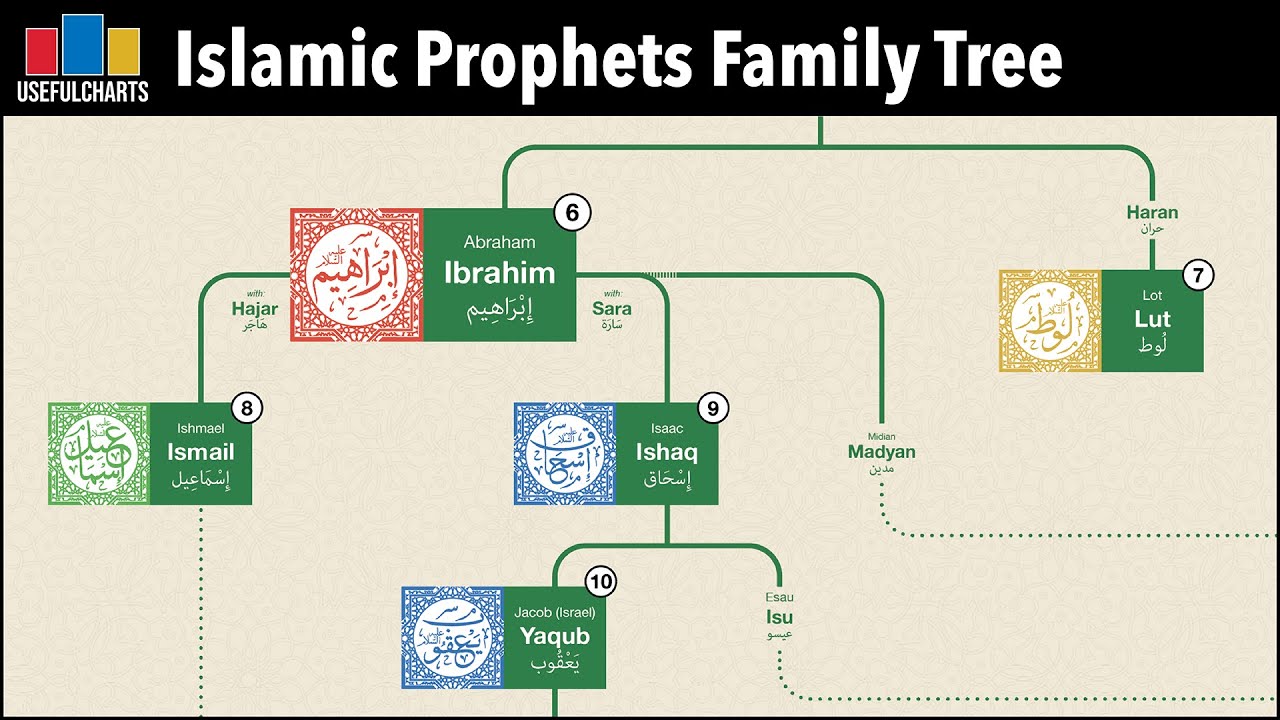
Further south are the Midianites, who, as you probably guessed, are the descendants of Midian. And then below them are the Arabs, who are the descendants of Ishmael. According to Islamic tradition, Muhammad is a descendant of Abraham's son Ishmael, whereas Jesus is a descendant of Abraham's son Isaac, which is why Judaism, Christianity, and Islam are known as Abrahamic religions.
I should also point out Job at this point. The Bible is not clear on exactly how he connects to the tree, although he is generally thought to fit in sometime during the period of the Patriarchs. Okay, let's now look at Jacob and his 12 sons.
Jacob marries two sisters, Leah and Rachel, who are the daughters of Rebecca's brother Laban. This makes Laban his uncle, and his two wives his first cousins. He also has children with Leah and Rachel's two servants, Bilhah and Zilpah.
Each of Jacob's 12 sons becomes the progenitor of one of the 12 tribes of Israel. Out of the 12, the two most important end up being Levi and Judah, which is why they get special colors. So, note that from this point onwards, red is used for the tribe of Levi, blue for the tribe of Judah, and yellow for all the other tribes.
However, before we move on, I should point out Joseph, the firstborn of Jacob's favorite wife, Rachel. He's the one who is sold by his brothers and then winds up in Egypt, where he becomes second in command under the Pharaoh. The Bible doesn't tell us the name of that Pharaoh, but the context suggests that the Joseph story might be connected to the 15th dynasty of Egypt, which is when a Semitic group known as the Hyksos ruled the Nile Delta.
While Joseph is ruling in Egypt, there's a famine in Canaan, and therefore Jacob's entire family ends up moving to Egypt, where they reunite with Joseph. Note that in Egypt, Joseph becomes the father of Ephraim and Manasseh, which is why in the Bible, the tribe of Joseph is actually considered to be two tribes, the tribe of Ephraim and the tribe of Manasseh. Anyhow, while in Egypt, the Israelites grow in number, and eventually, they are forced to be slaves, which brings us to the next main character in the Biblical story, Moses, from the tribe of Levi.
He is chosen by God to lead the Israelites out of Egypt and back to the land of Canaan, the Promised Land. He does this with the help of his brother Aaron, who becomes the first Israelite high priest. The story of the Israelites' escape from Egypt is called The Exodus, and it involves several famous events, such as The Parting of the Red Sea and God giving the Ten Commandments.
Now, once again, the Bible does not tell us the name of the Pharaoh involved in The Exodus story. However, the two most likely candidates are Thutmose III, if you choose to follow the timeline literally, or Ramses II, if you choose to go by context. The Israelites end up wandering in the desert for 40 years, during which time Moses dies, and therefore, it is Joshua, from the tribe of Ephraim, who ends up leading the Israelites into the land of Canaan, where they conquer the locals and divide things up among the 12 tribes.
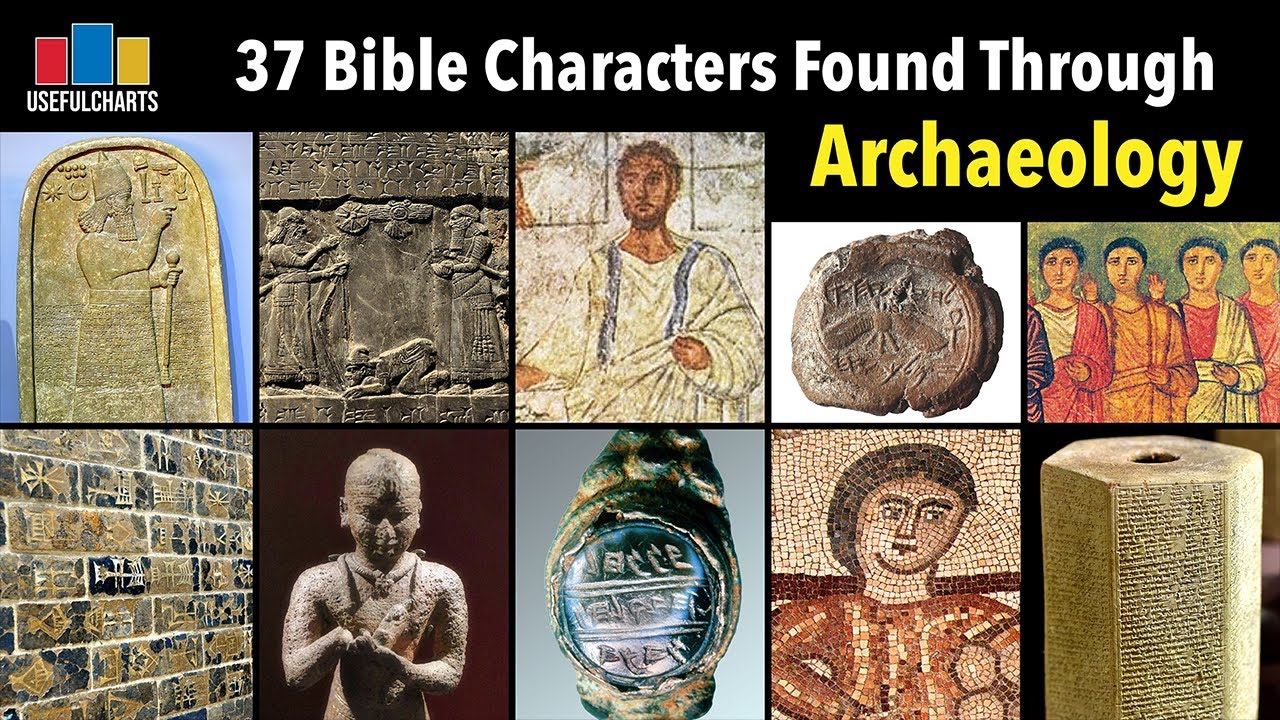
Initially, each tribe has its own leaders, with special individuals called judges rising up from time to time, whenever a coalition is needed. Some of the most famous judges include Gideon, Deborah, and Samson. It is sometime during this period that the Merneptah Stele was made, which contains the oldest reference to the people of Israel outside of the Bible.
It is named after Pharaoh Merneptah, the son of Ramses II. But returning to the Biblical account, eventually, the Israelites want a king. So, a leader named Samuel, from the tribe of Levi, anoints Saul, from the tribe of Benjamin.
Note that Samuel, like Moses, is called a prophet, a prophet being someone who receives messages from God and communicates them to the people. So, Saul becomes the first king of the Israelites, but God ends up being unhappy with him, and later instructs Samuel to secretly anoint a boy named David, from the tribe of Judah, as his replacement. As a boy, David serves as a musician for Saul, and then becomes popular with the people after killing a giant named Goliath.
Eventually, Saul gets jealous, and David has to go into hiding, even though David is best friends with Saul's son Jonathan, and also ends up marrying Saul's daughter Michal. In the end, Saul and Jonathan die in battle, and David becomes king, although initially, he was only king of his own tribe, as Saul's son, Ish-bosheth, becomes king over the rest of Israel. But eventually, David defeats Ish-bosheth and becomes king of all 12 tribes.
David makes Jerusalem his capital, and during his reign, he lusts after a woman named Bathsheba, having her husband killed, so that he can marry her. With Bathsheba, he has a son named Solomon, who goes on to become the next king. However, before I move on, I should point out that the Bible includes an entire book dedicated to one of David's great-grandmothers, named Ruth.
She was originally from the kingdom of Moab and is one of only four women mentioned in the Gospel of Matthew as an ancestor of Jesus. According to the Bible, Solomon reigns for 40 years and is the wisest man to ever live. He is credited as having written much of the Book of Proverbs.
In contrast to his father, David, who is credited with having written many of the Psalms. However, most importantly, Solomon is said to have built the first temple in Jerusalem. He is said to have started the construction in the fourth year of his reign, 36 years before his death.
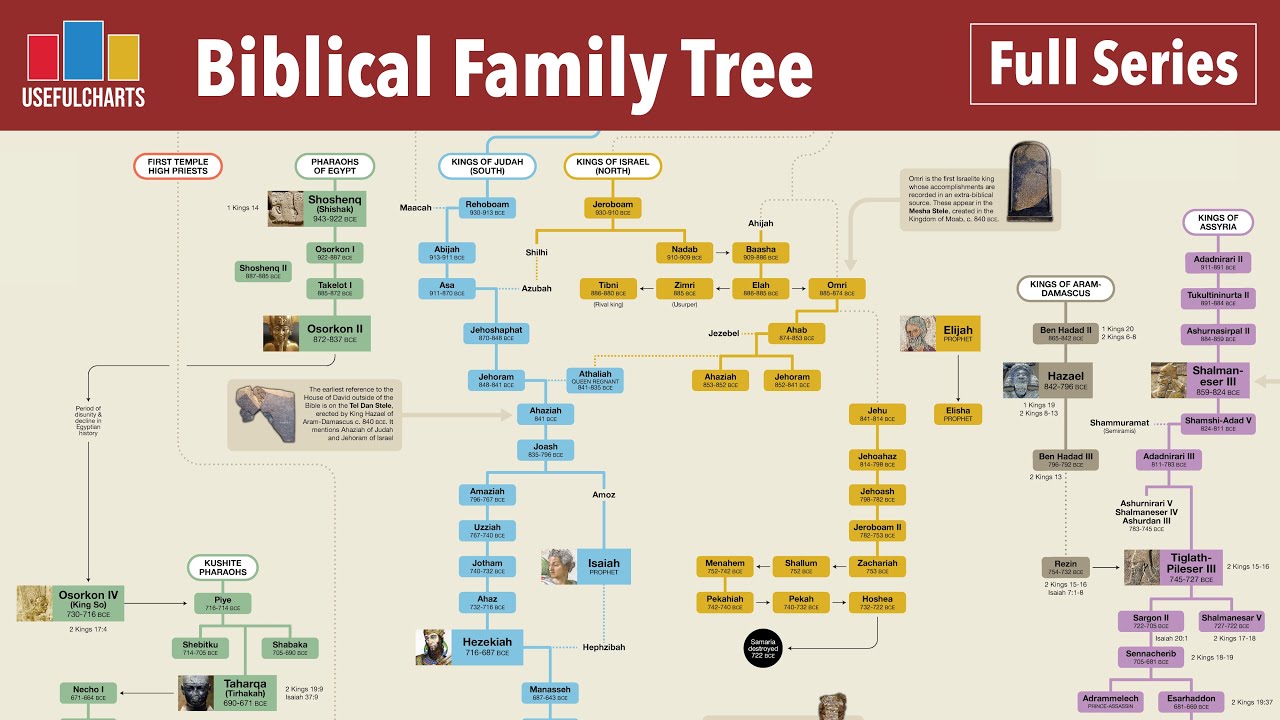
Remember the number 36, because I'm going to come back to it shortly. After Solomon dies, Israel is divided into two kingdoms. His son, Rehoboam, rules over the kingdom of Judah in the South, and Jeroboam, from the tribe of Ephraim, rules over the kingdom of Israel in the North.
You'll note that it is at this point on the chart that most names start to have a set of dates under them. These are not birth and death dates, but rather the dates for which a king reigned, or in the case of priest, for when that priest served. So, I want you to take note of the year 930 BCE, that's the year that both Rehoboam and Jeroboam start their reign, and it's the earliest Biblical date that virtually all Biblical scholars agree on, regardless of whether they are religious or secular.
That's because from this point forward, all of the dates on this chart, as well as many of the people, can be verified using sources both inside and outside of the Bible. For example, in First Kings, chapter 14, it mentions an Egyptian Pharaoh named Shishak, who reigns around the same time as Rehoboam and Jeroboam. From Egyptian records, we know that there was indeed a Pharaoh named Sheshonk, who reigned from 943 to 922 BCE, so that's a match.
Also, note that on this chart, I use BCE and CE instead of BC and AD. Basically, these two sets of terms can be used interchangeably, so whenever I say BCE, know that it means the same thing as BC. Nowadays, BCE and CE are the standard terms used in academic publishing, so that's why I use them instead of BC and AD.
Okay, at this point, let me now explain the timeline on the left of the chart. The year 930 BCE marks the start of the section labeled "historical dates". Again, these are dates that everyone agrees on.
However, above this, I've also included some speculative dates, which I've labeled "Christian literalist dates". These are for people who take the Bible literally and/or simply want to know what the Bible says internally about when certain events took place. So, remember the number 36.
If we count back 36 years from 930, we get 966, which would be the year in which Solomon started to build the temple. We can then count backwards from this date using some other numbers to get other dates. So, for example, in First Kings 6:1, it says that Solomon started to build the temple exactly 480 years after the Exodus.
If we take this number as being literal, that means that the Exodus must have taken place in 1446 BCE. We can then refer to Exodus 12:40, which says that the Israelites were in Egypt for exactly 430 years. From Genesis 47:9, we know that Jacob was 130 years old when the Israelites went down to Egypt, so that means that Jacob was born in 2006 BCE.
We know that Isaac was 60 when he had Jacob, and Abraham was 100 when he had Isaac, so this means that Abraham was born in 2166 BCE. The next step is to use the numbers given in Genesis, chapter 11. Doing this, we can conclude that Abraham was born 292 years after the flood, which means that the flood, if taken literally, would have occurred in the year 2458 BCE.
Noah was 600 when the flood happened, and according to Genesis 5, he was born 1056 years after Adam and Eve, so that gives us a final date of 4114 for the creation of Adam and Eve. Now, some Christian literalists come up with slightly different dates, depending on how they do the counting, but generally speaking, if you take the Bible literally, creation is going to be somewhere around 4000 BCE. Traditionally, though, Jews have calculated things a bit differently, which is why I labeled this side "Christian literalists".
However, if we move over to the other side of the chart, you'll note that I've also included the traditional Jewish dates. I'll explain those dates nearer to the end of this video. So, for now, let's go back to Rehoboam and Jeroboam and continue down the family tree.
I'll start with the Northern Kingdom of Israel. According to the Bible, Jeroboam is followed by his son, Nadab, but then by a usurper named Baasha, who in turn is followed by his son, Elah. But then things get really unstable, when Elah is killed by Zimri, and then Zimri is killed by Omri.
At this point, a man named Tibni, who was probably a relative of Zimri, sets himself up as a rival king, but in the end, Omri is victorious and goes on to build a new capital city at Samaria. Now, even though Omri is mentioned only briefly in the Bible, he is actually quite an important figure. For one thing, he is the earliest king from either Israel or Judah whose name and accomplishments can be confirmed by using an extra-Biblical source.
That source is the Mesha Stele, which dates to around 840 BCE and was made in the nearby kingdom of Moab. On top of this, later Assyrian records use his name to describe the Kingdom of Israel as a whole, instead of calling it Israel, they simply call it the land of the House of Omri. Omri is followed by Ahab, who the Bible does have a lot to say about, mostly negative things.
His evil deeds are mostly blamed on his wife, Jezebel, who is a Phoenician princess. It is during their reign that the prophet Elijah is active. Also, around this time, the kingdom of Aram, Damascus, in what is today Syria, comes into conflict with Israel.
We know about this conflict from both the Bible and from other sources. One of the most important archaeological finds in terms of the Bible is the Tel Dan Stele. It was commissioned by King Hazael of Aram, Damascus, and describes how he defeated Jehoram, the son of Ahab, but also Ahaziah from the House of David.
So far, this is the only extra-Biblical reference we have that mentions David, although note that it doesn't give any biographical information about him. It simply mentions that one of his descendants, Ahaziah, was defeated by Hazael. Returning to the kings of Israel, we know from the Bible that Jehoram was followed by Jehu, who may have been a member of the House of Omri from a different branch.
He holds the distinction of being the only king of either Israel or Judah for whom we have a contemporary depiction. An Assyrian record called the Black Obelisk shows him bowing down to Shalmaneser III, which indicates that Israel became a vassal of Assyria, Syria, at this point, probably in return for Assyria helping them to defeat Hazael. Jehu is followed by four of his descendants, before things start to go downhill.
There's a series of five final rulers, before Samaria is completely destroyed in 722 BCE by the Assyrians. According to the Bible, it is King Shalmaneser V who conquers them. It also mentions a king So of Egypt, who reigns around the same time.
This is almost certainly Osorkon IV, the last Pharaoh of the 22nd Dynasty, who rules just before the Cushite Pharaohs take over. Let's now go back and look at the kings of Judah. Unlike in the North, the southern kingdom is ruled the entire time by a single dynasty, the House of David, although there is at least one intermarriage with the House of Omri.
Rehoboam's great-great-grandson, Jehoram, marries Athalia, the daughter of King Ahab. After the deaths of both Jehoram and their son, Ahaziah, Athalia claims the throne of Judah for herself, having all other claimants killed. However, someone manages to save Ahaziah's infant son, Joash, and keeps him in hiding until he reaches the age of seven.
At this point, the high priest helps overthrow Athalia and places Joash on the throne, thus saving the House of David from extinction. Five generations down from Joash, we get Hezekiah, who is one of the most important kings of Judah. He reigns shortly after Samaria falls, and therefore, he has to face the Assyrians, who want to conquer Judah next.
By this point, it is Sennacherib who is the king of Assyria, but Sennacherib fails to conquer Judah, in part due to the rise of a powerful Pharaoh in Egypt, named Taharqa, who is mentioned in the Bible as Tirhaka, king of Kush. But it also boils down to Hezekiah's careful planning. The Bible mentions the construction of new walls and an underground tunnel to bring water into the city of Jerusalem, both of which have been found by archaeologists.
Also active during this time is the prophet Isaiah, who is himself a member of the royal family, as well as the father-in-law of Hezekiah. Hezekiah is followed by Manasseh and Amon, who are described in the Bible as being evil, before we get another young boy who is made king, named Josiah. Josiah sets things right, and during his reign, Judah really flourishes.
This is partly due to the fact that, by this point, Assyria is in decline, soon to be replaced by Babylon. The high priest during the reign of Josiah is a man named Hilkiah, who is a descendant of Zadok, the original high priest of the first temple, who served during the days of Solomon. The oldest copy of a Biblical text ever found dates to around the time of Josiah, and it is part of the Ketef Hinnom Scrolls, and includes the verses from Numbers, chapter 5, verses 24-26.
Josiah's story comes to a tragic end, when he is killed by Pharaoh Necho of Egypt, who, in other sources, is known as Necho II. By this point, Assyria has fallen to Babylon, and therefore, Babylon starts to interfere in the politics of Judah. Three of Josiah's sons reign as king, as well as one of his grandsons, before Jerusalem, including the first temple, is completely destroyed by King Nebuchadnezzar of Babylon in 586 BCE.
The final high priest of the first temple is Hilkiah's grandson, Seraiah, and the two main prophets during this period, Jeremiah and Ezekiel, are priests as well. Ezekiel, Jeconiah, a nobleman named Daniel, and many other elite members of the kingdom of Judah are exiled to Babylon. But eventually, the kingdom of Babylon is conquered by Cyrus the Great of Persia.
Cyrus allows the exiles, now known as Jews, to return to Jerusalem and gives them permission to rebuild the temple, in what is now called Judea. It is during the Babylonian and Persian periods that most of the Hebrew Bible is written. On the bottom right of the chart, you'll find a timeline that shows when each book was most likely written, according to modern critical scholarship.
Going back to the family tree, the governor of the first wave of returnees is Sheshbazzar, the son of King Jeconiah, and the first high priest of the second temple is Joshua, grandson of Seraiah. The Bible also mentions a governor named Zerubbabel, who leads the second wave. He is either the son of Shealtiel or Pedaiah, both sons of Jeconiah.
I'll come back to him a bit later, when discussing the ancestors of Jesus. There is also a third wave led by a priest/scribe named Ezra, and a fourth wave led by a governor named Nehemiah. Both of them are appointed by the Persian king, Artaxerxes the First.
How Esther fits in is a bit more complicated, because the Persian king in that story is named Ahasuerus, but this doesn't match with any of the known kings of Persia. However, Ahasuerus is usually assumed to be Xerxes the First. It is at this point that the Hebrew Bible, known to Christians as the Old Testament, comes to an end.
We thus enter the inter-testamental period, which we can learn about by using the apocryphal books, as well as extra-Biblical sources. For example, we know that eventually, the Persians are defeated by the famous Greco-Macedonian conqueror, Alexander the Great, and that after his death, his generals fight over the empire, and it is eventually split into four main parts. Two main dynasties are formed, consisting of the descendants of Ptolemy the First and Seleucus the First.
Initially, the Ptolemies, who were based in Egypt, rule Judea, but later, it is the Seleucids, based in Syria. By using Jewish sources, we can get the names of every high priest from Joshua up to the Maccabean Revolt. This revolt occurs when the Seleucid king, Antiochus IV, stops the usual Jewish sacrifices and replaces them with sacrifices to the Greek gods, Zeus.
The revolt is initially led by a man named Mattathias, but after he dies, it is his son, Judah, who successfully recaptures the temple and restores the usual sacrifices, with himself as the new high priest. He is nicknamed Maccabee, which means "the hammer", and this is why his entire family becomes known as the Maccabees. Eventually, the Maccabees, also known as the Hasmoneans, end up serving not only as high priests but also as monarchs, first as princes, under Simon and Hyrcanus the First, but then later as kings, starting with Aristobulus the First.
During this period, a legislative body known as the Sanhedrin is also formed, led by a pair of leaders known as the Zugot. This consists of the Nasi, who was sort of the president, and the Av Beit Din, who was sort of the vice president. Eventually, however, there's a civil war in Judea between two Hasmonean brothers, Hyrcanus II and Aristobulus II.
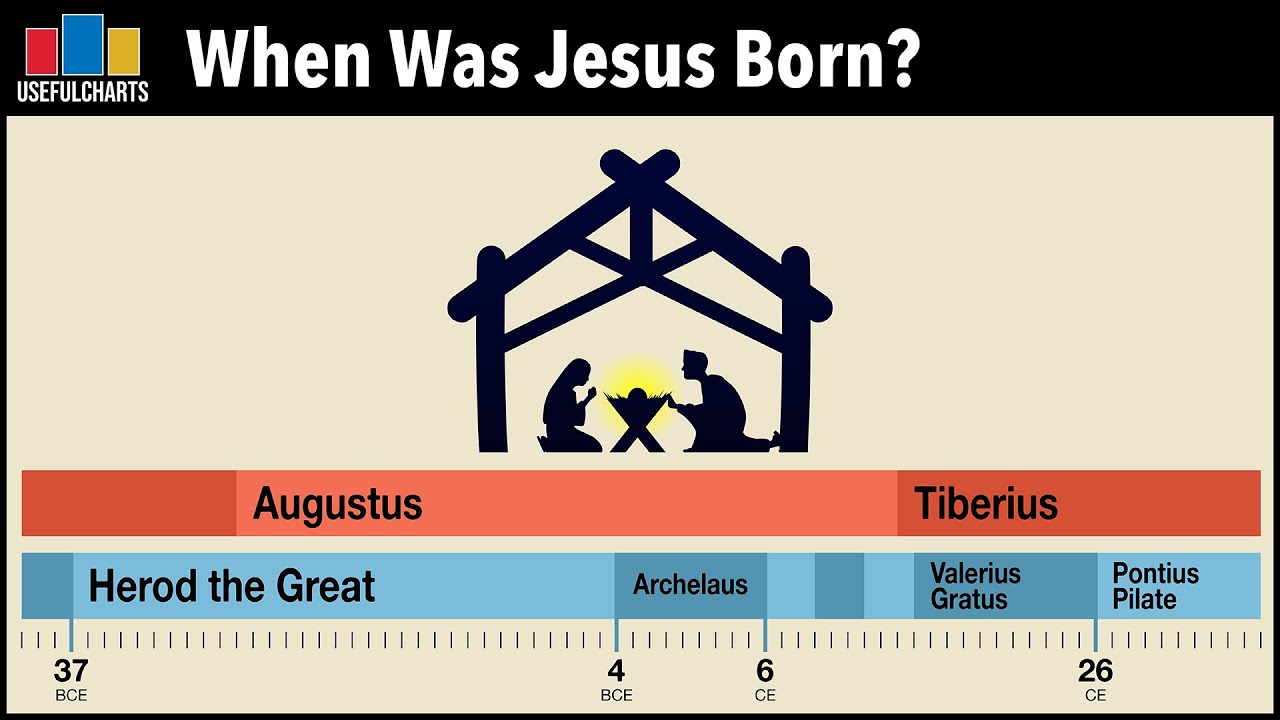
Rome intervenes, and in the process, Judea becomes a client state of the Roman Republic. In addition to this, the Hasmonean dynasty is eventually replaced with the Herodian dynasty, Herod the Great being the husband of one of the last Hasmonean princesses. At this point, the monarchy and the high priesthood are split, with the high priests now getting the job by appointment, instead of by inheritance.
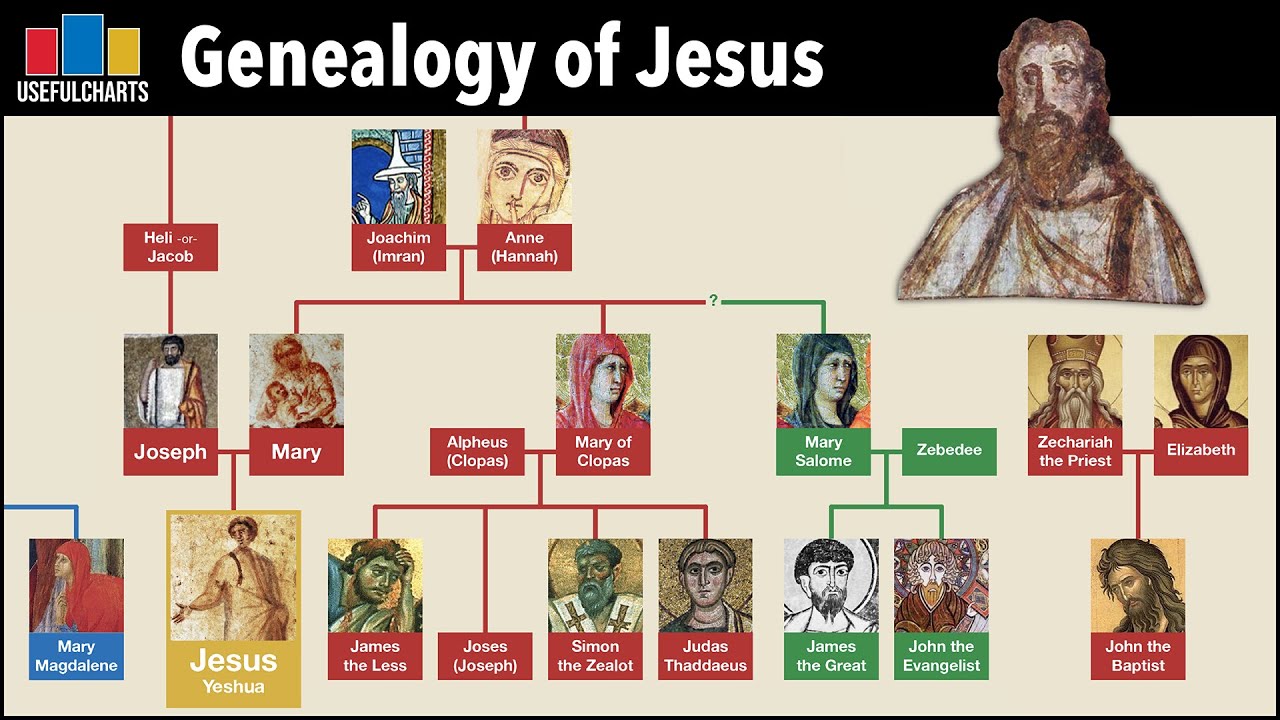
It is during the reign of Herod the Great that Jesus is born. The New Testament tells us that he is related to a fellow preacher, named John the Baptist, through their mothers, Mary and Elizabeth. According to Catholic tradition, Mary's mother's name was Anne, and presumably, Anne and Elizabeth's mother were sisters, making Mary and Elizabeth first cousins, and Jesus and John the Baptist second cousins, genealogically speaking.
The New Testament has more to say about Jesus's adoptive father, Joseph. According to the Gospel of Matthew, Joseph was the son of Jacob, whereas, according to the Gospel of Luke, Joseph was the son of Heli, a different set of ancestors is given for these two individuals, leading most Christians to assume that one line must actually be the line of Mary. Usually, Luke's account is considered to be based on Mary's ancestry, whereas Matthew's is considered to be based on Joseph's, although there are those who argue for the opposite.
In both cases, though, Jesus's ancestry is traced back to Zerubbabel, although note that Matthew provides half as many names between Zerubbabel and Jesus than Luke does, meaning that Matthew may have left out some generations. We know for a fact that he does skip generations elsewhere in his genealogy, for example, he leaves out Ahaziah, Joash, and Amaziah, jumping straight from Jehoram to Uzziah. The last thing I want to do is explain why the Jewish traditional dates, shown on the top right of this chart, differ from the Christian literalist dates, shown on the top left.
Basically, the Jewish calendar is based on the year 70 CE, which, as I just mentioned, was the year that the second temple was destroyed. According to Jewish tradition, the second temple stood for 420 years, and the first temple for 410 years, with 70 years in between. This gives us a total of 900 years, which places the construction of the temple in the year 830 BCE, which is more than 100 years off the date I mentioned earlier.
If we count back 480 years from 830, we get the date 1310, which is the traditional Jewish date for the Exodus, again, more than a hundred years off the date that most Christian literalists use. But it's the next part where the Jewish counting really differs. As I mentioned earlier, Exodus 12:40 mentions that the length of time that the Israelites lived in Egypt was 430 years.
However, according to the rabbis, the original verse read, "the length of time that the Israelites lived in Egypt and Canaan was 430 years". This means that if we count back 430 years from the Exodus, we come to the year that Abraham went down to Canaan, rather than the year that Jacob went down to Egypt. This cuts a further 215 years off the timeline and puts the birth of Abraham at 1815 BCE.
From here, we can use Genesis 5 and 11 to go back 390 years to the birth of Seth, another 500 years to go back to the birth of Noah, and an additional 1056 years to reach the date of creation, which Jews traditionally place at 3761 BCE. Okay, so that was a look at the entire family tree of the Bible, all the way from Adam and Eve to the time of Jesus. Once again, if you want to buy a copy of this chart as a poster, you can do so right now by visiting usefulcharts.
com. Thanks for watching!