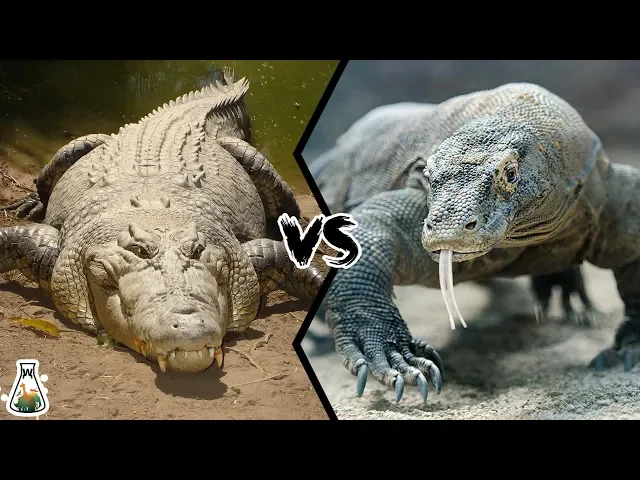
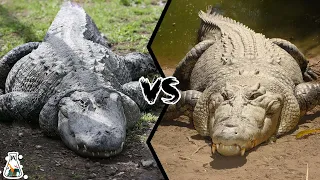
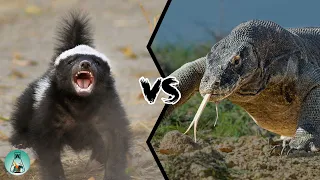
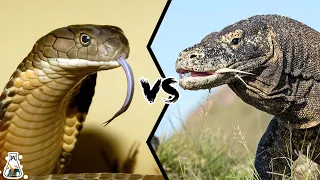
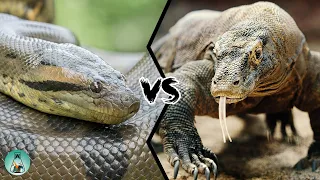
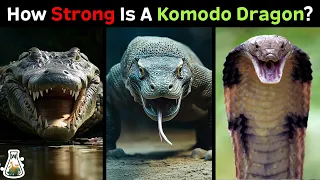
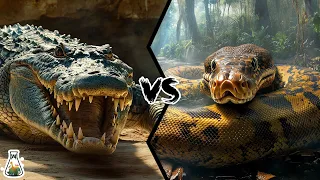
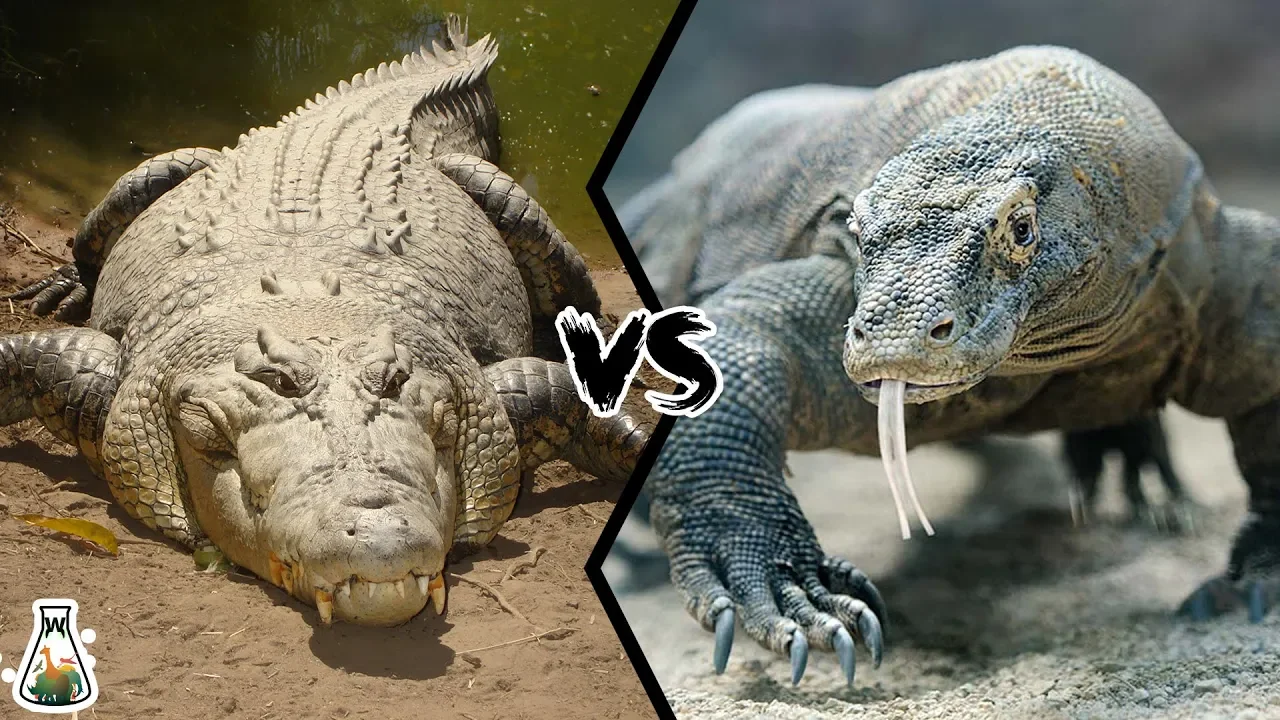
Crocodile vs Komodo Drgon Who would win this legendary battle? Saltwater crocodiles are the largest living reptiles on earth. These massive creatures are known by a slew of names, including sea crocodile, Indo-Pacific crocodile, saltie, marine crocodile, and estuarine crocodile.
They also have an incredibly wide distribution, as they live in regions from India and Asia, to Australia. The Komodo dragon is a lizard species that is found on the islands (particularly the Komodo Island) in central Indonesia. The komodo dragon is a member of the monitor lizard family and are the largest, heaviest lizards in the world and one of the few with a venomous bite.
Because of their size and because there are no other carnivorous animals, these apex predators dominate the ecosystem in which they live. Description Salties, as they are half-lovingly called, are intimidating creatures. They have a large, triangular head equipped with teeth that can measure up to 3.
5 inches long (8. 8 cm)! Though these crocodiles are capable of growing up to 23 ft.
long (7 meters)! most are 11 – 19 ft. in length (3.
3 to 5. 8 meters). Males are larger than females, and an older male can easily weigh over 2,000 lbs (900 kg).
Hunting has reduced the volume of exceedingly large animals in the population, and today it is rare to find any crocodile larger than 19 ft. or so. A crocodiles physical traits allow it to be a successful predator.
They have a streamlined body that enables them to swim faster. Crocodiles also tuck their feet to their sides while swimming, which helps the crocodile to swim fast, by decreasing the water resistance. Crocodiles have webbed feet which, although not used to propel the animal through the water, allow it to make fast turns and sudden moves in the water or initiate swimming.
Webbed feet are an advantage in shallower water where the crocodiles sometimes move around by walking. The average size of a male Komodo dragon is 8 to 9 feet and about 200 lbs. (90kg).
Females grow to 6 feet (1. 8 m). Komodos come in a variety of colors, including blue, orange, green and gray.
Their skin is rough and durable, reinforced with bony plates called osteoderms. They have long claws and a large, muscular tail. Komodos have good vision; they can see objects as far away as 985 feet (300 m).
They are also speedy. They can run briefly up to 13 mph (20 kph) but prefer to hunt by stealth waiting for hours until prey cross their path. They have about 60 frequently replaced serrated teeth that can measure up to 2.
5 centimetres (1 inch) in length. Their saliva is frequently tinged with blood, because their teeth are almost completely covered by gingival tissue that is naturally lacerated during feeding. They also has a long, yellow, deeply-forked tongues.
Range and Habitat The area of their distribution covers a vast territory: they inhabit the islands of Indonesia and New Guinea as well as northern coasts of Australia; the crocodiles also occur along the shores of Sri Lanka and eastern India; they live at the estuaries of Southeast Asia to central Vietnam. The saltwater crocodiles can also be found on Borneo, the Philippines, Palau, Vanuatu and the Solomon Islands. At the dry season, they most frequently occur downstream at estuaries, sometimes living in the open sea.
With the approaching of the wet season, they move to freshwater bodies, inhabiting swamps and rivers. These predatory lizards inhabit just five islands, four of which are within Komodo National Park in Indonesia. They can be found on Komodo, Gili Dasami, Gili Montang, Rinca, and Flores Island.
Komodo dragons have the smallest natural range of all the large predators. The lizard's habitat can be anything from a tropical dry forest to a savanna to a deciduous monsoon forest. No matter where they live, the Komodo likes extreme heat.
It is usually around 95 degrees Fahrenheit (35 degrees Celsius) with 70% humidity on the islands of Indonesia. Diet Classic opportunistic predators, they lurk patiently beneath the surface near the water's edge, waiting for potential prey to stop for a sip of water. They’ll feed on anything they can get their jaws on, including water buffalo, monkeys, wild boar, and even sharks.
Without warning, they explode from the water with a thrash of their powerful tails, grasp their victim, and drag it back in, holding it under until the animal drowns. Komodo dragons are carnivores, meaning they eat meat. They are such fierce hunters they can eat very large prey, such as large water buffalo, deer, carrion, pigs and even humans.
They will also eat smaller dragons. They can eat 80 percent of their body weight in one feeding. The Komodo has a unique way of killing its prey.
First, it springs up and knocks the prey over with its huge feet. Then they use their sharp, serrated teeth, which are a lot like a shark's, to shred their prey to death. If the prey escapes, it will die within 24 hours of blood poisoning because the Komodo's saliva contains 50 strains of bacteria.
With its fantastic sense of smell, the Komodo will find the dead animal and finish its meal. Behavior The Saltwater Crocodile has been thought of as one of the most intelligent and sophisticated of all reptiles. Their barks are a way of communicating with one another.
These creatures are highly territorial and do not tolerate one another’s presence. Males will share their territory with females, but not other males. Females are territorial as well, and will protect their nests from other crocodiles, and anything else that gets too close.
The Saltwater Crocodile spends most of its time thermogulating to maintain its body temperature. If they become too hot they often go into the water with only their eyes and nostrils showing and stay submerged until they are cooled. If they become to cold, they lay in the sun on flat rocks until they warm up.
Komodo Drgons are mostly active during the day but have shown some nocturnal behaviour. They are solitary animals that only come together to breed and eat. Young komodo dragons can climb trees easily with the use of their strong claws.
Because of their large size, Komodo Drgons are able to conserve body heat by sleeping in their burrows reducing their need to bask in the mornings. They typically hunt in the afternoons and stay in shaded areas during the hottest parts of the day. Now let’s come to the big question!
Who would win this legendary battle, between Crocodile and Komodo Drgon? Unfortunately for Komodo Drgon, Crocodiles are without doubt the most dangerous predator on planet Earth. Drgons are big for lizards.
A saltwater crocodile can weigh one ton, or more than six times the weight of the dragon. This size difference means that should the dragon find itself in the crocodile’s crosshairs, it would be essentially powerless to escape. That size also means the dragon is the exact size of animal the crocodile would want to hunt.
Crocodiles are also shockingly fast. A Komodo dragon, in short, would be death rolled and being drowned before it even knew what hit it.