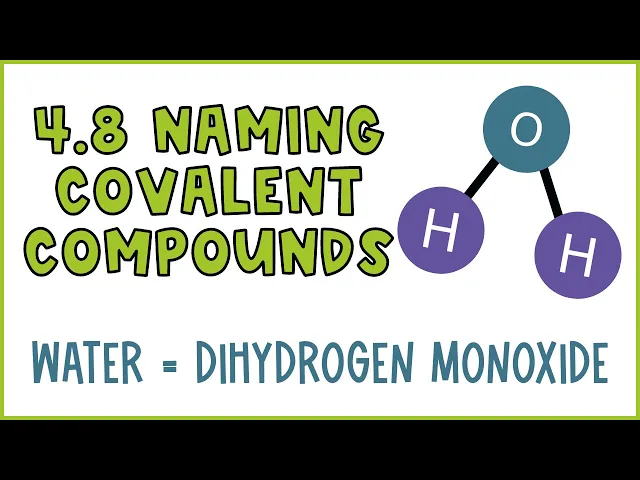
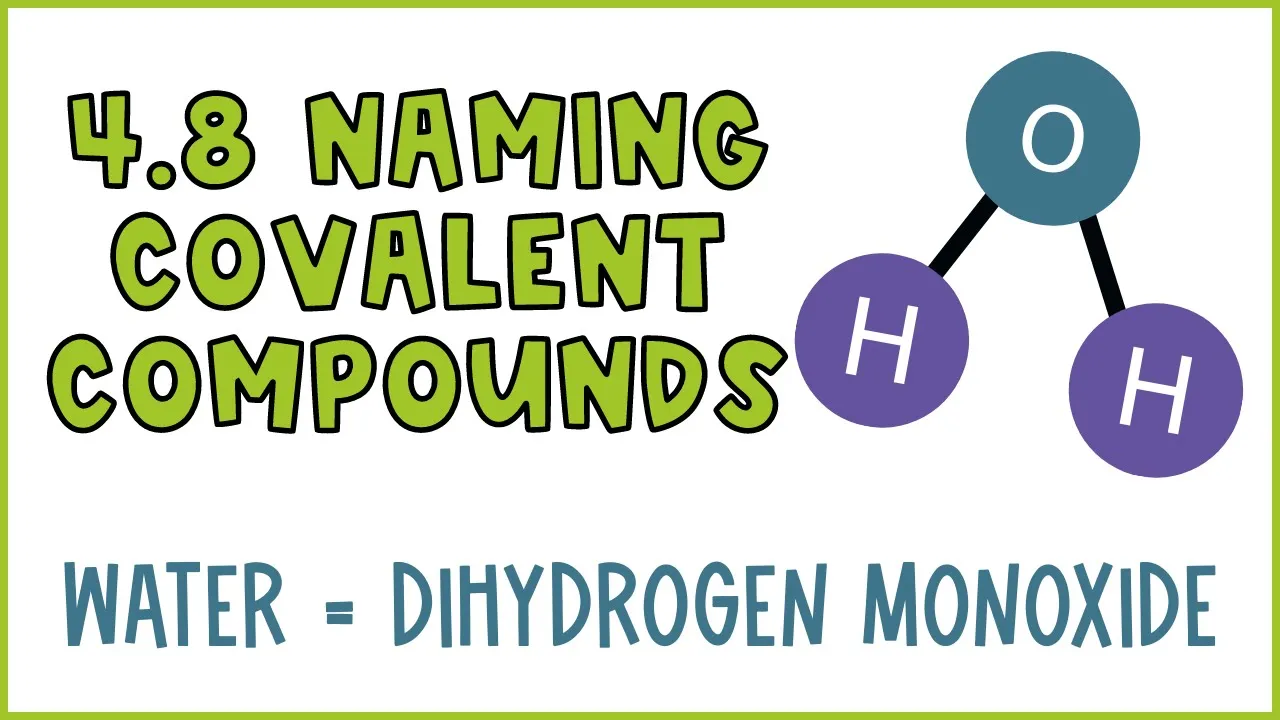
hello welcome to today's lesson on covalent naming or naming covalent compounds the question of the day what are a few ways that you can distinguish ionic and covalent bonds just a quick look back any compound that has covalent bonds is going to be made of non-metals that share their electrons and we have some examples NH3 is called ammonia CO2 you may know is carbon dioxide and I'm sure H2O you know is water these are the scientific names for the compounds that I just told you um so NH3 even though we call it ammonia and even
though H2O is called water those are its common names so really what that means is that it's the name that normal regular people use in the everyday world ammonia is often used for cleaning it's the primary component of Windex if you've ever used that it has a very significant smell I'm sure if you've ever cleaned with it you can remember the smell of ammonia well ammonia is the English term for the compound NH3 in other languages it's not called ammonia it has a different name in that different language and same with water um water as
strange as it may sound is a common name um in English we use water in Spanish it's agua so the name of the compound is going to change based on the language that you speak so chemists just like we had mentioned in the ionic bonding or in the ionic naming lesson they have kind of like a set of rules for how they're going to name compounds so that no matter what language we speak we can all come to the same conclusion of what the compound is so the true IUPAC scientific name for ammonia is nitrogen
trihydride carbon dioxide we use its common or we use its um chemical IUPAC name all the time and then water is actually called dihydrogen monoxide think of how scary that sounds if you struggled at all with naming ionic compounds naming covalent compounds is going to feel like a breath of fresh air because all you need to do is Count yes it is that simple we are going to count the atoms to come up with their specific chemical IU pack name let's take a look at these again nitrogen trihydride what does that really tell you it
tells you there's a nitrogen and it tells you that there are three hydrogens it tells you the formula carbon dioxide I know bi is often the prefix that we use for two but in chemistry we use dye carbon dioxide tells you there's a carbon and two oxygens dihydrogen monoxide dihydrogen tells you there's two hydrogens and monoxide think of the prefix mono tells you there's just one oxygen you're going to love this we're talking specifically about naming binary covalent compounds meaning that we're working with a compound that has just two elements in it there are more
naming rules depending on if your compound has organic bonds or if it's an organic compound that has a separate set of naming rules that I'll get to way later but for now we're just talking about inorganic binary compounds so um the second element just like an ionic bonding is going to have its name changed to I'd the ending of its name it will change to I'd think of carbon dioxide nitrogen trihydride dihydrogen monoxide again the eyed is going to tell you that this element is bonded and in this case um the element that comes second
is going to change its name when it gets married now I know I said it was super easy but there are just a few weird things to look out for so if you have a compound like carbon dioxide CO2 and you only have one atom of the first element we're not going to use the prefix mono we're just going to name the element it's kind of the same way that we don't use this subscript of one when we have just one atom of that element um that is if we okay so it was CO2 right
um there's no one behind the c if you write C there's at least one C right um so we're kind of doing that same thing here but that rule is only going to apply to the first element so we're not going to write mono carbon dioxide um because we don't need to just saying carbon dioxide indicates that there's one carbon carbon monoxide if you follow the rules um of just using prefixes you would wind up with a double vowel so you would wind up with um carbon monoxide which um sounds kind of silly I don't
know how chemists have decided that the double vowel was just too silly to keep um but in this case we are just going to use mon instead of mono but sometimes you will see ma no um like if you had a chlorine it would be a monochloride you would use the full prefix but if you're going to wind up with a double vowel from using a prefix you're going to drop whichever one kind of makes it sound silly in this case you would just drop one of the O's after going through those little blips you
may be wondering what prefixes are we actually using some of these don't sound very familiar to me well here they are the prefixes one through ten for naming inorganic binary covalent compounds are as follows if you have just one atom of that element you would use the prefix mono two is dye three is try four is a little weird with Tetra I know in Geometry you would call it a quadrilateral a shape with four sides but we are I think those are Greek prefixes and we're using Latin prefixes or vice versa I don't really know
which is which um but the way that I think of four being Tetra is the game Tetris if you've ever played the game Tetris um it's it's actually really fun I enjoy it quite a bit but the idea is that you have this board and the blocks fall down and you don't want the blocks to climb all the way up to the top you want to eliminate the blocks as they fall the game gets faster and faster and the more blocks you eliminate at once the more points you get well if you pay attention in
the game Tetris the blocks that fall are like five or six different shapes and they are made of four blocks each so you'll have a big block of a square that's a two by two you'll have a block that is a four by one it's just like a long skinny set of blocks you'll have some that are like zigzag shaped you have one that's like three on the bottom and one stacked on the top every single one of the pieces that falls is built out of four blocks hence the name Tetris like tetra and then
the rest of these you may remember from geometry they kind of line up the Greek and the Latin line up very well so five is Penta six is hexa seven is hepta I know sometimes you'll see it as SEPTA um but in this case it's hepta with an h and then we have OCTA Nona and deca so really it's just one through four that maybe you need to familiarize yourself with because the rest of them I'm sure you've heard before take a look at these compounds and see if you can come up with their IUPAC
names first up we have bromine pentachloride we are not putting mono on the first element so just stating bromine indicates that there's only one bromine and then we have five chlorines Penta chloride the same mono rule is going to apply in the compound SO3 that is sulfur trioxide then we have p203 which would be diphosphorus indicating we have two phosphoruses two phosphori and we have three oxygens so diphosphorus trioxide and I know that it sounds really silly to just say diphosphorus um because it's the full name of the element you're just like putting a prefix
on it but that's what we've decided for covalent bonds I couldn't tell you why um then we have as3 P5 that is tri-arsenic pentophosphide this one's a little bit weird because arsenic is actually a metalloid metalloids uh you may remember will sometimes act like metals and other times they act like non-metals a lot of the time um metals are going to particip I'm sorry A lot of the time metalloids are going to participate in covalent bonding and um when they do that they will be the um Central atom is what we call them so your
arsenic is going to be kind of in the Middle with the phosphides around it um when you are a high school chemistry student it can sometimes be hard to decide whether it's acting like a metal or a non-metal which is part of the reason why we love the naming system if you have prefixes in the name then you can know that this is bonding with covalent bonds arsenic is sharing electrons with phosphorus in the case of tri-arsenic pentophosphide if you had something like um Arsenic and phosphorus ionically bonding they would crisscross and it would just
be called arsenic phosphide in that case you would know that it's a it's an ionic bond because of the way that it's named so that's part of the reason why we have all of these naming rules um because it can give you a clue as to how the electrons are being either transformed transferred or shared then lastly we have iodine hepta fluoride again no mono on the first element and then hepta is the prefix for seven fluorines now take a look at these and see if you can come up with their formulas all right sulfur
dioxide sulfur is just sulfur we don't put the prefix on the first element if it is mono so that's just going to be sulfur dioxide two oxygens then we have dibromine monoxide so two bromines and one oxygen and they go in the same order too isn't that nice there's no need to you know unscramble rearrange nothing like that next up we have diphosphorus pentoxide to phosphoruses which remember is p and then five oxygens which you have o5 carbon tetrahydride this one's really cool carbon tetrahydride has a few different names if you are naming it inorganically
carbon tetrahydride would be this right here uh c h four one carbon and four hydrogens but you'll see in a future video on organic naming that um CH4 is actually an organic compound in the organic naming system we call it methane so technically this is not the best name for CH4 but just for the sake of practice it's good to have it here and then lastly we have sulfur hexachloride again no mono on that sulfur so it's just one and hexa is the prefix for six that's it on covalent naming not so bad right if
you have any questions leave them in the comment section below the video subscribe so you don't miss the next one and I'll see you there bye