hi maybe you have heard a term creative accounting in a past there are no rules for making professions and as result provisions belong to the most frequently used creative accounting practice while companies were involved in so-called big path provisioning which effectively means creating and reversing provisions back and forth from period period in order to smooth profit to prevent these practices the rules related to the reporting of provisions contingent liabilities and contingent assets were created in the standard is 37 and we will take a closer look at the standard in today's video I'm Sylvia of IFRS
box.com and I help people understand and simplify IFRS I have created the IFRS kit a complex IFRS course for you plus lots of free i4s material so you are welcome to check them out at IFRS Bolcom the standard is 37 belongs to older standards as it was issued in its current version in 1998 with the effective date of first July 1999 the objective of is 37 is to set the criteria and rules from measurement and recognition of provisions contingent liabilities and contingent assets plus the disclosures required for these items so what is a provision it
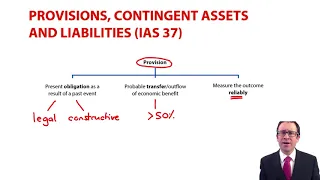
is a liability of uncertain timing and amount now let's concentrate on the first part of the definition what is the liability liability is a present obligation of an entity arising from past events the settlement of which is expected to result in an outflow of economic benefits of an entity the critical point here is occurrence of past event or obligating event that gives rise to an obligation well if there is no past even then there is no obligation and there is no liability past even might create two types of obligations the first one is the legal
obligation that arise from some contract legislation or some other operation of law for example a course decision second one is constructive obligation that arise from some entities actions such as from established practices or some statement of acceptance of some responsibilities well in fact there is no difference between provisions created by legal or constructive obligations with regard to accounting treatment however if you identify the underlying obligation whether it's legal or constructive that may help you to identify when to recognize a provision so when should we account for a provision well if all three following conditions are
met number one there must be a present obligation whether legal or constructive as a result of some past event or obligating event number two the outflow of economic benefits required to settle the obligation must be probable well this is the higher probability of having to pay than not having to pay in numerical expressions more than 50% when probability is less than 50% in other words it means that the outflow is just possible and then the company would probably disclosed just a contingent liability or even nothing if probability of outflow is remote number three there must
be reliable estimate of outflow of economic benefits that is required to settle the obligation in extremely rare cases when a no reliable estimate can be made liability exists but it cannot be recognized so when deciding on recognition of provision we must assess all three conditions if they are all met then the provision is recognized or if not just not meeting one condition is sufficient then entity just discloses contingent liability or even nothing if probability of outflow of benefits is remote well here in order to decide whether to recognize a provision or to disclose the contingent
liability or even do nothing is 37 gives us a decision tree and if you're interested you can also check that out in our complex course the IFRS kit with numerical examples if you find yourself in a situation when you're questioning whether to book a provision or not well you should ask yourself one simple question and the answer will guide you can you avoid the obligation by some future actions if yes then do not recognize any provision because it means that there is no past obligating event for example well when a government is introducing new laws
and your company must train the employees stay updated well your company may still decide not to continue in business or not to train the personnel and thus avoid expenses but if you really cannot avoid expenses by any future action then you must make a provision for example if you promised warranty repairs when selling some product to your customers then you must make a provision for expected costs associated with warranty repairs let me explain contingencies to you now clamp and II may face both contingent liabilities and contingent assets well a contingent liability is either possible obligation
that arises from past events and its existence will be confirmed by some uncertain future events that are not wholly or fully under company's control alternatively it is also a present obligation that arises from past events but outflow of economic benefits is just possible so less than 50% probable or the amount cannot be measured reliably while a contingent asset is something similar it is possible as that arises from past events and whose existence will be confirmed later by occurrence or non-occurrence of some future events out of entities control for example when you are suing somebody else
and expect winning the court case with some compensation from other party in such a case result of court proceedings is out of your control and this possible compensation would represent contingent asset need contingent liabilities nor contingent assets shall be recognized in financial statements that means no counting okay but you must disclose their existence their nature estimation of financial effects indication of uncertainties and some possibility of any reimbursements and disclosures must be made in the notes to the financial statements well how shall we measure the provisions provision should be measured as the best estimate of the
expenditure required to settle the present obligation at the end of the reporting period and this estimate of outcome and financial effect are determined by the judgment of the management of an entity supplemented by experience of similar transactions sometimes reports of independent experts and you should also consider any available evidence there are two most often ways of measuring provisions the first one is so-called expected value and it is used when measurement of provision involves a large population of items then the provision is measured as a weighted average of all possible outcomes by the probabilities the second
method is used when a single obligation is being measured and then the provision would be set as the most likely outcome when measuring provisions there are several consideration that you must look at risks and uncertainties that surround many evens and circumstances for example inflation also when you expect to settle your obligation beyond twelve months after the end of the reporting period then the amount of provisions shall be the present value of the expenditure required and there is some discounting involved amount of provision might also include certain adjustments for future events when there is sufficient evidence
that these will occur but be careful when measuring provisions gains from expected disposals of assets shall not be taken into account these gains are included in the income statement at the time specified by another eyes or eye for a standard for example is 16 how to account for a provision well a provision is recognized as an expense in income statement in most cases but sometimes it can be capitalized into the cost of another asset okay the credit side goes to liability but careful in the current or non-current distinction well when the amount of provision represents
its present value due to some discounting then you would charge an interest on a provision each reporting period to bring it to its future value by the time of its utilization this is called unwinding the discount and in this case you debit finance costs in profit or loss and on the credit side you should increase the amount of the liability while provision is utilized when an entity is obliged to settle in most cases and then simplified accounting would be just account for the related expenditure by direct debit into provision and credited cash suppliers bank accounts
whatever form the expansion has alternatively you can't really expenditure by its usual way posting it to profit or loss for example and subsequently reverse proportionate part of a provision that's what many entities do in fact when you expect some reimbursement from another party you can recognize very embarassment asset when it is virtually certain that it will be received but careful in the statement of financial position or balance sheet reimbursement must be shown as a separate asset so your journal entry would be to debit reimbursement asset which is some sort of receivable and credit expense for
provision creation in the profit or loss well it is not credited to some sort of income because is 37 permits the prison expense related to provision and its reimbursement as a net amount there are certain specific situations directly addressed by IAS 37 in relation to provisions the first one is future operating losses future operating losses they just don't meet the definition of a liability because there is no past event okay and moreover you can avoid future operating losses by implementing some measures to prevent them or by selling a part of operations making or loss or
some other actions therefore you should not create a provision for future operating losses but when you expect future operating loss that might mean that your assets are impaired so you should test your assets for impairment and recognize impairment loss ROI is 36 and you can find a summary of is 36 in this channel to another specific area addressed by the standard relates to onerous contracts or what it is it is unfair contract in which the unavoidable cost of meeting the obligations of the contract exceed the economic benefits of the contract in other words this is
a lost contract that cannot be avoided if a company identifies that a certain contract as onerous provision must be made in amount of unavoidable costs of or fulfilling it and unavoidable cost can be either net cost of fulfilling the contract that means cost less some income from the contract or penalty from non salty filling the contract whichever is lower of course you would also look to any impairment test the third specific situation addressed by is 37 is restructuring while this is the program that is planned and controlled by the management and it materially changes either
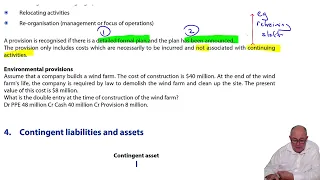
the scope of the business or the manner in which that business is conducted well in general a provision for restructuring must be recognized when two conditions are met first a company must have a detailed formal plane that contains the minimum information abroad related business location employees expenditures and sometimes schedule also a valid expectation must have been raised by the company in those affected by the restructuring that the company will carry out the restructuring and then is 37 specified with components or types of expenditures can and cannot form part of a provision finally let me also
name a few inter that deal with some specific cases of provisions so first I freaked one changes in existing decommissioning restoration and similar liabilities deals with the provision for removing the asset and restoring the site after the end of its useful life and this is very important for example in nuclear power planes that are obliged to remove nuclear plants at the end of their useful life well if you'd like to revise the full soft axel example about this type of provisions you're welcome to check our IFRS kit I've rigged five rights to entries rising from
decommissioning restoration and environmental rehabilitation funds is closely related to the first IFRIC number one and it applies when a company contributes to a fund for an investment of these expenses IFRIC six liabilities arising from participating in a specific market waste electrical and electronic equipment while this IFRIC specifies when the producers of electrical and similar appliances sold to households are liable for decommissioning of electrical waste and this applies mainly in the European Union which obliges all producers to do so also is 37 refers to two other interpretations which is IFRIC 17 distribution of non-cash assets to
owners and IFRIC 21 levi's so this was a short summary of is 37 you can find a full and detailed explanations with many numerical examples in our address kit and if you'd like to learn more about IFRS and its application you are welcome to check our website IFRS voxcom and subscribe bye bye and thank you for watching