hello and welcome to today's video in which i will summarize the standard is 12 income taxes and give you the basic guidance what it's all about i am sylvia of cpdbox.com the place to be if you want to understand and apply ifrs easily so you're welcome to check all of that at cpdbox.com this standard has been here for a while because it was issued in 1979 for the first time and then it went through certain development until its current form as we know it now the objective of is 12 is to prescribe the accounting treatment
for income taxes and the principal issue here is to determine how to account for the current and future tax consequences of various transactions and other events of the current periods that are recognized in the financial statements of an entity and future recovery of carrying amount of assets or settlement of the liabilities in the entity's balance sheet or the statement of the financial position with regard to tax consequences of various transactions and events in the financial statements is 12 makes it easy because you just need to account for taxes in the same way as for the
transaction itself that's very simplified view so if you recognize certain item in profit or loss then its tax consequence which is current or deferred income tax is also recognized in profit or loss 2 and the same applies for the statement of other comprehensive income so if the transaction goes to oci then also it's tax consequence goes to other comprehensive income well that's easy is 12 also guides us in the situation when the future recovery of assets or settlement of liabilities leads to different tax payments in the future than they would be if that recovery or
settlement had no tax consequences so simply speaking what happens if the tax rules are different from the accounting rules in this case the entity is required to recognize deferred tax asset or deferrtex liability well with some exceptions a key element of understanding is 12 is to understand a difference between accounting profit or loss and taxable profit or loss on one side and the difference between current tax and deferred tax on the other side so let's start with the accounting profit for the purpose of this standard it is defined as a profit or loss for the
period before deducting tax expense be careful and notice that is the profit before tax why to be consistent with the definition of taxable profit or loss which is the profit or loss for a period determined in accordance with the rules established by the taxation authorities upon which income taxes are payable or recoverable clearly as tax rules in your country might vary from accounting rules applied in your company there will be some differences between these two namely those are expenses recognized but not deductible for tax purposes for example non-deductible expenses for business lunch with customers that
are usually not allowable for tax purposes in some countries then there could be some income not recognized in the financial statements but included in the tax return for example some items taxed on a cash basis another type of difference might be expenses not recognized in the financial statements but deductible for tax purposes similarly as with interest tax on a cash basis there could be certain expenses allowable only when you actually pay them and then there could be income recognized in the financial statements but not included according to tax rules for example some government grants received
might not be taxable at all now when we have arrived a taxable profit from the accounting profit it's time to explain the basics of current income tax it is the amount of income taxes payable or recoverable in respect of the taxable profit or tax loss for a period income tax payable is calculated as our taxable profit multiplied with the tax rate and current income tax payable shall almost always be recognized in profit or loss so the accounting treatment would be to debit expenses in the net profit or loss and credit income tax liability be careful
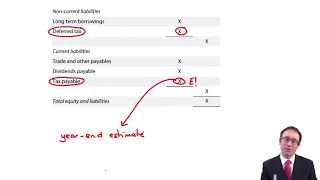
about negative tax or when the taxable profit is in fact loss then you should apply the rules for tax loss carried forward which i will talk about a bit later however in some cases current income tax is debited directly in equity or other comprehensive income for example when adjusting opening balance of retained earnings resulting from correction of errors etc now it's time to talk about deferred tax and explain differences between current and deferred taxation the first difference between current and deferred tax is its substance while current tax is the actual amount payable to tax authorities
in relation to activities in the current period deferred tax is an accounting measure used to match the tax effect of transactions with their accounting impact and thereby produce less distorted results another difference is the basis for calculation of both current income tax is calculated from taxable profit as mentioned previously and the basis for calculation of deferred tax is temporary differences between carrying amount and tax base of individual assets and liabilities finally the timing while current tax is payable in respect of the current period deferred tax will be recovered or settled in the future periods in
the financial statements now let's summarize the main principles of deferred tax differ tax is an income tax payable or recoverable in the future periods with respect of the temporary differences unused tax losses and unused tax credit it is calculated as temporary difference multiplied with the appropriate tax rate temporary difference is calculated as carrying amount of an asset or liability less its tax base what is a tax base while tax base of an asset or a liability is the amount attributed to that asset or liability for tax purposes in other words tax base of an asset
is the amount that will be deductible for tax purposes against any taxable economic benefits that will flow to the entity when it recovers the carrying amount of the asset for example imagine you have interest receivable of 1000 currency units in your accounts if the interest received is taxable on cash basis interest receivable has a tax base equal to zero tax base of a liability is its carrying amount less any amount that will be deductible for tax purposes in respect of the liability in future periods for example when accrued expenses are taxed on a cash basis
then the related liability has a tax base equal to zero and on top of that there could be some items that are not recognized as assets or liabilities in the statement of financial position and still do have a tax base for example research expenses that were recognized in profit or loss in the period when you paid them but tax law did not permit them as deduction until some later time once you understand the concept of a tax base we can compute temporary differences temporary difference is simply carrying amount of an asset or liability unless it's
tax base and when carrying a bond exceeds a tax base then it is a taxable temporary difference and it gives rise to deferred tax liability and the example of such a difference would be the interest revenue included in the accounting profit when occurred but text when cash is received on the other hand when carrying amount of an asset or liability is lower than its tax base then it is a deductible temporary difference and it gives rise to a deferred tax asset for example health care liabilities could be tax deductible when benefits are paid to employees
but liabilities should be recognized when employees rendered the service so if you're unsure whether it is taxable or deductible don't worry just visit cpdbox.com check out our articles and courses and you can learn everything step by step and we are here to help of course now let me add to you that that there could be one more circumstance giving rise to deferred tax asset when you have unused tax losses or tax credits that could be carried forward then the deferred tax asset might be recognized to the extent that it is probable that future taxable profit
will be available against which the unused tax losses and unused tax credits can be utilized right so if you assume that you will have tax loss also in the future periods and you cannot use the credit then don't recognize the fair tax asset now let's see how the deferred income tax shall be measured in measuring deferred tax you need to use the tax rates expected to apply in the period of settlement or recovery but based on tax rates that have been enacted or substantively enacted by the end of the reporting period sometimes different tax rates
apply for different types of transactions and the measurement of deferred tax liabilities and assets shall reflect the tax consequences that would follow from the manner in which you expect to recover or settle the carrying amount of your assets or liabilities so for example if you plan to use the building by its depreciation then you apply the tax rate applicable on profit but when you plan to sell the building then you need to apply the tax rate applicable on capital gains from the sale of property finally i want you to remember that neither deferred tax assets
nor deferred tax liabilities shall be discounted now let's see how to recognize different tax in most cases deferred tax is recognized as an expense or income in the profit or loss for the period but there are a few exceptions so when we deal with a transaction or even that was in the current period recognized outside profit or loss for example in other comprehensive income or directly in equity then the deferred tax arising from such a transaction is recorded exactly in the same place as the transaction itself so for example the deferred tax on revaluation surplus
on property plan and equipment is recognized in the same place as that surplus itself another specific situation we defer taxes arises on business combinations so if the investor acquires some other company deferred tax assets or liabilities shall be recognized and in this case the vertex affects the amount of goodwill or bargain purchase gain of investor but no deferred tax liability shall be recognized on initial recognition of goodwill now let's talk about presentation and disclosures related to income tax and the main issue of the presentation of income taxes in the financial statements is offsetting so whether
tax assets and tax liabilities arising from different transactions of the same entity might be presented as one net amount well with regard to current income taxes you might offset assets and liabilities when two conditions are fulfilled so the first one is that the entity must have a legally enforceable right to set off the recognized amounts and in most cases this condition is fulfilled when the taxes are levied by the same tax authority who agreed to settle on the net basis the second condition is that an entity intends either to settle on a net basis or
to realize the asset and settle the liability simultaneously with regard to deferred income taxes the entity can recognize the net amount only when it has legally enforceable right to set off current tax assets against current tax liabilities and we have just said when it happens but also deferred tax asset and deferred tax liabilities must relate to income taxes levied by the same taxation authority of the same entity and this is especially important when you're working on your consolidation and you're adding up the numbers of the parent and a subsidiary and one of them has a
deferred tax asset and the second one has a deferred tax liability so can you offset or not just answer that for yourself based on what we just said finally is12 requires the present number of disclosures related to income taxes but we will not go into many details in this video that was the short summary of iest well i appreciate you watching the video and i trust that you learned a lot so if you need to learn more get your cpds answers to your questions visit cpdbox.com thank you and bye