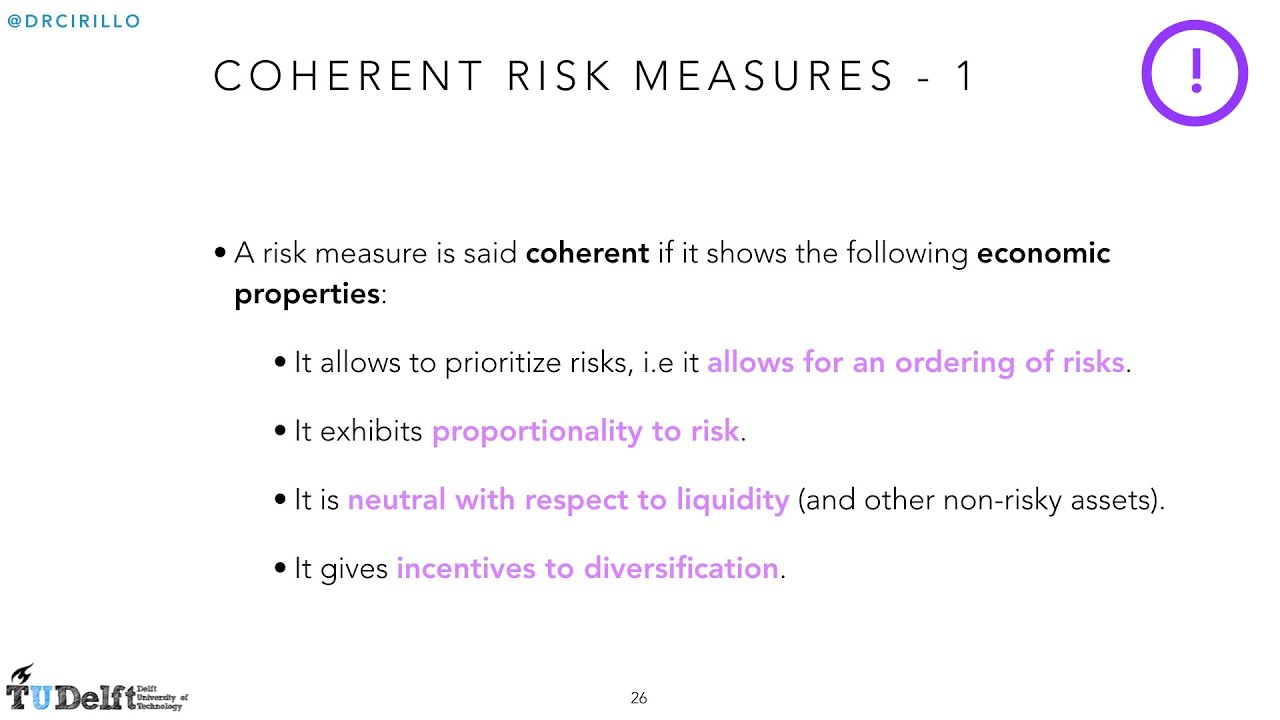
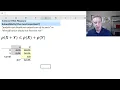
coherence is just one way to evaluate a risk measure it's a technical approach it is a very rigorous approach and it is a somewhat controversial set of criteria in this video I'll walk through each of the four axioms or sub conditions that need to be true in order to qualify a risk measure as coherent but I'll spend the most time at the end on sub ad sub additive 'ti because it's the most relevant in practice with an example using Value at Risk where I'll show a scenario under which value risk is not sub additive and
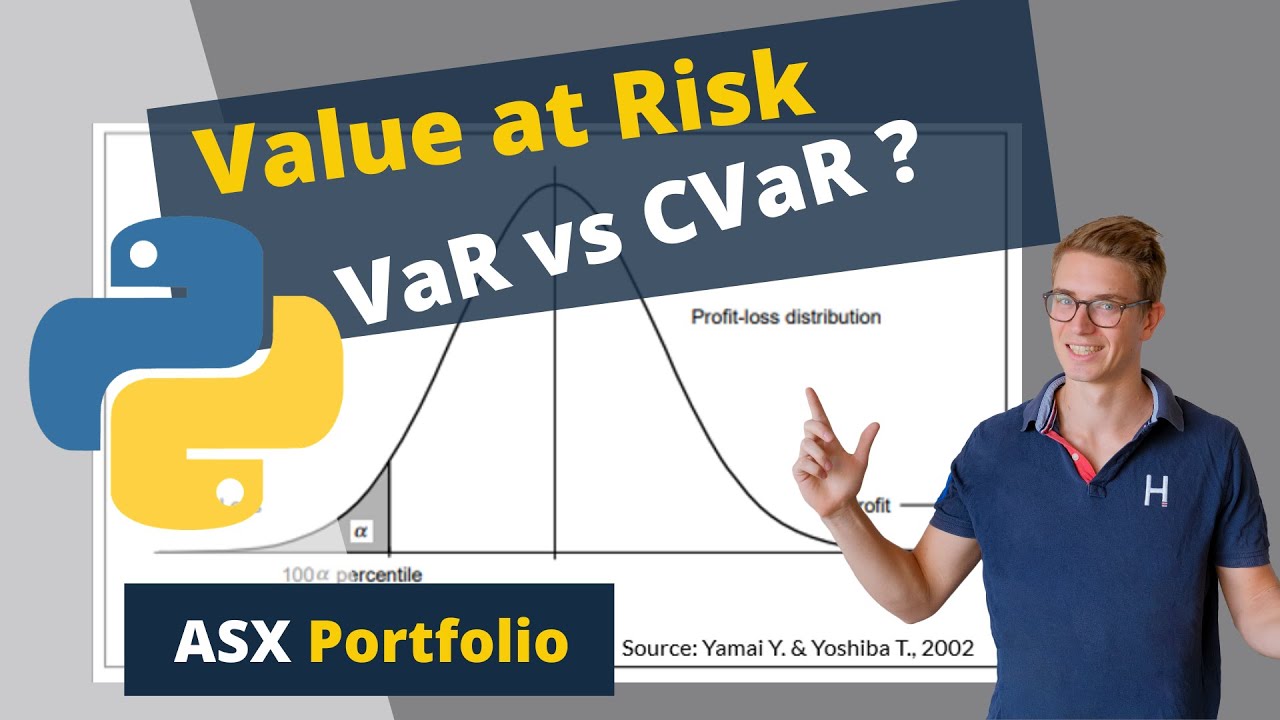
in showing value risk to be not sub additive in an example that will prove that var is not coherent the first thing that I might say about a coherent risk measure is that it's very strict in order for a risk measure to be coherent it needs to satisfy all four of these axioms or conditions and it needs to satisfy them always so for that reason value at risk or var an extremely popular risk measure is not coherent there's really no way around that and we get that question I would say every year on the forum
var is not coherent at the end of this video I'll show you a simple scenario under which we show that bar is not sub additive all I need to do is find the one exception because in finding them one exception I've shown that bar is not necessarily sub additive if far is not necessarily some additive then var is not coherent now that's not not to say that we can't impose a condition we can insist for example that our portfolio returns are normally distributed a common assumption well we've made a qualifying assumption there and then to
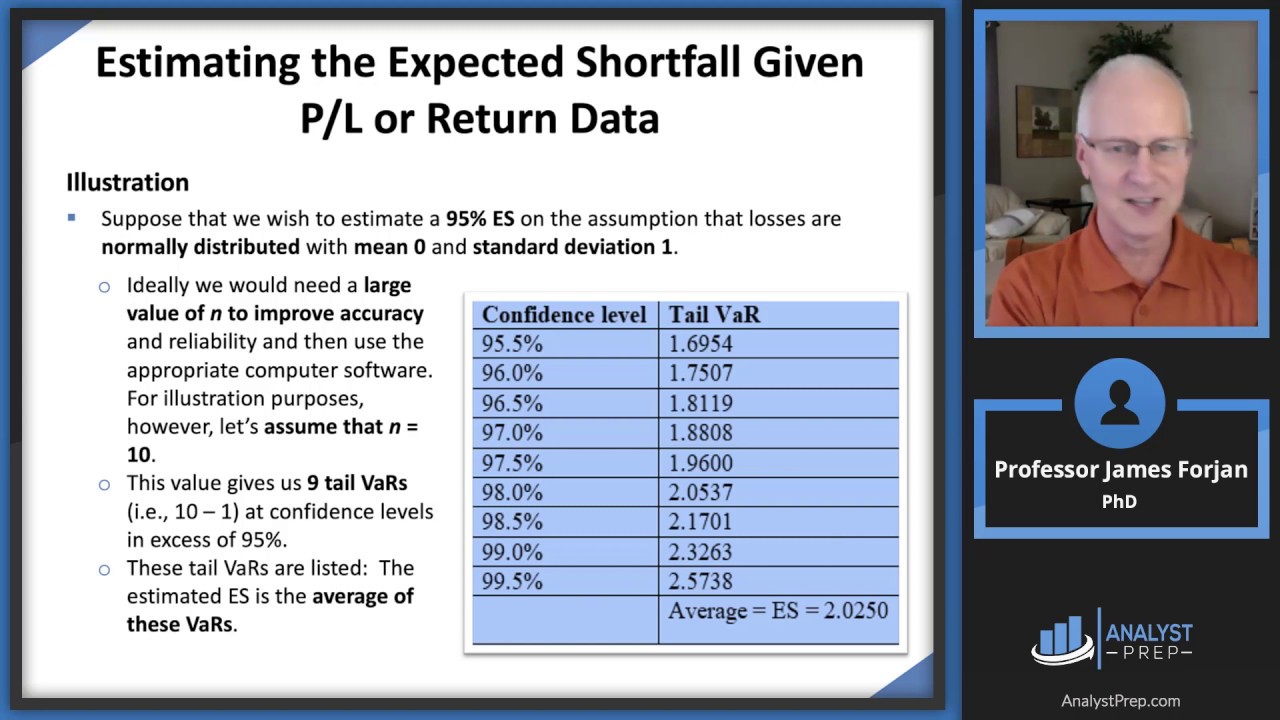
that condition bar in fact will be sub additive but that doesn't make bar coherent now I'm using generally the notation in Kevin doubt who uses this as part of an argument for a measure that is coherent and that is expected shortfall you mean that argument well over decade turned out to be prescient because in Basel 4 are really specifically the fundamental review of the trading book which in Basel 4 is the newest approach to measuring market risk at least unregulated Asians var has been replaced for expected shortfall and coherence was at least part of the
supporting argument ok so then the second thing I might say about these four criteria are act conditions or axioms as part of the current risk measure is that they are not all equally relevant in practice we don't give equal attention to all of them on the Left we have two that are more taken for granted probably more intuitive and then over here on the right positive homogeneity turns out to be academically controversial so not everyone would agree with it and for that reason not everyone would subscribe to the idea that coherence is the holy grail
in terms of evaluating risk measures and finally by far the most relevant in terms of practice the most practically relevant is subadditivity because in fact for example the fact that var is not necessarily some additive has real consequences so so bad activity gets all of the attention and finally just a note a point about the notation I mentioned this also just be in our experience and teaching with it this can be a stumbling block these are symbolic statements really right and we want any mindful here that we have an X oh and Y and a
function of x and y so x and y is symbolic it represents the position it could be the daily profit and loss or the future cash flow of the position and notice the difference here are an amount of tonicity we have x and y these are naked these are this is about the position and then here and the most these conditions we're talking about criteria for the risk measure and symbolically the risk measure is represented by Rho of X right so this is the risk measure as a function of the portfolio X so that's not
a very good Greek row but that Greek row here could be representing I think of the most common risk measure as standard deviation so it could be the standard deviation of X that's one risk measure or it could be as I mentioned bar of X that's another or it could be expected shortfall of X so you see how row here is a function of the portfolio and we're talking about the conditions of the risk measure itself how are we measuring the risk of the position so I'll take the first couple I'm going to spend less
time of them translation invariance is also called the risk-free condition for each of these I have developed really brief English explanation that I hope convey what they mean and for translation invariance my English summary is adding cash reduces risk and so you can see here again that's the symbolic notation of it the simplest example I could think of as here borrowed this insight really from Carol Alexander but imagine we have a portfolio of a million dollars and we decide to put zero into the risk-free asset so all 1 million is allocated to the risky stocks
let's say so we might view our capital risk as let's say it's 30% of that on some notion that perhaps 30% volatility so we have 300,000 capital at risk and 0 allocated to the risk-free capital may be US Treasury bills are a very very safe bond we could say our net capital risk is the full 300,000 well translation invariance says that our risk measure would reflect the idea that adding cash or reallocating to cash reduces our risk and right and now Illustrated if we decide to put 10% into the risk-free allocation then we have not
only 900,000 to the risky allocation 30% of that is 270 but now we have a hundred thousand and risk-free capital and as Keller L Carol Alexander says we can think of that as we now have a hundred thousand and risk-free capital to cover on our risky allocation our net capital at risk has been reduced adding cash reduces risk see see how - see so importantly it's not a zero it's not omitted okay positive homogeneity not gonna spend a lot of time on that maybe this is the most intuitive one of all my English summary is
that risk is proportional to size right think leverage I could on the one hand by 100 options in Facebook stock or then I may decide let me double that bet and by 200 well my loss on 200 options is double my law potential loss on a hundred we're talking about risk here so leverage is risk is proportional with size so we can think of leverage and derivatives are always a good way to illustrate this you might not expect to be controversial because on a on a superficial level it seems so intuitive the reason it's controversial
briefly is that I've ignored my or the investors whoever owns the position their utility function or implicitly presumes my utility function is neutral if I'm risk seeking I might not view doubling the bad as doubling my risk necessarily I might prefer a risk function that incorporates my personal utility function oh let me say about that currently ma tonicity the next one my English based summary is that if the portfolio Y dominates the portfolio X then Y is less risky so here we want to pay attention to the notation notice if Y dominates X then the
risk of Y is less than X and I've Illustrated that using VAR valuet risk or specifically what we call absolute value at risk here's my two portfolios x and y they have in common the same volatility Sigma 30% however why has an expected return to note of MU as usual up 8% which is double X so I ask you would you prefer X or Y well I would prefer why without any further information because they have the same volatility but why has double the expected return so I would definitely prefer why and now let's look
at in terms of absolute value risk we measure that by taking the expected return mu or drift and we add the volatility scaled by the normal deviate which is a function of our confidence level I'll use 95% and I get a normal I get an absolute value at risk a single period maybe this is a one year absolute value risk of forty five point three and if I do that for portfolio y I get a lower absolute value of risk and the difference is exactly the four percent Y dominates X and you can see my
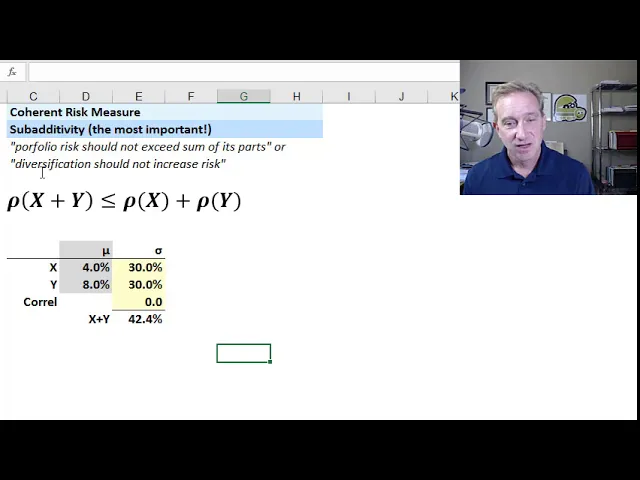
value at risk is lower for y precisely because it has a higher expected return so that's monotonicity and then the fourth condition here is for fourth axiom is subadditivity and i have two english summaries for that the first one is that portfolio risk should not exceed the sum of its parts or put another way diversification should not increase risk or we we might think about it this way that the risk measure should not penalize diversification I hope that's intuitive you can see here the risk of the portfolio should be less than or equal to the
sum of the risk of its individual components and here my example is the simple mean variance framework I'm gonna take X and y as from 4 but this time I'm going to drop the drift or expect to return terms we have X 30 percent volatility y 30 percent volatility if we assume the correlation is zero what is the volatility of x + y swimming they're equally weighted well you probably know that we would take X and square it again assuming equally weighted we take Y and square it and then we would add two times the
covariance term which is the volatility times the volatility times the correlation that's my variance I usually like to do the variance first and then wrap the square root to get my volatility and so a simple mean variance to asset equally weighted framework here the volatility of X plus y is forty two point four and notice that's meeting subadditivity the forty two point four here you can see is less than forty two point four is less than my thirty percent plus thirty percent and even as I raise correlation notice I've imposed implicitly implicitly really if not
explicitly I've enclosed the mean variance framework so my risk measure here my var which is just a scaling of this will always be sub additive but that's an important unrealistic condition but as I increase the correlation to point five notice my X plus y goes up and those you probably know the highest that I can go with correlation which is a unitless measure of linear Association or linear dependence the highest I can go there was one and at one the volatility of X plus y does equal so we've actually gotten right up to the limit
there but correlation well I don't even know if I did one point two I can't get this higher but correlation can't go higher and so this is illustrating the bad activity I think rather nicely now let me show you a violation of the subadditivity and now I'm just illustrating an example that's already in Kevin Dowd and this should be a why of course I my scenario is a portfolio of bonds now might put each bond all of my bonds here are going to have the same probably default four percent that means as a single variable
it's a Bernoulli however here I'm going to combine those three of those bonds into a portfolio and over here I'm gonna plot the density distribution so I implicitly made an iid assumption right when I combine them together iid and what I mean by that is in the portfolio they all have an identical default probability of 4% and fur further they are independent and meaning there's no default correlation among them so this is a Bernoulli a series of Bernoulli's is a binomial so all I've done here is plot the by Numa binomial probable probability density function
a PDM PDF are really technically a PMF because it's a discrete distribution and so let me just ask what is the let's just select the 95% var what is the 95% var of this three bond portfolio well the virus took the quantile all that means is we can look on the distribution and find the 95% here's 88.5 almost if we add 11.6 we're gonna be at 99 and change above 99.5 so 95 is clearly somewhere and here so the answer to 95% value at risk where the we have a three bond portfolio where the default
probability is 4% and we assume iid the 95% is one default or if we want to do dollars and with zoom zero recovery 100% loss given default you can assume the full full face value maybe that's a hundred dollars but we the 95% valued risk is one deep bond of one default now I'll go to two bonds and similarly I have a oops I went too far I meant to go to this page two bonds same 4% assumption and again same question 95% var for two bonds notice looking for the quantile it's not here at
zero it's somewhere here in one same answer two bond portfolio 95% var is one default or if we want to assume again 100% loss given default the full face value of one bond maybe that's $100 or $1,000 okay I'm almost finished now we go to one bond same 4% haven't changed that assumption now what is the 95% var well this is interesting it's actually if we are looking up this density function it's here it's 0 or no defaults that's because here we have a Bernoulli variable as long as the our confidence level of 95% right
is less than our 96% here we're going to end up with a var that's zero or put another way if the implicit significance level of this var which is 5% if that's greater than the PD then our single bond var is going to be zero this is an outcome of a discrete distribution that's the important difference from before we're not dealing with a mean variance or a normal distribution here we're dealing with a by in this case Bernoulli is a special case of the binomial these are discrete distributions so we can't expect the same behavior
and now that proves the lack of subadditivity so I've summarized that result here we only have a single assumption of 4% iid as you know this should be a Y my mistake 4% iid and if we have one bond the 95% var is 0 if we have two three or eight bonds for example it's and by the way we won't go into the detail on that but I'm just using the inverse cumulative binomial distribution function and so but I've demonstrated here a lack of subadditivity because if we take the two bond portfolio right the risk
of two bonds under this measure is 1 and how does that compare to adding the risk of them together or adding them individually the risk of one bond is zero so in fact the risk of the portfolio is greater than the risk of the individual components so you see how I've demonstrated a lack of subjectivity which we can do rather easily here when we're talking about portfolios of bonds but it's easy to do in other cases a also of continuous distributions in particular when we have a heavy tail and that's when we most are concerned
about the properties of our risk measure so the lack of sub activity is of significant practical relevance so I hope that's helpful if it is please and if you stay for me all 18 minutes then I will assume it's been somewhat helpful please do subscribe to the channel and we'll see you on the next video