hey welcome back everyone today we are talking about coherent risk measure and spectral risk measure now it's very confusing to most of the candidates uh regarding these two measures but but i'm gonna break this thing down for you and let's understand in a much better way all right so what is a coherent risk measure essentially when we are talking about coherent risk measure we mean to say that there are four properties in coherent risk measure and all the risk measure that we have beat value at risk beats standard deviation beat expected shortfall they must follow
these four properties all right so if they follow that we say that a particular risk measure is a coherent risk measure all right we'll get into the four properties but before that let's have a look at some of the terminologies that we will see in these properties now this thing that you see right here mathematically this is referred to as risk we denote r as the return on a portfolio or a stock so i can say that the risk of this particular portfolio can be anything okay whatever the risk is it can be anything so
if we have invested in a stock the risk of this particular portfolio will be the risk of that particular stock if if we have invested in commodities then the risk of that particular portfolio which is invested in commodities will be the risk of that commodity all right and finally i can say that the risk of cash is zero imagine you have ten thousand dollars with you so what is the risk the risk technically is zero right so the risk of cash is zero all right so let's look at the very first property okay so the
first property is monotony city now what it says is that when you compare to portfolios the portfolio with greater future returns will likely have less risk okay so let's say that we have invested in these two stocks abc company and the other one is the xyz now what happens is that whenever we invest our money in abc we get huge amount of returns but the same amount of money we invest in xyz we face huge amount of losses now tell me out of these two portfolio or these two particular shares which one is risky clearly
this one is much riskier as compared to abc right so i can say that i'm comparing these two stocks or portfolios the portfolio with greater returns will have less risk so i can say that the risk of abc will be lesser than the risk of xyz so this is the mathematical representation of what we mean by monotonicity all it says is that the return on the portfolio one is greater than or equal to the return on the portfolio two then the risk of this portfolio one it should be less than or perhaps equal to the
risk of portfolio two that's all it says so when you have two portfolios the one is giving you good returns then technically by monotonous city we mean that this should be less risky that's what it means right here moving on to the next property now some additivity simply means that when you add two portfolios the overall risk of the combined portfolio should not increase now this is very technically intuitive when you add two portfolios the diversification benefit will also come into play that if i have two stocks and if they are negatively correlated then in
such a portfolio you will have diversification benefit and hence the combined portfolio should not increase let's take an example to understand that just imagine that we have the same stock abc and xyz and let's say that the risk is measured by standard deviation and let's say that the risk is uh the standard deviation of this particular stock is let's say 15 and the standard deviation of this particular stock is let's say 10 then once i combine these two portfolio or these two share the overall risk of this combined portfolio should be less than or perhaps
equal to 25. so that's what we mean by several dvd now mathematically it looks like this the risk of a combined portfolio r1 and r2 when you combine it it should be less than or equal to the individual risk that we have make sense so understand that when we are talking about coherent risk measure we are just saying that whatever portfolio or stocks we have when you take the perspective of the risk you should see these kind of things right here that's what we mean by coherent risk measure all right moving on to the third
property and that is positive homogeneity now what it says is that the size of a portfolio will impact the size of its risk okay so let's take a simple example that here i have a portfolio worth one million dollar and here i have a portfolio worth 10 million dollar now you tell me which one would be risky both these portfolios are invested in only one share the same share okay by having a look here i can pretty much say that this one is clearly more risky than this particular portfolio and that's what positive homogeneity talks
about and mathematically this thing that you see right here this means the size of the portfolio okay so i can say that the risk of a portfolio worth this much size would be equal to the risk of this portfolio with this size let's understand this equation so if i say that the size of a portfolio is zero then obviously the risk of this portfolio with this much zero size would also be zero right and on the other hand if i say that the size is let's say one million dollar then i can say that the
risk of this portfolio would be as much as one million dollar in the worst possible case scenario we can probably lose this entire amount right so technically the risk of this portfolio would be as much as the size of this portfolio and that's what positive homogeneity means all right okay so the fourth property that we have is translation in variance now what it says is that if an amount of cash equal to k is added to a portfolio its risk should decrease by same amount of k so let's understand this let's say that if i
have this portfolio okay which is 100 percent into stocks all right so let's say the standard deviation of this particular portfolio is 20. now what i'll do is i'll go ahead and out of this 100 of my investment into stocks i'll reduce it to 50 percent let's say that this 50 is entirely cash now tell me if the standard deviation of 100 of this was 20 and if the portfolio is reduced into half now the standard deviation would also be reduced by 50 that is the new standard deviation would be 10 right and now what
i do is that i replace the other 50 of the portfolio into cash as well okay no money is invested into stock right so i can say that the risk of cash would be zero as we've already seen here the risk of cash is equal to zero so the standard deviation would also be zero so this is what translation in variance talks about that if we add an amount of cash equal to k the risk measure should decrease by k itself let's look at it mathematically so the risk of cash plus the portfolio that would
be equal to the risk of the portfolio minus the cash and let's say that cash in the portfolio is zero then technically all we have is just this all right so that's what is meant by this fourth property right here so if a risk measure if it respects all these four properties then we say that a particular risk measure is a coherent risk measure now var it violates this property of sub activity and hence we say that var is not a coherent risk measure on the other hand expected shortfall satisfy all the properties of coherent
risk measure so we say that expected shortfall is a coherent risk measure so this is something that you need to remember for the exam all right now let's talk about the spectral risk measure now a spectral risk measure what it does is that it talks about the weightings that we should give to all the percentiles keeping in mind the risk aversion of a particular individual all right let's break it down so here i have the distribution for value at risk and as you can see in this distribution what var does is that it gives 100
percent of weight to this particular percentile right here and no weight is given to any of these percentiles either to the right of the war or perhaps to the left of these losses right here all right no weight is given entirely 100 of the weight is given to this percentile now giving 100 weightage to only one percentile that clearly implies that investors are risk seeker beyond this bar level right here i'm not giving even 10 percent weight to this point uh perhaps even five percent weight uh to this losses all these are losses but in
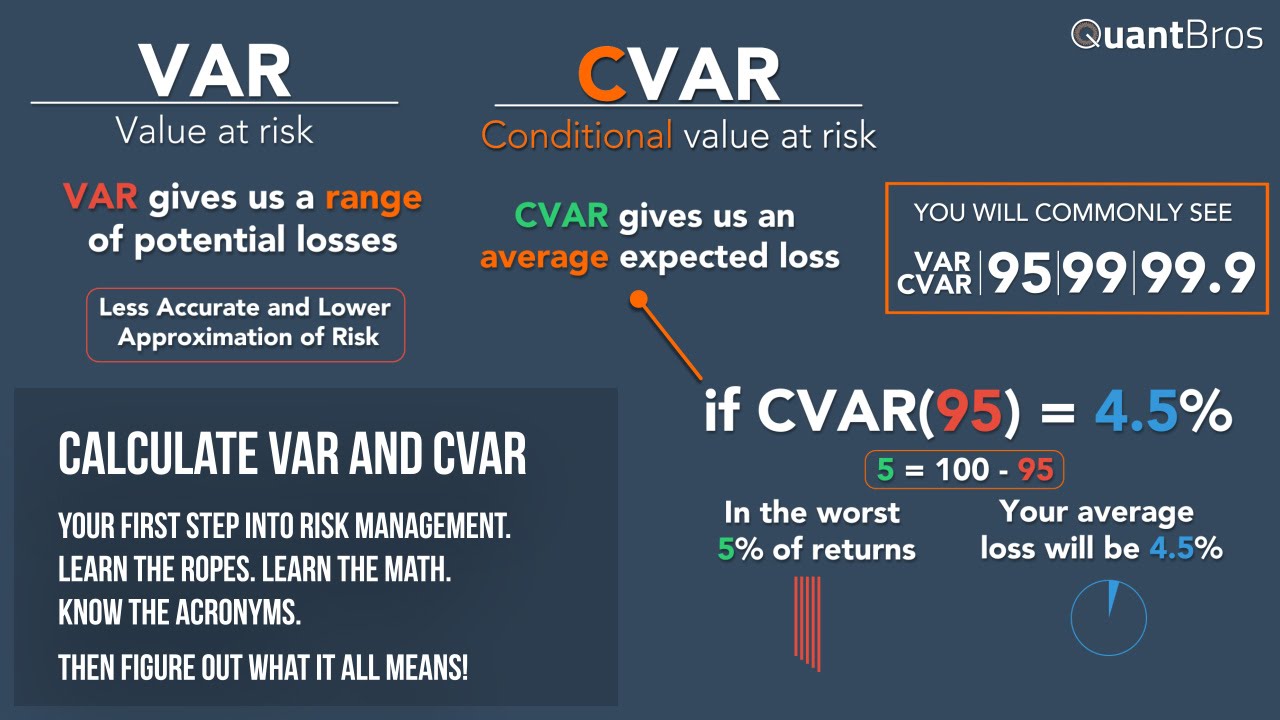
a way i am giving zero weight to all these losses right here and in a way it does imply that i am seeking the risk beyond the var level all right so this is a drawback of value at risk on the other hand when we talk about the expected shortfall the waiting system of the expected shortfall is like this one over one minus the confidence level and if the confidence level is 95 percent and if i solve for it then i get 20 weightage to all these losses right here so essentially i'm giving out equal
weight to all these losses which is beyond this bar that we have calculated right here and all these percentiles i'm going giving zero weight okay now having a weightage system like this this implies that investor is risk neutral imagine i'm giving 20 weight right here and the same 20 weight is also given to this greater loss than as compared to this loss right here so this technically means i am neutral towards this risk or perhaps even greater risk all right so both the var and the expected shortfall both these risk measure by carefully looking at
the distributions i can say that neither the value at risk nor the expected shortfall both these risk measure they do not take into account the individual's risk aversion and that is why we need a better measure than these two who can take into account the individual's risk aversion function so let's welcome the spectral risk measure now what this risk measure does is that it explicitly takes into account the individual's risk aversion and that's what we see right here so basically how it works is that in spectral risk measure i'm going to give weightage to all
these quantiles as per my risk aversion so let's take an hypothetical example assume that i am a risk averse individual so i do not like much risk hence my weights to all these higher losses will rapidly increase okay let's say that i give 10 percent weight to this particular loss quantile and this loss is higher than this one so i'm gonna give perhaps 15 percent weight and this is also higher so perhaps it's going to be 20 so so on and so forth the weight will increase as per my risk aversion and that's the entire
purpose of spectral risk measure now one very important thing that i want you to make a note of is that both the var and the expected shortfall both these risk measures are the special cases of the spectral risk measure now though both these risk measure do not consider risk aversion but still both these follow the underlying methodology of the spectral risk measure which is to give weight to these percentiles all right so that's it guys thank you so much for your time and if you haven't subscribed to our youtube channel make sure that you subscribe
it thank you