June 1942. Prague. Inside a church, hundreds of SS soldiers face a handful of Czech commandos who resist to the death.
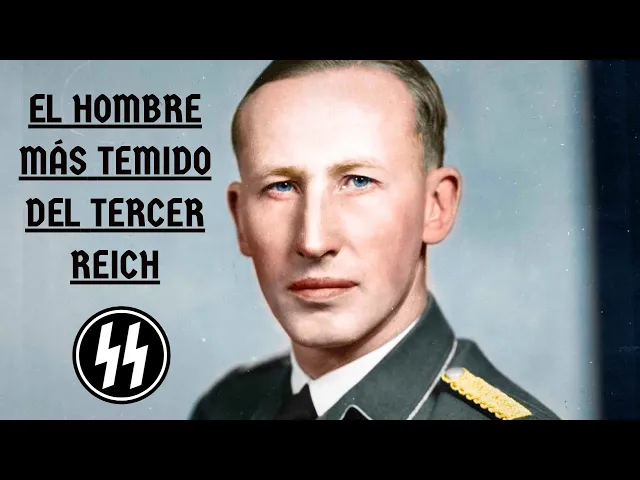
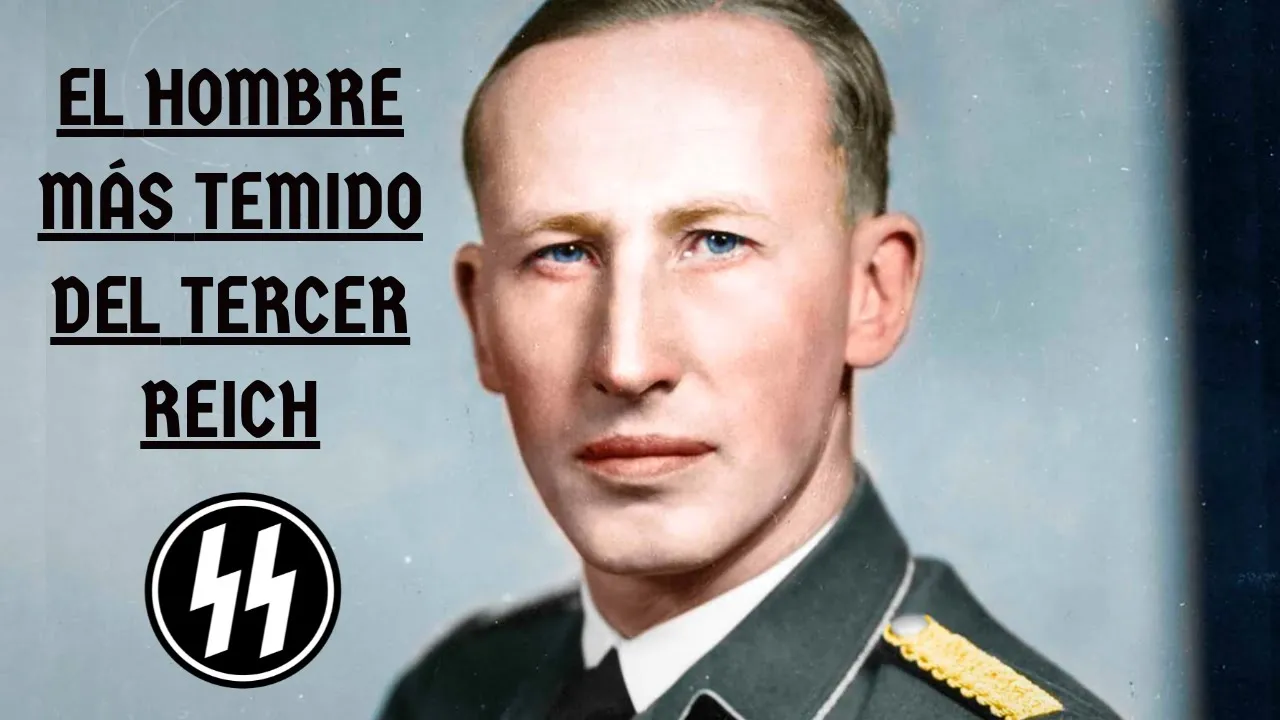
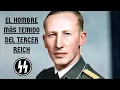
These commandos, just 1 month earlier, had murdered Reinhard Heydrich, leader of Nazi intelligence and the most feared man in the Third Reich. Now they faced the consequences of this brave attack. But, although Heydrich had been executed, his perverse work planned 5 months ago continued.
This was the planned extermination of millions of Jews in Europe, organized at the Wansee conference under the highest state secrecy. This is the story of Reinhard Heydrich, organizer of the Holocaust, leader of the SD, Hitler's favorite disciple, and his origins, his meteoric rise and his surprising murder in the middle of a public street. March 7, 1904.
Reinhard Trístan Éugen Heydrich is born in the city of Halle, in the German state of Saxony. His father Bruno is an opera singer and composer. In addition, he is the founder and director of the city's Music and Theater Conservatory .
His mother is also a piano teacher there. Around 1910, at the age of 6, Reinhard Heydrich already played the piano and violin. Since he was little, he has been passionate about music and the mythical Germanic world of Wagner's work, which will bring him even closer to Adolf Hitler 30 years later.
Adolescence is the time in which Heydrich awakens his passion for sports that would accompany him until the end of his days: swimming, athletics, sailing, horse riding and fencing. In addition to this, his family cultural environment allows him to excel in studies, especially in science and literature. He has been passionate about English detective novels like those of Sherlock Holmes since he was a child and will continue to be interested in the genre into adulthood.
Around 1916, a minor event occurred, but it had an enormous impact on Reinhard's career. The Riemann musical encyclopedia, the most important music encyclopedia in Germany, is going to include Heydrich's father in its edition that year. The expectation in the family is enormous.
But a former student expelled a few years ago manages, through a friend at the printing press, to distort Bruno Heydrich's biography as revenge. He describes him as “a Jewish composer with the last name Súss. ” Although Bruno is a nationalist and is not necessarily anti-Semitic, the fact must be clarified in a trial that he wins and the error is corrected.
But for Reinhard Heydrich, the future Head of the Reich Central Security Office of Nazi Germany, this will always be a shadow that his many enemies will use against him. Towards November 1918, Germany is shaken to its foundations. The First World War ends and the Hohenzollern monarchy falls.
Kaiser Wilhelm 2nd abdicates and Germany becomes a republic after 47 years of being an Empire. The climate in Germany and in Halle is pre-revolutionary. Strikes, demonstrations in the streets, violent clashes between nationalists and communists.
Germany loses 70,000 km2 of territory in the Treaty of Versailles and must pay astronomical compensation. In this climate and around 1920, Heydrich, from a nationalist and conservative family, at just 15 years old, joined the German Nationalist Federation and the Halle Fréikorps, both far-right paramilitary organizations with anti-Semitic tendencies. In April 1922, with his family ruined by the economic crisis, young Reinhard decided to enter the Reichsmarine, as a naval cadet at the Kiel base.
Towards the end of 1923 the consequences of hyperinflation hit Germany. The walls are papered with German marks and the unemployment rate reaches 23%. Heydrich, with his position in the navy, is safe from the catastrophe and is assigned to the naval college in Murwick.
Meanwhile, he also continues to practice the violin daily. But not everything is a bed of roses. The shadow of the false Jewish ancestor haunts him.
His comrades in the navy harass him by calling him “white Jew” or “Moses. ” The resentment resulting from prejudice and ridicule shapes his anti-Semitic character with unpredictable consequences. At that same time he became friends with the future admiral Wilhelm Canaris, who would be Ultimately Chief of the Abwehr or Military Intelligence Agency of Nazi Germany.
Canaris is struck by this tall, blonde young man with athletic virtues and artistic inclinations, so he becomes Heydrich's mentor. In July 1928, Heydrich was promoted to first lieutenant in the Navy and transferred to the communications division of the Kiél Base. There he finds the rise to power of Adolf Hitler and the National Socialist Party.
In September 1930, the Nazi Party obtained nearly 6. 5 million votes for the Reichstag, becoming the second largest force in parliament. At the same time, at a dance in Kiél, Heydrich meets a 19-year-old girl, Lina Von Osten.
Lina belongs to an impoverished family of the Danish lower aristocracy ruined by post-war hyperinflation. Unlike the Heydrich of that time, the von Osten are convinced Nazis and furious anti-Semites, including the young Lina herself. They even maintain contacts with Hitler, while Heydrich has not even read “My Struggle.
” It is the Von Osten family that introduces Heydrich into the circles of power and Nazi ideology. In April 1931, Reinhard and Lina agree to marry, but he continues to have a relationship with another young woman, who also considers herself engaged to him. He denounces it through a high-ranking contact in the navy.
Admiral Erik Raeder, commander-in-chief of the Reichsmarine, after a court of honor finds his behavior unbecoming and unworthy of a naval officer and discharges him. Reinhard is on the street, engaged to Lina Von Osten and without a job, in the middle of an unprecedented economic crisis for the country with 4 million Germans like him without work. His parents can help little.
They are ruined. The Von Osten's, on the other hand, no longer see him as the ideal candidate for Lina. Heydrich, at the insistence of his future wife, seeks to join the National Socialist Party.
Finally, he is accepted into the party with the number 544916. He cannot be said to be an opportunist, but neither is he an old member. Heydrich is useful to the Nazi Party because of his military training.
A friend of Lina's, Karl von Éberstein, recommends him to a then unknown Heinrich Himmler, who is a chicken farmer and head of the fledgling Schutzstaffel or SS forces. The SS originated as a body of parapolice and paramilitaries who served as Adolf Hitler's bodyguards. The meeting takes place at Himmler's poultry farm in Munich.
In this, the future ReichsFuhrer asks him to outline a plan for the creation of an SS intelligence agency. Heydrich lacks knowledge on the subject, but years of reading detective and espionage novels allow him to invent and convince Himmler to the point that he offers to take charge of the creation of the SS intelligence agency. In this way, the future Sijerjitdinst, in Spanish security agency, which is abbreviated as SD, was born.
In July 1931: Reinhard Heydrich formally joins Himmler's SS, which already has more than 10,000 members. Heydrich's will be number 10120. There he creates a network of spies whose intelligence information is systematically stored in the Brown House, the headquarters of the Nazi Party and used for the persecution of opponents and the construction of power.
From then on Heydrich is the executing arm of Himmler and Hitler, the man of action of the Third Reich. On the other hand, Himmler's rival organization in the Nazi apparatus, Ernst Róm's SA, has 100,000 men. It was in those turbulent years of street fighting that Heydrich gained notoriety.
The communists nicknamed him “the blonde beast” because of his ferocity. In December 1931: Reinhard Heydrich and Lina Von Osten marry in the Protestant church of St. Catherine, in the Baltic.
As a reward, Himmler promotes him to StúrbannFuhrer or Major. He already has his uniform and a military rank equivalent to the one he held when he was expelled from the navy. Although the social prestige of both positions is not the same.
At 1. 91 meters tall, blond, blue-eyed and clad in his black SS uniform, he is the prototype of the ideal Nazi. Its admission standards for SD are so high that it surpasses even requirements demanded for Hitler's elite guard, the famous “Léibstandarte”.
With Heydrich leading the SD, in July 1932, the Nazis obtained 13. 5 million votes and became the first minority in parliament with 37% of the vote. In this context, street fights between communists and Nazis also begin to intensify.
It is then that the shadow of his possible Jewish ancestors returns to haunt Heydrich. They denounce him to the head of the organization of the Nazi Party, Gregor Strasser. But an investigation is carried out and it is determined that the accusation is unfounded.
He is thus declared free of any Jewish background. Barely 7 months after this election, Adolf Hitler, within the framework of an alliance with Catholics and nationalists, is named ReichsKanzler by President Paul Von Hindenburg. After this and as part of the program to seize absolute power, the Nazis burned down the Reichstag (the German parliament) in Berlin and blamed the communists.
The ground is ready for the absolute seizure of power. That year the state began to be meticulously co-opted. Heydrich takes over the Bavarian police in Munich and the same will happen in the rest of the country.
It begins with the deployment of concentration camps to imprison political dissidents. Along with this measure, Herman Göring unifies the different police organizations of Prussia into the Geheime Staatspolizei, the secret state police, better known as the Gestapo. This being the muscle of internal repression in Germany.
In 1934 the Gestapo joined Himmler's SS and from 1939 punctually joined the Reich Central Security Office (RSHA) under Reinhard Heydrich himself. In July 1933, the rest of the political parties in Germany were banned and the totalitarian regime was established. The position of “Fuhrer” which means leader and that of Chancellor replace the figure of President of the Reich.
With the arrival of Hitler to power, the SS now controls state repression as “Fuhrer” and “ReichsKanzler”. But not the street gang that is still in charge of Ernst Rohm's SA. Ernst Rohm is a former ally of Hitler and also of Himmler and Heydrich in their fights against communists, socialists, conservatives and moderates.
Now he is a dangerous competitor. And not only for the Fuhrer himself, but also for the SS, which already has 200,000 members. To put an end to Rohm, the top brass of the SS and SD meet in Berlin, and Heydrich denounces that according to intelligence reports, the SA is about to stage a coup.
Suddenly the lists of leaders plotting against Adolf Hitler, the army and the State were drawn up. With these lists, Operation Kolibri is launched, in which the SA leadership is arrested throughout Germany. Hitler takes part personally and makes sure to clean up any political opponents.
Ernst Rohm and Gregor Strasser are murdered. The SS and the SD are the winners in the so-called “Night of the Long Knives”, and as a reward Heydrich is promoted to SS GrepenFuhrer or lieutenant general, at only 30 years old. After the promotion, Heydrich receives another favorable news, his old friend, Wilhelm Canaris is appointed head of the Abwehr, the army intelligence.
A few months later, in September 1935, the 7th Congress of the German National Socialist Party took place . The anti-Semitic Nuremberg Laws are sanctioned , excluding Jews from German public life. At that time, half a million Jews lived in Germany and were at the mercy of the Nazi state.
They are persecuted, their property confiscated, beaten, subjected to forced labor and even murdered. In the 12 years that the Nazis would govern the country, they would enact around 400 laws prohibiting Jews from owning property, practicing professions, getting married and even having a pet. By the end of 1936, Heydrich finally assumed control of all police forces in the Reich, being subordinate only to Himmler.
The SD would be in charge of state security and the Gestapo would be its executing arm. Both would be brought together in the Reich Central Security Office, headed by Heydrich. Counterintelligence tasks are part of his responsibilities and within this field, the radical leader of the SD scores a quick victory against Stalin.
In order to weaken the USSR during 1936, Heydrich forges false documentation about an alleged plot by important Red Army soldiers against Stalin. Such is the case of Marshal Mikhail Tukhachevski, hero of the civil war and chief of the general staff, who is executed. This intelligence operation concocted by Heydrich, contributes to leading the always paranoid Stalin to launch a great purge that reaches more than 35,000 of his best officers, accused of treason.
It is likely that Stalin had already contemplated this before the denunciations and took advantage of Heydrich's rumor to carry it out. This lack of trained officers would be suffered by the USSR a few years later, at the beginning of World War II. Heydrich's next great act is the coordination of the pogrom against the Jews, instigated by Propaganda Minister Joseph Goebbels.
Known as Kristalnacht or Kristallnacht, the night of November 9, 1938, the Jewish population was attacked throughout Germany. Synagogues, businesses, community centers and private homes are attacked by the SS, SD, Gestapo, Hitler Youth, as well as members of the Nazi Party. There are lynchings and beatings, the dead are almost 100.
Thousands of Jewish businesses and hundreds of synagogues are destroyed. 30,000 Jews are arrested and sent to concentration camps such as Buchenwald in Weimar or Dachau in Bavaria. It is the beginning of more aggressive measures against the Jewish population.
11 months after these events, Germany launches Operation “Case White”, the invasion of Poland. The “Casus Béli” is meticulously prepared in Nazi style. Heydrich's SS personnel simulate an attack on a German customs post and a radio station, to transmit from there a nationalist message in the Polish language.
Murdered prisoners from the Sasenhausen concentration camp will then be dressed in Polish uniforms. It was all the proof that was needed, duly covered by the related press. The first victims of World War II were prisoners in a concentration camp.
Barely 20 days later, with the Polish campaign underway, Heydrich sent a telegram to the heads of the Einsatzgruppen, his death squads, for the arrest, confiscation of property and concentration in ghettos of Polish Jews. They had been created by Heydrich during the annexation of Austria in 1938 but it was not until the campaign in Poland that they showed such brutality and played a criminal role. They march behind the regular troops of the German army operating against partisans, opponents and Jews, executing them summarily.
During the Polish campaign Hitler makes his plans regarding European Jews explicit: “If international Jewish financiers from inside or outside Europe once again lead nations into a world war, the result will not be the triumph of Bolshevism in the world and with them the triumph of Judaism, but the total annihilation of the Jewish race in Europe. ” His henchmen, guided by Heydrich, did nothing but follow his guidelines. This brutal action of the Einsatzgruppen in Poland motivated that in the French campaign (where the standards of treatment were different) in 1940, the army did not allow them to participate in the offensive.
This ban gives Heydrich time to join the Luftwaffe as a pilot where he reaches the rank of Major. He thus participates in missions on the Western Front piloting Messerschmitt fighter-bombers. Throughout the war, he participated in more than 100 air missions, including the Eastern Front.
He is decorated with an Iron Cross of the first class and another of the second class. Despite the medals, Adolf Hitler himself forbids it after a serious accident behind Russian lines in July 1941. In October 1940, the Jews of Warsaw are forced by order of the SS to live in the Ghetto.
More than 350,000 Jews, 30% of the city's population, are concentrated and crowded into an area of less than 3% of the city. Before starting the war with the USSR, Hitler dictates the “Commissars Order” in which members of the government and the communist party, Jews, and partisans must be summarily murdered. Heydrich's Einsatzgruppen are the key piece of this machinery.
June 22, 1941. Hitler launches Operation Barbarossa, the invasion of the USSR that represents the incorporation of 5 million Russian Jews added to the more than 3 million Polish Jews under the direct jurisdiction of Himmler and Heydrich. By then, his Einsatzgruppen had no more than 5,000 men for a front of almost three thousand kilometers from the Baltic to the Black Sea.
They will recruit locals, Ukrainians, Latvians or Belarusians for heavy work. The Einsatzgruppen between 1939 and 1941, prior to the systematization of the genocide, the development of permanent facilities and extermination camps, murdered one and a half million people on the Eastern Front, mostly Jews, through mass shootings and other methods. Around July 31, 1941, Reich Marshal and second in command below Hitler, Hermann Goering, formally commissioned Reinhard Heydrich to carry out all organizational and technical preparations for the “comprehensive solution of the Jewish question” or "final solution".
This order from Goring could not be given without the approval of Adolf Hitler. In line with this, in September 41, Heydrich issues a decree for the concentration of Jews in large Polish cities. Since October, thousands of European Jews begin to be sent to ghettos in Poland.
The largest and most emblematic is the one in Warsaw created in October 1940, where xx people live. In these same days, Heydrich is named “Protector of Bohemia and Moravia”, a position he will occupy along with that of Leader of the Reich Security Office. This title of protector includes complete authority over occupied Czechoslovakia, replacing the previous, more moderate authority Kostantin Von Neurath.
Heydrich began a ruthless repressive policy and within two weeks ordered the shooting of 550 Czechs considered dissidents. The objective is to break resistance and accelerate Germanization, diluting Czech culture. It is in Czechoslovakia where he earns his nickname “The Butcher of Prague.
” While this is happening, in the east the Einsatzgruppen arrive behind the Wehrmacht to the cities and villages, identify the Jews, take them to the execution sites, strip them naked and machine-gun them in graves previously dug by the victims themselves. In Babi Yar, on the outskirts of Kiev, more than 33,000 Jews are murdered in a single event by Einsatzgruppen D. That is the ruthless mechanics employed.
That same year, SS-GrúppenFuhrer, Ártur Nébe of Einsatzgruppen B, invited Himmler to witness what Heydrich knew perfectly well, mass executions. After witnessing the act, Himmler is shocked by what he sees and orders Heydrich to find different methods for the executions. He is concerned about the effect that the murder of defenseless, naked men, women and children has on the morale of the troops.
At the initiative of Arthur Nebe, the first mobile gas chambers emerged using carbon monoxide from vehicles. The method, however, is nothing more than a failure due to its inefficiency. Until then there is no official policy or system that contemplates the total physical elimination of European Jews.
By October 1941, Himmler prohibited the emigration of Jews outside the Reich. Ambiguous terminology is also beginning to be used. “deportation to the east”, “resettlement” or “Jewish autonomous territories” to refer to the ghettos.
By then, in the SS, these concepts and annihilation begin to become synonymous. In December 1941, the Empire of Japan launches a surprise attack on the United States at Pearl Harbor, Hawaii. The United States declares war on Japan on December 8.
Germany, for its part, declares war on the United States, hoping that Japan will declare war on Russia as a counterpart. The war already exceeds the framework of Europe and is global. And it is possibly lost to Nazism, which must confront the USSR, England and the United States at the same time.
Hitler's 1939 prophecies about the extermination of the Jews resonate. A few days later, at a meeting of the Nazi Party that brings together its most prominent figures, Hitler again declares unambiguously that if the Jews cause another world war they will be exterminated. For some reason he accused the innocent Jews of being guilty of the war that he had unleashed, or he simply used it as an excuse.
It is at this meeting that Adolf Hitler decides on the complete extermination of all the Jews in Europe. The green light for genocide had been given and both Heydrich and Himmler took due note of the comment. Towards the end of December, however, while Heydrich and his henchmen methodically plan the Holocaust, two young Czechs, soldiers Jan Kubis and Jozef Gabcik, parachute into the outskirts of Prague alongside a team trained by the Directorate of Special Operations.
(SOE) of the British Army. His sole objective is to assassinate Reinhard Heydrich. It is the beginning of Operation Anthropoid.
For January 1942, Heydrich resumes Göring's order of July 31 of the previous year, and reconvenes a conference for January 20 with the aim of carrying out the "final solution of the Jewish question. " This had originally been called for December 9 and canceled due to the Japanese attack, but it finally takes place on January 20, 1942. The place chosen by Heydrich is a quiet suburb southeast of Berlin, called Wansee.
A cool place where the wealthy classes and key figures of the regime such as Guébels or Albert Speer build their summer homes. Opulent mansions with lakefront gardens just minutes from Berlin's government district. Even Hitler's questionable and unorthodox doctor , Theodore Morell, has his own.
The house chosen for the conference is 56-58 and belongs to the SD, serving as a home for senior officials visiting Berlin. Heydrich indicates that at the end of the war this will be his own family home. January 20, 1942.
That cold and sinister day, the Wannsee Conference was attended by 15 high-ranking officials from the different areas of the Third Reich. Representatives of the Chancellery, the Ministry of Foreign Affairs, Martin Bormann's Nazi Party, the Ministry of Justice, Göring's Office for the Four Year Plan, the occupied territories, and the SS and the Gestapo. Most of them are young, ambitious university men, of the same rank as their host, Reinhard Heydrich, but with less power than him.
Who isn't afraid of Heydrich in that room? Yes, probably even Hitler himself fears him a little. The blonde beast has files on all the leaders of the Third Reich.
Of the 15 attendees at the meeting, only 2 know the details of the agenda. Heydrich himself and his lieutenant Adolf Eichman. SS Lieutenant Colonel Adolf Eichman is an efficient bureaucrat who deals with the logistical aspects of the Holocaust: transportation, infrastructure, emigration, deportations.
It is in Adolf Eichman's office that deporting the Jews to Siberia, or to the inhospitable island of Madagascar in the Indian Ocean, is being evaluated. The conference lasts between an hour and an hour and a half. It is enlivened with cognac, cigars, French wines and an extraordinary full buffet.
A warm environment far from the hardships of the Werhmacht soldiers in Russia, who suffer the terrible winter in deplorable conditions. A minute of the meeting is made and Adolf Eichman gives it to the attendees. They are numbered copies that they can only share with their superiors.
When reading the minutes everyone notices that what is stated is exactly what Reinhard Heydrich wants to appear as a general consensus. It is clear that the objective established by Goring and Hitler is “the final solution to the Jewish question in Europe”, and that control of the operation falls on Reichsfürer SS Himmler, and within its structure, in the person of Reinhard Heydrich. A spreadsheet is thus presented country by country, including England, where European Jews total 1,100,000.
The so-called final solution affects each and every one of them. The Jews must be sent to the East, where they will be subjected to forced labor in road construction until natural wear and tear kills them. The civilian areas of the Reich put up lukewarm and fearful objections, although they finally submit to Heydrich's will.
An example of this behavior is that of Dr Whilhelm Stuckart, prestigious Nazi lawyer for the Ministry of the Interior and author of the Nuremberg laws that excluded Jews from public life. At first, Stuckart maintains that it is necessary to evaluate how to treat Jews who are only partly Jews, that is, called mestizos, because they are partly German and the Nuremberg laws contemplate this. He finally gives in to Heydrich's pressure.
He proposes things like dissolving mixed marriages by law, forcibly sterilizing “mischlinge,” or having party experts seek a consensus on what to do with them. In practice he left the solution in the hands of the SS and Heydrich and Himmler. The one who raised the most objections and at the end of the war showed shame was Doctor Friederich-Wilhelm Kritzinger of the Reich Chancellery.
He maintains that Hitler has personally assured him that such a measure is not contemplated. Heydrich coldly replies that for political reasons he would continue to deny it but that the Fuhrer's secret order is the “final solution. ” Kritzinger had already shown some oppositional attitudes, such as refusing between 1940 and 1941 to declare German Jews stateless.
According to the great historian Theodore Mommsen, what incriminated him was his weakness, not his initiative on these issues. Another who raises an objection is Erich Neumann, sent to the meeting by Hermann Goeringy responsible for the Four-Year Plan. Neumann timidly suggests that since at that time the German war industry used slave labor, who were partly Jewish, their “deportation” would affect the level of production.
Heydrich replies that they will be replaced by Slavs. Heydrich states without a doubt that the surviving Jews will be eliminated. The same for those who from the beginning are not suitable for forced labor.
The vast majority are intellectuals, employees, merchants, scientists, teachers, artists who cannot resist these inhuman conditions for long. It will begin from West to East, starting with Germany and the Protectorate of Bohemia and Moravia (the current Czech Republic) to continue through Poland. Evacuation is clearly synonymous with extermination and no one will survive these deportations.
The only thing that is not defined is the modality of extermination. According to Eichman's testimony in his 1962 trial, specific measures of extermination, gas, sterilization and forced labor were discussed. In Wansee, regardless of the method, the extermination of the 11 million Jews living in Europe is decided.
It is undoubtedly the beginning of the Shoah, which means catastrophe in Hebrew. What Heydrich does not know is that he only has 4 months to live and that he will die in Prague a few weeks after the conference. In order to complete the systematic extermination, permanent facilities are built to which people are taken for elimination.
The victims are transported on freight trains in an inhumane manner to the extermination camps in Poland. The euphemisms are humiliating, there is talk of “Sonderbehandlung” or special treatment to refer to extermination. Forced labor camps are also available in Germany, Austria or Czechoslovakia.
But prisoners are not destined in principle for special treatment, but rather for gradual wear and tear due to work. After the German defeat, during the Nuremberg trials, the mechanism of the Final Solution would finally be revealed. In an unprecedented act, the head of the Auschwitz concentration camp, Rudolf Höss, admitted to having accidentally discovered the use of a pesticide called Zyklon B in 1941.
He claimed to have tested it on Soviet prisoners of war in September 1941, explaining that it took about 15 minutes to die, before the astonished gaze of the judge. After discovering this chemical and under orders from Himmler, the commander of Auschwitz, according to his own confession, says that false bathing rooms were designed where the naked victims were taken and where they were He murdered with that compound. He acknowledged having built crematorium ovens to destroy the remains of the deceased.
Jós places the beginning of the operation in March 1942. When asked by the court about how many victims there were, Jós estimated them without flinching at around 2 and a half million human beings in Auschwitz alone, although he clarified that this was an estimate since that there was no unified and detailed record. The chilling figures broke most of the accused and left Hermann Goering, who was trying to defend himself with intricate arguments, without any further arguments.
While the final solution is being prepared, Reinhard Heydrich with his wife Lina von Osten and their three children live in the Pánské Brezany Palace, a neoclassical country estate with extensive gardens, about 20 kilometers from Prague. The government headquarters from which Heydrich governs Czechoslovakia with an iron fist is the magnificent Hardcany Palace, more than 500 meters long, built in the 9th century as the residence of the Bohemian kings. Heydrich gives lavish parties at the Prague palace where he shows off his musical knowledge, and even exhibits a performance of his father Bruno's work.
May 27, 1942. Prague. It is a beautiful sunny day in the exquisite city of the Bohemian kings.
The waters of the Vltava flow calmly under the Kárluv Bridge and the sinister black medieval spiers of the Týn Church reflect their shadow over the old town square. The Czechs are preparing to live another day of the Nazi occupation, another since 1939. It had been a cruel winter and not only because of the extreme cold but also because of the iron dictatorship exercised by the "Protector of Bohemia and Moravia.
" Spring had arrived, but hope had not. Likewise, the cafes are full and the city despite everything seems to be alive. The Czechs ignore that that day was going to be glorious, although also the prelude to a great horror.
In the palace of Panenské Brezany, Heydrich plays with his three children. His wife Lina waits in the room. That day Heydrich is delayed.
He will leave his house for Prague only at 10 am. He will fulfill formal obligations at Hardcany Castle and then travel by plane to Berlin to meet with Adolf Hitler himself. Permanent gas disposal facilities are being built at a rapid pace in Poland.
The final solution agreed at Wansee five months ago is in full swing. His power is absolute and he feels safe. He gets into the convertible Mercedes Benz with his driver Johannes Klein at the wheel, without further custody or escort.
He wants to show that he is not afraid of the Czechs and that his authority is unquestionable. There are those who doubtfully maintain in the resistance that, if Heydrich is killed, Hitler will destroy Prague, the most beautiful city in Europe. Czech President Eduard Benes in London is not afraid of the consequences.
The English had already handed it over to Hitler in Munich in 1938. Nothing prevents a new armistice with Hitler from leaving Czechoslovakia forever within the Reich. It's time to play hard.
Heydrich repeats the same route day after day, so his murderers wait for him in a specific place. In the Líben neighborhood on a sharp bend where the car must slow down, trained Czech agents Josef Gabcik and Jan Kubis wait on the lookout. Anthropoid is underway and there is no turning back.
When the convertible Mercedes slows down on the curve, the young Gabcik confronts it with his British submachine gun “Sten”. But at that very moment, the gun jams. Gabcik despairs.
Heydrich, instead of ordering his driver to accelerate to escape, forces him to stop and draws his pistol, shooting Gabcik. But while this is happening, soldier Kubis approaches with a powerful explosive from the side and throws it under the Mercedes, which flies into the air when the bomb explodes. Heydrich's injuries are not fatal, but shrapnel and components from the car are embedded in his back.
The Nazi leader tries to continue shooting, but collapses. Kubis and Gabcik escape and hide in a nearby building. The attack on Heydrich makes the Nazis assume that it may be the beginning of an uprising general.
Prague is completely sealed off by three battalions of the Behrmacht, the Gestapo and the SS. More than 12,000 troops. More than 36,000 buildings are searched in search of the conspirators.
Reinhard Heydrich meanwhile refuses to be treated urgently by Czech doctors, which would be fatal. Instead, he waits for the German doctors sent by Himmler. On May 31, Himmler visits Heydrich, who is progressively improving.
But two days later he developed an infection that led to generalized septicemia. The seat of the Mercedes in which Heydrich was traveling was stuffed with horse hair, which had become embedded in his body, generating the infection. The head of the Reich's central security enters a coma from which he will never wake up.
Germany, unlike England, does not have penicillin. On June 4, 1942, Reinhard Heydrich died in the Bulovka hospital, at the age of 38. His coffin is paraded in a solemn procession through the streets of Prague and displayed at Hradcany Castle.
On June 9, he was buried with honors in the Reich Chancellery, with Siegfried's funeral march from Richard Wagner's Twilight of the Gods in the background. After the death of his best disciple, repression is not enough to appease Hitler's anger. Like Rome with Carthage 2,500 years ago, the randomly chosen town of Lidice is razed to the ground.
At 11 pm Gestapo and SD troops surround the city. Almost 200 men are executed. The 195 women are sent to the Raivensbruck camp and the 95 children to the Chelmno camp where most of them are murdered.
Those under one year old are taken to Germany for Germanization. The town is demolished and leveled. Lídice has ceased to exist forever.
The Germans declare that if those responsible do not surrender on June 18, the measures will be very harsh and unprecedented. Faced with this threat, Karel Čurda's betrayal and cowardice perhaps ironically saves Prague from catastrophe. Curda, was one of the paratroopers who arrived from London.
Although he does not know the whereabouts of Gabčik and Kubiš, he betrays his contacts in the resistance. The retaliation is terrible. Those responsible and members of the resistance and their families are imprisoned and executed.
On June 17, among other members of the resistance, the apartment of the Morávec family, which had helped Gabcik and Kubis, was attacked. Before murdering the family, the Gestapo tortures them and manages to find out the secret whereabouts of Heydrich's murderers. They are hiding in the Orthodox Church of Saints Cyril and Methodius, waiting for a plan that will allow them to escape from Prague.
The next day, 800 SS men surround the church and break into the premises, surprising Kubis and two companions, Adolf Opálka and Jároslav Svarc. They were on guard, so a hellish shootout broke out. The SS win and Kubis is taken prisoner while he is unconscious.
The rest is hidden in the church basements. Priest Vladimir Petrek admits that Gabcik and other commandos are hiding underground. After this, 6 hours of hard combat broke out, where the Germans lost fourteen men and another twenty-one were wounded.
Finally, with no chance to win and no ammunition, the commandos commit suicide to avoid falling into the hands of the SS. Kubis, who had been captured, died in the SS hospital from grenade wounds during the fighting. The traitor Kárel Curda must recognize the corpses of his former companions, and is rewarded with 2 million Reichsmarks by the SS.
After this event, the Bishop of Prague, Gorazd, takes the blame for the actions in the cathedral to minimize reprisals, but is arrested and tortured. After this the bishop, the church priests and the main lay leaders were taken to the Kobylisy shooting range in a suburb and shot. Despite having killed those responsible, the village of Lazáky suffers the same fate as Lídice, being erased from the map.
But although Reinhard Heydrich had gone down in history, his evil plan devised at the Wansee Conference was still underway. Between July and September 1942, between 250,000 and 300,000 Jews from the Warsaw ghetto were sent on freight trains to the Treblinka extermination camp. Only 55,000 remain in the ghetto.
After the assassination of Reinhard Heydrich, Himmler launches “Operation Reinhard. ” Between July 22 and November 4, 1942, in 3 months, one and a half million Jews were murdered, mostly in the extermination camps of Belzec, Sobibor and Treblinka. By January 1943, the Jews of the Warsaw Ghetto began to bravely resist, refusing to cooperate with the SS.
By April 1943, the Germans decided to eliminate the Warsaw ghetto. SS General Jürgen Stroop is in command of the operation . They do not have the heroic resistance of the remaining 55,000 sick, hungry and poorly armed Jews who will resist until May 16.
It is the first battle of Zionism led by Mordechai Anielevich. Many go down fighting, like Anielevich himself who committed suicide along with his close collaborators in his bunker on May 8. Others are killed when they surrender.
The majority, about 37,000, are sent to the Treblinka extermination camp. At the end of the war in May 1945, the result of the genocide of Nazi Germany coordinated by Heydrich against Jews, gypsies, homosexuals, Jehovah's Witnesses, Soviet prisoners, opponents and other groups reached 1,100,000 people in Europe, of which 1000000 are children. More than 6,000,000 are Jews.
During the Nuremberg Trials in March 1947, among mountains of documents from the Chancellery of the Third Reich, a peculiar red seal caught our attention, “Confidential Document of the Reich. ” Its title is “Meeting Minutes”. 30 numbered copies of the Wansee conference minutes had been made and this is the only one found.
It had belonged to one of the participants, Martin Franz Lúter, from the Ministry of Foreign Affairs. It was now part of humanity's consciousness. Heinrich Himmler commits suicide in Lünenburg on May 23, 1945 by ingesting a cyanide capsule after being captured by the British.
Hermann Goering is convicted of war crimes and crimes against humanity at the Nuremberg Trials and sentenced to hanging. He managed to commit suicide in his cell on October 15, 1946 with a cyanide capsule. Ernst Kaltenbrunner, Heydrich's successor at the head of the RSHA after his death and continuator of his work until the end of the war, is found guilty in Nuremberg of war crimes and crimes against humanity and sentenced to hanging where he would die.
on October 15 , 1946. A similar fate would have awaited Heydrich had he survived the war. Adolf Eichman manages to escape but is detected, 15 years after the end of the war and captured by an Israeli Mossad commando in Buenos Aires.
He was taken to Israel, tried and then hanged on June 1, 1962. Eichman had been one of the architects of the Final Solution and a close collaborator of Heydrich. Rudolf Jos, head of the Auschwitz-Birkenau camp, was sentenced to hanging, a sentence that was carried out at the site of his crimes in Auschwitz, Poland, on April 16, 1947.
After the war, Karel Cúrda was executed in Prague for high treason. . On January 20, 1992, on the occasion of the 50th anniversary of the Wansee Conference, the mansion where it took place was converted into a Holocaust Museum.