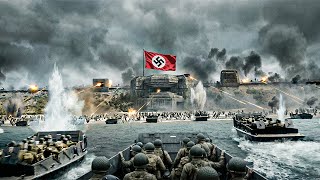
June 6, 1944. 6:30 in the morning. The largest landing in human history takes place on the beaches of Normandy. Some 5,000 landing craft escorted by more than 100 destroyers and more than 20 cruisers, along with other ships, cross the English Channel towards the coast of France. The allied fleet is supported by 3,000 warplanes that cover the sky and seek to ensure the success of the operation. Hitler, for his part, is sleeping soundly in his alpine refuge in Berchesgáden. The night before he had stayed up late talking with Propaganda Minister Josef Goebbels, and had taken sleeping
pills provided by his personal doctor, Dr. Morell. None of his subordinates dares to wake him up in the first hours of the landing. On the battlefield, the German defense is led by Marshal Erwin Rommel, Who had been reinforcing the obstacles and firepower of the beaches in the previous months. However, that day Rommel is in Germany, for his wife's 50th birthday. He is soon warned of the attack and sets off towards the combat zone. Across Europe, in Moscow, Josef Stalin takes comfort in knowing that the Allies will finally open a second front in France. The Soviets
have been fighting Germany for almost 3 years, having already suffered more than 20 million deaths, so the landing in Normandy represents a great relief. The Third Reich finds itself facing the attack that will decide the future of the war. If they defeat the Allies in Normandy, they could relocate the 50 divisions they have in France and Holland to the Eastern Front to fight the Soviets. With this additional power, perhaps they can stop the fierce advance of the Red Army. If they fail in their defense, the Germans will find themselves trapped between two pincers, one in
The east led by Stalin and another in France led by the United States and England. In that scenario, the Third Reich would enter a serious coma and have almost no chance of winning. This is the story of D-Day, its immense preparations, its fierce fighting, the subsequent fighting in France, the liberation of Paris and the fall of the Third Reich. August 1943. In the fields of Kursk, Germans and Soviets clash in a titanic confrontation. The German troops, after an initial success, must however retreat in the face of the Russians' defense in depth. For the first time,
a German summer offensive had been stopped without major problems. The Soviets have been fighting Germany for 2 years now, and after having suffered millions of casualties, they are beginning to understand how to combat the blitzkrieg. However, Hitler's defeat is still a long way off. The Third Reich only strengthens its production and swells its ranks with more men despite the recent defeats at Stalingrad and Kursk. Stalin knows this, and that is why he asks the United States and England to open a second front in Europe. If the Allies managed to land in France, Hitler would be
caught between two pincers and it would be very difficult for him to resist defeat. With this objective in mind, Franklin Roosevelt for the United States, Winston Churchill for Great Britain, and Stalin for the Soviet Union met in Tehran . The person who best describes the meeting is Andrei Gromyko (USSR ambassador to the US), who was present: “Stalin urged the allies to open a second front in Western Europe as soon as possible. At one point, unable to contain himself, he stood up from his chair and said to Voroshilov and Molotov: "We have too much to do
at home to waste time here. "We're not going anywhere like this." Disturbed and evidently fearful that the conference might fail, Churchill said hastily: 'The Marshal has misunderstood me. I can give an exact date: May 1944.” In this way, the date for D-Day is set, although it would later be moved to June. The landing place, however, was still the subject of some debate. As the first option, the Pas de Calais appears in France, just 34 kilometers from England. From that place, Hitler launches his V1 rockets with 850 kilograms of explosives over London. Calais would also allow
direct entry into the Third Reich, through the industrial zone of the Ruhr River. But despite this, the region has numerous canals and rivers, which would complicate the initial advance of the troops. The second option is the coast of Normandy, where there are not so many aquifers and the advance would be easier to achieve with armor and infantry. Normandy also makes it possible to threaten the important ports of Cherbourg on the Cotentin peninsula and Brest on the Brittany peninsula. The great port of Cherbourg was the only point on the continent where the HMS Titanic stopped before
embarking on its fateful voyage. Having these ports, the allies could land material without problems to supply their troops quickly. In Germany, Hitler had already reinforced the Calais Pass decisively with 380-millimeter cannons, which had been extracted from French warships. Normandy, on the other hand, is poorly defended, with a few divisions of Russian prisoners and poorly trained units. Because of this, the allies finally choose the latter for the landing. The Allied invasion plan consists of three consecutive phases. The first phase is codenamed “Operation Neptune.” This Consists of the bombing of the German defenses, the launching of paratroopers
in the rear and the subsequent landing of troops on the beaches. The beaches of the Norman coast chosen bear code names: Utah and Omaha objectives of the United States, Sword and Gold of the British and Juno of the Canadians. The second phase of the operation is the consolidation of the beachheads, with the consequent arrival of all the necessary war material and supplies. Finally, the in-depth attack on the interior of France, having as important points the port of Cherbourg, the town of Saint-Lo and the city of Caen near the coast. Due to the characteristics of the
landing, air and naval superiority must be absolute. Air attacks on railways, roads and depots must isolate the entire region from the rest of the Reich, so that the German response will be slower. In charge of the entire operation is General Dwight Eisenhower of the United States And in charge of all forces on the ground is the British Bérnar Montgomery. Eisenhower is not only a born planner, but he also knows how to negotiate with egocentric personalities such as Churchill, Montgomery, Patton or De Gaulle, to keep the alliance afloat. From the German side, defenses against invasion had
been built since 1942 at the hands of the so-called Todt Organization, directed at that time by Minister Albert Speer. With the help of Speer, the “Atlantic Wall” was built, which is a set of 15,000 bunkers, large cannons, blockhouses, trenches, casemates and other fortifications, ranging from Norway to the border with Spain. At least 250,000 workers are used in its construction, mostly slave labor from prisoners of war and civilians. Speer uses one million tons of steel and twenty million cubic meters of concrete in the construction of the defenses, which are used To publicize the unbeatable German defense.
Josef Goebbels (Reich Minister of Propaganda) provokes the allies, his great slogan at that time being: “They are supposed to come. Why don’t you come then?” But beyond the resources invested and the propaganda, the reality was different. At the end of 1943, Field Marshal Erwin Rommel, at Hitler's request, inspects the beach defenses. Rommel begins to study the coast from Denmark to France, but to his disappointment finds the defenses unfinished and in a poor state. Propaganda had made him believe that the wall was impenetrable, but after the visit, he is forced to write a lapidary report. The
invulnerability of the Atlantic wall was a farce. Just a few days later, in January 1944, Hitler appointed Rommel commander of the German armies from Holland to the Loire, in France. The famous marshal is now responsible for repelling the invasion, And his only superior is Gerd Von Rundstedt who is in charge of the entire Western Front. Contrary to what Rommel thinks, Von Rundstedt is convinced that the wall is not important for defense and that the invasion is inevitable. The “last Prussian” believes that “To defend everything is to defend nothing” and prefers to fight once the allies
have landed on land. Marshal Rommel is convinced that the invasion will be decided in the first 24 hours and is feverishly engaged in a race against the clock to strengthen “the wall.” Spend your days touring the defenses by car and walking along the beaches. He barely rests. It establishes its headquarters in the castle of the Duke of La Roche-Guyon, 180 kilometers from the coast of Normandy. Two years earlier, Rommel had fought in Tunisia, Libya and Egypt commanding the Afrika Korps in the middle of the desert. There with temperatures of up to 50 degrees, Rommel had
earned the nickname of the Desert Fox, thanks to his brilliant Mobility offensives that allowed him to defeat enemies superior in number. But now, the scenario is different. The defense is static and the enemy will come from only one possible direction, the sea! With great mental agility, Rommel creates and deploys all kinds of defenses that arise from his imagination. It places millions of land and sea mines, posts to prevent landings, builds bunkers, installs machine gun nests, installs metal structures in many cases mined in the landing areas and builds powerful concrete defenses. All of these fortifications would
be protected by cannons of different calibers or the powerful MG-42, which could fire 1,200 bullets per minute with a caliber of 7 point 92 millimeters, which generated fear in the enemy troops. The characteristic sound generated by its high cadence was similar to a saw, which is why it was nicknamed “Hitler's saw.” Its predecessor, the MG-34, could fire 850 rounds per minute, While the Allied machine guns were only around 500 or 600 rounds every 60 seconds. Returning to defense, Rommel's objective is to stop the landing or massacre the enemy when they are stranded on the beaches.
In just 5 months he manages to place 4 million mines of all types. In the water, on the beaches, on the cliffs and in the approaches to the coast. In the two previous years, only 2 million had been placed. Your goal is to reach 50 or 100 million mines, but you won't have enough time. For the Allies it is fortunate that Rommel did not assume this role a few months earlier, the invasion would have been much more difficult and costly, if not impossible. They also benefit from the strained relationship that Rommel has with his superior
Von Rundstedt. Both Rundstedt and the high command of the German Wehrmacht are convinced that the attack will be in Calais, while Hitler and Rommel in Normandy. Rommel is convinced that the only chance is to stop the enemies on the beaches and, if possible, at sea. He proposed to Hitler to take the 1,600 available tanks to fixed positions on the coast. From there, keep the beaches under fire from the artillery of the Atlantic Wall and armored vehicles. The mobility master here does not believe in the usefulness of mobile reservations. He is convinced that if the enemy
overcomes the coastline, the war will be lost. This criterion is not shared by Von Rundstedt or the high command. The logic of Rundstedt's decision is that if there are no divisions left in reserve and the Allies manage to break the front, the entire road to Germany would be open to them. British General Montgomery, who had fought Rommel in Africa, comments: “It is evident that their objective is to beat us on the beaches. “He is an energetic boss, Full of determination, and everything has changed since he took over.” But Rommel's difficulties do not end at Rundstedt.
The Luftwaffe and the Kriegsmarine do not cooperate either. Hermann Goring refuses to supply anti-aircraft guns and the Luftwaffe has almost no operational capacity in the West. The Kriegsmarine, on the other hand, ignores his request to mine all shipping channels. The troops in charge of defending the wall are also not of the best quality. They are older men from the East, Polish, Russian, Czech and even Asian deserters who joined the German army in an attempt to survive. There are also divisions punished by the harsh eastern front that have been recomposed several times. Sergeant Hans Stober of
the 17th SS Panzer Grenadier Division belongs to the elite rear troops. On an unusual morning, he meets a Russian on the coast that he himself had taken prisoner in 1941. Life in France is peaceful for the soldiers compared to the rigor of the Russian front. Food, drink and fun abound . The French climate is pleasant and they feel lucky. Only three divisions are placed near the coast, the rest in the rear. The latter are under the control of the High Command, and not Rommel, who intends to also deploy them on the coast. The marshal only
has the 21st Panzer Division near the beaches, south of Caen, on the Cotentin peninsula. Rommel asks for at least one more armored division, near Saint-Lo, to have more coverage for a landing in Normandy and Cherbourg. But they deny it. By the beginning of 1944, Germany deployed 179 divisions in the East, 26 in the South East, 22 in Italy, 16 in Scandinavia and 53 in France and the Netherlands. Only 3 of these are on the French coast, and one in Normandy. Despite this, from the German high command Alfred Jodl promises Rommel that once the Allied invasion
occurs no less than 10 Panzer divisions will arrive at the front, and that a new generation of fighters and submarines will decide the war. These empty promises do not convince the marshal, who will continue to demand more divisions on the coast. From the Allied side, in order to confuse the Germans about the point of the invasion, Operation Fortress is launched. This seeks to convince the Germans that the invasion will be in the Pas de Calais and not in Normandy. Along these lines, 11 false divisions are created made up of tanks, planes, boats and inflatable vehicles.
The general to whom this army is assigned is George Patton. His great reputation in Germany helps convince them of the deception. The inflatable army is located in Kent and Sussex near the coast, and even fake radio communication is generated as if it were a real army. Patton will continue his charade until even 1 month after the invasion. One of the participants in this deception is agent Joan Pujol, known as Garbo. Garbo manages to create a fictitious network of spies in England, and makes the Germans live in an unreal world about the future invasion. The intelligence
information provided by “Ultra” is another key factor. The interception and decoding of German communications in code of the “enigma code” gives the allies a terrible advantage of anticipation. In addition to Calais, preparations for an invasion are also feigned in the Balkans and Norway. In April 1944, the Führer met with Jodl and artillery general Walter Warlimont at the Berghof. The Pas de Calais remains the topic of discussion. Hitler gives them his opinion on Patton's troop movements in front of Calais: “The Allied maneuvers are a hoax, the invasion will not be there. Everything is served for us.
It's false". He goes so far as to tell them: “There is no better place for landing than the Cotentin peninsula.” This is precisely the main allied objective. On the same day Rommel wrote to his son Manfred: “The favorable time for landing begins in May. There we will face the decisive battle.” Hitler and Rommel's intuition is correct. Rommel demands that he reinforce the area where both are waiting for the landings immediately. The inexplicable thing is that Hitler, despite his intuition, for the second time does not order measures to reinforce Normandy. The troops stationed in Norway remain
there uselessly until the end of the war. The Pas de Calais is the most fortified sector of the front. There are powerful dismounted 380-millimeter cannons located there. of French battleships and there is also the second Panzer division. Barely a month before the invasion, Rommel tells his adjutant, Captain Helmut Lang: “Believe me Lang, the first 24 hours of the invasion will be decisive. The fate of Germany will depend on its result . “For both the Allies and Germany it will be the longest day.” On the Allied front, around May 3, the last large-scale invasion test with
live fire was carried out. The failure is complete. 600 American soldiers die, partly from their own fire and partly from a German torpedo boat that interferes in the exercise. By then there are already one and a half million American soldiers in the United Kingdom. These are housed in camps and even in private homes. Large columns of men and armor are progressively concentrated in the south of England. Just 4 days before D-Day, Rome falls to the Allies. Germany, however, would continue to resist in Northern Italy until the end of the war. The siege is closing for
Hitler. The only chance for the Third Reich is the failure of the invasion in The West. If that happens, he can allocate 40 divisions to the East to try to stop the Russians. That afternoon of June 2 at the Berghof, Jodl and Hitler return to the topic of the invasion. The increase in activity in the south of England is evident, and it is concluded that the most probable time of the invasion is between the 5th and 13th of that same month. German intuition is good. Eisenhower has chosen June 5 as the date for the invasion.
The problem in terms of weather is not only the crossing of the channel, but to capitalize on aerial bombardments it is key to have a clear sky. The Wehrmacht meteorological services predict more than a week of terrible weather. Seeing this, the Germans relax. But the Allies have more and better information than the Germans about the weather, and the invasion is held for June 5 but is finally changed to June 6. Eisenhower is tormented by the thought of postponing the operation. Troops cannot be embarked and disembarked, since it is an army of 250,000 men. Maintaining secrecy
is absolutely key. Above landing ships and at airfields, delays test the nerves of soldiers and airmen. Around June 5, Marshal Rommel, due to atmospheric conditions, considered the landing unfeasible and traveled to Germany with permission from his superior Von Rundstedt. It is his wife Lucy's 50th birthday and even General Günther Blumentritt writes: “Rommel is tired and tense. A man who needs a few days at home with his family to rest.” On the day of the invasion, other senior German officers are also not at the front. SS General Sepp Dietrich in charge of I Panzer Corps is
in Brussels. Teodore Kranke, naval commander in the west, is on his way to Bordeaux. Major General Edgar Foichtinger, commander of the 21st Panzer Division, is in Paris. General Friedrich Dolmann, Commanding the 7th Army in Normandy, has left his headquarters to attend a war games exercise in Renes, as has General Heinz Helmich, commander of the 243rd Division. The BBC broadcasts in code the day before the landing a warning to the French Resistance. The key is in the first line of the poem “Autumn Song” by Paul Verlaine. In this case, the Germans, through torture, have obtained information
about the resistance. On the appointed day they get the message, but due to lack of intelligence they do not take advantage of it. A copy of the report is lost in a pile of papers on General Jodl's desk. On the other hand, Allied counter intelligence generates confusing information about an attack in the Calais area aligned with Operation Patton's Fortress. Hundreds of dolls are dropped by parachute to mislead the Germans. The French resistance collaborates with the invasion in a notable way, helping to isolate Normandy from the rest of the Third Reich. During the first months Of
1944, 808 locomotives were destroyed. They rescue downed Allied pilots, sabotage the railway, telephone lines, telegraph, damage bridges and roads. They are a source of information for allies. No one knows better the obstacles on the beaches, the tides and currents, the topography and the enemy's deployment. They have a chain of command, organization and operational capacity that reaches each town on the coast. Albert Auge is the head of the Caen train station in Normandy, and his mission is to destroy the locomotive engines. André Farine is the owner of a Café in Isigny, and with his team he
must cut the telephone cables of Normandy. Cherbourg must be cut off. Aives Gresselin is a merchant in Cherbourg, and must dynamite the Cherbourg-Saint Lo-Paris railway. The life expectancy for an active member of the French resistance always exposed to German infiltration or torture of its members in 1944 is less than 6 months. But not all of France is on the same side. The Prime Minister of collaborationist France, Pierre Laval, broadcasts a radio message calling for respect for the pact with Germany: “If they take part in the fight, France will be plunged into a civil war.” Marshal
Petain makes a direct appeal to support the German forces: “The Anglo-Saxons have set foot on French soil.” In the early hours of June 6, General Dwight Eisenhower as Supreme Commander addresses the troops: “You are about to embark on the great crusade, the eyes of the world are upon you.” In a draft prepared in case the invasion fails he writes: "If there is any fault or fault in the attempt, it is mine alone." Eisenhower is consumed by nerves like soldiers; he feels an enormous responsibility. By then he sleeps poorly and smokes four boxes of Camel cigarettes
a day. After 2 years of preparation, the final assault on Hitler's fortified Europe begins. If the operation fails and the allies are driven back to sea, it will take several years to be in a position to launch a new invasion. Churchill is no less nervous than Ike. He writes that: “It is very difficult to believe that in a few hours the invasion through the channel will begin. I feel restless. In the best of cases the result will be very far from the expectations of most people.” The British Prime Minister wants to observe the bombing from
the cruiser Belfast, but is dissuaded by King George VI to stay ashore. Before the attack, pamphlets are dropped warning of the invasion so that civilians can take shelter. Twelve hundred aircraft punish the German defenses Of the Normandy coast with more than 15,000 tons of bombs. Despite the warning, between 11,000 and 19,000 civilians die in these bombings. Before boarding, breakfast is served and the American soldiers are fed a banquet consisting of steaks, sausages, chicken, ice cream, coffee and donuts. Many would vomit everything into the landing craft a few minutes later. After the generous breakfast, 160 thousand
soldiers leave for France under the command of English admiral Bertram Ramsey. Ramsey had led the rescue of the English army at Dunkirk 4 years earlier. While this is happening, twelve hundred planes take off from their bases in England to transport 23,400 paratroopers behind the German defenses. They carry almost the same weight in equipment, between 35 and 50 kilograms. These paratroopers are the first to touch French soil and begin D-Day. Their objectives are to capture bridges, destroy German cannons and slow down the arrival of reinforcements to the different beaches. Around 5:30 in the morning, A gigantic
fleet of more than 6,000 boats gathers from different points of the canal off the Norman coast. It is the largest fleet in history and follows routes that have previously been meticulously marked. Nothing is ramdomly. The fleet is made up of 5,000 landing craft with men, equipment, supplies, vehicles and armored vehicles. They are escorted by 6 battleships, 4 monitors, 23 cruisers, 104 destroyers and 150 escort ships. The 277 minesweepers sail ahead clearing the planned routes of the canal. Most of the ships are British and American, although there are also Norwegian, Polish, French and Dutch. Anti-submarine forces
are deployed to the southwest of the English Channel to prevent an underwater attack. At the crossing, German submarines are easy to spot and do no damage. Neither does the Luftwaffe. Mosquito planes have been deployed on the French coast to shoot down any German aircraft that might spot such a fleet. From the sea, cruisers and destroyers shake the beach defenses with a bombardment that extends from 5:45 to 6:25. For the inhabitants of Normandy everything begins the night before. Since midnight on Monday the 5th, hundreds of planes fly by towards the Cotentin peninsula. The noise of the
engines is deafening. Then comes the roar of artillery. They get up from their beds and run to look at the sky. Jacqueline Noel remembers the beaches: “It was something you can't imagine if you haven't seen it. It was boats, boats, boats and more boats, boats everywhere.” Lieutenant Colonel Cromwell Lloyd-Davis states that: “The canal looks like Picadilly Circus. “There are so many ships that it is incredible that the Germans did not know about the attack.” In a German bunker, a corporal from the 716th Infantry Division recalls his vision as the sun rose: “The invasion fleet appeared
on the horizon like a Gigantic city of large buildings. And the naval bombardment seemed like an earthquake.” Inside the landing craft, nerves overcome the soldiers who fight against the constant seasickness caused by rough seas. Private Clare Galdonik of the 359th Infantry Regiment relates that “Like everyone else, I became seasick and the stench of vomit permeated our boat.” Another US Marine describes in his diary his feeling of “approaching a great abyss without knowing if they were sailing into a gigantic trap or if they had taken the enemy by surprise.” At 6:30 the amphibious landings begin and
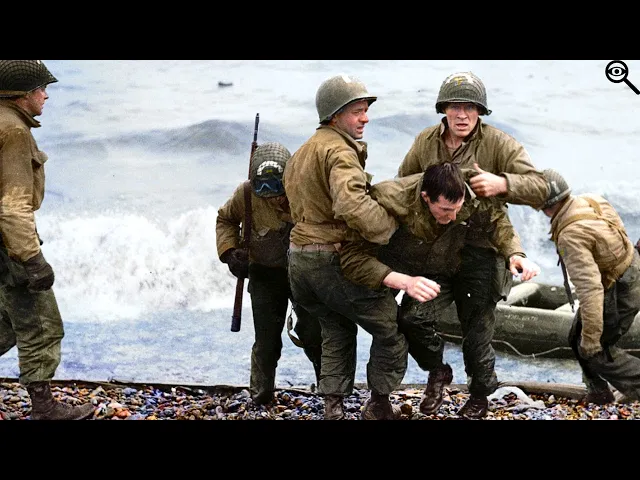
the war machinery manufactured during the previous two years has its baptism of fire. The 4th US Division lands on Utah Beach. There are 23,000 men, whom the current carries 1,800 meters from the landing point. The chance accident causes them to encounter little resistance in that area and advance quickly. To make matters even better, Some 28 of the 32 floating Sherman tanks make it ashore. These tanks had been modified to be able to float and move in the sea thanks to a waterproof fabric that was raised over their hulls and a pair of underwater propellers. Returning
to Utah Beach, the Americans there suffer barely 200 casualties between dead and wounded and manage to venture more than 6 kilometers into dry land. For some of the men who land in “Utah” like Private First Class Donald Jones, it resembles a routine operation: “It looks like just another invasion exercise.” The soldier Rey Man feels disappointed: “the landing was not so difficult after all.” An hour later on the beaches “Sword”, “Gold” and “Juno” the result is similar, the English and Canadians take the beaches after brief combats. But unlike these, the beach nicknamed “Omaha” is hell on
earth. The aerial bombardment has had no effect and the defenses are intact. The Bombs fall past the German bunkers and cannons. The naval attack, for its part, was too brief and failed to stun the defenders. Furthermore, in that area, the Germans are preparing to carry out a shooting exercise on the same day of the invasion, so on the morning of June 6 they are already ready for combat. The veteran 1st Division and the fledgling American 29th face the 352nd and 716th Wehrmacht. The Germans from the cliffs open fire with machine guns on the landing craft.
They concentrate a greater amount of fire on this beach than on all the others combined. In the others there were no cliffs either, and in Omaha it is full of them. Getting the boats to the coast is a difficult task with the sandbanks and obstacles set up by Rommel. The most experienced boat drivers, from the Coast Guard, manage to reach the beach by turning off the engine in the right moment and letting the boat glide alone over the sandbanks. When the doors of the boats open, the soldiers fall collapsed. A sergeant from Wisconsin remembers that:
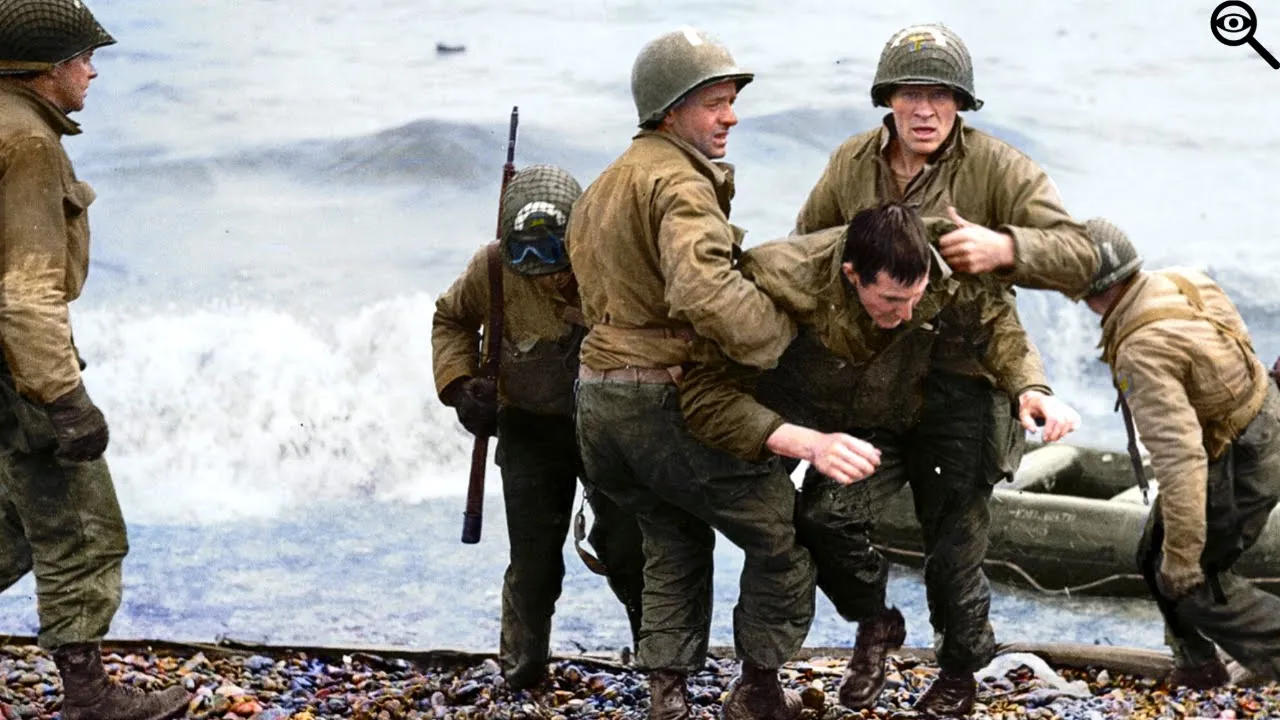
“When the ramps were lowered, and the machine guns opened fire, the men fell dejected like ears of corn fall on a conveyor belt.” Some barges stagnate on the sandbanks, and the soldiers go down in ankle-deep water. As they advance, however, they encounter pits 2 or 3 meters deep and under fire from 100-millimeter cannons and German MG-42 machine guns. In those moments of despair, Captain Richard Bush remembers that the soldiers: “They were devastated and scared. Many of them had forgotten that they had firearms to use.” Many times the option was to jump into the water, but
the weight of the equipment weighing more than 30 kilograms dragged them to the bottom. Because of this, many get rid of their weapons and equipment to reach the shore, although some do not even know how to swim. The wounded soldiers drown and the dead float in the water like logs. In desperation to respond to German fire, many tear off the waterproof covers from their weapons before reaching the beach. As a result, 80% of the infantry's weapons are inoperable on Omaha Beach. Little by little, the water turns red due to the soldiers' wounds. Everything seems to
happen in slow motion like in a nightmare. Captain Hall, who is a surgeon's assistant, comments: “I saw a soldier approaching the ship in a state of flight shouting and waving his arms. He had discarded all his equipment and was fleeing the fight. Many were caught in the water by the fire and drowned when the tide rose. I yelled for whoever I could and told them to swim. Some listened to me, but others seemed not to function mentally. They were simply sitting or standing there, they could move, but they seemed incapable of reacting or doing anything...
Another group of wounded people piled up on the bottom of a stranded boat, but they drowned one by one as the tide rose... Another boy was splashing around. the sand, As if he were walking, suddenly they shouted at him to get down and a burst of gunshots drew a circle around him, he was miraculously saved. In another case, a young engineer was trying to leave the beach, going up and to the sides, until a bullet hit him and killed him.” Doctors work non-stop supplying blood, plasma, morphine and nembutal. Blankets are also provided to prevent hypothermia.
A case of courage is that of Corporal Jones, who, measuring 1.65 meters and weighing 58 kilos, manages to go and return 6 times from the breakwater, saving the lives of several soldiers. His boss would say that Jones was the last one he expected something like this from. The few injured who are lucky enough to be rescued are transferred to the boats, and from the boats they are lifted on stretchers with cranes. Once on a ship, a wounded soldier realized that he was missing a leg and exclaimed, “My God, my leg, what am I going to
do now?” “I am a Farmer!” Soldiers who manage to reach the sand after about 50 meters in Waist-deep water have 200 meters of beach full of obstacles ahead of them. The beach is mined and covered in smoke, and is punished by German cannons and machine guns that can fire crosswise thanks to the curved shape of the coast. Barely trying to survive, many hide behind Rommel's obstacles. Others, injured and in a state of shock, ask for their mothers while crying lying on the sand. While the first troops try to land in Omaha, a group composed of
two Ranger battalions under the direction of Lieutenant Colonel James Rudder, attack the important cliff of Pointe Du Hoc. This cliff, located between Utah and Omaha beaches, was very relevant given that Rommel had placed 6 155-millimeter cannons on its crest. With a range of 10 kilometers, these weapons could sweep both beaches and put an end to the landings, so the Rangers' task was vital to the success of D-Day. Approaching with boats and launching grappling hooks with climbing ropes, Rudder's Rangers manage to climb the 30 meters and surprise the Germans. They soon engage in combat with the
grenadiers of the 916th German regiment, who take refuge inside from the fire of two Allied destroyers that were firing at them from the sea. The 155-millimeter guns were not mounted on the battery, but inside and were soon destroyed by the Rangers. Despite this, the fighting would continue all day, in the face of numerous German counterattacks in that part of the coast. Returning to the landing, despite the hundreds of casualties of the first group, the following waves of boats reach the coast. After this, the demolition teams begin to work to open a path free of obstacles
for the armored vehicles and infantry. These sappers attach explosive charges to a cable where there are obstacles and mines, and warn soldiers to run or they will be blown up into the air. As a result of the tide, the regiments, companies and platoons had dissolved and mixed up during the landing , causing the chains of command to break. After an hour of action, the 5 kilometers of “Omaha” beach are a mixture of confusion, destruction and death. Colonel George Taylor of the Sixteenth Infantry Regiment shouts: “On this beach there are two types of people: the dead
and those who are going to die. Let's get the hell out of here!” As if all this were not enough, most of the Sherman amphibious tanks that sought to reach the coast floating were lost, as well as the floating trucks that transported 105-millimeter howitzers. Some 11 of a total of 13 howitzer trucks were sunk by the Omaha waves that day. The situation is desperate, but as the minutes pass, more officers arrive at the beach, imposing their authority and organizing the advance. Among these are Colonel Charles Canham and General Norman Cota, commanders of the 116th Infantry
Regiment. Born in Mississippi, Colonel Canham had warned his men that two- thirds of them would die. Now he was walking the beaches, with one hand already injured by a gunshot and with a Colt 45 in the other to encourage the troops. Upon recognizing him, a lieutenant general warned him: “Colonel, take cover or they will kill you!” To which Canham responds: “Get off your ass and get out of there! And get these men off this fucking beach!” On the other hand, General Norman Cota organizes an advance in the center of the beach. Taking advantage of the
smoke produced by the seaweed, Cota pushes some of his men to advance under the cliff. The Germans, seeing that most of the Americans were taking cover behind the first breakwater, began to attack them with mortars, creating carnage. A mortar bomb landed next to Canham's group, killing two men standing next to Cota and launching another radio operator six meters upward. While this is happening in the channel and on the beaches, The German High Command is in chaos. In the wee hours of the morning the beginning of the attack is noted, but no one dares to wake
the Führer. Hitler had met with Goebbels the previous night until very late, and was now sleeping in his alpine retreat in Berchesgáden under the influence of sleeping pills given by his personal doctor. Hitler's naval aide Admiral Karl von Pútkamer remembers that at approximately five in the morning he was awakened by a call from Jodl Headquarters for "some kind of landing in France." Pútkamer later recalls that: “There wasn't much to say to him anyway, and we feared that if we woke him up at that hour he might start one of his endless nervous breakdowns that would
lead him to make the most insane decisions.” As a consequence, the order for the transfer of the two reserve Panzer divisions that are in Paris is delayed. These can only be mobilized with an order from Keitel, Jodl or Hitler. But Jodl is also sleeping and Keitel is reluctant to send them so soon. At 6 a.m., Rommel, who was in Germany, had been notified and set out immediately for Normandy to assess the situation personally. By 9:30 in the morning the news of the Omaha disaster reaches General Bradley at the head of all the American troops. Bradley
evaluates evacuating the beach and transferring the remaining troops to “Utah” where the situation is under control. But little by little the situation begins to tilt in favor of the attackers. The 11 destroyers assigned to the area approach the beach almost to the point of running aground, and begin to directly shell the German forts. This helps destroy defenses and motivates Americans greatly. At 11 in the morning, General Cota with his Colt 45 in hand guides a mixed group of Rangers and soldiers from the 116th Infantry Regiment forward, achieving the first major penetration of the day. This
mixed group is nicknamed Cota's bastard brigade and manages to lead the way to taking over the entire beach. Cota also attacks the town of Vierville west of Omaha. In that town, a group of French peasants told him that about 400 Germans had fled when the destroyers began the bombardment. The Americans manage to begin climbing the sand hill that climbs the cliffs but the mines present considerable danger. A soldier walking up the road found another lying on the ground, half a foot blown off by a mine. Very calmly, he had settled himself comfortably on the floor
and warned those who passed by while he smoked a cigarette. Returning to the German side, Hitler for his part wakes up at 10 in the morning. He listens to the report of his generals, who continue to think that Normandy is a diversionary maneuver. They have finally convinced him that the main attack will be on the Pas de Calais. The Führer that morning is dispersed, focused on the V1 rocket attacks on London. That same morning, Alfred Jodl for his part again denies Günter Blumentritt (Von Rundstedt's Chief of Staff) the Western Panzer reserves. Jodl still thinks the
invasion is a distraction. ““You must repel the attack with the forces you have. “This is not the time to move reserves.” By then, Normandy is defended by the 7th Army commanded by General Friedrich Dollmann and Calais by the 15th, both under Rommel's superior command. By around 12 noon, the Americans had already landed 18,000 men in Omaha and the attack had gained an irresistible momentum for the Germans. Although the Germans had tried to resist valiantly, American superiority in resources had been too strong to resist the attack. By 1 p.m. the German command center of the 352nd
Infantry Division at Coleville Sur Mer was being surrounded and attacked. By 2:30 p.m. the first Germans in said town were beginning to surrender. With the German surrenders there were cases of illegal executions by the United States. Many American soldiers, thirsting for revenge for those who died on Omaha Beach, shot at captured and surrendered Germans. At 5 p.m., Colonel Taly sent a message to the high command, indicating that the beach was now free for the circulation of vehicles and tracked vehicles for the most part. The Battle of Omaha was over. Rommel, when he is informed in
the middle of the afternoon that the Allies are already occupying the beaches, knows that nothing else can be done. He knows that the war is lost. At the end of the day 34,000 men have landed on “Omaha Beach”, about 2,000 men have died in combat. In total, that day there were 9,000 Allied casualties on the beaches, half of them dead, of which there are 2,500 Americans, 1,641 British, 359 Canadians and as many Norwegians, French, Australians or New Zealanders, and Belgians. By the end of June 6, 160,000 Allied soldiers cross the English Channel and prepare to
attack the Third Reich. In addition to all the measures taken, the great key to D-Day was air supremacy . While the Allies fly 13,600 missions, the Germans only fly 309. Rommel writes in a later report: “Our aviation has hardly taken part in the combat.” A few days later Hitler vented his fury in public on Goring, who is second in the hierarchy and was in command of the Luftwaffe. “Göring! The Luftwaffe is doing nothing! It's no longer worth it to be a standalone weapon. It's all your fault." According to General Guderian, great tears rolled down Goring's
cheeks. The Germans now face a massive landing, although the high command still believes that Normandy is a farce, and that the main attack would come through the Calais Pass. In the afternoon hours of June 6, and in the face of countless complaints from Von Rundstedt, the high Command released the two Panzer divisions that had been held for more than 10 hours in the Paris area. These are the 12th SS and the Panzer Lehr, which arrive on the coast between June 7 and 9, when it is too late to turn the invasion around. With this delay
the Germans lose the only chance to stop the Allied attack. Initial Allied plans aim to capture Saint-Lo, Caen and Bayú on the first day. They are not available. But the beachheads are established. There are almost 100 km of front and the casualties are less than expected. Once Caen and Bayú are occupied, the Allied objective is to establish themselves between the Loire and the Seine. Take Cherbourg and Brest, then liberate Paris and the rest of France, then march towards Germany. Given the success of Normandy, Josef Stalin sent a congratulatory telegram to Winston Churchill: “Hitler, who boasted
for two years that he would force the English Channel, was unable to bring himself to even hint that he would try to carry out His threat. History will record this fact as an achievement of the highest order.” Stalin sarcastically refers to the frustrated “Operation Sea Lion” planned by Hitler to invade the British Isles and thwarted by the defeat in the Air Battle of Britain. Returning to the front, the Americans target the port of Cherbourg on the Cotentin Peninsula, located northeast of Utah and Omaha. For this mission, two elite North American divisions had been parachuted in.
The 101st led by Maxwell Taylor and the 82nd led by Matthew Ridway, both of enormous caliber. Ridway, about 10 years later, will be the commander in chief of the US army in the Korean War. Taylor, on the other hand, will be the Chairman of the Joint Chiefs of Staff and also the main military advisor to President John Kennedy in the Cuban Missile Crisis of 1962. The capture of Cherbourg is a key and difficult objective from the beginning. General Matthew Ridway sums up the spirit in one sentence: “You never give up gained ground.” The British, Canadians
and other allies focus on taking the city of Caen, across from Sword, Gold and Juno beaches. For June 7, Normandy, which was a Dream place since the Middle Ages, is about to become a nightmare place. The Allies launch “Operation Perch” to surround and take the city of Caen. But they do not succeed due to fierce German resistance. The allied attempt fails 3 times. The obstacle is none other than the 12th Panzer Division Hitlerjugend of the Waffen SS, with its Panzer IV H variant tanks, which have 75-millimeter guns. The Hitlerjugend troops, made up of young people
of 17 or 18 years old, fight with fanaticism and ferocity. They are the toughest troops that the allies face in France and at the time of their withdrawal the casualties would reach 60%. Lieutenant Walter Kruger of the 12th Division comments on the feeling: “Absolute confidence in victory from start to finish. They had received proper training. “They had an absolute sense of order and discipline.” The 21st Panzer Division also participates, whose commander in chief is the ObergruppenFührer or general of the Waffen SS, Sepp Dietrich. Dietrich was, along with Paul Hausser, The highest-ranking officer within the Waffen
SS, having fought in Poland, Holland, France, Greece and the Russian front. Without a doubt, extensive experience that is worth a lot when fighting with numerical inferiority. The Germans considered the Caen area the base of their position in Normandy and were determined to maintain a defensive arc from the English Channel to the western bank of the River Orne. Within the twenty-first Panzer division, the 503rd heavy Panzer battalion had its place, composed among others of 10 King Tigers weighing 69 tons. These beasts could withstand fire from any Allied tank and had an outstanding range of more than
2 and a half kilometers thanks to their 88 millimeter cannon. Movements, however, were not his forte due to his low speed of 38 kilometers per hour on the road and 20 in the open field. Due to this and the Allied air superiority, position changes were usually carried out at night when it was more difficult to be seen. Faced with stiff resistance from the Panzer divisions, the British bombed the city, destroying 70% of it and causing the death of 400 civilians. In addition to lives and property, irrecoverable artistic treasures are lost. The battle for Caen would
take several British operations to win, with Operation Godwood being the last of all, which occurred on July 18. In this operation the Germans sold their retreat very dearly, causing between 4,000 and 5,000 casualties for the Allies and between 200 and 400 tanks out of action. The Germans would lose around 100 tanks and about 2 thousand soldiers. Despite having a preponderant force and air superiority, British progress ended up being slow and disorderly and ultimately failed to break the front forcefully. Caen would finally fall on July 20, but not in the way the Allies expected. From the
Allied side, General Patton questions Montgomery: “Monty has been too slow in attacking and thus has allowed the Germans To consolidate in fixed positions and have had time to bring in reinforcements.” Churchill himself is worried. He believes that if there is not a quick breakup of the front it will take a year to reach the Seine and the Rhine. He is sincere with Supreme Commander Eisenhower, telling him: “You only have to express your dissatisfaction with any British officer regardless of his rank for "He is relieved of his position." Monty is included, or Churchill refers to him
specifically. From the German side, the arrival of reinforcements to Normandy, as General Heinz Guderian states, is practically impossible. Allied bombing and resistance sabotage have blocked access to the region. The delays are endless. Once again, Rommel's theory of keeping Panzer divisions close to the coast demonstrates its strong support. On the other hand, with the gradual advance of the allies, little by little there would begin to be Cases of rape of French women and also robberies on public roads. The American soldiers sometimes drank too much and attacked the French women or attacked the French by stealing objects
from them. The American military courts installed on French territory would try 139 soldiers for rape. Of them, 68 were sentenced to life imprisonment and 22 to the death penalty, but many other victims never filed a complaint. General Eisenhower himself ordered that the executions be public, at the scene and with the assistance of the victims, relatives and neighbors. He thus sought to calm the wave of protests that began to flood the press of the time. Despite this, in German territory the violations by the United States would continue and reach eleven thousand according to researcher Robert Lily.
On the eastern side, the Soviets would rape at least a million German women as they moved deeper into German territory. East Prussia, Silesia, Pomerania and Berlin would bear the brunt. On the German side, around June 10, the “Oradur Massacre” took place. This was German retaliation for the murder of an officer by the resistance. In it, the SS Das Reich division burned the town of Oradur, killing 600 people. Faced with this event, Rommel complains to Hitler but the Führer's response is blunt: “Don't get involved in that. Resisting the invasion is your only job.” The distance between
Rommel and Hitler was beginning to become evident. The Germans would have similar actions in several other towns, also including mass shootings in other parts of France. By June 11, five days before the invasion, Rommel sees the worst coming. He tells Admiral Friederich Ruge: “Even if the British dominate us, it is better to end the war now than to see Germany completely ruined. “I know Hitler and he will not commit suicide as long as there is one house left standing in Germany, without caring in the least about the German people.” The next day, Rommel informed his
superiors: “Our enemy's ground power is growing at a speed much faster than our reserves to reach the front. Our operations in Normandy will be made exceptionally difficult, and even particularly impossible, by the overwhelming superiority of the Allied air forces and the effects of heavy naval artillery. Sergeant Helmut Gunther of the 17th SS Panzergrenadier Division sees it his way: “We no longer expected to achieve total victory, but we still had an absolute sense of loyalty. In Russia we had fought men against men. “We knew that in Normandy it would be men against machines.” That June 12,
the head of the 12th Hitlerjugend Panzer Division of the Waffen SS that does so much work in Caen, BrigadeFührer (or Brigadier General) Fritz Witt, dies from fire from an English ship. Replacing Witt comes the young 33-year-old BrigadeFührer Kúrt Meyer. Nicknamed “Panzer Meyer”, he is the youngest to hold that rank and upon assuming office he is already famous among his troops and also his enemies, for his exploits in France, Greece and Russia. Meyer is a convinced National Socialist, and has a very risky combat style, always being close to danger and leading by example. Upon assuming command
of the Hitler division, Jugend comments: “I have received the order to defend Caen. Our men are 17 or 18 years old, weeks ago they had entered combat with fresh and flourishing faces. But now their muddy hooves cast a shadow on their faces, whose eyes have looked into another world. They stagger sleepily with ammunition strips around their necks. We all know that the fight will end with death or being captured. But no one is willing to stop fighting, we will continue fighting for our country.” The fanatical 12th SS division led by Meyer would continue fighting in
France until it was reduced to a group of just over a thousand men. Meyer himself Would be captured in September 1944 and as a prisoner of war would declare: “You will hear many things against Adolf Hitler in this camp, but never from my mouth. As far as I'm concerned, it was and remains the best thing that happened to Germany.” By mid-June, the Allies use the artificial concrete ports built at Churchill's initiative. Nicknamed Mulberry, it is a feat of engineering. Cement blocks that are driven to their location and sunk. These allow thousands of men and tons
to be unloaded every day to swell the allied army. On those same dates, General Dietrich of the Waffen SS confesses to his superior Marshal Rommel that: “I am bleeding to death and I am getting nowhere. We need another eight or ten divisions in a day or two, or we will be finished.” Just a few days later and as we already reported, the divisions of the first SS corps under Dietrich withdrew from Caen On July 20, handing the city over to the British after a month and a half of fighting. As if the situation in the
West were not enough, the largest operation of the Red Army was about to take place on the Russian front. Around June 22, just 16 days after D-Day, Stalin launches Operation Bagration in central Belarus. This attack composed of 2 million Soviet soldiers devastates the central German army, generating 400 thousand casualties in a month and a half. The Wehrmacht will never recover from this catastrophe. That June 22, when Bagration begins, the Americans attack the city of Cherbourg, at the tip of the Cotentin peninsula. The German defenses are prepared for an attack from the sea, but not from
land. Campaign delays lead to Eisenhower to say angrily, “There are times I wish I had General Patton there.” The terrain is more complicated for the advance of armor and infantry through the French “Bocage” terrain. Plots separated by dense hedges that Are very characteristic of the Norman landscape. The difficulties would be repeated on the route to Paris, but not only for the allies. Also for the German troops in their retreat. “None of us had really anticipated the difficulties that would entail. Those enormous walls of earth, lushly covered with trees and bushes, that bordered each field were
impenetrable for battle tanks; each was a natural fortified line. On the Cotentin peninsula, the difficulties of the terrain were aggravated by large areas of wetlands equally impassable for armored vehicles, which were thus restricted to roads.” By June 26, with German armor bogged down in the fighting for Caen, Cherbourg finally falls. The port is occupied on July 1st but is destroyed and will not be used until September. Marshal Wilhelm Keitel, Chief of the High Command, Calls Marshal Von Rundstedt and this conversation takes place: Keitel exclaims in despair: “And what are we going to do now?” Rundstedt
replies: “Call for peace, idiots. What else can they do now.” Following this incident, the aristocratic Marshal Gerd Von Rundstedt, nicknamed "the last Prussian", who privately refers to the Führer as "that Bohemian corporal", is replaced as head of the Western Front by Field Marshal Günter von Kluge, recently arrived from the Russian front. By June 28, Rommel is recalled to Berlin at the Führer's request. Hitler wants to motivate him to continue resisting. The Desert Fox, on the other hand, once again presents with crudeness and his usual honesty the reality on the front and the need to evaluate
an armistice with the allies. He even (and in reference to Dietrich) tells Himmler to ask his Waffen SS officers their opinion. Hitler's response to the proposal is icy and unexpected. -Rommel: “Mein Führer, I must speak bluntly. “I can’t leave here without talking about the issue of Germany.” (refers to peace with the allies) -Hitler: “You didn't come here to talk about politics, Marshal” Given Rommel's respectful insistence, the response is unexpected. -Hitler: “Please leave the room. I think it will be better this way.” That would be the last meeting between the two. On the morning of July
6, General Patton escorted by 4 P47 Thunderbolt fighters heads by plane to France. He lands in “Omaha”, and cannot help but stand up in the jeep that is going to pick him up to go see Eisenhower and Bradley. He addresses some words to the soldiers present that become iconic: “I feel proud to be here to fight at your side. Now, let's cut the crap out of those Germans and get the hell out of Berlin! And when we get to Berlin, I'm going to shoot that son of a bitch wallpaperer myself.” The applause and excitement are
general. Patton will assume control of the US Third Army in early August. From the German side, things look very bleak by mid-August. Rommel, obsessed with the destruction of Germany and the advance of the Soviet hordes, sounds out to officers at the front about an armistice with the Western Allies. His personal aide-de-camp Captain Helmuth Lang declares that even General Sepp Dietrich at the front shares his opinion: “You are the boss Herr Marshal. “I will obey only you, whatever you are proposing.” But on July 17, the Allied aircraft accidentally attacked Rommel's car in a bombing raid. He
is seriously injured and miraculously survives. Rommel, despite his wounds, prepared a complete report for his new Chief of the Western Front, Marshal von Kluge, in which, among other things, he pointed out that: “Our aviation has hardly taken part in the combat. Our troops fight heroically but the end of this battle leaves no doubt.” Von Kluge makes his own assessment of the situation and sends it to Hitler: “After long discussions with the responsible leaders of the various fronts, in particular with the SS leaders, I have come to the conclusion that, unfortunately, Marshal Rommel was right. There
is absolutely no possibility of conducting a battle facing such a powerful air force without giving ground.” Precisely what Hitler does not accept under any circumstances. Withdrawals or surrenders. On July 19, the town of Saint Lu is liberated after almost 50 days of fighting. 95% of the city is destroyed and 500 of its 12,000 inhabitants die. For the allies it is a bittersweet victory. Between dead, wounded and missing, the casualties reach 1,200. The next day, July 20, 1944, a powerful bomb explodes in the conference room of the Führer headquarters in East Prussia. Hitler Is meeting with
his generals and was waiting for Mussolini that afternoon. Miraculously, he emerges unscathed from the explosion. Just after the explosion, Keitel discovers that Hitler, with his clothes torn, survived the attack; As soon as he got up, she embraced him, exclaiming: "Mein Führer, he's alive, he's alive!" But this is not just another attack. It is Operation Valkyrie, a civil-military plot with wide ramifications in the Army commands. The plan contemplates the assassination of Hitler, and the mobilization of the reserve army to seize power and neutralize Heinrich Himmler's SS. The bomb had been planted by Colonel Claus von Stauffemberg.
Those involved reach all levels of the army and all fronts. And in particular that of Normandy. No less than 7,000 civilians and soldiers are arrested by the Gestapo. Among them the Chief of Army Intelligence, Admiral Wilhelm Canaris, The Military Commander of Belgium, Baron Alexander von Falkenhausen, the Chief of the General Staff, General Franz Halder, the Head of the General Office of the Army and the General Friederich Olbricht, among them von Stauffemberg. Marshal Erwin von Witzleben, destined to be Chief of the Army, is arrested and sentenced to death. Upon hearing his sentence he told the trial
prosecutor Roland Freisler: “You can hand us over to the executioner, but within three months the people, disgusted and vexed, will ask you to account and drag all of you through the filth of the streets.” The ramifications of the plot against Hitler arrive like a blow to the Normandy front. Rommel knows about the plot from his Chief of Staff, General Jans Speidel, and is willing to collaborate with the new government. But he does not agree to participate, above all he is a loyal soldier. In von Kluge's case he is more involved than Rommel. His Chief of
Intelligence Colonel Rudolf von Gerdsorff is arrested And his Chief of Staff General Gunther Blumentritt is implicated. Von Kluge and Rommel are finally forced to swallow a cyanide capsule. Von Kluge on August 19 and Rommel on October 14, 1944. Both Chiefs of Staff survive. In the case of Speidel, after the war, he would become Supreme Commander of NATO's Land Forces between 1957 and 1963. Returning to the front, once the Cotentin peninsula had been taken at the end of July, the allies launched Operation Cobra, with the objective of taking the city of Brest, taking advantage of the
fact that the Panzer divisions were busy defending Caen. Along these lines, Patton would lead the Third US Army. Patton's choice is Eisenhower's and he takes it in England a month before the landing. Bradley was previously Patton's subordinate in Africa and Sicily, but is now his superior. They are two opposite personalities. Patton is self-centered, arrogant and impulsive. Bradley has a very low profile and is completely professional. Bradley sees the situation this way: "This is an opportunity that a commander encounters less than once every hundred years. We are about to destroy a hostile army almost in its
entirety and advance from here to the German border." To optimize His advance, the meticulous Patton studies William the Conqueror 's conquest of Normandy . He says in his memoirs: “I read “The Conquest.” of Normandy” by Freeman paying attention to the roads used in Normandy and Brittany.” In August 1944, the United States Army advanced through the Brittany peninsula with the aim of taking Brest with its important port. The Battle of Brest is one of the toughest of the Norman campaign. The city is besieged by the VIII Army Corps. The German paratroopers put up stiff resistance. They
fight house to house. The city would only surrender on September 19, resisting more than Paris. The allies pay another high cost, Some 4,000 casualties in deaths and injuries. They take 38,000 German prisoners. After this Allied advance, Marshal Von Kluge asked Hitler for permission to withdraw. Hitler, already suspicious of Kluge's involvement in Valkyria, relieves him and appoints Marshal Walter Model as his replacement. On August 21, finally, and after being surrounded, the German troops surrendered in the “Falaise pocket”. About 100,000 escape but 50,000 are captured by the Allies and 500 tanks are destroyed. At that time, Operation
PLUTO was already taking place, which consisted of the construction of a 130-kilometre pipeline under the English Channel from the Isle of Wight to Cherbourg to bring fuel to the Allied Army. Through this energy route, almost 800 million liters of fuel are supplied to the Western allied forces. By mid-August, the Allies also carry out a landing in southern France, Operation “Dragoon”. 100,000 men land on the coast of Provence near Nice. About 2,000 ships participate and the objective is to occupy the ports of Marseille and Toulon, and then link up with Overlord's troops. It is the final
blow for the Axis forces in France, which are already thinking about a defense behind the border of Belgium and Germany. After the landings in the south, the French Resistance rises up against the Germans in Paris. It is not a priority for the allies but Eisenhower makes the decision to help the Resistance. The Americans fear a bloody fight like the one they saw in Brest, Caen or Cherbourg. But in a city of 4 million inhabitants and with an unmatched cultural treasure, entering the city is a danger. Because of this, they plan to overtake the city, advance
to Germany and have Paris surrender without a street fight. The plan is carried out by General Patton without any major problems. Desperate, Hitler wrote an urgent cable to General Dietrich von Choltitz who was governor of Paris: "Paris must not fall into the hands of the enemy except as a field of ruins." The general with great courage ignores the message and pays no attention. At that time great generals and marshals were being arrested and executed for the July 20 plot. Furthermore, Choltitz has a wife and three children in Germany, but that does not change him. his
decision. Under his command, beautiful Paris would not be destroyed. By August 24, Eisenhower was liberated at the request of French General De Gaulle, who was already thinking about the post-war period, allowing French troops to enter Paris first. Under the command of General Leclerc, the second armored division takes the main points and arrests the German general von Choltitz. But within this group, there is also a group of 150 Spaniards who enter the Parisian city before anyone else . of General Franco, his tanks nicknamed “Madrid, Santander or Guernica” Travel along the Elysées Avenue. A member of said
group named Manuel Fernández comments: “We were volunteers for the defense of freedom, which Franco took from us, always with the. “I thought that this would lead us to cross the Pyrenees and return freedom to Spain, but it was not to be.” Paris is liberated with the French and Spanish at the helm, saving itself from the fire planned by Hitler who had already sent a detailed list of bridges, museums and even the Eiffel Tower to be destroyed. Intrigued by the fate of his plan, the Führer often asked. : “Is Paris burning?” But General Dietrich von Choltitz
does not obey and surrenders that same day, signing the capitulation. Less than 3 months after D-Day, Vichy France is dead, and France belongs to General de Gaulle. But why did von Choltitz disobey Hitler and not burn Paris? His attitude is a product of his last personal meeting with the Führer a few days before. On August 6 he is summoned to the Wolf's Lair in East Prussia before taking over as Reich commander in the Paris region. Until then he had faith in the Führer and had even murdered Jews in the east. But the image of Hitler
that afternoon is demoralizing. Choltitz comments on seeing: “An old man, bent and flabby, with thinning gray hair: a trembling and physically broken human being. As Hitler ranted about the perfidy of the generals' July 20 plot to kill him, I witnessed the terrible eruption of a hate-filled mind. He spoke in bloodthirsty language with foam literally coming out of his mouth. Sweat ran down his face as he spoke enthusiastically about the hanging of the generals. I saw in front of me someone who had lost his mind. The fact that the life of our nation was in the
hands of a crazy being who could no longer judge the situation or was unwilling to really see it, depressed me immensely.” Hitler was clearly no longer in his right mind, And Choltitz as he comments decided to save Paris at the risk of being executed along with his entire family. After being captured by the Allies, Choltitz always presented himself, not only as the “savior of Paris,” but as a convinced anti-Nazi despite having acknowledged atrocious crimes. Once in captivity in England, he would confess: “The worst task I carried out, although I carried it out with great efficiency,
was the liquidation of the Jews. I carried out that order down to the smallest detail.” Despite this, Choltitz would never be taken to a war tribunal and would die in 1966. With the liberation of Paris, the writer Ernest Hemingway returned and wrote in 1944: “I had a feeling of suffocation in my throat. I put together the glasses because there now, below us, gray and always beautiful, stretched the city that I love most in the entire world.” After the fall of Paris, the allies would continue advancing, with Montgomery to the north through Belgium and Holland and
Patton to the center as the main protagonists. There would still be 8 long months of fighting before the end of the war in Europe. On the other side of the front, the Soviet Union was pressing forcefully with an army of more than 6 million soldiers. By the end of 1944, the Soviets were already capturing Warsaw and approaching the German border. Stalin's troops would arrive first in Berlin and achieve the German surrender on May 7, 1945 unconditionally, definitively ending National Socialism. The Allied landing in Normandy had not only served to accelerate Hitler's fall and to save
numerous Soviet and German lives. But it allowed the Americans and British to recover France, Belgium and Holland, which otherwise would have fallen into the hands of the Soviet Union, as happened with half of Germany, Romania, Czechoslovakia, Hungary and Poland, which from 1945 would be of socialist regime. If you liked the documentary, don't forget to like it and share it with your friends. If you want to help the channel you can join as members from YouTube and Access exclusive benefits. Greetings and see you in the next video.