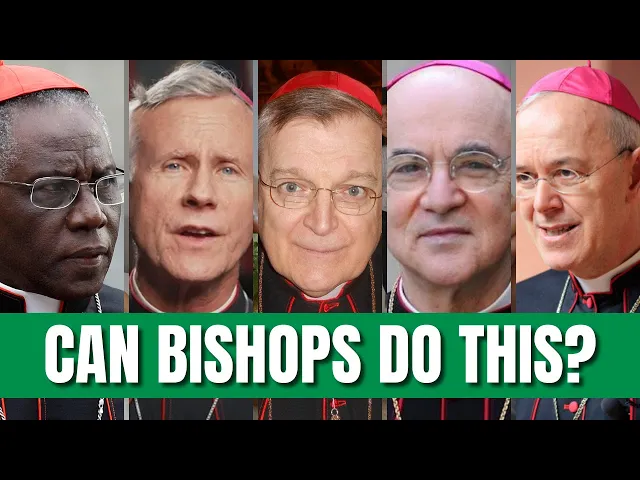
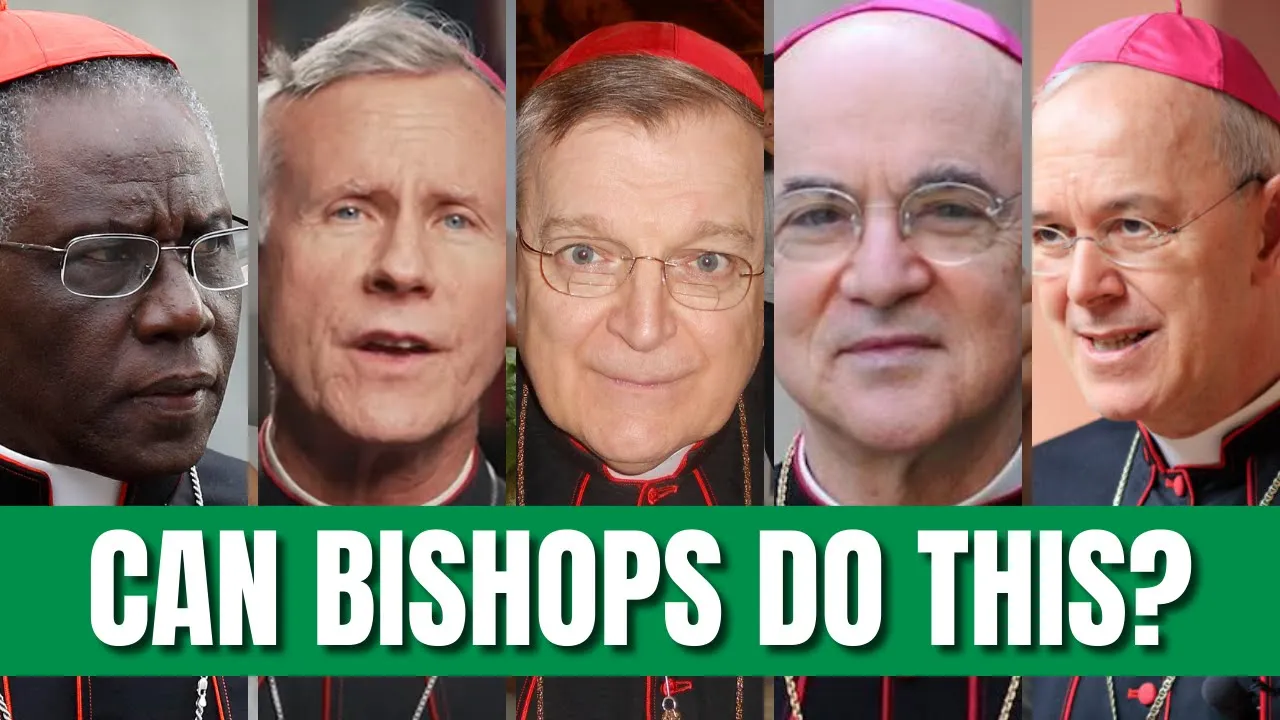
do Bishops have to follow magisterial teachings stick around to find out [Music] [Music] [Music] well lately we have noticed a phenomenon of a parallel magisterium a group of people who attempt to exercise authority over and against the actual magisterium of the Catholic Church magisterium being the teaching authority of the church that Christ established and so what we often see is instances of Bishops not only not assenting to magisterial teachings but actually opposing them and some people will follow the Bishops in their opposition to the magisterium so we need to have a discussion about number one
our Bishops themselves bound to follow maerial teachings and number two this notion of dissent and a parallel magisterium what has the church said about it those are the things that we're going to explore today to introduce this I think it's important for us to take a look at some comments that Cardinal Fernandez made back in September of last year which were really timely and helpful given uh some things that we've been seeing going on in the Catholic church so this is from an article exclusive Archbishop Fernandez warns against Bishops who think they can judge the
doctrine of the Holy Father and so here it notes the incoming prefect of the dasty for the doctrine of the faith has warned that Bishops both Progressive and those from traditionalist groups who think they have a special gift of the Holy Spirit to judge the doctrine of the Holy Father they are on a road to her Y and Schism and boy that has been validated with the case of vgo among others so he's taking a very balanced approach and he's saying look there's some Bishops on the left and some Bishops on the radical right who
are both toying around with heresy and Schism he says in response to a question on accepting Pope francis's magisterium because remember every Pope exercises the papal magisterium and so thus we could speak of John Paul II's magium and Benedict's magisterium and francis's magisterium not in opposition to each other that's how some people read this at the time but no not in opposition to each other but as in harmony a hermeneutic of continuity we apply that to ecumenical councils but also the papal magia but in so far as Pope Francis has taught things authoritatively we speak
of that as uh Pope francis's magisterium in so far as Pope Leo the great taught some things authoritatively we speak of Pope Leo the uh pop Leo the Great's magisterium but again not as opposed to each other Always In Harmony well speaking in response to a question on accepting Pope francis's magisterium Cardinal designate uh Archbishop Victor Emanuel Fernandez told register senior correspondent Edward Penton in an exclusive September 8th email interview that the pope not only has a duty to guard and preserve the static that is unchanging deposit of Faith but also a second unique charism
only given to Peter and his successors which is a living and active gift now some people often miss the point that this charism being discussed here is not the charism of infallibility we're probably all aware that the pope has a charism of infallibility when he teaches ex cathra I think most people are aware of that um however Pastor eternis also notes a broader charism and this is often overlooked by most people the broader one is going to be a charism of assistance of the Holy Spirit not for infallibility but at the very least to secure
the doctrine that is being presented so that it won't be destructive to souls and that is a unique charism that the pope alone exercises as opposed to other individual Bishops and that is what he is calling attention to here now Fernandez says I do not have this charism nor do you nor does Cardinal Burke today only Pope Francis has it said the uh Archbishop Fernandez now Cardinal who takes over from outgoing Spanish prefect Cardinal Lewis ladaria forer this week and will be elevated to Cardinal at a consist on September 30th Cardinal Burke recently wrote the
preface of a book that was sharply critical of the upcoming Senate on cality and has often expressed concerns about some teaching of this pontificate in fact cardinal Burke has said many times that multiple magisterial documents of Pope Francis he says outright they're not magisterial and you don't have to follow him and that's 100% not true 100% false he says now if you tell me that some Bishops have a special gift of the Holy Spirit to judge the doctrine of the Holy Father we will enter into a vicious circle where anyone can claim to have the
true Doctrine and that would be heresy and Schism so spot on words of wisdom from Cardinal Fernandez because he's being very balanced here and he's pointing out a real problem that we're noticing where some Bishops are going against the magisterium maybe even accusing the magium of heresy I've given multiple examples of cardinals doing that and Bishops and I've shown how that is forbidden in the Catholic church not to mention they're in eror because the pope hasn't taught heresy anyway um be that as it may we still have to ask the question okay what is their
obligation to accept magisterial teachings well let's take a look at the profession of faith that all Bishops have to profess so if you have a bishop out there who is saying you know I don't accept this magisterial document or this magisterial document is heresy or the faithful don't have to follow this I want you to ask the question are they being in consistent with their own profession that they have taken when they became a bishop and then if they became a cardinal that they had to profess again I want you to ask are they being
consistent well let's see what a bishop has to say the code of canon law spells that out in Canon 833 those who are obliged to personally make a profession of Faith according to the formula proved by the apostolic seed they are going to be those who are Cardinals and those who are made Bishops as well as anyone equivalent to a diois and Bishop among other people okay so at the very least Cardinals and Bishops have to do this in some cases theologians do as well there are some other I with firm faith and belief profess
each and everything that's contained in the Creed and so you're going to have the nying Creed then the bishop professes with firm faith I also believe everything contained in the word of God whether written or handed down in tradition which the church either by a solemn judgment or by the ordinary and Universal magisteria sets forth to be believed is divinely revealed so in other words the bishop and even a theologian would profess this part the bishop is going to say I'm holding to everything that's dogmatic everything that is divinely revealed by God so the bishop
had has to profess this again according to the code of canon law as it is established here in Canon 833 another part that the bishop or even Cardinal has to say is I also firmly accept and hold each and everything definitively proposed by the church regarding teaching on faith and morals and so what this is referring to is what's called secondary objects um these are going to be teachings that are not necessarily revealed by God but they are logical or historically connected to things revealed by God maybe what we would call dogmatic facts um virtually
revealed truths and so on so it's a second category of teachings now then there's a third thing that the bishop and or Theologian whoever takes the profession of faith says moreover I adhere with religious submission of Will and intellect to the teachings which either the pope or the College of Bishops enunciate when they exercise their authentic magisterium authentic here means authoritative even if they do not intend to Proclaim these teachings by a definitive act and so in other words even if these teachings are not infallible in nature they're not taught definitively the bishop still has
to profess them and again then is the oath of fidelity which again usually theologians take uh but this first part of the profession is going to be the theologians and Bishop Bishops profess so notice that third part so even the nonin fallible teachings of the church whether we're talking about the College of Bishops or we're talking about the pope so the papal ordinary magisterium as it's often called there is an obligation for Bishops to Ascent to those things and that's why you can find elsewhere in magisterial documents that when the bishop teaches in his own
Das and he demands religious submission of intellect and will on part of his flock his teaching must be regulated by the Pope's teaching in other words he can't teach something contrary to what the pope teaches for multiple reasons number one he's already profess in his profession of Faith he will submit to those teachings of the Pope and or College of Bishops so if you see a bishop out there or a cardinal out there whether they have a flock or not whether they're retired or not and they're saying I oppose this teaching or this is heretical
what you have is an instance where that bishop or Cardinal is violating their own profession of faith and so you have to ask how faithful are they actually being to the very thing that they professed when they became a bishop Andor Cardinal it's a very serious matter now I want to take you to something else here related to Canon 52 and this is referring to that third level of teachings that we saw there the non-definitive teachings and it says for Canon 752 although not an Ascent of Faith a religious submission of intellect and will must
be given to a Doctrine which the pope or the College of Bishops declares concerning faith and morals when they exercise the authentic magisterium even if they do not intend to Proclaim it by definitive act so that's what we saw there in the profession of Faith Bishops are bound to do this because an individual Bishop is not the College of Bishops they are part of the College of Bishops but the College of Bishops is a collective body it's not manifested by one Bishop except the bishop of Rome the bishop of Rome can speak individually for the
College of Bishops but no individual Bishop can speak individually for the entire College of Bishops in fact the individual Bishop must submit to either the pope and and the College of Bishops both now notice the next part however in the Canon and this applies to again Bishops and also Ley and theologians especially ones who have taken the oath of fidelity but even regular Le who have never uh taken the oath of fidelity we all to ascend to the profession of Faith therefore the Christian faithful so that's everybody that's everyone Christian faithful are to take care
to avoid those things which do not agree with it so if the pope is teaching something even non infallibly we have to according to can of law avoid those things that do not agree with what the pope is teaching so if a bishop is saying otherwise we have to part ways with that Bishop on that particular point and have to say I'm sorry Bishop but you're wrong you're not only violating your own profession of faith that you profess when you became a bishop and we can say the same of a cardinal whether active or not
whether they have a flock or not but we also have to say this about all of the Christian faithful YouTubers theologians even priests if they are saying something contrary to the papal magisterium it's a no we're not going to follow you on that and that's explicitly in the code of can of law in fact we're required to avoid anything that contradicts the papal magisterium now I also want to take a look here at this Apostolic letter this is from Pope P the 9th so this is a preconc silar pope 1800s mid late 1800s he says
something interesting he says but in order that these things may be properly accomplished it is necessary venerable brother recall and inculcate in the mind of the faithful entrusted to your care that it pertains to the Catholic faith that full power and authority has been handed down by our Lord Jesus Christ to the pope and blessed Peter to feed Rule and govern The Universal Church the free and full exercise of which cannot be restricted or checked by any territorial National limits and all who boast of the Name Catholic so if you claim to be Catholic must
not only communicate with the Pope as regards faith and dogmas but also submit to him as regards rights and disciplines so notice how expansive that is it's not just an adherence in an Ascent to teachings of the Pope but we're also talking about those disciplines and lurgical disciplines of the Pope anyone who Bears the name Catholic and that includes Bishops must be in communion with the Holy sea and follow the holy sea in these matters and that point is actually taught infallibly by the Council of Trent in the first Vatican Council now let's talk briefly
about instances where you might have somebody dissenting perhaps they're a theologian but this also applies to Bishops those who are not just questioning things those who are not just struggling with a teaching but are actually opposing the teaching and even publicly doing it well we know in the case of a bishop or even a theologian who has professed the oath of fidelity we already know that they're in violation of their own profession they've basically broken their promise before God and the church it's it's almost like breaking a vow now obviously this isn't a vow but
it is a very solemn promise that one keeps and so it's a big deal when we violate this whether we are a bishop or not but it talks a little bit about this in the document donam veres it says it's the duty of pastors that's going to be the Bishops by virtue of the authority they have received from Christ himself to guard this Unity and see that the tensions arising from Life do not degenerate into divisions their Authority which transcends particular positions and oppositions must unite all in the Integrity of the Gospel which is the
word of reconciliation as for theologians by virtue of their proper charisms they have the responsibility of participating in the building up of Christ's body and unity and Truth their contribution is needed more than ever for evangelization on a world scale requires the efforts of the whole people of God if it happens that they encounter difficulties due to the character of their research so if they're struggling with the teaching of the church they should seek their solution in trustful dialogue with the Bishops in the spirit of Truth and charity which is that of the communion of
the church now both Bishops and theologians will keep in mind that Christ is the definitive word of the father and whom as St John of the Cross observes God has told us everything all together and at one time as such he is the truth who sets us free the acts of ascent and submission to the word entrusted to the church under the guidance of the magisterium are directed ultimately to him and lead us into the realm of true Freedom so it's saying the magisterium is really what is entrusted with the word of God and the
preservation of the faith and both Bishops and theologians have to be in agreement with that magisterium and in this case for a bishop it's going to be especially the papal magisterium so a bishop does not get to violate their own profession of Faith they don't get to dissent and accuse the pope of heresy they don't get to say oh I am not going to Ascent to this or this teaching is erroneous or the faithful don't have to follow this teaching of the Pope they don't get to do any of that there's a long section in
Dona veritus about descent but I'll grab just a few more points from it descent has different aspects it goes on to say descent has different aspects in its most radical form it aims at changing the church following a model of protest which takes its inspiration from a political Society so if you don't like what's going on in society you protest politically right and that's the mindset that some people have if they don't like what the church teaches they begin to protest publicly more frequently it is asserted that the Theologian is not bound to adhere to
any magisterial teaching unless it is infallible we've heard that once or twice haven't we thus a kind of theological positivism is adopted According to which doctrines proposed without exercise of the charism of infallibility are said to have no obligatory character on them because they'll say hey it's not taught him fallibly so I could just ignore it leaving the individual completely at Liberty to adhere to them or not to take it or leave it the Theologian would accordingly be totally free to raise doubts or reject the non-ins of the magisterium particularly in the case of special
moral Norms with such critical opposition he would even be making a contribution to the to the development of Doctrine descent is generally defended by various arguments two of which are more basic and character the first lies in the order of hermeneutics the documents of the magisterium it is said reflect nothing more than a debatable theology the second takes on theological pluralism sometimes to the point of a Rel of a relativism uh which calls the Integrity of the faith into question here the interventions of the magisterium would have their origin in with theology among many theologies
while no particular theology however could presume to claim Universal normative uh status in opposition to and in competition with the authentic magisterium there thus arises a kind of parallel magisterium of theologians now we've seen this before we we've seen people say Hey you know we don't have to accept this teaching of the church it's not taught in fallibly so you're free to reject it and we've seen this parallel magisterium especially with theologians oddly enough we're starting to see it now with some Bishops who are setting up their own parallel miserium in opposition to the magisterium
Bishops exercise the magisterium on the local level if they have a particular flock a bishop who doesn't have a particular flock doesn't exercise binding Authority that binds on the conscience the kind of authority and teaching authority authority that they have is not one that is binding in nature because you have to have a flock in a particular flock usted to your care in order to have that kind of character of binding teaching Authority per the magian himself but even a bishop who does have a flock is able to bind the consciences of his own flock
whenever he teaches but has the number one be regulated by what the magisterium teaches on the universal level he doesn't get to go against what the pope is teaching or what the entire College of Bishops teach and thus if you have a bishop who is teaching something contrary to what the pope is teaching whether he has a flock usted to him or not he's setting up a parallel magisterium and so we're not only seeing a parallel magisterium of theologians we're also seeing a parallel magisterium of individual Bishops now that's happened for 2,000 years we've had
heretical Bishops for 2,000 years often they're kicked out of the church and most times hopefully they're kicked out of the church we've seen many cases like that noorus and so on and we could certainly say whenever that happened they were setting themselves up as a parallel magisterium to that actual magisterium that they themselves were bound to adhere to today's no different if a bishop is out there telling you the pope is teaching heresy or you don't have to Ascent to this they're violating their own profession of faith and they're setting themselves up as a parallel
magium in opposition to the actual magisterium on the universal level it says certainly it is one of the theologians task to give a correct interpretation to the text of the magisterium and to this end he employs various hermeneutical rules among these is the principle which affirms that magisterial teaching by virtue of divine assistance has a validity Beyond its argumentation so if the magian teaches something um even if it is not something that you would have concluded by your own theological reasoning you are to Ascent to it that applies for Bishops as well which may derive
at times from a particular theology as far as theological plural ism is concerned this is only legitimate to the extent that the unity of the faith is not in its objective meaning is not jeopardized essential bonds link the distinct levels of unity of Faith Unity plurality of expression of the faith and plurality of theologies ultimate reason for plurality is found in the unfathomable mystery of Christ who transcends every objective systematization this cannot mean that it is possible to accept conclusions contrary to that mystery and it certainly does not put into question the truth of those
assertions by which the magisterium has declared itself as to the parallel magisterium it can cause great spiritual harm by opposing itself to the magisterium of the pastors so here we're going to be talking about the College of Bishops collectively and also the pope and in some sense it also applies to the local Bishop whenever he teaches consistently with what the pope is teaching and if a theologian were to oppose what his Bishop teaches no he he has to be in line with what his Bishop teaches again assuming that his Bishop is in line with the
pastor of pastors and that is Pope Francis indeed when dis dissent succeeds in extending its influence to the point of shaping a common opinion it tends to become the rule of conduct this cannot be seriously this cannot but seriously trouble the people of God and lead to contempt for True Authority so when you have people dissenting against the the papal magisterium even a bishop what they're doing is they're causing contempt for True Authority and in a odd way that Bishop is actually undermining their Authority if they have any binding Authority in the church today they're
undermining their own authority because if we don't have to listen to the pope why would we have to listen to a bishop so it is spiritual suicide one more thing to read to you from the code of canon law Canon 823 in order to preserve the Integrity of the truths of faith and morals the pastors of the church have the duty and right to Be watchful so that no harm is done to the faith and morals of the Christian faithful through writings or through the use of instruments of social communication so what we should be
seeing is Bishops instead of opposing the magisterium and accusing the pope of heresy wrongfully I'll add and then dissenting against the magisterium what they should be doing is addressing people in their dases who have large influence on social communication social media who are themselves dissenting so in other words the bishop should not be occupied with opposing the magisterium rather they should be spending time addressing the people in their dicese who have a large amount of influence who are opposing the magisterium of the church they have a duty as Bishops to do that and unfortunately it
seems sometimes Bishops don't exercise that Duty instead they usurp Authority and begin to descent against the magisterium itself keep this in mind next time you a bishop a cardinal whether they have a dicese or not keep this in mind next time it means they are violating their own profession of faith and it also means they're setting a really bad example for the rest of people because if the rest of the flock sees a bishop accusing the pope of heresy they'll become desensitized to these things and if they see a bishop descending from the magisterium a
lot of people will probably feel comfortable with also dissenting from the magisterium themselves anyways I hope this was helpful to youall if it was hit that like button and hit the Subscribe button and of course let me know what you thought about this in the comment section and check me out of course patreon.com reason in theology God bless for years I've tirelessly defended the Catholic magisterium despite push back from numerous people slandering this ministry misrepresenting it and calling for its cancellation our situation today is very similar to the days of St Maximus the Confessor who
was constantly pressured to deviate from the teachings of Rome and embrace the heresies that many other Bishops were promoting he was exiled ridiculed slandered but he stood fast despite this persecution which also included the Imperial Court of Constantinople cutting off his arm and ripping out his tongue so that he could no longer write the truth and speak the truth it can be costly to speak the truth and defend the papacy in an age that is so hostile towards it just like during the days of St Maximus but this is what we are called to do
this is the faith and tradition of our forefathers I plead for all Catholics to stand up for our church and defend it and consider supporting this channel that has been Vindicated by Rome's decisions time after time again you can do that by subscribing and supporting this ministry at patreon.com reason and theology or reasonin theology. locals.com there's also a Paypal in a gofund meink l in the description of this video God bless