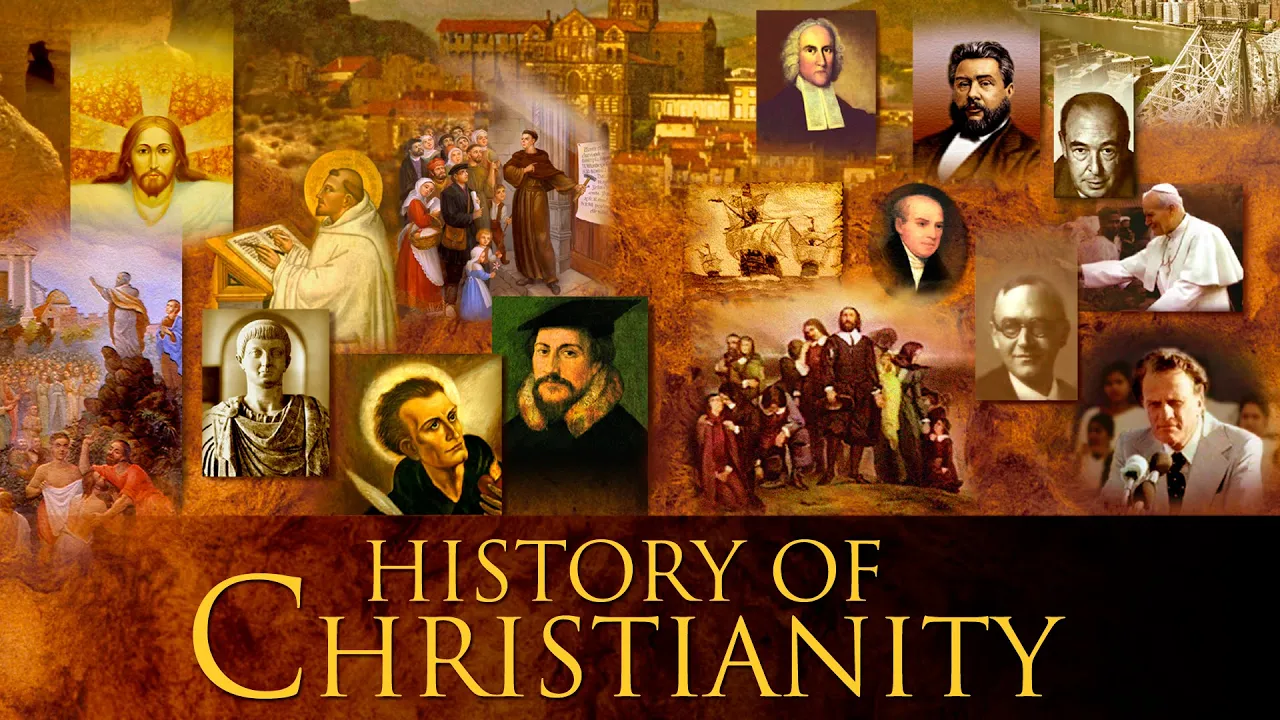
(uplifting atmosphere music) - [Narrator] History of Christianity is developed and hosted by Timothy George. Internationally noted theologian, author and editor, and Dean of Beeson Divinity School. History is a survey course designed to stimulate further your curiosity by providing glimpses at some of the pivotal events in the spread of Christianity.
And sketches of great Christian figures who have significantly affected Christian history, thereby shaping the history of the world. But when the fullness of time was come, God sent forth His Son. Made of a woman, made under the law to redeem them that were under the law, in the fullness of time.
Two words designate time in the New Testament. Chronos, root of the English chronic and chronology, is measured time. Time counted in minutes, months, centuries.
The tick tick tick of an alarm clock, of a stopwatch in a race. Time as we live it that circumscribes our activities and our lives day in and day out. Kairos means the right time, the opportune time.
Time laden with meaning. The fullness of God's time. The event of Jesus Christ, his life, his death, his resurrection, forever changed the meaning of time and history.
In Jesus, chronos became kairos. Counted time and momentous event merged, so affecting world history that even the measure of time was divided into before Christ and after Christ, BC and AD. (uplifting atmosphere music) - Christianity is not primarily a philosophy of life, or a code of behavior, or even a set of rituals.
It is the story of what God Himself has said and done, in space and in time. In the person of His Son on Earth, and the work of His spirit through the ages. We remember the words of Jesus, upon this rock I will build my church and the gates of Hell shall not prevail against it.
The history of Christianity is to some extent the story of the fulfillment of that prophecy. Christianity began as a small sect within Palestinian Judaism. But by the end of the first century it had already become a significant force within the Roman Empire.
When Jesus died, the Roman governor Pontius Pilate required that the words this is Jesus, King of the Jews, be written on his cross in three languages: in Hebrew, Greek, and Latin. These three languages represented the three worlds into which the early Christians carried their message of a crucified and risen redeemer. - [Narrator] Among Jesus' disciples and early Christian evangelists, the apostle Paul was his greatest interpreter.
Paul was a Jew like Jesus, but unlike many of the other disciples he was classically educated, a member of the Jewish elite, and free to travel throughout the Roman Empire and among the gentiles. - One of the most important decisions of the early church was the retention of the Old Testament as Christian scripture. Above all else, this meant that the god of creation, the god of the covenant, the god of Abraham, Issac, and Jacob, was none other than the god and father of the Messiah Jesus.
And the world of Greek culture, since the time of Alexander the Great some 300 years before Christ, the Mediterranean world had been drawn together into a common intellectual and cultural unity which we know as Hellenism. A new form of the Greek language, the koine or common tongue came into general use. It was in this language that the New Testament itself was written.
And the message of Jesus spread throughout the Roman Empire. Christianity came into contact with Greek ideas and philosophical traditions. With a heritage of Plato and Aristotle.
An early Christian father from Carthage named Tertullian asked the famous question "What has Athens to do with Jerusalem? " This tension between faith and reason, between philosophy and theology, would run throughout the Christian movement right down to the present day. Christianity made its way in the world of Roman order as well.
For more than 200 years the world had known a period of relative peace and stability known as the Pax Romana, the Roman peace. It was during this time that the Christian church was born and the story of Jesus carried along the major highways and well-developed sea routes of the Roman Empire. From the beginning Christianity was a missionary movement with a worldwide vision and a universal message.
- [Narrator] Inevitably, Christianity was perceived as a threat to the prevailing world system and to Caesar, its ruler believed to be divine. Religious pluralism was fashionable and minimal Christian concession might have resolved the conflict had Christians been willing to worship Jesus and also to place a pinch of incense on the altar of the imperial deity. But when the emperor Domitian delegated to himself the title Lord and God, Christians would not concede.
Jesus is Lord, they said, not Caesar. And the blood of the martyrs became the seeds of the church. - Under two previous emperors, Decius and Diocletian, the Christians had been savagely suppressed.
Their churches destroyed, their bibles burned. Many of them put to death because of their refusal to sacrifice to the pagan gods. But rather than quenching Christianity, these persecutions were a stimulus to its growth and expansion.
The joy and equanimity with which so many Christian martyrs faced horrible torture and even death became the means by which others were brought to faith in Christ. As many of those who had witnessed the martyrs die with such constancy became followers of Jesus themselves. In time the story of the martyr's death developed into a kind of devotional literature.
Including the famous story of Perpetua and her servant girl Felicitas who were put to death in the area in 202 in the city of Carthage. - [Narrator] Conversion of the Emperor Constantine was a major turning point in the fortunes of Christianity. Constantine, a politically astute soldier with aspirations to emperor, recognized the religious temper within the Empire and in his legions.
He had initially linked his destiny with the sun god Sol Invictus, a deity claiming universal dominion over all parts of the Empire. But in 312, as he prepared for battle at Milvian Bridge near Rome, Constantine dreamed he must place the sign of Christ, the Chi-Rho, on the shields of his soldiers. In another version, he also saw, written across the sky, "In this sign you will conquer.
" Constantine complied. He subsequently won the battle of Milvian Bridge, became emperor, and changed his allegiance from the sun god to the Son of God. The sincerity of Constantine's conversion is debated among historians.
Was it the result of divine intervention or an act of political expediency? By either interpretation however, it was evidence of God's will and had enormous consequences for the church. - In 313, the Edict of Milan recognized Christianity as a legal religion to be tolerated along with other religions within the Roman Empire.
In time, Christian symbols began to appear on Roman coins, and eventually December 25th, the festival celebrating Sol Invictus, became the day for Christians to celebrate the birth of Jesus Christ. This Christianization of the Roman Empire brought many wonderful benefits to the Christian church, but there was a downside as well. For in time Christianity came not only to be tolerated, but even to be dominant.
And some Christians gave way to the use of force, suppressing other dissenters who would not follow in their particular beliefs. And so a heritage of persecution and coercion was mingled with the gospel of Jesus Christ. The fourth century was a watershed in three other ways as well.
There developed a new sense of history, a new form of spirituality, and the classic statement of Christian theology. First history. The earliest Christians looked forward to the coming of Christ, to his return in power and glory.
But now while Christians did not abandon this belief, they began to look not so much forward as backward. Church architecture was born as Christians moved from worshiping in the caves and catacombs into the beautiful basilicas and stately houses of worship. Constantine's mother, a very devout woman named Helena, was a great advocate of developing beautiful churches in the holy land, and in 333 we read about a group of pilgrims from France making the great trek to the Holy Land.
With the cessation of persecution, martyrdom was no longer a possibility. It was at this precise moment that a new and distinctive form of Christian spirituality emerged. The white martyrdom of monasticism as it was called would leave an indelible mark on the history of the church.
The father of monasticism was St. Anthony, who at the age of 18 entered a church at the very moment the words of Jesus were being read. "If you want to be perfect, go and sell all you possess, "give it to the poor, and come follow me.
" Immediately Anthony obeyed. He secluded himself in the desert of Egypt where he lived in tombs doing hand-to-hand combat with the Devil and the demons of the dark. Eventually thousands of others followed Anthony into his monastic retreat.
The monks saw themselves as the successors of the martyrs. Now they were the frontline fighters in the ongoing struggle against the world, the flesh, and the Devil. At this same time Christianity was developing a new sense of history and a new form of community and spirituality.
There also developed the classic Christian orthodoxy as Christians define for the first time, in a definitive way, the doctrines of the Holy Trinity and the person and work of Christ. From the beginning Christian theology had been preoccupied with a question that Jesus himself asked during his earthly ministry. Whom do you say that I am?
The Christian community answered with the apostle Peter you are the Christ, the Son of the living God. What we know today as The Apostles' Creed developed out of this kind of basic confession of faith. - [Narrator] The church developed principles of Christian belief reflected in questions which were asked of each new Christian as a baptismal confession of faith.
We hear them echo through the ages now, alive and powerful in The Apostles' Creed. "Do you believe In God, the Father Almighty, "Creator of Heaven and Earth? " The new Christian answered pisteuo.
I believe. "Do you believe in Jesus Christ, who was "conceived by the Holy Spirit, born of the "Virgin Mary, suffered under Pontius Pilate? " Pisteuo.
"And do you believe in the Holy Spirit, "the Holy Catholic Church, the resurrection "of the body, and the life everlasting? " Pisteuo. - Still unresolved however was the fundamental question of how Jesus of Nazareth was related to the eternal God whom he called Father.
In its most basic form, the Doctrine of the Trinity is the effort of the Christian church to reconcile the Old Testament affirmation, "Hear, O Israel, the Lord our God, is One," with a New Testament confession, "Jesus Christ is Lord. " This was not merely a matter of semantics or philosophical word games. It went to the very root of Christian piety and the fact that Jesus was an object of worship and prayer.
The issue came to ahead in the early fourth century in a fierce conflict between Arius and Athanasius, the Bishop of Alexandria and Egypt. Arius emphasized the uniqueness and the transcendence of God. "The essence of God is indivisible," he said, "and therefore it cannot be shared "with anyone else, not even with His Son.
" "And so the logos, the Son, must be a creature," Arius said. "He must have had a beginning. "There was when he was not.
" But over against this idea of Christ as a creature, Athanasius proclaimed that the Son of God, the logos, was homoousios, of the same essence as, the Father Himself. "A mere creature," Athanasius said, "however exalted, could never atone for our sins. "Only God Himself could rescue us from sin and death.
" - [Narrator] In 325, when Constantine convened the Council of Nicaea, the church established this view of Christ. "We believe in one Lord Jesus Christ, "the only Son of God, eternally begotten "of the Father, God from God, Light from Light, "True God from True God, begotten, "not made, of one being with the Father. "Through Him all things were made.
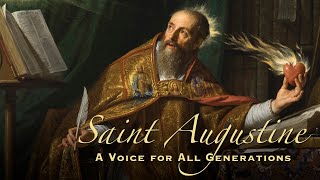
"For us men and for our salvation, "He came down from Heaven. " - In the west it was St. Augustine who summarized this theology in his great treatise on the Trinity.
Emphasizing the unity and equality of Father, Son, and Holy Spirit as well as the personal dynamic of relationship within the divine God had. Augustine himself had come to Christian faith through a torturous, intellectual, and spiritual quest. He was born in 354 in Thagaste in what is today the modern country of Algeria.
His father Patricius was not a Christian, but his mother Monica was a devout believer who had a dominant influence on Augustine's life and thought. Like C. S.
Lewis in our own century, Augustine tried many different paths before he found the true Christian faith. For seven years he belonged to the Manicheans, a dualistic sect which emphasized a radical difference between good and evil, light and darkness. Then he became a skeptic, doubting whether genuine truth and meaning could be discovered at all.
Eventually he became a Neoplatonist, a philosophy which offered him a model of transcendence, pointing him beyond the visible world of flux and flow. From the temporal to the eternal. - [Narrator] Sermons of Ambrose, Bishop of Milan, brought Augustine closer to the Christian faith.
Still he resisted. One day, sitting alone in the garden, he heard a group of children singing a song at play. Tolle lege, tolle lege.
Take and read, take and read. He picked up a copy of the scriptures and it opened to this text in Romans 13. "Not in reveling and drunkenness, "not in quarreling and jealousy, "but put on the Lord Jesus Christ and make no "provision for the flesh to gratify its desires.
" To Augustine, this event was as though the light of confidence had flooded his heart and all darkness and doubt was dispelled. It was the turning point in his quest for God. - Augustine has been characterized as the first modern man, but we might also call him the first medieval man, for his life and his theology would exert a profoundly shaping influence on the one thousand years of Christian history between his death in 430 and the birth of Martin Luther, another Augustinian monk, in 1483.
Augustine was not only a great theologian, but also an active bishop and shepard of souls as this 15th century Flemish manuscript shows him. His voluminous writings would deal with all forms of the Christian life, the nature of sacraments, discipline and penance, worship and prayer, how to venerate the martyrs and saints, how to study and teach and preach the bible. And in his debates with the British monk Pelagius, Augustine set forth a theology of God's grace and salvation which emphasized the impotence of human beings apart from Grace and stressed God's sovereign love and mercy.
And the church would later honor him by the title Doctor Grazia, the Teacher of Grace. With the death of St. Augustine in 430, the world of classical antiquity drew to a close giving way to a millennium of turbulence and realignment in Western Christendom.
In his fulsome life as a religious seeker, bishop, spiritual ascetic and theologian, St. Augustine summed up the major themes of the early Christian era. His vision of God, and his description of the Christian life, would form the basis for numerous streams of medieval spirituality.
When he was born, the blood of the martyrs was still warm and wet in Christian memory. When he died, the organized church had become sufficiently strong in the world to assume the place of the fallen Roman Empire and the formation of a new civilization. One thousand years later, both Protestants and Catholics would claim St.
Augustine as the forerunner of their own efforts to advance the cause of Christ. Today all Christians look back to St. Augustine and we read his marvelous autobiography The Confessions, and we see in him the master teacher of the introspective conscience.
The opening words from his confession still speak to us today. "Thou hast made us for thyself, and our hearts "are restless, until they find their rest in thee. "Whoever does not want to fear, "let him probe his inmost self.
"Do not just touch the surface. "Go down into yourselves. "Reach into the farthest corner of your heart.
" Thank you so much for joining us for The Early Church. The first in a six part series on the history of Christianity. In part two we will explore the Middle Ages.
The challenging millennium between the fall of Rome in 430 and the fall of Constantinople in 1453. We'd love to hear from you with your questions and comments. Thank you so much.