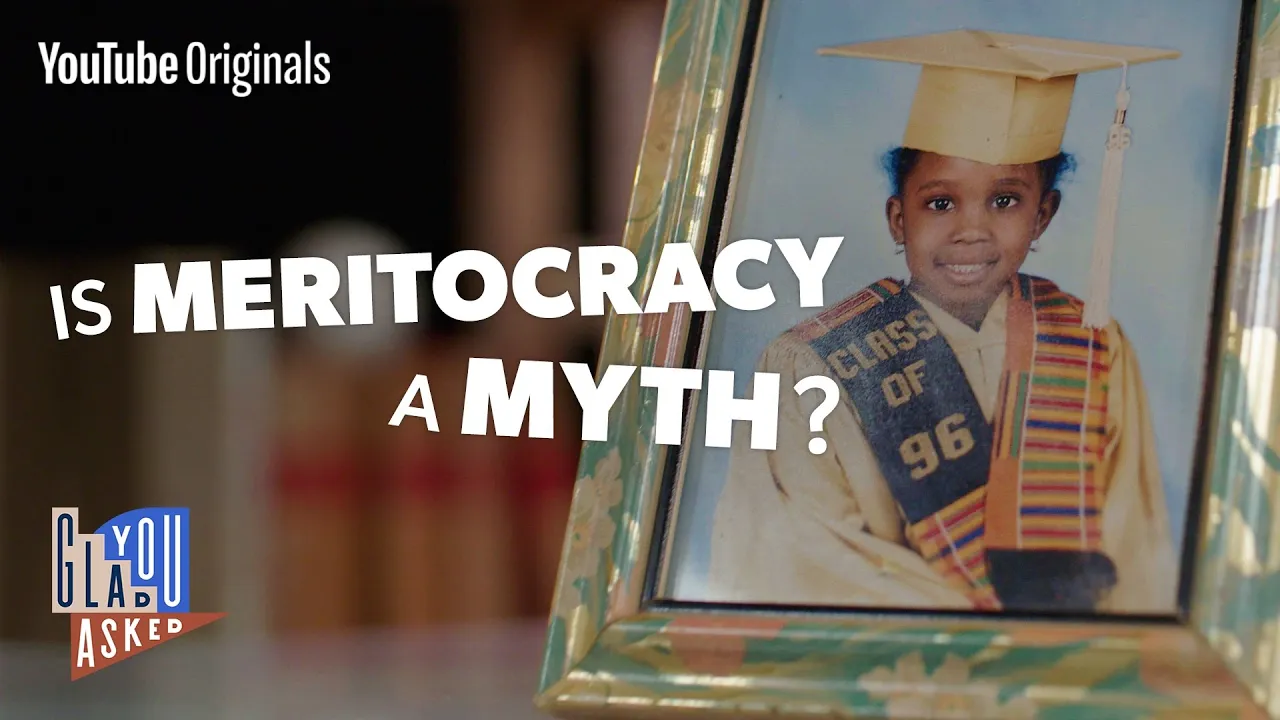
Yo! Hi. Thanks for meeting me here.
This is your high school? - This is my high school. - What, uh-- Murry Bergtraum High School for Business Careers.
As you can see, we're directly next to-- - Across from the Tombs. - Yeah, surrounded by One Police Plaza. So, Bergtraum is viewed as one of the worst schools in the city.
Like, I had to kind of join an elite group within this high school to stay afloat. I just felt like most of the time, I was trying to survive. Our meritocracy, because it's based on competition, worships superiority rather than excellence.
Certain people get to start way farther ahead. Fabiola: I feel like for so much of my education and childhood, it was just like, studying hard for tests specifically to prove that I'm good enough through tests. <i> Education is supposed to be an equalizer.
</i> <i> It is built on the meritocratic belief</i> <i> that effort and ability are the keys to success. </i> <i>But is that really all it takes to be successful in school? </i> <i> What about opportunity and access?
</i> This false notion of a meritocracy has furthered the interests of those of great wealth in this country and those of great political power. So, why are we here? I'm on a quest to figure out why the meritocratic beliefs that the American dream is built on don't really work for people who look like us.
And so I want to figure out how we got here and what we will do about it. <i> ( theme music playing )</i> "Halls of hell at New York's worst high school. " This is a headline about my high school, published in March 2012.
This headline is super dramatic. - Just a little dramatic. - ( Fabiola chuckles ) How did you end up at Murry Bergtraum in the first place?
So, I had a pretty high GPA in middle school. It was a selective middle school that I had to test to get into. Uh, but in New York City, you basically rank what high schools you'd be interested in going to, and not a single school selected me.
I got a call instead from, like, the Department of Ed saying, "Hey, you gotta go to second round. " And that's something you don't want to do, 'cause second round, what they did was they handed you a list of high schools and said, "These are the places that have room. " And when you look at that list, it's basically a list of schools that were considered failing schools, schools that were plagued by violence, just under-resourced.
And so I looked at the list and was like, "I'm gonna make a choice based off of what's less bad. " That's crazy, though. That's, like, med school.
- It's-- it's bad. - You shouldn't have to match for high school. - Yeah, it's bad.
- Christophe: Or middle school. I mean, the idea of in elementary school having to test into a competitive middle school - was completely not on my radar at the time. - Fabiola: Exactly.
So, the reason why I have you here today is because I'm exploring this question is meritocracy a myth? Here we have a game called Rigged, and I think this can help us illustrate whether it's just ability and effort that allows you to get successful. The object of the game is to get to Glad You Asked University.
Look how beautiful that is. There are two different sides to the board game. So, we have Pleasantville on that end and then we have Smallville over here.
So, I'm going to have you pull a card to determine essentially what your fate is. - Are you guys ready to play? - I'm ready.
All right. My card says, "Home. You come from a two-parent middle class household.
Action: Move two steps forward at Pleasantville. " "Your mom is a food service worker and your dad is cab driver. Go start at Smallville.
" "You come from a low-income household, and I start from the start at Smallville. " Both of my parents are lawyers, and guess how far I get to move on this path. I get to move five steps forward at Pleasantville.
One, two, three, four, five. "You've been selected for the honor roll. Advance three steps.
" - So, you got an opportunity. - Opportunity! "You have won a scholarship for being athlete of the year.
" - You gotta be kidding me. - ( laughter ) "You did not go to pre-K. Pay $15,000 and skip a turn.
" Bill de Blasio, where you at? I'm already almost cooked. "Serendipity.
Your teacher recommends you for a gifted and talented program that you test into. Collect $10,000. " "You inherit $40,000 from your distant uncle.
Take the next ladder. " Oh, my God. I'm enjoying this ride.
I can tell who designed this game. "Your big brother was shot. " - Whoa.
- Wow. Jesus. "You miss two weeks of school for bereavement.
Pay the bank $10,000. " - Jeez. - That's intense.
- Yeah. - "You can't do your homework because the wifi is out. Pay $5,000.
" - That's hard. - I have done stories on that. - Yeah.
- Mm-hmm. "You start to doubt your abilities as a student in middle school so you begin to act out. Take the next detour.
" - So, you just gotta-- - Nothing's working out. You know, I mean, this is what happens when you're watching your kid siblings at night and your mom's missing work. - And you're tired when you get to school, you know?
- Yeah. I mean, you talk back to your teachers, and then you can't escape ol' Smallville. - All right.
- Fabiola's about to win. - She really is. - Two steps.
Wow! I think you guys need to clap for me. Thank you so much.
So, is this game fair? - Do you think this was fair? - Obviously not.
- Obviously not. - Why not? - Because we lost.
- ( laughter ) Clearly. Uh, no. I mean, just by the fact that certain people get to start way farther ahead means that it can't be fair.
Our positions are also exactly following our family wealth. You can't escape your neighborhood, like, no matter what you do. The odds are just stacked against you.
This is incredibly frustrating. So, my question is why is America so obsessed with merit? Why is it such a huge part of our country's fabric?
<i> The concept of a meritocracy goes back centuries. </i> <i> However, it took off in America in the 1950s</i> <i> due to dissatisfaction with an inept</i> <i> yet excessively wealthy aristocracy. </i> <i> In a quest to diversity the elite</i> <i> and increase social mobility for the working class,</i> <i> a group of reformers came together and decided</i> <i> that society must offer enough opportunity</i> <i> for talent to combine with effort</i> <i> so that anyone could rise to the top.
</i> <i> However, 1950s America was consumed by racism and segregation. </i> <i> Black and Native American children were not taught with white children,</i> <i> often had less access to resources,</i> <i> and were schooled in sub-standard buildings. </i> <i> Nevertheless, the term meritocracy took hold,</i> <i> and society embraced merit as the key way to unlocking the American dream.
</i> So, what is your reaction just off the bat? You know, if you have a connection between race and class, let's say, and you exacerbate economic inequality, you're gonna harm people of color, even if you also benefit some people of color whom you admit. Unless you're either super talented or super lucky, if you're outside of the elite, probably hard work is not gonna be enough.
The new meritocrats, who had themselves gotten ahead by being good in school and good at tests, had an almost unlimited appetite for educating their children and incredible capacity to do so. And so today's meritocrats, they spend resources on training their kids that nobody else in society can match. If you go to the average public school in America today, probably about $12,000 to $15,000 a year is spent on educating you per child.
If you go to one of the "Forbes" top 20 private schools, probably about $75,000 is spent per child per year on educating kids. And so it's not just poor people who can't keep up with today's elite. - It's the middle class.
- As part of this journey, I've been trying to understand why we rely on tests so much and what they're actually measuring. Our meritocracy, because it's based on competition, worships superiority rather than excellence. And so the way in which they measure people's whatever, "merit," is not neutral, particularly as between white people and black people.
If you have resources to hire people whose job it is to teach your kids how to do well at the tests, you know, they're gonna do really well at the test. So it's not just a matter of outputs, but also inputs. What chances did you have, and importantly, will society commit to giving everybody meaningful opportunity?
How many tests do you think the average American kid takes between grades K through 12? Well, I have a terrible memory, but it makes sense to me that we probably took maybe two a year. So, from pre-K to senior year, it would've been 28?
Ooh. Okay, good guess. But I regret to say that it is not that.
It's actually 112. - No way. - Yeah.
Test-taking is a specific skill - that is not like anything else we do in our lives. - Yeah. And I really question how much it transfers to actual, like, things you need to succeed as an adult.
So, I want to explore the tests that we took growing up. I feel like this one gets overlooked because it's not mandatory. But G&T, gifted and talented, are you familiar with that?
I am. Yeah. I mean, we didn't call it that in Arizona, though.
We had a program in elementary school called Project Potential. These names are so-- as I'm older, thinking about these names, I'm like, they weren't trying to hide what their motives were. - No.
Yeah. - Like, "This is what it is. " The teacher would refer certain students for testing, which in retrospect gives a lot of power to that teacher.
Fabiola:<i> You're right. </i> <i> A 2016 study found that a teacher's race</i> <i> and racial bias consistently affected</i> <i> how they interpreted their students' behaviors or abilities</i> <i> and who they would recommend for a gifted program. </i> <i> Additionally, black students are more likely</i> <i> than their white peers to receive suspensions,</i> <i> be excluded for greater periods of time,</i> <i> and be disciplined for less serious offenses.
</i> And we see the same kind of bias in testing with the SHSAT. In New York City, the SHSAT was the test that you had to take in order to get into a specialized high school. If you can't pass this test, sorry, you can't, like, go to one of these top schools.
So, Stuyvesant, New York City's most selective public school, in 2019, out of a class of almost 900 students, only seven black kids got in. <i> In 2019, the New York City Independent Budget Office</i> <i> simulated what offers to the incoming 9th grade class</i> <i> would've looked like if admissions were based</i> <i> on students' ranking in the top seven percent of their middle school</i> <i> instead of their ranking on the SHSAT. </i> <i> The report found that about 19% of admissions offers</i> <i> would have gone to black students,</i> <i> and about 27 would have gone to Hispanic students,</i> <i> compared to the actual 4% and 6% respectively.
</i> It seems like testing doesn't happen in a bubble, right? It depends on how much money your parents have. It depends on where you live.
All of these things impact what kinds of resources you're able to access inside and outside of the classroom. I think the one that hasn't really entered our conversation yet is the SAT. Joss: Ah, yes.
Yeah, did you know that the SAT was founded by a guy who supported the eugenics movement? - No. That's deeply disturbing.
- Yeah, it's very disturbing. This is data straight from College Board, which administers the SAT. In 2015, 1.
7 million students sat for the SAT. What stands out probably the most is for black test-takers, we see the lowest scores across the board, and the lowest in writing. And it's not just how well you prepare for this one test, but how well your entire education has prepared you for it, and we know that the schools are not equal.
For me, I was fortunate enough through a program called Legal Outreach to take an entire summer of SAT prep course. Reflecting on that opportunity, I was like, "Wow, I had to apply, again, to get into that program. " I may have a 95 GPA, but these programs kind of helped me understand how to play the game of the system.
So, how was the test for you? The test? I actually-- I think because of the prep, I enjoyed taking the SAT.
- With reading and writing, like, I did really well. - You're a full nerd. - Yeah, I'm just, like, into that kind of thing.
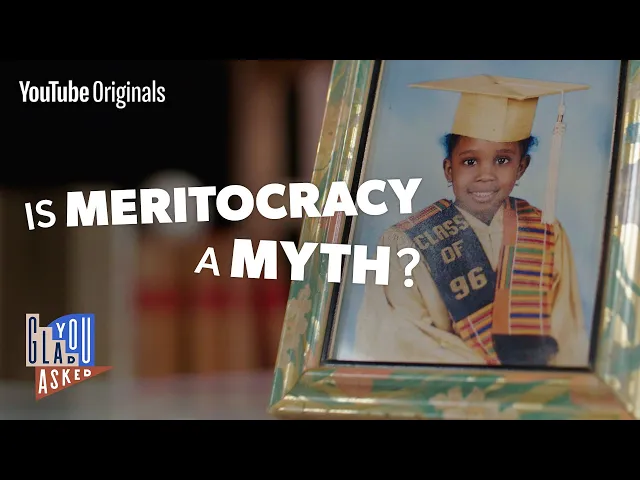
- You enjoy testing. There is one specific story that I want to get into that I think helped shape my idea of ability and what it means to feel special through the system. My sister Grace, who's two years older than me, got into a program in New York City called Prep for Prep.
That program basically identifies the high-achieving, low-income students across the city and says, "We want to help train these students by giving them extra course work to prepare them for some of the best private schools in America. " So, Grace ended up going to Exeter, then got into Princeton. This is her Princeton diploma.
Thank you, Grace, for letting me have this here today. My sister and I did very well. We are low-income kids, grew up in Brooklyn, New York, and clearly meritocracy to some extent has worked for us because we were able to take advantage of opportunities like Prep for Prep, like Legal Outreach, like the Posse Foundation, which by the way gave me a full tuition scholarship to Dickenson.
But I'm conflicted because I'm the exception. Like, should I be up here talking about this? Should I be talking about my sister when we are the exceptions?
I wish that there were a way to actually level the playing field so that everyone gets help, everyone gets opportunity. - Fabiola: Hey, sis. - Hey, sister.
- What's going on? - Nothing much. Just calling you as I work through this episode.
Thank you again for letting me use your diplomas. As I'm working on this episode, I'm conflicted, right? Because it's worked out for us.
It's helped a lot of people in our family, but at the same time, meritocracy has kept a lot of people back. Poor people, black and brown people, they're still not getting ahead. Yeah, that's something I think about as well.
Our accomplishments are definitely celebrated, but at the same time, they're weaponized and used against people who look like us to pretty much say, "If they can do it, why can't you do the same? But they're forgetting the fact that ultimately we always just had to do way more with a lot less. So, there's actually an organization, they're called the Brotherhood/Sister Sol, and they've been working to level the playing field.
They've been giving students more opportunities because they realize that it's just not fair, so I want to try and talk to them. I'm gonna reach out and see if they can help me wrap my mind around this. Cool, cool.
Let me know how it goes, sis. I will, thank you. Bye.
Man: You see our college pendants up on the ceiling, which is the universities and colleges where our young people are studying. And, you know, it inspires the next generation that comes in to see, you know, what are opportunities. We take them on college tours as well, but this is just a daily reminder.
And are the students bringing these back themselves? Yeah, they're always proud, especially if they're the first to go to a school, to put it up. Fabiola: Okay.
Previously, we were looking at SAT results and we saw that black students did not as well as their white and Asian counterparts. What's your response to that, and also would you call that an achievement gap? I think there's a fundamental access gap in the country.
It's not an achievement gap. You can't have a country that has 13 generations of slavery, when it was illegal to read and write, four generations of segregation, when the system was by law unequal, and two generations of legal freedom, and expect the playing field to be equal. Until we create a true equal playing field, you will not have equal achievement.
And we have to look at access and opportunity. Those are the key inflection points, and I think that's what we have to talk about if we really want an equitable society. When I was in eighth grade, I entered a program called Legal Outreach.
But I had to, like, show what my grades were, and you couldn't have below a certain average to be in the program. Can you talk about this idea of cherry-picking, and do you have the same kind of philosophy at Bro/Sis? We do no sifting here.
What we mean by that is you can have any grade point average and join the organization. I think the role of education should be focused on the development of the whole child. It's really about wraparound support for young people so that they are supported and guided and loved, but that they also have opportunities and access so that they can develop their own agency in life.
In thinking about the public school system right now in New York City, what is it gonna take to make it a real meritocracy? New York City has a public school system that is a caste system, where you have elite schools, good schools, mediocre schools, and horrible schools. And where you go depends on your zip code or the access, either economic or cultural, of your family.
One of the reasons that the public school system has been allowed to flounder for so long is that it's overwhelmingly serving low-income black and brown kids. We have students in the New York City Public School system still today who don't have access to computers and technology at home, who don't have access to wifi at home. The school system has not been able to provide that, so we at Brotherhood/Sister Sol have provided that for all of our young people.
So, COVID is just accentuating all of these existing realities that were already here, and you see it in the educational system, you see it in the labor force, you see it in the housing situation as well. The non-profit sector, which is a huge sector in New York, is expected to do the work that government has abdicated. Really, at the end of the day, we have to change the entire narrative of what is acceptable in this country, what true opportunity, equity, and justice looks like.
Fabiola:<i> It is clear that meritocracy is a myth. </i> <i> And it's a dangerous one,</i> <i> because it legitimizes inequality. </i> <i> Education was supposed to be the driving force</i> <i> behind social mobility and racial integration.
</i> <i> It was supposed to help us all achieve the American dream. </i> But until America can give us all an equal chance at success-- that includes an equal starting point and equal resources-- America can never be a meritocracy. As long as we define merit according to the whims of winners, we'll always fall short.
What's always been missing from the equation. . .
<i> . . .
are opportunities</i> and social good. Take one, mark. ♪ There's no such thing as cold, no such thing as cold ♪ - Oh, my God, I broke it.
- Oh, no. - I'm sorry. - Can we have some glue?
- You just collected. - Lee: You just collected. You were supposed to pay.
You just robbed the bank.