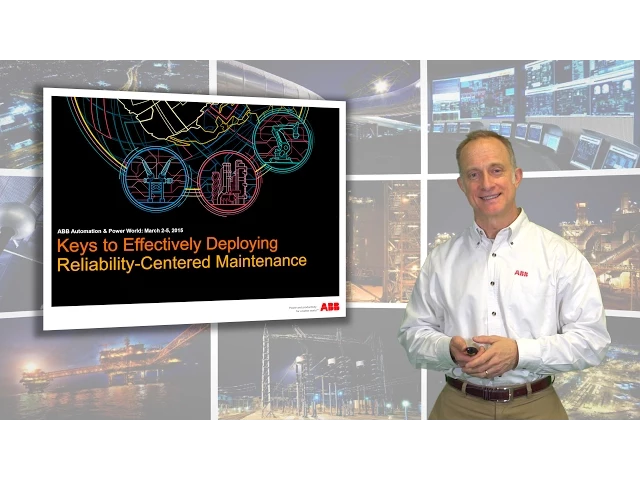
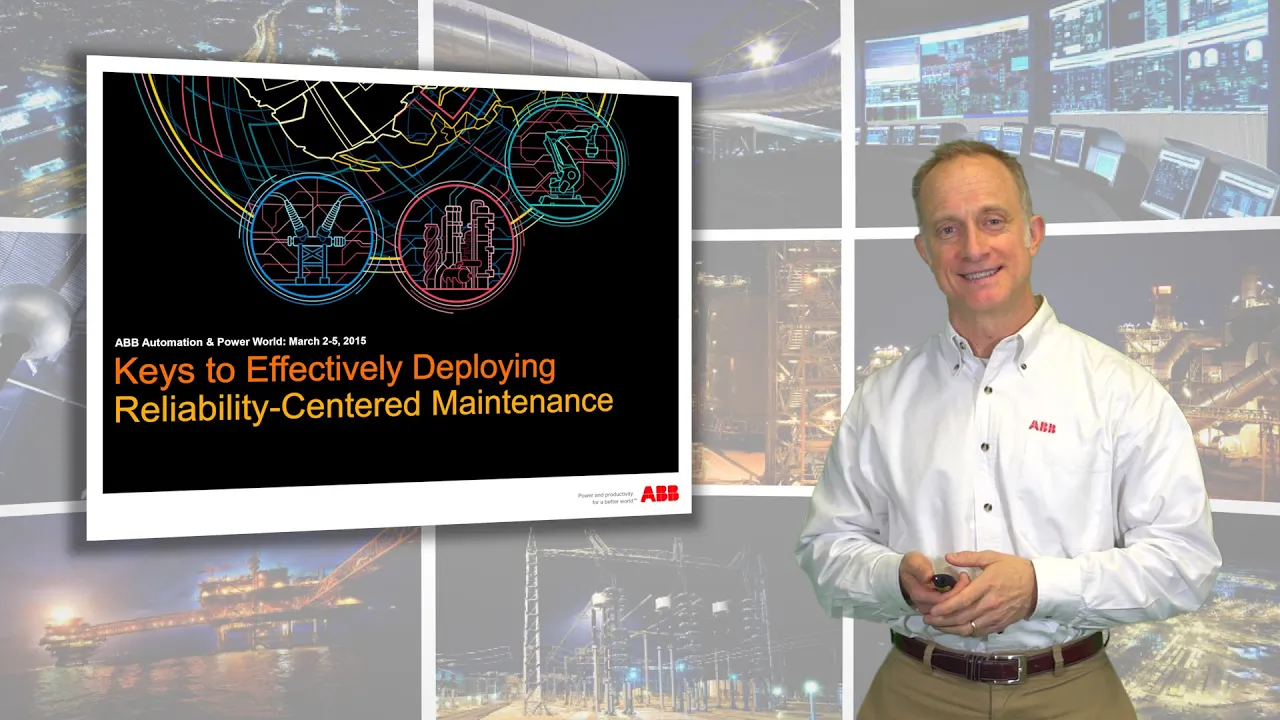
[Music] hello my name is Dave beos I'm the global product marketing manager for ab process automation service and today we're going to learn about an important service concept called reliability centered maintenance now why would we want to learn about reliability centered maintenance it's considered the worldclass maintenance approach for process Industries and Manufacturing and other Industries as well so we're going to cover three main areas in this presentation it's just an overview uh but those three main areas are equipment criticality and Analysis failure modes and effects analysis on the equipment and some Basics about how to
implement reliability centered maintenance so let's start with the definition of reliability centered maintenance reliability centered maintenance is a highlevel maintenance strategy that's meant to optimize all the assets in the facility and it uses a iety of Maintenance approaches uh to put together an overall approach that's meaningful for every different system or equipment category and these maintenance strategies are optimized to really provide the most overall efficient functioning of the plant so the notion of preventive maintenance is that the more preventive maintenance we do as you can see here in this line that's curving up these bars
that curve up here then the fewer unplanned maintenance activities will be required those are break and fix emergency repairs what also happens the more preventive maintenance that we do the actual planned maintenance hours also come down we're just doing things more effectively and we see cost benefits across the board but what if we do too much preventive maintenance is that possible it is possible there's a sweet spot where we only want to do the right kind of maintenance at the right time if we touch the equipment too much we can actually induce failures that are
costly or we can just spend too much time maintaining equipment and the actual cost will beginning to creep up so we want to be right here in this sweet spot so what did we have before reliability centered maintenance well first of all we had reactive maintenance something breaks and we go and fix it the idea is to get that equipment back up as quickly as possible there's no real preventive maintenance without a approach uh costs aren't really considered that carefully uh it's popular because it's very easy to deploy something breaks and we go fix it
it's very ineffective it's a very inefficient use of Manpower and capital well we've already discussed preventive maintenance of course that's the next step if we can address something that might break on a piece of equipment before it breaks then we're a step ahead of the game but as I also said it's possible to do too much prevent a maintenance we don't want to do too much but still that's a step in the right direction and it's usually time directed we do it on a regular basis every 6 weeks we're going to lubricate a piece of
Machinery then we go to proactive maintenance this is the notion of looking at a a production line or a piece of equipment even before it's put into operation and make sure that it's easier to access to maintain or to look at equipment say is that equipment is that piece of equipment easy to maintain should we replace that equipment or if you're building a plant or building a new line you can have that as a criteria of looking at new equipment is this equipment easy to maintain that's proactive maintenance there's also predictive maintenance this is when
we use a variety of Technologies such as infrared or or thermography or lubrication analysis different kinds of technology to assess a piece of equipment even while it's an operation uh that might be able to determine certain things on that piece of equipment that we can't see with our naked eye or we can't hear uh that will alert us hey something needs to be addressed here then finally we get to reliability centered maintenance and as I mentioned before reliability centered maintenance takes advantage advantage of all of those things and only chooses the right approach for the
right piece of equipment even reactive maintenance or a strategy might be to not choose any maintenance Approach at all a right strategy might be to just let a piece of equipment run to failure if it's low cost and you have a hot spare maybe it's just too costly to try to touch that on a regular basis let it let it fail all right so let's talk about the three main steps to effective reliability centered maintenance the first one is to make sure that you preserve equipment functionality by establishing criticality levels of the equipment the second
one is to identify and prioritize failure modes once we understand what the equip criticality is then we can start looking at what's likely to fail in this piece of equipment and put together some plans to address it and then thirdly Implement reliability centered maintenance by choosing the correct approaches so for criticality let me just State this clearly the first consideration for criticality should always be safety here we have an example of a refinery in Asia I won't name the country that exploded in 1992 and the explosion killed a number of people and injured many more
when the analysis was done on why the explosion occurred it was determined that it was really a maintenance failure you see there some of the reasons for why repeated ratcheting red reducing diameter of a gasket retainer well I'm not that familiar with this case but repeated ratcheting that could be an example of too much preventive maintenance so the right maintenance approaches weren't taken here and it led to a disaster so as I said safety is always number one one when you're putting together criticality analysis environmental is up there in the same level of safety the
next consideration is production stoppage if you're not making product you're not making money the third one is the maintenance expense how costly is it to repair a certain piece of equipment the fourth is the effect on the systems remember systems is a collection of equipment so what is the effect if something breaks here what kind of effect will a ripple effect will it have on other pieces of equipment could be a big effect so take that into consideration and fifth redundancy does this production or is this process have some redundant feature so that if it
fails in one area it picks up in another area if it's lacking redundancy then it could be a a higher level of criticality we put those criticalities into certain levels so this is an example of criticality level number one first of all if a failure occurred here then it could result in a loss of life or would High likelihood of resulting in loss of life or limb or permanent disability High likelihood of an environmental emission High likelihood of a very costly impact on production and high likelihood of a costly equipment repair maybe there's no redundancy
with that system so that would get a criticality level number one then we just go down there criticality level number two might be a measurable impact on safety and environmental or or a less costly impact to production or a less costly maintenance you get the idea level three just a potential still something to watch out for but not high likelihood um and then number four no safety effects no environmental effects no impact on production very minimal minimal maintenance costs and maybe there's multiple redundancy in in this level and so you just don't have to worry
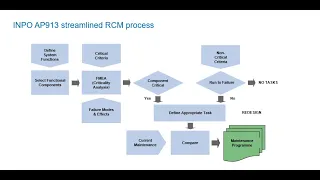
that much about it so those are criticality levels and before we can assign criticality we need to establish the systems systems is a group of components uh in an equipment category a piece of equipment and all the subcomponents or it could just be One Singular complex piece of equipment here's an example we'd have a major system with major sub major assemblies major subassemblies components and we get down to a part level for for example a compressed air system we'd have compressor assemblies compressor units uh each compressor unit would have a motor a compressor and controls
and then you get down to a parts level with a motor so we want to identify all the major components of a system group them together if we can just do it in a sensible fashion so for instance we would have with that same kind of example we would have in our failure modes and effects analysis worksheet we'd have the compressed air system looking at the subsystem of air compressor assembly and the components would be compressor motor and valve then we want to identify the failure modes what could go wrong with each of those components
so that for a compressor for instance it might seize and that would be a failure for motor might fail to start failure valve fails to close failure next we want to look at the failure mechanism M what would cause these things to fail uh here's just some examples could be corrosion or erosion or or a part fails or it's not calibrated so forth so again in our example uh with a compressor uh the failure mode is that it seizes and what would cause that might be a bearing failure so we just go through all of
our systems like that and fill out this sheet and we create a likelihood table of that happening with a level such as this remote very low low high up to extreme we also want an effects descriptions so if we think about the levels that we defined earlier when we were talking about levels of criticality a level one criticality would be loss of life body part or loss time accident and so forth uh so we want to identify those specifically because we want to apply we want to have an Apples to Apples comparison with all the
systems in in the plant so again back to our example we have with a compressor we have the likelihood of it happening as ranked high and we also have the failure effect also ranked high would have a major impact on production then we want to put together the actions that we would take if there were a failure so we put together a list of recommendations if a compressor seizes uh as a result of a bearing failure we know that that's high likelihood and also uh a high negative impact on production so the recommended action is
to maintain lubrication so that was just a very cursory overview of what criticality analysis and failure modes and effect analysis is now we'll talk briefly about how a plant would actually Implement reliability centered maintenance first of all you want to make sure you have a team a cross functional team you would have that include mechanical maintenance uh instrumentation electrical maintenance process control operations systems or plant engineering and per perhaps a facilitator you'd want to understand your current maintenance processes after you've done that criticality analysis and the failure modes and effect analysis you might have identified
areas where your processes just wouldn't allow you to really effectively act on the recommendations that you just put together as part of the failure modes and effect analysis you want to put together a plan then to address those areas that might be weaknesses in your processes uh start by setting goals what do we really want to do here do we want to increase production what are the plants business goals are we starting up a new line and so we want to get it right the first time do we need to reduce maintenance costs put together
your approach how are you going to track it uh how are you going to who's going to be responsible for what make sure that people know that they're accountable so there's a name for a certain action so it doesn't fall into the cracks finally Implement into an Enterprise asset management system also known as a computerized maintenance management system this is software that where work orders can be implemented and the preventive maintenance routines can be in there and the planning and scheduling can be done there and all the things that we've just discussed can all be
implemented in there and it expedites effective uh implementation of reliability centered maintenance now ABB has its own computerized maintenance management system for ABB equipment and that's called Service Pro but Service Pro is uniquely designed for ABB use for ab equipment and processes and it comes already with a hierarchy of systems and subsystems and components that you see here it also comes with the preventive maintenance routines uh already embedded in there so those things that we saw that are a result of a failure modes and effects analysis many of those things are already embedded in the
service pro for many AB asset classes Service Pro is also very helpful for customers in doing their criticality analysis what you see here is an analysis of the service events and the number of hours spent maintaining specific pieces of equipment you see here that analyzer 1200 has had a high number of service instances and also a high amount of service hours well that'll tell the customer perhaps it's a critical piece of equipment that we need to put in a different level a higher level of criticality or maybe that's a piece of equipment that needs to
be addressed or redesigned or even replaced Service Pro also provides benchmarking for specific pieces of equipment at other sites around the world that have that same kind of that same piece of equipment since Service Pro is used by ABB engineers and customers at hundreds of sites all over the world a customer can look at this kind of data and see the piece of equipment my plant needs more repair than that same piece piece of equipment at many other customer sites is there something wrong with the way I'm maintaining it does that piece of equipment need
to be replaced all of this is an important contribution to a criticality analysis and a failure modes and effects analysis another tool that ABB has that will help customers very much in doing a criticality analysis and a failure modes and effects analysis as part of a reliability centered maintenance implementation is Advanced Services powered by Service Port as many of you know and we deliver advanced servic Services we are gathering lots of data and analyzing that data and identifying categorizing and prioritizing things that need to be addressed the same thing that happens in a failure modes
and effects analysis here is a typical screen that you'd see in a fingerprint report or on the service port itself that would show the systems or subsystems or components that we are monitoring Gathering data from with the advanced service and with this size bar we see uh events that might indicate that that piece of equipment needs to be looked at more closely or that component needs to be looked at more closely so again that would be a great contributor to a customer undertaking a reliability centered maintenance program we'd love to be able to provide that
that kind of analysis for customers for all of their systems right now we only offer them for certain important ABB asset classes we provide that kind of analysis via Advanced Services powered by service port for the harmony control system system 800 XA LV drives mine hoists and quality control systems for the paper industry so that's just a brief overview of reliability centered maintenance thank you for your time [Music] [Applause] [Music]