How do you describe what someone is doing in Dutch? Like him, her, or . .
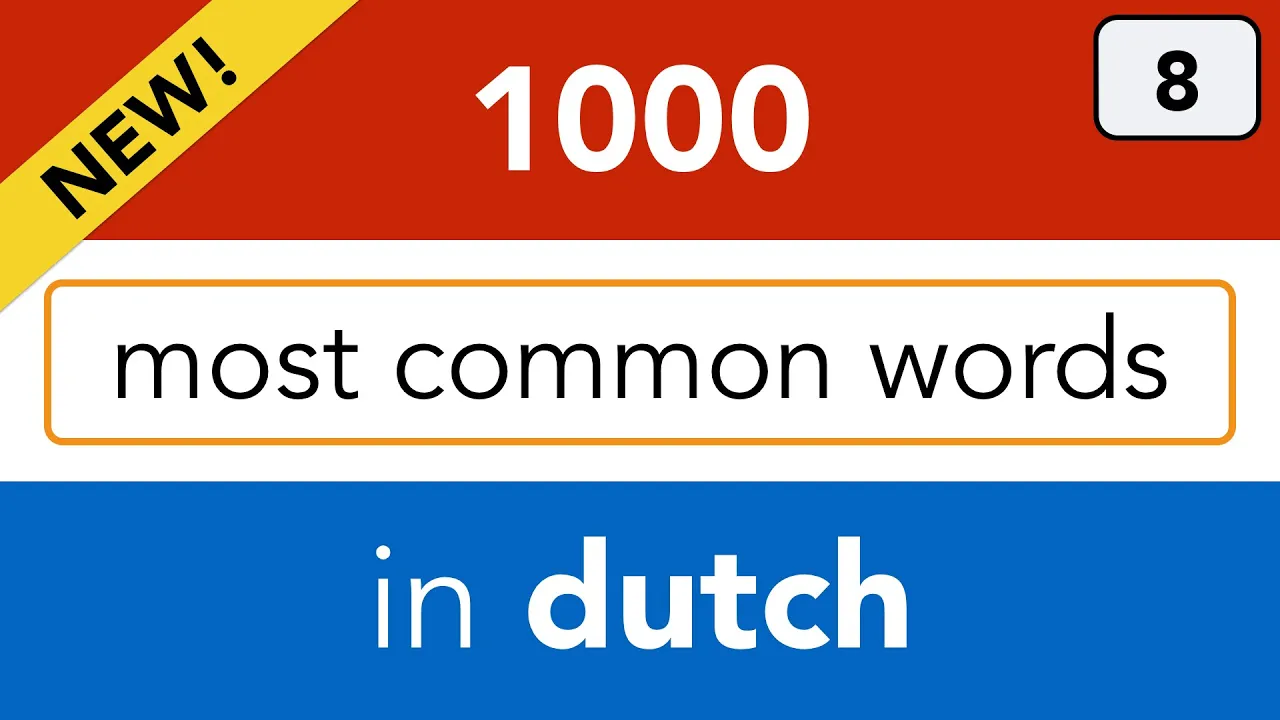
. And what's the difference between talking about your own actions and what someone else is doing? I am the online Dutch tutor Bart de Pau and this is "1000 most common words in Dutch" the online video course for learning basic Dutch vocabulary with additional exercises on learndutch.
org. I created 40 lessons. Each lesson contains 25 of the most frequently used words in Dutch.
Lesson 8 is the first lesson concerning the most common Dutch verbs or as we say in Dutch: "werkwoorden". And we will discuss the conjugation of regular verbs. [TO WALK] Do you remember the personal pronouns that we discussed in lesson 2?
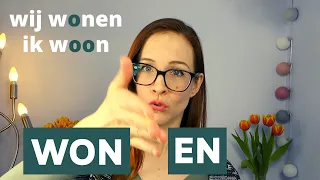
Now, let's have a look at the conjugation. "loop" is the stem In the 2nd and 3rd person singular, we add at [t] to the stem. Now let's have a look at the plural.
The plural form of the verb is the same as the infinitive. Regular Dutch verbs, like "lopen", always end on [-en]. As you may have noticed, we write 2 [o]'s in the singular form and 1 [o] in the plural form.
This has to do with spelling rules for short and long vowels, as discussed in my pronunciation of the alphabet video. In lesson 4 of my online course #dutchgrammar, I explain in a 23-minute video lesson in detail about how all the spelling rules affect the writing of the conjugation of the verbs. [TO HAVE] [TO BECOME] [TO GO] Now this is one of the few verbs that does not end in [-en].
But the conjugation is more or less the same: The 2nd and 3rd person singular acquire a [t]. The plural is the same as the infinitive. The only difference is that it ends in an [n] in stead of [en] [TO ASK] [THE QUESTION] [TO ANSWER] [THE ANSWER] [TO BUY] [TO GET] [TO EAT] Do you know what this guy is eating?
Well. . .
I'll explain it to you in lesson 10. "Uit" means: from or out of. And I guess it's clear what body part is meant with "neus".
If you think only children do this. . .
then I invite you to observe a typical Dutch morning traffic jam! [TO DRINK] By the way, “eten” en “drinken” are also used as nouns for food and drinks. We learned that already in lesson 4.
[TO DRIVE] We use the same word for transporting ourselves in a car and on a horse. [TO FORGET] [TO HEAR] [TO LISTEN] [TO SEE] [TO WATCH] [TO KNOW] But what do you say, when you don't know? That's an important phrase for a beginning Dutch learner.
. . because you may need it a lot.
Please note the word "het", that's different than in English. So the Dutch literally say: I don't know it. [TO LEARN] And to learn Dutch is: "Nederlands leren" [TO SLEEP] Sleeping is actually an important part of the learning process, especially in learning vocabulary.
The university of Cambridge proved in a study in 2009 that practicing words just before you go to sleep, helps the brain storage process. So here’s a hint, watch my videos before you turn off the light! [TO READ] [TO WRITE] Good question: is the conjugation correct?
Because the verb is written with a "v" (schrijven); but here - with the conjugation of ik - it is written with an "f". Well, yes, it is correct. .
. In the beginning of this lesson I already explained that spelling rules are important when conjugating verbs. This not only concerns short and long vowels.
As you can see, sometimes a [v] changes into an [f]. Again, you will find out all about these rules in lesson 4 of my grammar course. [TO SPEAK] And what about the lady?
What is she doing? You remember? You just learned that verb!
[TO TALK] [TO SAY] [TO THINK] And as far as my understanding of women goes. . .
I say this. But I think that. What do you think.
. . "wat denk jij?
" Do you agree with me? [TO WORK] [TO WAIT] Hey, wait, "wacht"! Why would you waste your time?
There is no reason for that. We developed an app. With our flash card app, you can learn the words of this course any time you need to wait somewhere!
Don't wait. "Wacht niet" and download the app now! Did you like the lesson?
It would make me happy if you reward it with a thumbs up. And do not forget to share this on social media. Subscribe to my Youtube channel for weekly videos to learn Dutch.
In the next lessson we will talk about adjectives: words that describe objects or people. See you then!