Have you ever visited Dutch people at home? Sorry for being curious, but have you ever gone to this place. .
. did you notice anything? Oh no.
. . I'm not talking about anything dirty.
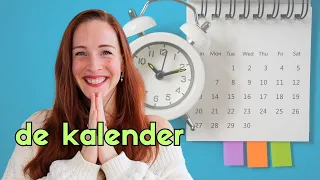
. . Most Dutch people have a birthday calendar there!
But how do we say the days of the week, the months and the seasons in Dutch? I am Bart de Pau. This is "1000 most common words in Dutch" The course in basic Dutch vocabulary with exercises on learndutch.
org; 40 lessons, in each lesson you learn 25 of the most frequently used Dutch words. In lesson 10, we will read the calendar! [TODAY] And the next one, you remember from lesson 1: [TOMORROW] [GISTEREN] [THE WEEK] This is my agenda for next week.
It’s empty, so you can expect more videos from me. [THE DAYS OF THE WEEK] And "dagen" is the plural noun of "dag" (day), that word we learned in lesson 1. As you can hear, this is an example of short-long vowel change You can learn all about that in #dutchgrammar lesson 44.
[WHICH DAY OF THE WEEK? ] This is a common question when you make an appointment. You can also say “welke dag?
”. [MONDAY] And that's the beginning of the week. When one is happy to go back to work.
For me, this is not a punishment, but my job is making videos and I like it. What about you? [TUESDAY] On the third Tuesday of September, it is “Prinsjesdag”.
This is the opening of the year for the parliament, in which the king reads the government’s plans. That happens here. I made a video lesson about it, and especially if you are in the process of civic integration (inburgering), I recommend watching it.
[WEDNESDAY] Here you see “gehakt”, which is minced meat. “Woensdag” is traditionally the day that we eat minced meat (gehakt). [THURSDAY] Like most of weekdays, it is named after Germanic gods.
And this is the god “Donar” (or Thor), the god of thunder (donder). [FRIDAY] That’s the day that we eat fish. “Vrijdag, visdag”.
Fish is "vis". And the fish on the picture is “haring” (herring). It is extremely tasty and the Dutch typically eat it like this.
[SATURDAY] Saturday, the Dutch usually spend time on their hobbies, such as playing football. [SUNDAY] Sunday is for going to church (de kerk), although churches are quite empty now, especially since the introduction of “koopzondag”. You remember?
“Kopen” = to buy. So “koopzondag” is a Sunday when the shops are open. [THE WEEKEND] [THE MONTH] The word “maand” comes from the word for moon.
[THE MOON] [JANUARY] Many Dutch start the new year like this. If want to know all necessary vocabulary related to celebrating new year, please watch the special video lesson that I made about it. [FEBRUARY] We saw that already in the previous lesson.
[MARCH] March is the month when Keukenhof opens. It is one of the most famous tourist attractions of the Netherlands, with millions of flowers. [APRIL] The 27th of April is King’s Day, the Dutch national holiday.
On this day you see the Dutch flag on every house. [MAY] On the fourth of May, we commemorate the victims of the second World War. And on the fifth of May we celebrate the liberation.
[JUNE] The Dutch like to go for a bike ride in summer very much. [JULY] [AUGUST] [SEPTEMBER] The opening of the academic year. [OCTOBER] That is the month that this guy, perhaps you know him, has his birthday.
[NOVEMBER] We have a lot of stormy weather in November. [DECEMBER] On the fifth of December we celebrate Sinterklaas. For children that's the most important holiday.
I made a video about this typical Dutch event too: the "Sinterklaas Tutorial". There I explain all you need to know and provide you with all related vocabulary. [THE YEAR] [THE SEASON] We now will discuss the four seasons.
[THE WINTER] [THE SPRING] [THE SUMMER] Now what is this picture about? Well, that's our Dutch Summer School. From all over the world, people travel to the Netherlands to learn Dutch.
In the 2015 Summer we had over 100 students. On the internet you can learn a lot, but to really speak it, is something else. In our Summer School the main focus is conversation.
We do everything to create a comfortable and social atmosphere so that our students are not afraid to make mistakes and build confidence to speak Dutch. And believe me, you leave the Summer School not only with a better knowledge of the language, but also with a lot of new friends! [THE AUTUMN] Most people find it depressing, but this is the right attitude!
Remember that when learning a language. . .
it is sometimes difficult, but if you stay positive you manage to get through! For now, congratulations because you finished already 10 lessons and you know 250 Dutch words! If you are serious about learning Dutch, you have probably already registered for our free e-mail notification service.
Learndutch. org is more than just videos on youtube. If you want to be updated when we publish other course materials (and that could be exercises, word lists, or video lessons that are not on youtube); then sign up for the e-mail notification service.
Have you not registered yet? Well, go to the website and enter your name and e-mail address. Each time we publish a new lesson - you will be informed.
See you next lesson.