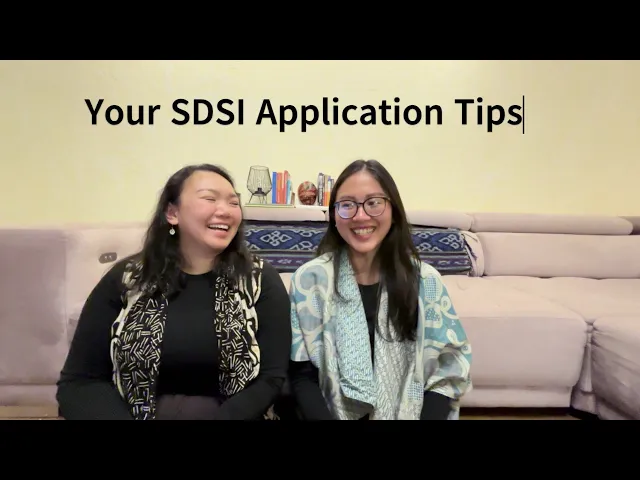
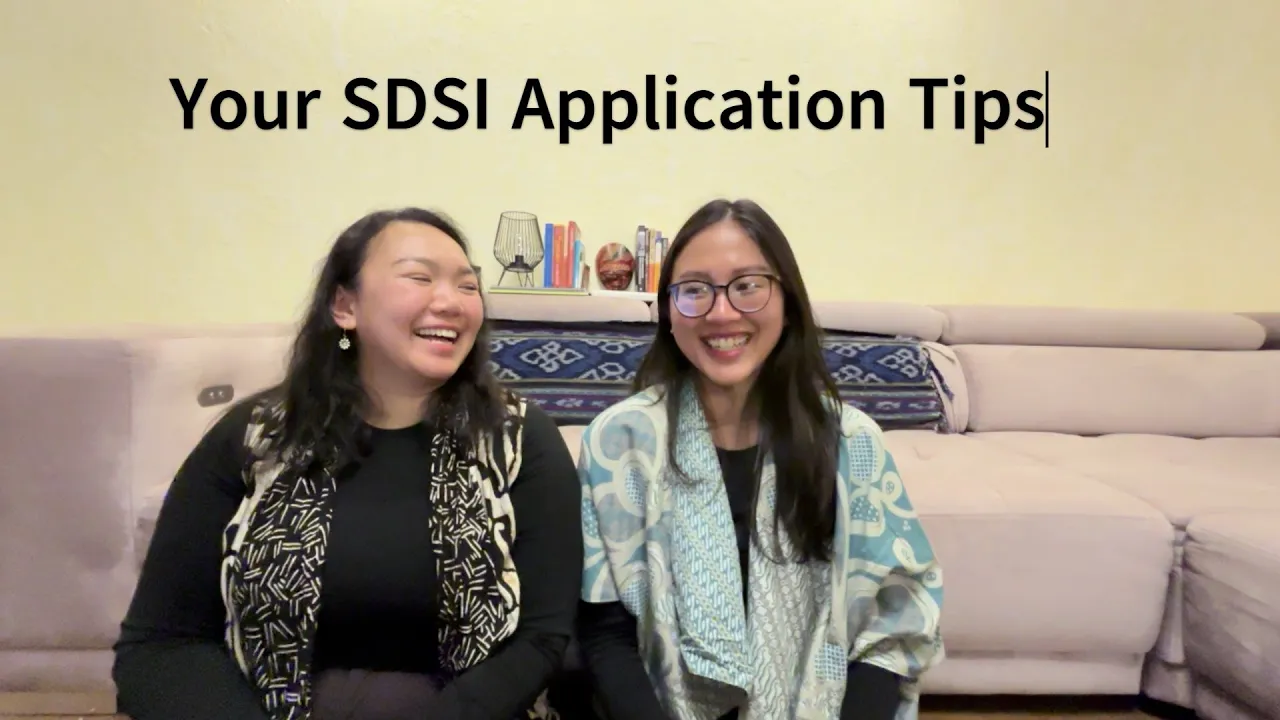
Hi, I'm Catelyn from Indonesia and I'm Inda. I'm from Canada and Indonesia and we are both recipients of the Arasmos Munda Scholarship for the service design strategies and innovation program. It's a joint master's program that takes place in Latvia, Estonia and Finland.
Uh, yep. It's our second semester here. And so, yeah, Inda, why did you apply to SDSL?
I applied because I am a creative person at heart. I've been working in my background is in journalism and communications and I've done some grassroots work with youth um and I've worked with NOS's and now I want to bring my creative uh side with my social impact passion and I wanted to pursue a master's degree and it's expensive to study anywhere really right now. It's expensive to study in Canada.
So, >> I wanted to look for a scholarship and this program offers a scholarship and I also wanted to try living and experiencing life somewhere outside of Canada. Uh so, yeah, this is the perfect program for me, I think. >> What about you?
Yeah, >> my reason is quite similar actually. Um, I've always wanted to study my masters abroad, not just for the learning and the theoretical areas, but also for my own personal growth. And um so you know I I've looked and applied to other programs as well for about a year or two and then I found SDSI learn about what service design is about and figured out that it's actually quite related to my work >> and I applied and here I am in Latia.
Okay. Now, uh so this video is basically to help you guys out there for your application and we wish you all the best of luck. So here are some tips of what we did last year.
So for me um for my application, you know, I did all the basic stuff. I've prepared my IELTS, my passport, my document. It was already set.
So I didn't miss any deadline as well. And then there is motivation letter video, solution video and admission assignment paper. >> Mhm.
>> Okay. So first let's talk about motivation letter video. How was yours?
>> Well I it took me a long time because as you probably know we have so much in our career and our educational background. um your personal and professional achievements to put into only three minutes, but I heard that this year it's only two minutes. Good luck.
You can do it, guys. You can do it. Um but it took me a long time to figure out how do I tell my story to make it authentic.
Um to, you know, so that I stand out as well. Um but also so that it's not sounding like I'm also bragging. You got to keep the balance.
You sell yourself but keep it humble. >> Yeah. >> What about you, Kathleen?
How did you do your motivational letter video? >> Yeah. So, basically, uh I would say on the SPS website, the PDF they provided.
It already has all the criteria and evaluation needed. Like, as long as you guys fulfill that, like it's great. Mine I introduce myself, my background, my hobbies, what am I passionate about, fun fact about myself, some of pictures of my experience, um work experience.
I kind of explained why I'm a good candidate, why service design is interesting, um if I got accepted and I graduate, how service design would help me in my career. And yeah, make it as unique as possible. Yeah, you are going to compete with hundreds of people from all over the world.
So really, I think one of the best tips that one of my friends told me um as I was talking to people, please do talk to people about uh their opinion um some insights and advice. Um, my friend told me to just be yourself. Your make your authentic story shine.
And it worked for me. What about you? Did it work for you?
>> Uh, yeah. I'm here. >> Well, yes.
That's right. Yeah. Okay.
Now, moving on to the solution. Mhm. So, uh last year our theme was about education.
>> Mhm. >> And this year's theme was about uh health. >> Healthcare.
>> Mhm. Yeah. Okay.
So, uh Yeah. You want to go first? >> Yeah.
So, our theme was the future of education and our sol my solution video. Um again, I use my journalism skills from back in the days. Um, and I use I told the my research story and my solution story in the form of almost like um a news story that you can see on the on CBC or BBC or something like this, but also mixed with like a vibe of content creator.
Um, so I used stats, I used different angles, I used stock video, I used um news articles, anything to support and show uh the research that I was actually talking about. Um, and also I showcased actually pieces of my solution. For example, my solution was a card deck.
Um, so I laid out what the card deck looks like so people can al also take a look into what I'm talking about. Um, and then I also talked about very specific and detailed things uh detailed context um for my solution. So for me it was based in Canada.
It was about Canadian schools. It was about diversity in Canadian schools. Um and so it's focused on problems that teachers and parents and uh students face.
Um yeah and the solution you propose is personal. You've been there, you've worked there. >> Yeah.
So it it was actually inspired by a friend of mine, a really close friend of mine who is a teacher and she was talking to me about this problem that she saw in her classroom and I heard other friends that were also teachers who said this had the same problem. So that's where the idea for me for the the main challenge came from. >> Okay.
>> So it wasn't vague like the future of education is I don't know inclusive but what does that mean? So you have to focus on one specific thing. >> What I liked about yours was she literally showed her products like the exact theme and topics and words in it.
So it was very easy for me to relate to what are the solution that you proposed. Yeah. Okay.
So mine was uh AI integration for cognitive training for elderly in Indonesia. So it's basically uh you know a cross word puzzle but it's personalized to each of the elderly's mental health state and with the help of AI they could also change the questioner's language into the national language of Indonesia or even traditional languages and the research was in depth and you know maybe a tip from for me would be you know when you're talking about the future AI and digital AI is very a broad term >> and when you say AI you got to be specific which tool is it you got to mention mine was for example AI crualist and I literally put on a photo of the research paper on it uh so did you yeah I also put a lot of pieces of research and uh where I got my stats from and for me my solution was not tech based at all. It was um you know how do we my problem was that um as Canadian schools was diversifying um there's more kids that might be getting the wrong messages from online and so how do teachers and parents help kids understand and empathize with maybe students that are from minority groups and marginalized groups.
Um and so my proposal was more from arts and improv based and imagination and facilitation kind of tool. >> And you really designed the cute cards. >> Yeah, a little bit because I didn't have time to finish it.
It was so cute though. >> Um, mine was very detailed and specific. >> Yeah.
>> And I showed the research, you know, I think almost every sentence I said there's like a like a proven research behind it. um very specific, very simple and the flow was great. Um I also talk in a timeline wise from like let's say the beginning of when you create the tool to the application and you know what would happen 5 to 10 years later.
So I hope that could help you guys. Yeah, I really like that Kathleen's uh solution was based on a very real story from her life. Um something that she's seeing with the elderly people that in in your own life and it comes from a very personal place, right?
So it's not like asking for pity but it was literally a personal experience because that idea also came from my prof uh personal and professional experience working with elderly and I bring that that was literally the first sentence of my video I think. >> Yeah. And um you know people have different styles.
So if you guys ask how to create the videos some people did vlogging style. um journalistic style, you know, news reporter. I did like like a pitch presentation.
You could did like maybe a sales pitch like Shark Tank. Yeah. And if you're really good at video editing, you could you could do your magic, you know, just be yourself, be unique, and tell a good story.
Yes, that's how you would capture the program coordinator's heart as scholarship committee. >> Yeah. >> Yes.
>> And uh that's sort of video. What about the paper? My paper was also research very heavy on research base.
I put citation on like at the end of the sentence and I asked review for my friends. Peer review is always good because >> with the deadline and the stress you might you might get the flow wrong. You might have weird ideas there.
So, it's good to have new perspective. Yeah, I agree. I totally agree.
I think for me the uh the insights and advice from my friends came before I wrote my paper. I was so confused what to write about the future of education. Uh I know that a lot of people well I I didn't know I assumed that a lot of people would do techbased solutions or tech based challenges and I actually did a little survey on my Facebook with the parents um on on my network and I asked like what are some of the things that are bothering you about you know the school system for your children and then I talked to my friends who are teachers and then I came with two ideas finally of what I was going to focus about uh focus on and one was about uh diversity in schools and how online u content could impact uh people who are or classrooms that are more diverse.
And the other one was something related to AI. I don't even remember what it was anymore. Uh, and then I went back to two of my friends who are designers and they are also parents and I went to them and I asked what do you think as parents which one would actually be more helpful to you?
Which one would be more interesting? And they said this one. So I took that idea um I worked on that idea and that's what my paper's on.
Yeah. >> Mhm. So I I agree.
So that's actually what you call user centric. >> Yes. >> Imagine when you're presenting it and the users are right in front of you, the investor, the government or whatever, the the people you're trying to make it for and they would actually use it, take it and apply it, you know.
>> Yeah. How did you come across to your topic? How did you decide?
Uh well actually back then when I was working in a therapy center, they have this memory training game, I actually was going to use it back at home for my grandma because she has been showing uh dementia symptoms. >> But I figure like, oh, I couldn't be with my grandma 24/7. >> So I was thinking, you know, imbued crossword puzzle could be a great cognitive training for her.
That was like an idea I had like two years ago and then when SDSI came up I was like hey I could use this idea >> and that's amazing and and modify it and yeah >> yeah sometimes it's already probably things that you're already curious about and it seems to fit inside the topic >> and yeah it's your time to actually dig in and maybe win a scholarship out of it. Just one more tip about submitting your application. Don't wait until the last day just in case there's glitches, your document doesn't upload, you have questions, maybe there's an opportunity to edit before the deadline.
Um just give yourself ample time in case of things like that because once the deadline is there um you can't change it anymore. >> You can't submit it anymore. You know, if you submit the wrong PDF.
Yes. >> Or if you upload the video in a Google Drve link and it's not pro, it's not properly public, like the committee can't see it. You know, you got to >> you got to be prepared.
You need to make sure that your video is accessible to the committee. Um, I use Vimeo unlisted. Um, so that was helpful.
I know. Do you use Google Drve? >> Yeah.
Yeah. Some people use YouTube. Okay.
So, uh yeah, after the deadline for the documents and the paper and the video, you got into the interview stage. >> Nerve-wracking. >> It was very nervous, but the interview was so short, was so chill.
>> Again, quoted from the last cohort's video, it was a vibe check. Be it your background, your country, your professional work. >> Mhm.
>> It's all very diverse. >> Yeah. Yeah.
So for example in our class right now we have like an economist a neuroscientist product designers uh people from tech >> from HR education NGO people journalists uh who else >> business owner >> business owners yeah people from business uh people from STEM physicists like chemistry like that kind of background. So it's really really like professionally very diverse backgrounds as well. >> Mhm.
>> Yeah. Marketing, communications, >> it a lot. Wow.
Very colorful. >> Yeah. HR.
>> Um Oh, I can't even begin. Just stop her LinkedIn guys. >> It's like do not >> lines of experience.
Uh >> but we also have less graduates. So >> yes. Yes.
>> Don't be discouraged if you have no work experience. Yeah, that's true. Actually, there's like fresh graduates that has maybe like design challenges that they've done or >> um they've done some work, but probably like their career is not as long as some of the people who are older.
Also, it's very age diverse. Yes. >> Too.
There's people who are like >> 21, 22 >> and people that are like >> over 35 as well. >> Over 35. >> Yeah.
>> Yeah. Okay. So we were talking about the interview.
>> Yes. Sorry. So my interview >> uh it was around 20 minutes.
>> Mhm. >> And uh I was interviewed by two people. One was a professor, one was the program coordinator.
Um the questions was a bit similar to what they asked last year too. uh you know about adaptation because the Nordic the Baltic countries are very cold, very dark and especially in Kooliga you're going to be here a year and it's a small small city. >> Mhm.
>> How are you holding up? >> I'm great but I'm used to I live in a smaller city in Canada and I also went to my do my bachelor's in a smaller city in Canada. um not as small as this.
I've never lived in a place as small as this, >> but I'm more used to some quiet and uh I'm used to snow and I'm used to, you know, shorter winter days. >> Um things like that. Uh yeah, but it's still it's still hard and I think if we if our cohort was not as close, it will be difficult.
Like we have a really great community with SDSI. >> Yeah, experience can vary. People grow up differently, >> but for me, I I live in a very metropolitan city, >> so it was >> the biggest city in the world, >> Jakarta, guys.
>> And um so you the adaptation questions are very important. So you've got to figure out how to answer that. For me, I was honest in a way that you know, adaptation is not easy.
I'm going to cry. I'm going to be homesick. it needs time but I will recover three to six months.
That that what I that was what I said in the interview. And I also answered that I will join an international Indonesian organization >> called uh PPI or Pepe uh in hoping that if I join them I could cook Indonesian food together, talk in Indonesian and I would feel just like at home. So that's my example.
You guys could ideulate your own examples how you tackle this adaptation. >> So like have some strategies if you know you're going to struggle have some strategies that you can fall back on kind of thing. >> Yeah.
They're going to ask you know have you ever lived alone and lived very very far from your home? Yeah. How are you going to answer that?
>> Yeah. That's also uh for some people it's the first time that they've lived abroad. very far from home.
So, homesickness is for sure. >> Um, for me, it's not my first time and homesickness is still a thing, too. So, it's for everybody.
>> Yeah. >> Yeah. >> Uh, so yeah.
Uh, another question that you struggled with or >> Yeah. >> that was memorable. >> Oh, I think that I also asked the interviewers questions.
>> So, the interview took all of 15 minutes. Exactly. 15 minutes.
you get in on the on time. So, be prepared before uh it's time to log in. Be ready.
Um and you will leave at exactly 15 minutes. Um I don't know what it's like this year, but that was our experience. >> I was also interviewed by a program coordinator and a professor, a different one.
And I also was asked if I would be okay working with um different generations of people uh because it's a very group based program. And they also asked me if because I'm older, I'm one of the older students. Um I'm over 30.
So the they also asked if I would be bored for example like because I had some design backgrounds but I didn't call it design before. Um I've done some design work but I didn't call it design. Um but they asked if I might be bored and I said I don't think so.
I think people have different perspectives and working with different generations would be amazing actually. Yeah. >> Nice.
Yeah. Uh for me I was uh I was a bit caught off guard >> because they asked me about you know if you got accepted what would be your master thesis and >> what would you do after graduation? >> I don't know.
And well in my heart I was like that was explained in my video but I couldn't answer it again. Uh yeah, I said that my thesis would revolve around HR and I would continue working as an HR after graduation by applying service design methodologies. So, so one more tip for me, uh, you know, I I was in HR, I did some interview.
Um, some people, let's say, might be nervous, that's why you practice, or might struggle a bit on how to express themselves. I would suggest you look up into the STAR method. It's like an interviewing method.
So star stands for situation, task, action, result. It will help you explain yourself better because you might be a competent person but you don't know how to explain it. >> So yes and practice definitely practice practice practice.
>> Practice on the mirror, practice with your friends and watch this video. >> Yeah, practice during your date. No, I'm just joking.
Anyway, >> anyway, >> another common question. What is service design, Inda? >> So, hold on.
Okay, so uh service design uh I think I would quote a friend of ours um one of our classmates actually from Australia. Her name's Theresa. Shout out Theresa.
Um so she actually gives this analogy of service design uh with fast food analogy. So imagine you go to a fast food restaurant. Um UX design would do would design probably the kiosk um but service designers would design the whole service journey.
So that's everything from the ordering on the kiosk or the apps um pickup the drive-thru the walk up windows to the back end also staff and all like things like that and even post service um to you know encourage customer loyalty and things like that and another friend of mine who works in government making government services less bad. So that's a way to think about service design. True, true.
>> And um we learned service design through literally working on an actual project and in an actual team. We are in fact in the same group as Espresso. And yeah, I learned a lot from the class, the team members >> and the real life project.
We get to hold the workshops. We facilitate and we prototype and We did research user uh research on the users uh behaviors and things like that. >> Um we work with an actual uh an actual issue with an actual organization here in Latvia um on waste management and on something that's going to happen in the future.
So hopefully one of our designs can be um adapted or used adopted or used and by the organization. That would be really cool. >> Yeah.
>> Yeah. >> The classmates all did amazing job. And so what do you think that our classmates have in common?
Like what screams SDSI from them? >> I think creatives. >> Definitely creatives, open-minded people, >> very adaptable people.
Yeah. >> Yeah. >> Um and resilient.
>> I think uh curious. What else? >> I feel like they are passionate about something.
>> Whatever it is, you know, uh whether it is exercise, you love nature, you love music and they actually create or made something you. She has her own nonprofit >> back in the day. Yeah.
>> So, some own and lead their own nonprofit institutions, some own businesses, some own their own blogs and articles, content creators, some have their own podcasts. So, yeah. >> Yeah, it's really a diverse group.
>> It's been one semester and the experience has been lifech changing, >> I think. So what why made it life changing for you? >> I mean oh my god the friends, the travel, everything, the the new trees, the new food.
>> Yes, learning Latian. Um >> I only know a few words, but just being exposed to it and we have like we get one week of Latian before classes start. Um, if you come if you can come early and you want to take part in that, it's optional.
Uh, but I think it's really useful because at least you know how to say thank you and how are you and excuse me. >> Um, so that's really useful. Yeah.
>> Mhm. >> Kathleen and I were on the bus to Ria for so often that we learned how to say next stop >> in Latian. >> What was it?
You don't need to have a design background. >> Yeah. >> And do your research.
You know what is service design? You could look it up. Uh look at the institutions, the design agencies, you know, for for example, IDEO from the US.
We actually studied that in class today. >> Mhm. Um, and there have been so many videos explaining the SDSI program in YouTube, Instagram, LinkedIn, from the program's official website, and from the SDSI students personal platform as well.
And there are some um examples of projects from I think I don't know about our cohort if it's up yet, but other cohorts as well. Their projects are on the website. So you can take a look at what kind of things people worked on whether as part of the program um or part of design challenges.
And I think it's really cool to have this like pool of people who are really just like we're exchanging ideas all the time. We're working together all the time. >> Um and I don't think that I would get this anywhere else.
>> True. >> Yeah. A a >> Okay, that's all from us.
Thank you guys. >> Thank you. >> Good luck.
Good luck.