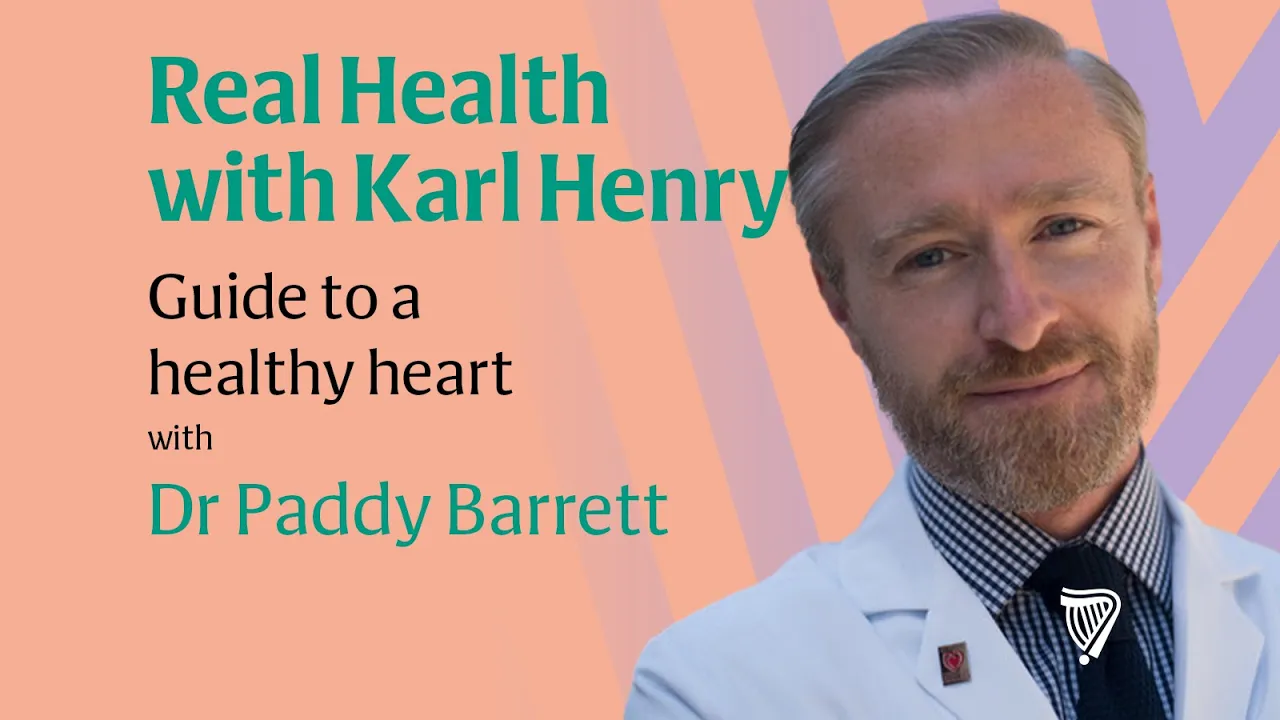
if you look at someone in the top 2. 5% of the population for v2 Max and compare them to the bottom 25% you actually have a fivefold difference in terms of the chances of them dying from any condition over a 10-year [Music] period welcome to real Health before we get took into the podcast if you want a chance of winning A500 one for-all voucher head to my podcast feedback. com pop in the code health and fill out our short survey for the chance to win a 500 one for all voucher folks heart health is essential especially when we look at the frightening figures 10,000 people die in Ireland from cardiovascular disease every single year accounting for 36% of the debts heart and owner's guide is an engaging introduction to heart health where the goal is to live longer author and consultant cardiologist based in the Black Rock Clinic DrPatty bars who also has a weekly substack with over 20,000 subscribers joins me on the podcast Patty how's it going how are you all very good good to be here I'm looking forward to this episode we've had you on before we are very lucky to have you on you're a fascinating guest to bring on what made you write the book let's start there is it as scary out there as those numbers and stats would have us believe um I think it's uh two equal measures of scary and um benefit for opportunity um the way I look at this is that the the two statistics that everyone should really be aware of is as you introduced at the start um cardiovascular disease is the leading cause of death um globally and in most developed Nations but it's also the most preventable in terms of 80 to 90 90% of it can be prevented at an early stage if you just follow the right steps and formula um so I look at it as a scary opportunity and is it fair to say that no matter what age you are you can obviously presumably if you start earlier the better but regardless of age listing in you can reduce your cardiovascular risk factors at any age profile that's correct um uh but the the analogy that I like to use is you have to think of it like a pension um you can of course uh make contributions to your pension later in life but the compounding benefit that you get will obviously be much less so if you are basically investing in your pension at a very early time point you get a much more um exaggerated result in terms of returns and reduction in risk and the reason that that is important is because although cardiovascular disease is super important at the later stages of your life uh coronary Archer disease or the dise that actually causes the events is building up throughout your life uh even starting in kind of early teenage years and sometimes documented even before wow okay yourself and own McGee would get on very well we've had own on the show all about pensions before let um cardiovascular disease let's start with that what what definitively is cardiovascular disease so there's often a lot of confusion here cardiovascular disease heart disease Etc um when we talk about this it's really coming down to what's called aeroic cardiovascular disease which sounds like a really kind of fancy scary term but ultimately that is the technical term for plaque in the arteries and we're talking here about plaque in your coronary arteries or your heart arteries um the the issue is is that when people have risk factors think you know cholesterol blood pressure diabetes the more risk factors you have the higher likelihood you will develop plaque buildup in your coronary arteries and the earlier you will build up plaque in your coronary arteries the more plaque you have in your coronary arteries the higher the risk of an event like a heart attack or a stroke so we always have to be careful in terms of making the distinction between risk factors high blood pressure cholesterol diabetes the disease which is coronary artery disease or plaque in your coronary arteries and the thing that we're trying to uh basically prevent which is the event of a heart attack or stroke and the simple formula is you minimize the risk factors to delay the onset of plaque in your Carn arteries as long as possible uh to minimize the chances of an event and it's really just applying that formula whereby you can take the leading cause of death write down the the chain and actually minimize your chances uh over time and checking for that plaque buildup is that a calcification score is that how we check for that so that is that is probably one of the most commonly used tests um description being really a cardiac CT which is two components a CT Cary artery calcification score and also a CT car anagram which looks in more detail for non-calcified plaque and and other details the the key distinction here though is that if you're using the model of healthy centenarians in terms of those those who live very long lives without major chronic diseases the key takeaway we have uh received from their research is that they get the same diseases as everybody else cardiovascular disease Cancers and dementia the key difference is they get them 20 to 25 years later so you're looking to defer the onset of the disease so a cardiac CT is looking for the disease but if you're just waiting for the disease to present and then aggressively treating it you've really miss that window of opportunity to defer it as late as possible so while a cardiac CT is really important in terms of looking at whether you have the disease and how much and what that means for your risk of a heart attack over the near term the real leveraging of risk reduction comes from managing the risk factors much earlier in life when you're likely to not have any plaque in your Carn arteries visible on a CT scan and when you manage those risk factors then you delay the likelihood of the buildup of plaque that we would see on a scan and ultimately the risk of an event like a heart attack and those risk factors and getting to them as early as you can that brings us into that Health span concept that you talk about well I think we we need to make the distinction between these uh these metrics in in my view Health can be characterized by the optimization of three factors lifespan how long you live Health span the quality of your life in terms of how you physically move and think in the world and that's basically the avoidance of major chronic diseases including dementia and then Soul span is this idea that with a long life of high quality what are you going to do with that time and for me that's that's arguably the most important question because we're all working to live longer with with a higher quality of life but fundamentally you have to use Soul span as your as your motivation for why and that is the that is the the basis for all of this because you know we have to ask ourselves what we're going to do with that time and so specifically to answer a question around healthspan Health span is is the avoidance of a major chronic disease maintaining your functional capacity in terms of what you're able to do physically and also cognitive capacity in terms of how you use your mind um over that period of time Soul span I like that I've never come across that one I love hearing new Concepts that's a that's that's that's fabulous so you know for get for people listening in it's not necessarily about living longer if you don't live well as you get older isn't it that that idea of Living Well longer being able to do the things that you want to do as long as possible well and again we have to split them across different domains there you know everybody in their life knows somebody who lived a long life but maybe had a major chronic disease um so they their their quality of life in terms of what they could physically do or cognitively do from a denture perspective was reduced and then there are people who live maybe a short life and and maybe even their health span was reduced but the way that they lived their lives was an incredibly intentional uh life and they they really extracted all the maximum value uh from it so you have to ask in terms of what your goals are and what you're trying to achieve I think for most people who are interested in health they want to live as long as they can with the the greatest amount of uh physical capacity and cognitive capacity and then to really ask themselves what they're going to do at that time um for for me that becomes the motivation as to why you would do the hard things required to have the motivation to to actually get your risk factors in place um and that is is really around using kind of the lifestyle approaches of exercise nutrition sleep and stress and they're kind of the four key pillars and if you optimize those four key pillars most of the risk reduction can be achieved and then for a small number of people they will actually have say genetic predispositions that give them a risk factor that may require a medication to be layered on on top of that is cardiovascular disease uh a result of the Modern Life that we live I.
E it's you know we're more Sentry we eat more ultr processed foods we have poor sleep we're addicted to social media you know is it linked to that that modern Lifestyles that that we that we lead now it's not if you actually look at CT scans that were done of Egyptian mummies that are 4,000 years old um they had multivessel coronary Archer disease and some of them had it as early as 40 years of age um so although our modern environment incentivizes us to behave in ways that actually increase our risk um there's no doubt that cardiovascular disease and heart disease has been with us for thousands and thousands of years now historically it wasn't a leading cause of death because other conditions actually killed people so if you looked at historical periods of time most people died from infectious diseases but if you look at uh contemporary periods 90% of people will die from a non-communicable disease and most likely it will be cardiovascular disease cancer or dementia um and so really just looking at this on an Actuarial math basis you say listen these are the leading causes of death we know that there are solid inputs that we can use in terms of managing blood pressure blood sugar control exercise nutrition Etc that can actually decrease the risk of not only cardiovascular disease but also many cancers and certain dementias uh and so you get the the aggregate benefit of that and it really comes back to then that idea of living with intention or trying to be well with intention finding that why that's you know just shutting to you already that's really what it's coming back to isn't isn't it finding your why to eat better your why to lift weight you're why to sleep better that's a crucial part of cardiovascular disease prevention and well Wellness for lifelong Wellness too well this this this really comes back to you know like the famous authors that have been talking about this Charles Bowski and and and the stoics kind of Greek philosophers Etc um if if you don't decide what you're going to do with yourself the world will tell you what to do and generally you know that won't be a good outcome for you and and most people's dissatisfaction really is that separation between their expectation and their reality and most people intrinsically know what it is they want to do at some level um but the world basically incentivizes to behave in ways that is often um at odds with that as Charlie Monger says basically show me the incentive and I will show you the outcome um and so if you don't go at this with a very intentional um approach um you will be led to directions that are going to be bad for your health across all the domains of lifespan Health span and soul span and so you need to set very clear goals if you don't have a clear destination the the likelihood of you landing at that destination is is very low um and that's really what the the the book is about it's about asking yourself what is your goal how do you intend to hit it are you hitting the actual metrics of input across the the risk factors in terms of exercise nutrition sleep stress cholesterol blood pressure blood sugars Etc um and are you then going to get the benefit uh from that and in what in what serving what need for you uh in terms of your goals in terms of health s and soul span with that was a cardiologist always your goal was that always your plan uh well I think uh if I if I think I always wanted to be an airc rescue helicopter pilot but yeah yeah so that was that was my original goal um but I couldn't I couldn't actually do that because I didn't have 2020 Vision at the time all the recruitment for airc rescue helicopter Pilots was uh through the the Irish airp um at the time um I I then decided uh you know I would do something different um and uh you know uh became a doctor instead um but uh yeah I think uh from you know uh it wasn't from an early age that I wanted to be a doctor it was something I only thought about later in life um but yeah so I just found myself in kind of the the area of Cardiology and uh it's it's served me well ever since it that was a random question purely because I love I anytime I chat to you anytime follow your stuffff your passion just shines through and I'm always intrigued by people who have such a grow for what they do it's always it's always interesting to ask them that was their that was their plan back to the book uh in was it all was it always your intention to put a section on the structure of the heart in the book is that important to educate people about the structure of it as as as well as the content about heal span and souls and soul spans and stuff so I think there there are certain Core Concepts that people need to lay down as a framework so they can understand what they're talking about just like the question you asked me about heart disease people people know the term they hear it used it's used in the media but often there's there's not a clear understanding of what it is that heart disease actually is heart disease kind of can relate to many different things issues with the valves issues related to kind of the actual heart muscle and a whole variety of uh of different components um it was actually the the Publishers who pushed me more to to include that those anatomical uh features but because for me it just was easy it was something that kind of I have ingrained in my mind but um we tend to forget um the the core fundamentals are are not as obvious to to other people um and they're crucial pieces of the the framework to to understanding how things work because if you don't understand the problem you're trying to solve and the the pieces that it's made up of the likelihood of you being able to put in place a solution to that is is much lower um so that's that's why um that is included at the start of the book really to give context to what we're talking about one of the things we haven't shattered about is the genetic component to heart disease and cardiovascular disease talk to me about that so genetics are are really um important when it comes to cardiovascular disease but in general we all were taught mandelian genetics about kind of some Franciscan monk you know growing peas and basically it was either you had the Gene and then you got the disease or you didn't get the Gene and you didn't have the disease modern uh diseases including cardiovascular disease are often much more complex um and genetics give us a probabilistic increased risk rather than deterministic and what I mean by that is that if you have certain genes for cardiovascular risk it increases that risk but doesn't necessarily guarantee you will get the the disease or the event um so it's It's always important to look at it that way um we know that even for those with significant risk uh determined by their genetics with the right lifestyle factors you can reduce the risk by about 50% um at least so again uh genetics loads the gun and lifestyle pulls the trigger as the famous line goes so it's not actually determined uh that even if you see you know that there is a strong family history of of heart disease in the family it doesn't imply that that you were on that exact same path you may be at an increased risk and you may need to be more aggressive earlier in life but it doesn't it doesn't mean that you are kind of set on a very determined path the two key points to uh get across when we talk about uh genetics and cardiovascular disease is number one around cholesterol about 60% of the variability of your cholesterol is genetically determined so frequently go people go to their doctor with high cholesterol they they change all their LIF so they do do all the right things which are really important things to do but the impact it has on their their circulating cholesterol levels is often modest for some people it's large but for most people it's modest and they get very frustrated but that is because a huge percentage of it is driven by their genetics the second thing is that probably the most common genetic cholesterol disorder in the population is what's called an elevated LP little a or lipoprotein a and it impacts about kind of 10 close to 20% of the population um and it is very infrequently checked so this is one of those things that I think most people are surprised to hear um when we they you know when I hear the story dad had a heart attack at 40 and his dad heart had a heart attack at 40 this genetic condition which is very common but infrequently checked is often the explanation um and an important Arbiter of risk so kind of they would be kind of my my main takeaways when we think about genetics and heart disease another one of those risks then is visceral F so just tell us a little bit about what that actually is and why it's a why it's a problem so when people talk about the the RIS of heart disease related to excess weight or obesity um what we're really talking about is is the excess fat that is what's called visceral fat and you have two types of fat there's subcutaneous fat and that is the stuff that's on your side that you can pinch and and although people may not like the appearance of that for for some people it it contributes very little to your excess risk in terms of heart disease and diabetes and high blood pressure Etc it's the fat that is actually inside your abdominal cavity that is the engine of inflammation that drives cardiovascular risk um and for people who are say overweight or have obesity there is obviously a higher chance they will have excess visceral fat but there's also groups of individuals who have less subcutaneous fat but a significant amount of visceral fat and so they they don't appear to be overweight by any obvious metrics but they're carrying excess visceral fat which is driving their risk of heart disease and this excess visceral fat really kind of drives what a condition called insulin resistance which acts as a massive amplifier of risk for all the major chronic diseases cardiovascular disease Manny Cancers and dementias and so it's it's not that it is the exclusive cause of these conditions but it is very much the amplifier of risk so you have to think about it as the gasoline that is poured on the fire and if people want to measure their visceral fat it's it's SM it's a smart scale it's either in a pharmacy or at home that will give you a decent indicator roughly a rough indicator so there's with everything in life there there are accurate uh ways to do it that are obviously complex and sometimes expensive and then there are much more simple ways that don't have the same accuracy so we always have to ask which test we're using arguably the simplest test is to measure your waist circumference that is the circumference of your abdomen around where your belly button is rather than your your Gene size um and really that it's this is where kind of Having excess you know people describe it as belly fat but really it's that fat in your abdominal cavity um that actually increases risk and so often people will see you know you may have have excess uh fat on your bottocks for example but that's subcutaneous fat and it doesn't add really significant uh excess risk so the easiest way to do it is is is your waist circumference uh enlarged um the the the metrics vary by country but generally if it's greater than 35 uh inches for females and 40 inches for males I could be saying that incorrectly but um the the this is the the circumference around your waist at the level of your belly button it's that kind of body shaped concept isn't it it's the the Apple shape versus the pear that apple shape is a is is a more is a riskier shape from a health perspective that kind of pear or Latino kind of shape where the bone when the hips carry the excess fat is a much healthier body shape correct and that's to do with the distribution of where fat is in your body females tend to accumulate fat predominantly in their bottocks and thighs um and that doesn't significantly increase risk whereas males often increase it or or have that distribution of fat in their abdominal cavity which is excess visceral fat now the reasons for that are kind of are somewhat unclear but one of the evolutionary reasons is that females actually have to carry uh children uh in their uterus so they they distribute fat away from that area where males actually don't so that's you know that's one of the theories okay so but a very very very this is a very simplified level that if you are in apple shape you are at higher risk of a higher visceral fat and a higher risk of cardiovascular issues later in life correct and and you know we can go up the the chain of complexity in terms of how we evaluate this the most complex way is to and the most accurate way is to do something like a dexa scan as long as that dexa scan has software to actually give you what's called a vat mass or visceral adpost tissue mass and so you can then Benchmark it against percentiles for age and sex um you know MRI scans of the abdomen will be able to calculate similar uh features but arguably probably one of the easiest ways to to assess whether you have excess visceral fat is is to see that do you have any of the the downstream consequences of Having excess visceral fat and that is the the features of insulin resistance and metabolic syndrome so metabolic syndrome is is is a set of characteristic features that actually indicate whether you have the the consequences of excess visceral fat and metabolic syndrome is basically having any of the three any three of the following five features of high blood pressure high triglycerides that you see in your cholesterol test low HDL or often referred to as good cholesterol um abnormal blood sugar levels or an excess in terms of waste circumference so if you've any three of those features you meet the criteria for having metabolic syndrome which significantly increases your risk of cardiovascular disease and other conditions but we know that even having one of those features does increase your risk the encouraging thing about that is that although it significantly increases your risk there's still a huge amount you can do particularly from a lifestyle point of view to actually decrease that risk and one of those lifestyle factors is aerobic fitness that's a really important aspect of from a lifestyle perspective to to to to keep an eye on on a personal perspective isn't it well so when we think about Fitness there's there's multiple domains and we have to think about what your goal is I mean if your goal is to be a 100 meter Sprinter your your your Fitness uh targets will be quite different to if you want to be a shot putter or a different kind of sporting event but for me my fitness goals are around functional longevity that's living longer and having a higher capacity to do those things later in life so if that is your goal we know that very high levels of aerobic fitness which are traditionally measured uh by uh metrics like V2 Max have some of the highest predictive capacity and biomarkers for Longevity if you look at someone in the top 2. 5% of the population for v2 Max and compare them to the bottom 20 5% you actually have a fivefold difference in terms of the chances of them dying from any condition over a 10-year period And even if you're just in the top 25% compared to the bottom 25% there's a four-fold difference so that difference is is obviously a huge difference in terms of the likelihood of dying from any condition and also cardiovascular disease it's something that is trainable um and it's certainly something that people can move up the scales and they get most of the benefit in really getting off zero rather than kind of being frustrated with this idea of maybe not making the top 2.