Hi, guys. Another Wednesday. Our snake talk is back here.
And today I'm going to fulfill a request that people are making. They are asking me what is the difference between urutu and jararacuçu. You both know they are Bothrops.
They are of the same genus as the jararaca. Urutu and Jararacuçu are both Bothrops. Both are poisonous snakes.
But what is the difference between them? Let's see this in today's video. Come on, no time wasted, let's go to the vignette.
Let's start talking about the urutu. Bothrops alternatus which is a very feared snake in southern Brazil and in the south-central. It occurs in all southern states of Brazil, plus São Paulo, Minas, Rio de Janeiro, southern Goiás and Mato Grosso do Sul.
It is very feared because it is a great producer of poison. It is one of the most poisonous in Bothrops. There are already studies showing that it produced 380 mg of venom in a single extraction.
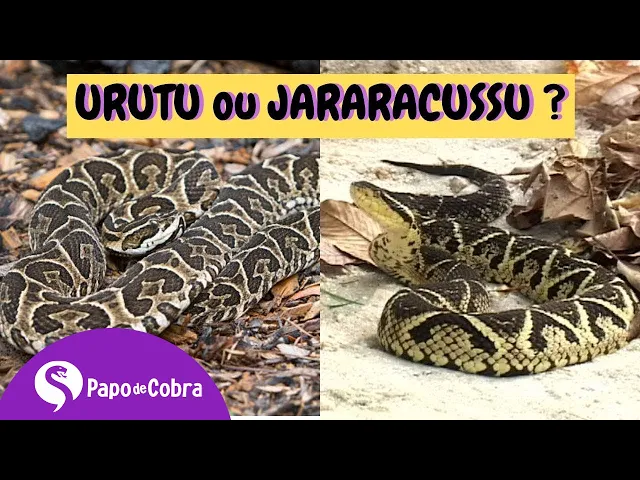
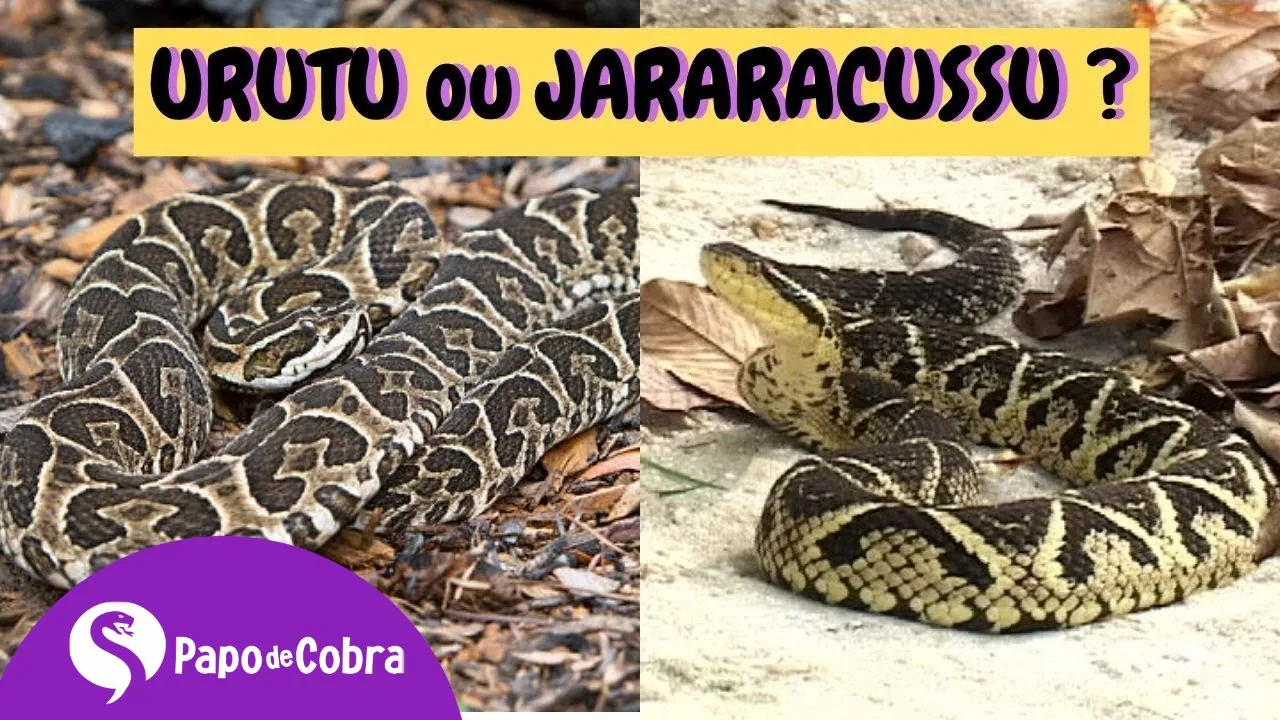
But let's see her difference. Its first characteristic are the stains that are laterally on the body, which are shaped like a horseshoe or those old telephone hooks . It is dark brown, round around in a whitish-yellow half.
And it's a very cute animal . So its color is this: these hooks in the shape of a telephone. Now let's see what the top of her head looks like.
You can see here in this image what the drawings are like in her head. And in a little while, we will compare it to jararacuçu. Now notice a detail: let's start seeing now the detail of the animal's head.
Fix the side view of the animal's head . You can see there the loreal pit, which is characteristic of viperids. And see that the supralabial scales do not enter the pit, they do not touch the pit.
You see some tiny scales there. So one of the characteristics of the urutu group. It is not the only species that has this, but to differentiate it from the jararacuçu, which we are doing in this video.
Note that the supralabial does not touch the loreal pit. So if you don't know what super labial scales are, if you haven't seen this video, I'll put a link here for you to see the videos explaining what the name of the scales on the head of a snake is like. So the characteristic of the urutu is that the supralabial scales do not touch the loreal pit.
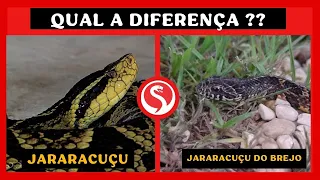
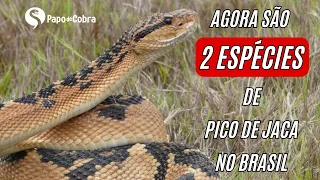
It separates. So, as I said, this is not the only species that happens, but it is a differential for us to separate it from jararacuçu. Now let's see the jararacuçu, which is the largest snake of the Bothrops genus, reaching up to 2 m in length if it is a female.
Females are much larger than males and have tusks up to 2. 5 cm long. It is a species that can produce the greatest amount of venom among Bothrops.
We have venom extractions that exceed 6ml. It's too much. It is a predominant species in southeastern and southern Brazil.
So we will find this species in Espírito Santo, Minas, São Paulo, Rio de Janeiro and also a little in the south of Mato Grosso do Sul, Paraná and Santa Catarina. The color of the species is totally different from the urutu. Notice that there I have drawings in the shape of a fish tail.
It is quite yellowish and black for females and darker for males. That's why many people call it the golden jararacuçu, as if it were another species. It is not.
Golden Jararacuçu is a female. When the person says that the jararacuçu is dark or brown, it is because it is normally a male. So that's the difference.
I 'm going to show you now how the top of the jararacuçu's head is, so that we can differentiate it from the urutu. See the image with the top of the jararacuçu's head. Now again looking at the detail.
Let's see the difference that separates the urutu from the jararacuçu. The jararacuçu, looking at the head. Let's look again at the supralabial scales.
And now we will see that the second supralabial scale, it touches the loreal pit. Different from the urutu. So you are seeing in detail how the supralabial scales are distributed in the jararacuçu group.
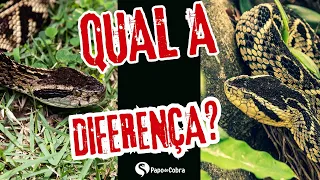
So, as I said, it is not the only species that enters, the supralabial scale enters the loreal pit, but to differentiate urutu from jararacuçu, this is a very important feature. Well, let's now look at the two structures side by side. The structure of the head of an urutu compared to the head of a jararacuçu.
The supralabial scale not entering the loreal pit. It has tiny scales that separate, in the case of the urutu. And in the case of the jararacuçu, which is on the right, you can see that the supralabial one touches the loreal pit.
The second super labial. So, reinforcing, if you don't know the name of the scales, watch the video we made talking about it. So guys this was our video for today.
The urutu and the jararacuçu are very beautiful animals, aren't they? I am fascinated by them. Snakes are very, very amazing animals.
So that was our video for today. I hope you enjoyed. And if you liked it, subscribe here on the channel.
Not only does not watch. Also sign that important for us. This is quick.
this is very important to us. Thanks guys ! !
! Comments down here. Give your like there and next week, I'm counting on you here again, in this new "Snake Talk".