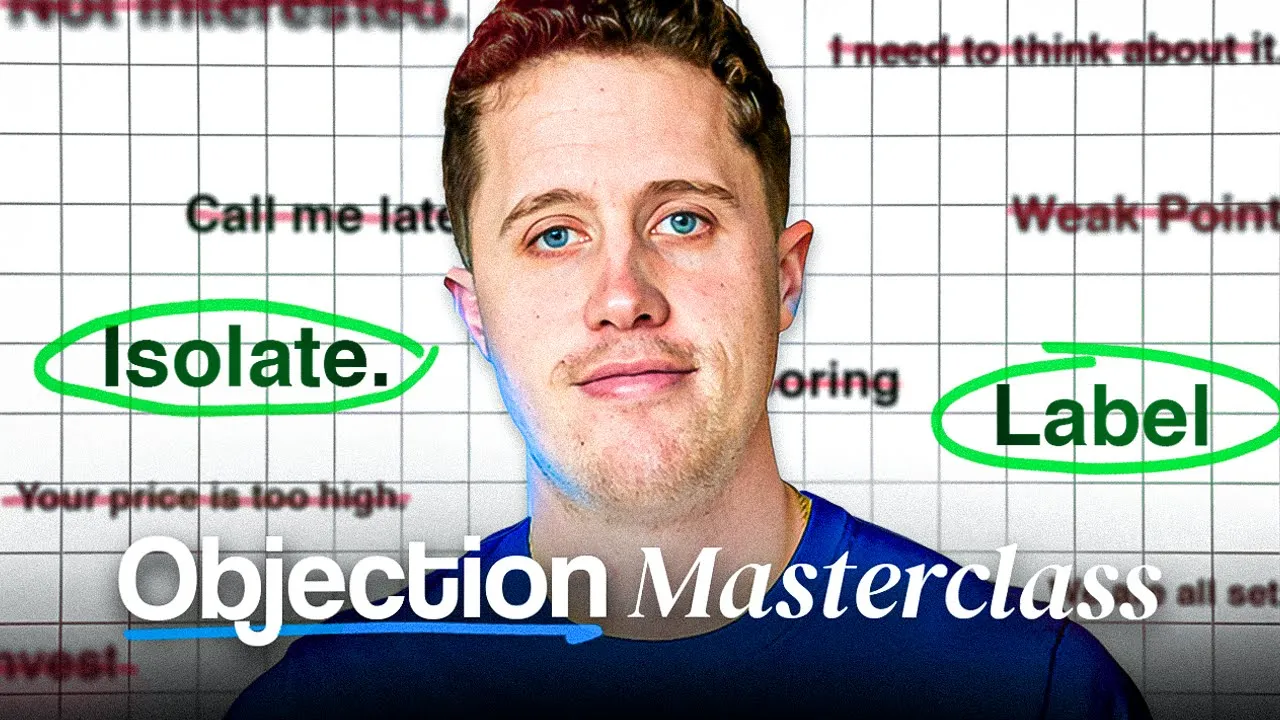
All right, guys. Today we're talking about sales objections. Most reps hate them.
By the end of this video, you will not because we're going to walk through the five best techniques, super simple and easy, to move sales conversations forward when you do get hit with resistance, and how to use these techniques to handle cold calling, pricing, and stalling objections. But first, we have to get something out of the way. When I type sales objections in YouTube, these are some of the top videos that pop up.
And you'll notice a common theme. Overcome, overcome, prevent, overcome. 99.
99% of salespeople, this is their mentality when they get hit with resistance. I'm not interested on a cold call. Your price is too high on a sales discovery call.
What they're trying then to do is overcome that objection. And quite frankly, guys, most sales people when they do hear an objection, they're not listening to the prospect whatsoever. The only thing they're listening for is silence.
The prospect stopped speaking. So now it's my turn, the salesperson, to jump down that prospect's throat. And what this does, it creates this mentality for the salesperson.
It's you verse me. Up, you just told me you're not interested. Up, you just told me your price is too high.
This is an obstacle that I have to overcome. I have to beat you here, Mr or Mr. Customer.
And when you do this, when you have this mentality, you look like the used car salesman. This happened when I was in high school. Me and my dad were turning in his Toyota Avalon.
He always had Toyota Avalon throughout his entire life. Not sure why. He just loved that brand and the car.
He was turning that car in for a four-door Jeep Wrangler for me and my brother to drive our senior year of high school to make sure we looked cool. Anyway, we're sitting down with the used car salesman and my dad said, ' Listen, Chris, I appreciate you walking us through all the numbers here. This was super helpful.
I'll get back to you. I need to think about it. And Chris came back and said, "You don't have to think about anything.
You have all the numbers in front of you. Let's do this. " And I remember my me and my dad got up and walked out.
My dad was super angry because the guy did not acknowledge, did not listen whatsoever. Absolutely ridiculous. And it's good news for me and you guys is because we're not used car salesmen.
What we're going to do instead is we're going to listen to understand the real meaning behind the objection. And the real meaning behind the objection is key here because an objection can mean five to seven different things. Matt, I'm not interested.
That objection on a cold call, guys, can mean a lot of different things to a lot of different people depending on their company, their situation, that specific person. Without taking a step back to number one, acknowledge the objection, and number two, better understand what you're up against, you're not going to know if it's something that you should even move forward. There are some objections out there that are real objections that you have no chance of handling to move the conversation forward.
And that is okay. disqualify that opportunity out because you're going to waste your time and their time. So, without understanding, you're not going to know if it's worth your time or not.
Take a step back, acknowledge. That's the foundation of this entire video. Without understanding, none of these techniques around how to better handle cold call stalling, pricing objections matters whatsoever.
And again, some objections are real and that is okay. Move forward to another prospect. you actually have a chance to close.
So, the five strategies to handle objections without sounding salesy. I learned these techniques in the book Never Split the Difference by Chris Voss. Guys, this is one of my favorite books of all time.
It's not a sales book per se. It was written by Chris Voss, obviously, on the screen here. And Chris is a former FBI hostage negotiator.
And a few of the techniques in this book I use every single day, whether it's on my cold calls, especially on my sales discovery calls and closing calls with potential customers. So, if you haven't read this book, I would encourage you guys to pick it up and read it. The first technique in the book is selective word mirroring.
And I really like Chris's his company is the Black Swan Group up here. I really like his definition on this page. So, it's super simple.
Repeat the last one to three words your counterpart, your customer, the prospect just said. Or if you really want to be surgical, select one to three critical words from some portion of what they've said and ask a question, keyword question based on those words. Phrasing it as a question means your voice needs to inflect up at the end of the mirror like you're genuinely c curious.
So for example, if I were to get hit with, "Hey Matt, we really like what we saw today, but your price is too high. " Uh too high inflect at the end for the high indicating it's a question. your delivery, your tonality, and your pacing is super super important here because if you don't have that inflection, it's not going to come across as a question, and it's going to be super awkward during that sales conversation.
So, that's number one. What this does, guys, number one, it shows the prospect you're actively listening. And number two, a mirror, like a few of these other techniques, is going to encourage elaboration or elicit more information out of the prospect.
Now, you can use mirrors in other places in the sales conversation. Let's say, for example, I'm meeting with a prospect, you're meeting with a prospect, and they say something during the sales conversation that doesn't make all that much sense. That's a perfect time to use a mirror because that mirror again, it's going to elicit more information out of the prospect to better understand what they just said that you didn't understand.
Now, this technique, guys, labeling is my all-time favorite sales technique. If you watched my sales discovery calls, and you can in the link in the description is access to the sales discovery and demo system. There's gosh, maybe 10 of my sales discovery and demo calls in my previous role at IBM.
You'll notice, guys, that I use this technique all the time. And it sound it starts with phrases like it sounds like, it seems like, it looks like. And it's accomplishing the same exact thing as selective word mirroring.
It's showing the prospect, hey, I'm I hear you. I'm with you. I'm listening to you actively.
And more importantly, again, like mirroring, it's eliciting more information out of the prospect for them to expand on their concerns. This is the best sales technique of all time. Now, there is a special form of a label where you get the label wrong on purpose.
It's called mislabeling. Now, it's important to note, guys, don't overuse mislabels. Don't overuse labels.
If you use them too much, it sounds weird. I've used them too much in past sales conversations. I'm watching them back and I'm like, "Oh my god, what am I what am I doing?
That's too many labels. But mislabels again is you're labeling something wrong on purpose. So you want the prospect to come back and correct you because prospects love correcting salespeople.
Now, this technique is not necessarily going to be used to handle objections. It's more so going to be used to uncover hidden objections you think they have that they haven't brought to the surface yet. So, for example, maybe I'm having a sales conversation and I want to verify, is this project that we're talking about, is this problem that we're talking about, is it big enough where it's a top priority?
And I'm not sure if it is or not. I might say something like this, Chris, I it it's it seems like like this problem that we've been talking about the last 30 minutes. It's a big problem, but I'm getting the sense that, you know, it's not a big enough problem where you folks need to solve this now rather than, you know, like six months or next year.
And I'm hoping the prospect comes back and says, "No, Matt, like this is a big enough problem. We need to solve this now. " And this is why that's what we're going for with a mislabel more so to uncover rather than to overcome.
But labeling like I said it is this technique guys absolutely incredible. Third technique accusation audits. Now there's a movie.
You might be able to guess it. Comment in the the comment section of this YouTube video. There's a movie.
It's based in Detroit. It features a rapper who uses accusation audits at the end of the movie. and you'll get a heart for me if you comment it in the comment section.
I'm showing it now. It is Eight Mile featuring Eminem. So towards the end of the movie, Eminem is in a rap battle and he goes first and this is for the championship and he gets ahead of it and says all the negative things this rapper here is about to say about him.
And now this rapper has pretty much nothing to say and just hands Eminem the mic. Accusation audits, guys, is about getting ahead of any objections, negatives, and push backs the prospect, the other side might have. So, for example, before you hear a price objection from the prospect, you're going to bring it up before you present the price.
You're probably going to think, "Chris, the product is way too expensive. " or you probably think you could get XYZ cheaper elsewhere. So, accusation audits, they typically will start with the phrases you're probably going to think or you probably think.
Now, more from the black swan on accusation audits. There was something in here, guys, that I wanted to Here it is. So, anytime you're going to make an ask of your employee, anytime you're going to make your ask of a prospect, you should set that up with an accusation audit.
And for the best results, you might want to use no oriented questions. So, no oriented questions. People, especially prospects, feel safer saying no than yes.
It's simple psychology. So, let's say, for example, I'm on a cold call and I want to go for the estimate. So, I'm going to use a note oriented question.
I'm going to I'm going to set it up with an accusation audit. So that might sound like this. Chris, you're probably going to think this is a ridiculous ask, but would you be opposed to exploring this in a bit more detail when I'm not cold calling you completely out of the blue?
Accusation audits. Labeling the negative emotion that prospect might have diffuses it. Killer killer sales technique.
Number four, this one is key. further along in the sales cycle. So, you're not really going to isolate objections on a cold call or prospecting, but you are definitely going to want to isolate objections on a sales discovery call, on a closing call, on a pilot.
The first objection, oftent times, the first thing the prospect says, excuse me, is a smoke screen. And what I mean by that is they might tell you an objection, but the real objection is actually behind it. and they just don't want to tell that to you.
And how you uncover that is by saying something as simple as this. Objection aside, Chris, is there anything else holding you folks back from moving forward? So, let me take a step back.
Let's say, for example, I'm meeting with a prospect and they say, um, hey Matt, uh, listen, like this solution, but your price is too high. Okay, Chris, appreciate that. Thank you for letting me know.
Chris, outside of the price being too high, you know, is there anything else holding you folks back from moving forward? Yeah, Matt, there actually is. Uh, a couple folks on our team used your solution in the past and they didn't like it.
Boom. That is the real objection. The price objection that Chris just threw out to me was a smoke screen.
And the real objection was, hey, some other folks on the team used this and they hated it. That's what we really need to handle to move that conversation forward. Isolate the objection.
take a step back, calm down, and isolate. And then this technique, let's see if the book's behind me here. It's actually right here.
The technique of ledge statements was in objections by Jeb Blunt. Absolutely fantastic book, focused on sales objections, 100%. And this is actually a throwback, guys.
You'll like this. If you want, I can link this in the comment section, but this is an article I wrote on LinkedIn back in October of 2019 about how I handle cold calling objections. And these the ledge statements work, cold calling, prospecting, stalling, closing.
So here it is. So ledge statements give your brain what neuroscientists while I was talking about neuroscientist back in 2019 they called the magical quarter of a second. So that magical quarter of a second is all your brain needs to rise above the emotions associated with rejection.
So oftent times when you're hit with an objection especially on a cold call your mind scrambles right your mind goes blank. My mind goes blank all the time. That's why when I'm making cold because I have my objections right on my my handlers right out in front of me.
But these ledge statements to Jeb Blunt's point give your brain a couple seconds, not a couple seconds, probably like a 75 or a second to process that objection to figure out how do I best handle this and move the conversation forward. So these ledge statements can be that makes sense. That's exactly why I called.
I expected you to say that. I'm with you. I figured that was the case.
Now, the one I use the most still to this day is that makes sense. And you'll notice here, I understand that's also a ledge statement. However, I don't list it here because 99.
99% of sales people when they're hit with resistance, when they're hit with an an objection from a prospect, that's how they start their objection handling process. And because of that, prospects know what's about to come after that is showing that they actually don't understand whatsoever. So that's why I do not use I understand.
I would stick with these five up here. Again, that makes sense. I'm with you.
Or the two that I use the most. But killer killer technique by Jeb Blunt, one of the best. And then guys, ask questions.
The only way to understand an objection is to ask questions. There's there's a technique called calibrated questions by Josh Brawn. Just be curious and ask thoughtful questions to better understand the good thing.
I know I mentioned this a couple times, guys. No one else is doing this stuff. They're not.
They're jumping down the prospect's throat, asking questions to understand rather than overcome. Now, let's start handling these. All right.
Cold call objections first. I'm not interested. Now, I handle I'm not interested different depending on where I get it on a cold call.
So, let's say I get it at the very start of the call. You're probably going to think, Chris, I'm trying to tell sell you something you have no need for whatsoever. So, what I'm trying to do there, what technique was this?
This was an accusation audit. Remember, labeling negatives diffuses them. And this phrase here might buy me another 15, 20 seconds with this prospect.
I will say guys that this objection, I'm not interested at the very start of a call. It's nearly impossible to handle, right? They're probably not going to hear you.
They're probably going to hang up. That's okay. Move on to the next person.
But I would handle it differently if I got hit with I'm not interested after the pitch, the reason for the call. That makes sense. We're using a ledge statement.
I know you didn't ask me to call you. Before we hang up, if you don't mind me asking, is it because I called it the worst possible time or are you happy with what you have? A thoughtful calibrated question.
Ledge statement. This is a Josh Braw technique here. Or you could use some humor.
Chris, it sounds like I sounds like I completely butchered the bit the pitch here. I've used this to try to get humor, get them on my side. Does it work every time?
No. None of this is going to work every time, but it's going to work more often than overcoming and doing what everyone else is doing. So, we got humor with a label.
And we got a ledge statement with a question. Where was the label here? There's no label there.
Let's get rid of that humor with a question. Cool. I'm heading into a meeting or I'm busy.
We know they're not busy, guys. If they were busy, if they were in a meeting, if they were heading into a meeting, they wouldn't have picked up the phone. That makes sense.
That makes sense. Ledge statement. I'm calling completely out of the blue here.
Chris, can I steal just 30 seconds to tell you why I called and you can let me know if it's worth calling you back or it sounds like Chris, I caught you at the worst possible time here. would it be, you know, would it be okay if I stole just 30 seconds to tell you why I called and you can let me know if I should call back? So, similar techniques here.
And you'd be surprised, guys. Like, if they give you 30 seconds, you might be on the phone for 10 minutes and you call their bluff. Basically, the same techniques were used on this one and this one.
Ledge statement label. We're going for the ask. The worst they could say is, "No, I don't have 30 seconds.
" And guess what? Call them back in two weeks. They're not They're not going to remember you.
They're not going to remember you. All right, we already have a vendor. Label, right?
Label. Oh, awesome. It sounds like they're doing a great job.
And then let them talk. And then what you want to do is you want to go for the ask. And what we're going to do here is two steps.
An accusation audit number one plus a no oriented question. Chris, you're probably going to think this is a complete this is a complete waste of time, but would it be a ridiculous idea to explore this or explore if there are opportunities beyond what you have in place today to accomplish XYZ that might not be on your radar? That way, if your situation changes in the future, you have someone in your back pocket you can call.
Now, I want to deliver it like that. I would deliver it much more chill and and laidback. But again, when you're going for an ask, set it up with an accusation audit, labeling the negative diffuses it.
And then use a nooriented question. People feel safer saying no, then yes. Key.
All right. Call me back next quarter. Happy to.
I'll put it in my sales force to call you back. Curious before we hang up here, what's going to be different next quarter where a conversation makes sense or happy to just put it in my counter to call you back in September? Before we hang up, you mind if I you mind if I ask a blunt question?
I've been doing this Chris a long time and typically when folks like you tell me to call them back next quarter, it's actually translation or what they really want to say is, "Matt, listen, never call me again. I'm not interested. " It's not going to be an interest now, nor is it ever probably.
Is that the case here, Chris? You're not going to hurt my feelings if it is. Like, I'm going for the no.
Some people get so happy when it when they hear, "Call me back next quarter. " They think there's like a project going to happen next quarter. Slow down.
There's probably not a project going to happen next quarter. And all I want to do now is call their bluff and make sure I'm not wasting time by calling them next quarter. I want them to be eliminated from my call list.
Delete them from Salesforce. Go for the no. That is okay.
And going for the no also works great when it comes to the objection we all get all the time, guys. And most sales folks get happier when it comes to this. Send me an email.
Sounds good. Chris, you mind if I ask a quick question before we hang up? Cool.
Thanks. You know, I've been doing this a long time, and typically when someone like you tells me to send along an email, what they really mean is, "Send me the email, Matt. " But like, this is just to get you off the phone.
And it's going right in the trash bin when I receive it. I'm not even going to look at it. You're not going to hurt my feelings, Chris, if that's the case here.
Am I off base with that assumption? Or this one over here? Let's see.
I've sent a lot of emails to folks like you from calls like this and I've actually I've actually never received an email back and kind of do it in a joking manner. Would it be a ridiculous idea to explore this in a bit more detail when I'm not calling you completely out of the blue? So, there's two different avenues you could go.
You could either go for the no when you get send me an email or instead of going for the no, you could go go for the meeting. might be worth it, guys, to go for that meeting. But don't get happy ears and be like, "All right, cool.
I'm going to send you the email and hop off. Price objections. Your price is too high.
Isolate. " Got it, Chris. Appreciate you letting me know.
Price aside, is there anything, you know, anything else holding you folks back from from moving forward? This should be a question. And let's say they verify, "No, Matt, the only thing holding us back from moving forward is your price.
It's just too damn high. " Got it. It sounds like you're comparing my price, you know, to that of a few competitors.
Now, this could be either a label or it could be a mislabel or you might want to say, "Gotcha, it sounds like you guys just don't see the value here or it sounds like, you know, the value just isn't here for you. " And you want them to come back with this misleading and be like, "No, Matt, like the value is here, but the price and get they're going to provide more details. " Again, this is all we're trying to do.
Get more details. What is it exactly about the price that is a big concern here? And then you want to ask a question.
Let's say they say, "Hey, Matt, yeah, we've we're looking at XYZ and ABC. " Got it. If if the price were the same, like if my price Chris were the same to ABC and XYZ, which solution would you rather use?
Who would you rather do business with? If they come back and they say, "Hey, Matt, I'd rather do business with you. " Got it.
Can you walk me through all the reasons why? And when they exhaust that, I'm going to say something as simple as, "So you could see why we're more. " So they just sold themselves on why my price is justified.
That's key. That's out of my budget. We're going to use a mirror.
Out of the budget, remember inflection to indicate it's a question. Or you could isolate and label like above. So an isolation would be this.
Budget aside, is there anything else holding you folks back from moving forward? And then you might want to use a label as well or a mislabel. and then ask a question opposed to even seeing Chris if there's a business case to be made here to you know find budget with you and your team asking calibrated questions to better understand what you're up against.
We only have X dollars only 500 mirror list more information demonstrating Listen Mr Mr. prospect, I hear you. Isolate.
Money aside, is there anything else holding you folks back from moving forward? Again, the isolation is to ensure this is the only objection and the real objection. There isn't an objection behind it.
Smokec screen. Label or mislabel. We're hoping this here is a mislabel.
You know, it sounds like you guys have like a lot on your plate and those other projects are just a bigger priority. You want them to come back and say, "No, this is our main priority. " And it's okay if they say, "Yeah, Matt, we have other priorities.
" Then I know I'm not going to waste my time with this prospect. When will this be a priority? Okay, cool.
Let's table this for now and let's come back to it and discuss it when it is a priority. And then ask, when you say you only have X dollars, does that mean you only have X dollars this quarter and you know you'll have money to spend on this next quarter or you only have X dollars for, you know, the remainder of the year? And you'll notice, guys, like these questions, they're not rocket science whatsoever.
There's simple simple questions based on the objection, based on the conversation to understand your competitor is cheaper. I I would get hit with this one all the time in my previous role at IBM. This was my favorite one.
Got it. I appreciate letting me know. I'm curious, you know, if they're cheaper, like why haven't you purchased XYZ or ABC?
Or I'm curious if if XYZ is cheaper, why are we still talking? That might be a little bit too aggressive. Or what motivated you to speak with me today?
If they're cheaper and they're going to come back and they're going to say, "Yeah, Matt. Well, I'm speaking with you because you do X, Y, and Z, ABC. " And they don't.
Okay. So, you could see why we're a bit more expensive. Not that difficult.
You got to sometimes like push back on these these folks. Stalling. These are my favorites because they come up more often than any objection.
I need to think about it. Think about it. Inflection label.
It sounds like Chris, I'm getting the sense like it sounds like you guys have some hesitations here. And you'd be surprised, guys. They will tell you what those hesitations are.
And then typically when I hear from folks like you, Chris, I need to think about it. It means one of two things. Either number one, you're not interested.
And if that's the case, you're not going to hurt my feelings by telling me. Or number two, you're interested, but you're just not 100% sure sure yet. Of those two options, like how do you feel about this?
If it's I'm not interested and I I was just nervous to tell you, fine. Cool. Now we're now I know that's okay.
I'm going to now exit the call and find somebody who is interested. Or if they say, "Yeah, Matt, listen. It's number two.
We're interested, but we're not quite sure yet. " You mind walking me through the areas where you're not sure? No.
No, Matt. Not at all. No oriented question for the win.
I'll get back to you. We all know, guys, when someone says, "I'll get back to you," that's the last time you're going to hear from them. So, just call it out.
H Chris, I mean it sounds like this is going to be our last convers like our last conversation here. Put it back on them or just like this one up here. It sounds like you have some hesitations and then an ask.
I've yet to hear Chris. I've yet to hear back from somebody after they said they'll get back to me. The reason why is, you know, typically they have a few concerns.
You know, is that the case here or am I off base? Easy, easy questions. I need to speak with my partner, wife.
Isolate. Aside from speaking to your partner, your husband, your wife, you know, is there anything else, Chris, holding you back from from moving forward? Now, this objection when it comes to a business partner, a wife, a husband, my goal is never to try to close the prospect then and there.
I know they're going to have to talk to their wife before purchasing the car. I know they're going to have to talk to their business partner before purchasing the software. All I'm trying to do here is set up another meeting where I can handle any hesitation or question the wife, the husband, the business partner might have.
So that might be a big difference between how I do this and what most people say on YouTube because I've watched a ton of YouTube videos on the specific objection here. You know, Chris, would it be how difficult would it be like to get you, me, and Chris, your CFO on the phone? I'm sure and the purpose of the the call, I'm sure, you know, Jeremy, your CFO, I'm sure he's going to have a lot of questions and maybe some hesitations.
It would be better to address those head-on, you know, with your help on a call. How difficult do you think that will be to get set up? And you've been working with Jeremy for a really long time.
Like you probably purchased technology like this in the past with Jeremy's approval. Like what what type of questions or or hesitations did he have in the past? Now I'm trying to get ahead of it to understand, okay, these are the things that are going to come up on this call with Jeremy that Chris is setting up for me.
Now I'm prepared to handle the objections. Guys, it's all about understanding versus overcoming, mirroring, labeling, mislabeling, accusation audits, ledge statements, most importantly, just asking thoughtful, curious questions to better understand the objection. Should I handle this to move the conversation forward or should I not eject and move on to a different prospect and disqualify them out?
Hopefully, you don't hate objections. Now that you watch this video, and if you're curious how some of this works in a live cold call, check this video out right here. Thanks for watching, guys.