Hi guys welcome back to our physical chemistry lecture Series so in this video we'll be discussing a topic that's a little different from our previous discussion on thermodynamics so this time we'll be looking at the field of chemical kinetics which Now deals with the rates of chemical processes okay so just to emphasize the difference between the fields of thermodynamics and kinetics recall that thermodynamics Deals with systems in equilibrium Okay so all the parameters that we've studied for our systems are those that correspond to equilibrium States and even if our system under goes different processes the
final state will correspond to the final equilibrium State and in addition when we're studying these processes we're typically interested in the changes in state functions for these processes so we're just concerned again with the final and Initial state of our system so overall we're not really looking at anything that happens in between right like how the initial State arrives at the final state so thermodynamics isn't really concerned with how equilibrium is reached like how long it actually takes or the mechanism by which it arrives at that State okay and a nice example of this missing
part from thermodynamics is one that's some people might find to be intuitively surprising so this is the Stability of diamond versus graphite okay so if we look at the standard gibes free energy of formation for Diamond formed from graphite we could see that the standard gives free energy is positive so this implies that the process in which Diamond transforms to graphite has a negative Gibbs free energy so therefore it is spontaneous okay this ultimately tells us that diamond is actually not stable at standard conditions and it will Spontaneously transformed to graphite so of course we
could ask ourselves why don't we see Diamond breaking down into pencil Le by now okay so actually while the process is indeed spontaneous according to thermodynamics the process takes a very very very long time to happen Okay so according to some sources it could take like 10 rais to 80 Seconds to occur which is long enough to be forever for us so overall that's why thermodynamic parameters don't Necessarily tell the whole story when we want to study processes of Interest after all we also want to know practical things like how long a process can occur
and this question is addressed by kinetics which can complete the picture for us okay so chemical kinetics this is overall the study of the rate of chemical reactions okay this field addresses a number of questions like how fast are reactants consumed and products formed what factors affect the rate of a Reaction so this will allow us to optimize reaction conditions to maximize the rate of product formation for example and kinetics also addresses the question of how a reaction proceeds which may be useful for us especially if we're interested in intermediate compounds okay so here's our
discussion outline we'll start with a review of the basics on how we could express the rate of reaction with rate laws and we'll also look at some empirical methods to Determine the rate law so after establishing our empirical rate laws we can look at two major kinetic theories that construct models to explain how a chemical reaction occurs so these two models the Collision Theory and the transition state Theory they give us mathematical models to understand the different factors affecting reaction rates which includes temperature then lastly we'll look at reaction mechanisms and how we can determine
the rate law From a reaction mechanism and we'll also investigate special mechanisms like unimolecular reactions and radical reactions okay so first and foremost let's establish some definitions so we'll be using the following reaction as an example for our discussion and we'll be looking at what happens when we start with our reactants and allow our reaction to proceed with time all right so say that we have a single vessel and we start at time zero with the same Amounts of reactant A and B indicated here and initially we have no product at the start as well
okay so when we allow the reaction to proceed we expect to see of course that reactant a decreases with Time same with B because they are reacting together to form product C which we see increases in concentration with time okay so the plot that we have here is a concentration versus time plot so if we're interested in the rates of the formation of product and the rate of Consumption of reactant our rate is essentially just the slopes or the derivatives of these curves so the instantaneous rates of disappearance of the reactant are given by their
corresponding derivatives and the instantaneous rate of appear of product is given by the corresponding derivative okay so a derivative evaluated at a certain time T will tell us the instantaneous rate at that time okay however if we get the change in species Concentration over a change in time say say that we get Delta a over delta T okay so say that we're doing this from time Z to time T this will give us the average rate over this certain time range okay but derivatives will give us the rate at an exact time okay but anyway
we could see here that the slope of the tangent lines at T1 will give us this corresponding instantaneous rates at T1 okay so note that the slopes for our reactants are negative because their Concentrations are decreasing while the slope for the product is of course positive because its amount is increasing ING with time okay so since we want to express the rate of an overall reaction as a positive quantity we typically express it directly as a stoch metric rate of appearance of product okay so in this case since there is a one to one correspondence
for the stochiometry of the reaction and the number of moles of C we could express The rate of the reaction as DC DT okay so speaking of geometry also note that the magnitude of the slopes is different okay so in some cases they're different in some cases however they're equal and we could establish these relationships between the rates based on the stochiometry of the reaction okay so for example the rate of disappearance for B is larger than a since for every mole of a consumed two moles of B will be consumed so the rate of
consumption of B Is twice than that of a okay on the other hand for every mole of a consumed one mole of C is produced so we expect the magnitudes of the rates to be equal but opposite in sign okay so we could also Express the rate of the reaction as the negative of the rate of disappearance of reactant a and we could also even relate the rate of reaction to the rate of disappearance of reactant B just by considering the stochiometry of B with respect to the reaction okay so We could see that we
could also Express the rate of the reaction as negative 12 DB DT okay another point of interest in this plot is at t0 which can tell us the initial rate of the reaction which corresponds to the rate of the reaction the instance the reactants are mixed together okay but as time proceeds of course the instantaneous reaction rate decre increases until it reaches another point of Interest which is when the concentration versus time curves reach Constant values okay so there appears to be no change in concentration of species in the system here okay so this pretty
much is the point when equilibrium is established okay so usually this happens after a significant amount of time has elapsed after mixing the reactants together and to be super safe the time which equilibrium is established is generally set at Infinity okay which usually just means a very very long time okay so anyway if we look at the rate of Reaction at this time we can see here that the slopes of the curves they're all equal to zero okay so of course this pretty much means that the rate of the reaction is pretty much zero okay
so an overall zero rate of reaction however doesn't really mean that nothing is happening anymore it just tells us that the concentration of species in equilibrium is constant okay so equilibrium after all is actually a dynamic process and what happens at Equilibrium is that the rate of the forward reaction is equal to the rate of the backward reaction okay so we see no net change in the concentration of our species at equilibrium but of course when we're studying kinetics we're mostly interested in this part over here when we do see changes in the cont concentration
of our species with time okay so the next question is how can we determine an expression of the function that describes the rate of the reaction Okay so from this plot we see that the rate changes as the reaction proceeds right because as the reaction proceeds the amount of reactant decreases since it gets consumed so naturally it will lead to less product being formed okay so we expect then that the rate of the reaction is the dependent on the concentration of reactant present in our reaction vessel okay so this expectation is confirmed empirically in that
the rate of the reaction is usually Proportional to the molar concentration of reactant raised to a power okay so this can lead us to construct a function that tells us the effect of reactant concentration on rate okay so this mathematical expression that relates the molar concentration of reactants to the overall rate is the rate law okay so for example if we're given a reaction a + 2 B yielding C the rate law can be written in the following General manner okay so we have rate is equal to some constant K Times the concentration of a
raised to M times the concentration of B raised to n okay so again our K this is our rate constant m is the order of reaction with respect to A and N is the order of the reaction with respect to B okay so note that the orders M and N they need not be equivalent to the stochiometric coefficients in the balanced chemical equation so we'll discuss further why this is and in which special cases where the order is actually equivalent to the Styom metric coefficients later on when we discuss reaction mechanisms okay but typically these
orders here they are determined experimentally and they could also be a very rich source of information as it can be used later on to deduce the mechanism by which the reaction occurs okay so as another note guys also keep in mind that the rate law can also include other species like catalysts and even products for more complex reactions Okay but for simple reactions the rate law usually shows dependence only on reactants okay so there are two major methods to experimentally determine the rate law of a reaction both of which have probably been discussed in your
general chemistry classes but we'll be reviewing them here in our discussion okay so there are a number of Advanced Techniques to study reaction rates like relaxation methods but we'll be limiting our discussion to these two here but Overall the method used depends on the type of data gathered of course so we just have to be wary of the data available to us since I see a lot of confusion with students sometimes on which method to use when confronted with a set of data okay so the first method is the most commonly encountered one which is
the isolation method so this is also known as the method of initial rates or the differential method but they're all pretty much based on the Same principles okay so the type of experimental data used here is the measurement of reaction rate okay so typically the initial rate upon varying the initial concentration of reactant okay so the initial rate is measured because this is the rate that that corresponds to the state when we have the initial concentration of reactant which we can easily control okay so if we have multiple reactants it would be necessary to keep
the others constant While just varying one to make sure that the effect on the reaction rate is only due to the variation of that one reactant okay so for example if you want to study the following reaction here one experimental trial might set the initial concentration of a as one molar while that for B is one M okay so another trial might increase a while keeping B constant and we could also do another trial over here okay so the same procedure can be repeated for reactant B And here's a typical set of data that we
might gather for this type of experiment okay so for the trials in which we kept B constant while varying a these can be used to determine the order of reaction with respect to a okay so keep in mind that we have several data points over here so it's going to be useful to plot the data in order to determine our unknown okay but as is our rate law isn't very friendly in terms of plotting so it's usually best to to sort of Linearize this equation in order to work with something a little bit more friendly
and plottable okay so one strategy for this since we're dealing with our unknown variables as an exponent is to get the logarithm of this expression okay so this will give us log rate is equal to log K * the concentration of a raed to M * the concentration of B raed to n okay so we'll be using the rules of logarithms in order to simplify Our expression so we'll get log rate is equal to okay so let's put together the terms that are constant okay so in this case since we kept B constant this term
over here is going to be constant as well as our rate constant Okay so have log K * the concentration of B raised to n plus the log of a ra to M okay so we could also use the laws of logarithms in order to bring down this exponent over here so our final expression is going to be log rate is equal to log * our Collection of constant terms over here plus m times the log of the concentration of a all right so this expression here can be plotted okay so our X variable is
going to be the log of the concentration of a okay so this is the parameter that we're varying in our experiment our independent variable and our dependent variable is the rate over here okay so this is set as our y variable okay so of course our M the order of the reaction With respect to a this is going to be be our slope and this part over here our constant terms this is going to be equal to our Y intercept okay so we'll be performing some linear regression in order to determine our unknown parameter which
is our slope okay so overall we could plot our data we could get the log of the concentration of a and then the log of the rate and we could determine the order of the reaction by getting the slope okay so this here is the plot of Log rate versus log a and we can see here that the slope is given by this value over here it's not going to be a perfect integer so we might need to do some rounding so we can see here that this value is very close to two Okay so
we could say here that the order of the reaction with respect to a is equal to 2 okay so the same treatment can be done for reactant B okay so in this case we'll be using trials 1 4 and 3 Okay so so note that the concentration of a is Held constant okay so these are the trials that we could use to determine the order with respect to reactant B okay so overall the equation that we'll be using is going to be similar in form to the one that we use for reactant a okay so
in this case however our concentration of a is going to be held constant so our working equation is going to be the log rate is equal to the log of our collection of constant term so that is our rate constant times the Concentration of a raised to its corresponding order plus n time log concentration B okay so again since we're varying the concentration of B okay so this serves as our independent variable X okay so our rate is our dependent variable y okay so our n the order of our reaction with respect to B this
is expected to be our slope and this term over here this is expected to be our intercept okay so we could get the log of the concentration of B and The log of the rate and if we plot this we see that we get this curve over here with very poor linearity but overall we could see here that the slope of our curve is very close to zero okay so we can see from the data after all that there's not really much of an effect on changing the concentration of B on the rate of the
reaction okay so these variations in our values here might just be due to experimental error okay so we could see here that the order of the Reaction with respect to B is equal to zero okay so we could complete our rate law okay so we could say that the rate of our reaction is equal to K times the concentration of a raised to 2 okay times the concentration of B raised to Zer okay so just for simplification we could just say that this is equal to one okay so the rate of our reaction is equal
to K time the con concentration of a s okay so we could also solve for a value of K okay so using some of the Trials over here okay so let's say that we use trial one okay so solving for K this will be rate divided by the concentration of a squared okay so this is just equal to 0.0101 molar per second over 1 molar squar okay okay so we could see here that K okay this is going to be equal to 0.0101 1 over molar second okay so note that the units of the rate
constant will be dependent on the order of the reaction okay so we could use the units Of the rate constant as a hint as to what the overall order of the reaction is okay so an alternative approach to rate law determination is a curve fitting method using integrated rate laws okay so the experimental data obtained for this method is the concentration of a species with time okay so for this particular case we have a single reactant decomposing to form products okay so we start with an initial amount of reactant a at time Zero and we
allow the reaction to proceed and at regular time intervals we can then then monitor the concentration of reactants okay so this can be done in real time by measuring a property like a like absorbance as the reaction proceeds okay so we can actually fit all these data points together to form a smooth curve and the function that describes this curve can ultimately tell us the rate law of the reaction okay so working backwards we know that the rate of the Reaction can be expressed as a negative of DH DT which is also equal to K
* the concentration of a raised to some power n okay so if we integrate this rate expression we get a function of a versus time which is this function over here okay so this function that we get from the rate is called the integrated rate law expression okay so the overall objective of these types of experiments is to fit the concentration of a versus time data to an integrated rate law okay So it might be necessary to try fitting it to several equations before finding the best fit okay so it's kind of like a guess
and check sort of thing okay but of course the disadvantage to this is that you need to have worked out the integrated rate law expression which can really get complicated if we deal with more than one type of reactant so that's why for our discussion will'll be limiting ourselves to just one reactant type reactions okay so again again here We have our general expression for the rate law with an order of n okay so for every value of n actually there will be a unique integrated rate law expression okay so let's evaluate the integrated rate
law expressions for commonly encountered orders starting with the zeroth order okay so let's write down the rate expression for this okay so this will be da over DT this is equal to K time the concentration of a raised to 0 okay So this term over here actually simplifies just one so our expression just becomes da over DT is equal to K okay so we have this differential equation over here so it's going to be useful if we transfer this differential to the other side okay so we'll have da is equal to k k DT Okay
so we could integrate this expression okay so we'll be integrating from time zero to a certain time t Okay so this corresponds to the concentration Of a the initial concentration to the concentration of a at a certain time T okay we'll be evaluating this from0 to T okay so the integration for this is straightforward okay so the integral for da is just going to be a okay so our expression just becomes concentration of a at time T minus concentration of a at the initial is equal to K T okay so it's T minus 0 all
right so we could arrange this equation okay So we have concentration of a at time T is equal to KT plus the initial concentration of a all right okay so if we arrange our equation in this following way okay we could definitely see here that we have a concentration versus time curve okay so our graphical test in order to check if the order of our reaction is equal to zero is that we could plot time on our x axis okay so this is going to be our X variable okay and then our y variable is
Just going to be concentration so if our reaction is indeed zeroth order we expect we're going to get a linear curve okay so the corresponding slope is going to be the rate constant okay and then the initial concentration of a is expected to be our intercept okay so again we plot t on our x- axis and then we have the concentration of a okay so we expect that we're going to get a negatively sloping curve like this here okay so the slope here this is going to Be equal to K and of course course the
concentration at time zero this is expected to be the concentration of a at the initial State okay so we'll be doing some linear regression here to check if the data does indeed fit this linear curve over here so we could evaluate the r SAR of the data when we fit it in this type of form here okay okay so note again guys that we usually do linear regression since it's a simple type of curve fitting that we could perform so An easy way to evaluate whether the expression fits our linear equation is just by checking
the Pearson coefficient squared okay so we could also derive an integrated rate law for other orders okay so let's check out what happens if we want to check if the order of the reaction is equal to one okay so starting again with this same basic equation over here we could write da over DT is equal to K a * the Concentration of a okay so the order of the reaction is equal to one okay so let's rearrange our expression let's bring all the terms that contain the concentration of a on one side and then separate
the differential over here that contains t on the other side so we have da over the concentration of a is equal to K DT so our expression over here we can now integrate this with respect to each VAR variable okay so we'll be integrating this side from the initial Concentration to the concentration of a at time T and on this side we'll be integrating from 0 * 0 to the time of Interest okay so upon evaluating this note that da over a this gives us Ln okay the natural logarithm so our expression here becomes Ln
of the concentration of a at time T minus Ln of the concentration of a at time Z is equal to again KT so we could again rearrange this expression okay so we'll get Ln of the concentration of a is Equal to KT plus Ln of the initial concentration okay so again if we write our expression in this form over here we can see here that we have a linear equation okay if we set time t as X and then the Ln of our concentration of a as our y variable okay so if we plot these
variables here our slope is expected to be our K and our intercept is expected to be Ln of the initial concentration okay so if we plot this over here we plot t on the x axis Ln a over here on The Y AIS we'll get a negatively sloping curve with netive K as a slope Ln of the concentration of a at the initial State as our intercept okay so again to check if our day if our reaction is indeed first order check the value of r s okay so next we could check if our reaction
is second order okay so again same exact procedure okay so let's start with our basic expression over here okay so we have da DT is equal to K * the concentration of a a s okay so again Let's rearrange our expression over here let's separate our differentials okay we'll get da over a 2ar is equal to KT okay so we'll be evaluating at the same limits okay so initial concentration of a to the concentration of a at time t Okay 0 time 2 time t Okay so upon evaluating this we expect to get 1 over
the concentration of a at time T minus the negative of 1 over the initial concentration is equal to KT okay so we could rearrange and simplify this Expression so this will be 1 over the concentration of a at time T is equal to KT plus 1 over the initial concentration okay so if we write our expression in this following way we can see here that if we set our time as our X variable and the inverse of our concentration as our y variable our slope is going to be the rate constant K and our intercept
is going to be the inverse of our initial concentration so the graphical test to check if our reaction is indeed second Order is to plot time on our x axis the inverse of the concentration on our y AIS and we'll expect to get a positively sloping curve in which the slope is equal to K and The Intercept here is equal to 1 over the initial concentration of a all right so again we'll have to check the r s to check the linearity of our curve here okay so again usually we'll have to check several integrated
rate laws and compare the corresponding linearity or the fit Of our data to these linearized integrated rate laws okay so another important parameter that can be derived from the integrated rate law is halflife okay so this is just the time it takes to have the initial concentration of reactant okay so based on this definition at the halflife the concentration of a is just going to be half of the initial concentration okay so using this definition we can derive expressions for the half life of a Reaction based on the integrated rate law Expressions okay so if
our reaction is zeroth order so let's check out what our expression for halflife is going to be so let's recall our integrated R law expression so that is just a t is equal to KT plus the concentration of a at the initial State okay so again we'll be using this definition over here okay so we could replace the concentration of a as2 times the initial concentration is equal to K T half life plus the Concentration of a at the initial State okay so solving for the halflife okay so the halflife this is going to be
equal to okay so this is going to be2 of the initial concentration over K okay so this simplifies to the half life for a zeroth order reaction is going to be the initial concentration over to 2 K all right okay so we can see here that the halflife is directly proportional to the initial concentration okay so if we look at consecutive Half Lives okay so For example let's say that we start at an initial concentration of a okay and then we proceed to half of the initial concentration okay so this is going to be our
first halflife okay okay so if we now use this as our initial concentrations how much time is it going to take to have this concentration so in other words how long is it going to take to get to 1/4 of the initial concentration of a okay so that is going to be our second halflife okay so based On this since we decrease the initial concentration we could see here that we decrease our halflife as well okay so it's going to take a shorter time to decompose this existing amount of a okay so we have 1/4
of the initial concentration of a over here and we continuously expect this to decrease for consecutive Half Lives okay so now let's look at what happens when the order of a reaction is equal to one okay so again let's recall the integrated rate law Expression for this okay so we know that this is the Ln of the concentration of a at time T is equal to KT plus the Ln of the initial concentration okay so setting our time as the halflife okay so we could rewrite this expression for the concentration of a at time t
as 1 12 of the initial concentration is equal to KT halflife plus Ln of the initial concentration okay so rearranging this okay we get Ln 12 in initial concentration of a Minus Ln initial concentration is equal to KT half okay so we could use the rules of logarithms okay and we could express this as Ln 1/2 initial concentration of a over initial concentration of a okay so we can see here that this cancels out so this is equal to KT half life okay so we have Ln 12 is equal to K half life okay so
not that we could express 1/2 as equal to 2 raed to -1 right okay so let's rewrite the this Expression over here as Ln 2 raised to1 okay so this is equal to KT halflife okay so using again the rules of logarithms we know that we could bring down the exponent here as a coefficient okay so we could rewrite this as ln2 is equal to KT halflife okay so this ultimately simplifies to the halflife of a first order reaction is just equal to ln2 over K all right okay so the important thing to note here
is that the initial Concentration of a does not appear in our expression okay so this tells us that the halflife of our reaction is independent of the initial concentration okay so if we look at consecutive half lives so say again that we start at an initial concentration of a and then we want to have this okay so this is going to take one half life right okay so if we want to have this value over here we could see here that our half lifee for a first order reaction is independent of Initial concentration right so
it's actually going to take an equal amount of time to get to 1/4 of the initial concent ation of a okay so same halflife okay so this will also take the same amount of time to get to 1/8 of the initial concentration okay so all of these values here of our halflife are equal okay so it shows no dependence on the initial concentration of a and it's just dependent on the rate constant here okay So we could also do again the same treatment for our second order rea okay so let's recall our expression for the
integrated rate law so this is 1 over the concentration of a at time T is equal to KT plus 1 over the initial concentration of a all right so setting our substitutions over here okay so the concentration of a at the halflife is going to be 1/2 of the initial concentration so this is going to be equal to K * the half life + 1 over the Initial concentration okay so rearranging this expression and solving for the halflife okay so note that we have a fraction in the denominator over here so we could raise this
up into the numerator so we have 2 over the initial concentration of a minus 1 over the initial concentration is equal to K * the half life okay so just solving for the halflife then okay so we get 1 over the initial concentration of a times the rate constant here okay so this is our Expression for the half-life of a reaction if the order of a reaction is equal to two all right okay so we can see here that in contrast to our zeroth and our first order reactions the halflife is now inversely proportional to
the initial concentration okay so this tells us that if we're looking at consecutive Half Lives we expect that the halflife is is going to be increasing if we decrease the concentration of our initial Concentration of a okay so again if we start with an initial concentration of a okay so this is going to be our first halflife okay so the second halflife in order to get 1/4 of the concentration of a okay from here this is going to take a much longer time okay so this is 1/4 of the initial concentration of a so the
second half life is going to be longer than the initial halflife okay so just to summarize okay so for zeroth order our integrated rate law is as follows Okay so we could plot the concentration of a versus time in order to test if we have a zeroth order reaction and the half-life expression is as follows okay so we can see here that we have a direct relationship between the initial concentration of a and the halflife okay so for first order okay the integrated rate law is as follows okay so we need to plot Ln of
the concentration of a versus time in order to test whether our data fits first order and the halflife Of our expression is shown to be independent of the initial concentration of a all right so we expect to have constant Half Lives as as our reactant breaks down okay in addition for second order okay so this is our integrated rate expression so we should be plotting the reciprocal of our concentration of a versus time in order to evaluate whether our reaction is second order and we could see here that the halflife is inversely proportional this time
to the Initial concentration of a okay so with all this in mind let's try to solve a couple of problems using integrated rate laws okay okay so first let's check out this problem over here okay so we're dealing with changes in blood plas as a concentration of a beta blocker drug with time okay so we pretty much have a one reactant type process and we want to determine if the drug removal is a first or second order process okay so luckily we just need to check if our Concentration versus time data fits the first or
second order integrated rate law Expressions okay so to check if our data fits the first order integrated rate law we'll just need to plot the natural log of concentration versus time and to check if it fits second order we'll need to plot the inverse of concentration with time okay so plotting our data and getting the linear regression curves we see that our data fits the first order integrated rate Expression more okay so we can see that from the Pearson coefficient squared okay so the R squ value over here is 9984 okay so we have very
good linearity here but over here we see that our data points are kind of curving here so it doesn't really fit our second order integrated rate expression as much okay so overall we could conclude that the rate of the process is first order okay so we could write the rate of drug removal as rate is equal to K * C okay So C in this case is the drug concentration measured at time T all right so we can determine the rate constant from our plot over here okay so recall again that our integrated rate expression
is Ln C in this case is equal to KT plus Ln C KN okay so we can see here that the slope corresponds to the negative of the rate constant okay so that means that K this is equal to 0.0076 okay so be sure to include units okay so so our units for time is in Terms of minutes okay so that means our rate is in terms of concentration per minute okay so C this is our concentration so that means that K this has to be in terms of 1 over minute okay so this is
our rate constant over here okay so next we want to determine the half-life of the process okay so since we know that our reaction is first order we could use the Expression For the first order halflife which is equal to ln2 over k to determine the halflife of This process okay so this is ln2 over 0.0076 inverse minutes okay so that means the half life of this process is 91.2 minutes okay so next up let's try out this problem over here which requires a little bit more analysis okay so at 60 degrees celsus we're given
the following reaction which we know to be first order and we also know that it proceeds to completion okay so when we have pure a decomposing in an empty vessel we are Given the total pressure at 10 minutes and also the total pressure after a very long time okay so we're tasked to calculate the initial pressure of a pressure of a after 10 minutes the rate constant and the half-life of the reaction okay so note here that in this problem we're given pressures okay so previously when we were dealing with rate constants and whatnot we're
dealing with concentration okay but note that we could assume that we have ideal gas Behavior for our gaseous system and from the ideal gas equation we know that it's PV is equal to nrt right so we could rewrite this as pressure is equal to n over V time RT so n /v this is just our concentration so we know that our pressures are directly proportional to our concentrations okay so in place of concentrations we could just use partial pressures of each of our components okay an additional important note about this problem is that the Given
information is total pressure okay so that means the total pressure this is equal to the corresponding partial pressures of our reactants and our products all at the given times okay so that means we also need to keep in mind what happens to our amount of both the reactants and the products as the reaction proceeds okay but luckily we know that we start out our reaction with only pure a in an empty vessel okay and we're also given the stochiometry of the Reaction anyway okay so it's very useful in this particular problem to kind of write
out a reaction table okay so we want to see what happens at 10 minutes and also after this very long time over here okay so let's check out what happens okay so let's write down our reaction we have a okay decomposing into b + 2 C okay so let's indicate what we have in the initial State okay let's also indicate our changes okay so this kind of looks Like a nice table right but instead at equilibrium our final state will be at time of 10 minutes and also at time when we have a very long
time or t Infinity okay so our initial State over here okay we have pure a so let's say that this is the initial pressure of a all right we only have a in our vessel initially so we have z0 okay so our reaction will proceed as follows okay so for every mole of a okay there's going to be one mole of B that forms okay and then two Moles of C that form okay so we could express the partial pressure of a at time 10 minutes as the initial pressure of a minus X okay so
the partial pressure at 10 minutes for B is going to be X and for C it's going to be + 2x okay so as for time Infinity the Expressions over here are actually going to be the same but let's just indicate the corresponding changes with a prime okay so we have initial pressure of a minus X Prime okay the partial pressure Of B is going to be X Prime and then the partial pressure of C is going to be 2 x Prime okay so in general we could also write down an expression for our total
pressure okay so the total pressure is just going to be the summation of all the partial pressures right okay so the partial pressure of a at any time t Okay so let's indicate this that this is the expression for the total pressure at any time T this is the partial pressure of a so that is initial pressure minus X+ X Okay so this is the partial pressure of b + 2x okay so we can see here that this expression simplifies out to PA a KN + 2x okay so again in this particular problem we're just
given the total pressure after a certain time T okay so we don't know what this is yet okay but a big hint to this problem in determining the initial pressure of a is this data over here okay so what exactly happens after a very long time okay so initially we kind of mentioned this Whole time Infinity over here right so this is when when we have equilibrium established okay but in this particular problem we know that the reaction proceeds to completion okay so this implies that after a very long time our reactant a gets completely
consumed okay so we know that after a very long time this quantity over here the partial pressure of a is expected to be zero okay all right so let's move on to a fresh slide just to get more space over Here okay so again just to emphasize at T approaching Infinity okay so we know that the partial pressure of a okay this is expected to be zero right because our a gets completely consumed okay so the reaction proceeds to completion okay so the partial pressure of a is given as PA a KN minus X Prime
okay so this allows us to express the initial pressure of a as X Prime okay so let's recall our expression for the total pressure okay at time Infinity okay so this is going To be equal to the initial pressure of A+ 2x Prime okay so from our analysis over here we were able to express the initial pressure of a as X Prime okay so this gives us PT Infinity is equal to okay so this is X Prime so this is equal to 3x Prime okay so we know that we know the total pressure at a
very long time right so that is equal to 270 t Okay so 270 T that is equal to 3x Prime okay so that means that the corresponding change at a very long time is going to be equal To 90 T okay so since we know that X Prime this is equal to the initial pressure of a okay so that means that the initial pressure of a this is equal to 9 t okay so overall here solve this problem here now okay so next we want to solve for the pressure of a after 10 minutes okay
so our expression for the total pressure at 10 minutes okay so this is going to involve a different change now okay so this is going to be p a KN plus 2X okay So now we can determine what the change was at 10 minutes okay in putting all our values over here so we know that the total pressure at 10 minutes was 170 T okay and the initial pressure of a is 90 t Okay so solving for x this will be equal to 40 Tor all right okay so we could write the partial pressure of
a at 10 minutes as the initial pressure of a minus X okay so we already know what this is right so this is 90 T and we know that X is equal To 40 T so the pressure pressure of a after 10 minutes we could say that this is 50 T right okay so next up we need to determine the rate constant and the half life of the reaction okay so we already know that the reaction is first order so it's just a matter of applying the first order integrated rate law expression okay so let's
move on to our next slide okay so so our rate law expression as we solved earlier was Ln of the Concentration of a at time T is equal to netive K t+ Ln initial concentration okay so we could adapt this for pressures by writing instead Ln of the pressure of a at time T is equal to KT plus the Ln of the initial pressure of a all right okay so let's just rearrange this okay so actually we just have two data points that we know okay so we know that at Time Zero the initial time
okay so we know the initial pressure right so the Initial pressure of a is equal to 90 T right and then at 10 minutes we also know that the pressure of a at 10 minutes is equal to 50 T okay so we could just use like a twoo form of the integrated rate expression okay so solving now for the rate constant okay so we could rearrange this expression okay so we'll get Ln PA a pressure partial pressure of a at time T over the initial pressure this is equal to KT okay so overall the rate
constant is Going to be equal to netive Ln of the partial pressure of a at time T over the initial pressure divided by the time okay so K this is equal to Ln 50 T over 9 t over 10 minutes okay so our rate constant this is equal to 0.588 reciprocal minutes all right okay so next let's solve for the halflife okay so we know that the halflife expression is just equal to ln2 over K this gives us 11.8 minutes right so this is the halflife okay so overall we are now familiar with experiment m
al determining rate loss okay of course keep in mind that we've arrived at these descriptions of the rate of a reaction empirically and currently we have no insight as to what happens exactly on a molecular basis okay so in other words while we can describe and predict the rate of a reaction we don't exactly have a picture Yet of why the rate law is the way it is and why the rate constant for a certain reaction is the way it is okay so what we need now is a model that could expl explain reaction rates
okay and hopefully by the end of our discussion of these two major chemical kinetic theories Collision Theory and transition state Theory we could answer the following questions okay so one how does a reaction occur and two what is the meaning of the rate constant okay so the First and simpler Theory we'll be discussing is Collision Theory okay so this Theory pictures a chemical reaction as a collision between the reactants Okay so more specifically a collision with both the minimum kinetic energy and orientation that can facilitate bond breaking and bond making for the formation of products
okay so for example if two reactants Collide but it doesn't have enough kinetic energy there will be no reaction okay but if the Reactants collide with sufficient energy and also proper orientation it is possible to form products so this type of collision is called an effective Collision okay so an additional note about Collision Theory guys is that Collision theory is modeled after ideal gas behavior okay and imagines molecules to be hard rigid billiard balls as pictured here so in our discussion we'll be using many of the equations that we derived from our earlier discussion on
Ideal gases and the kinetic molecular theory including Collision frequency and the Maxwell bolman distribution okay so the energetics involved in an effective Collision can be visualized using an energy reaction coordinate plot here okay so if we start with our energy of our reactants here okay the two reactants can collide with sufficient energy going over this energy barrier here to form products okay so the energy barrier the energy required for an Effective Collision is is just the activation energy okay so overall based on collision Theory we could see that the rate of formation of products and
ultimately the overall rate of the reaction is dependent on the number of effective collisions that can occur okay because as soon as there is an effective Collision products will then soon form okay so again the reaction rate is directly proportional to the number of effective collisions okay in turn the Number of effective collisions will be directly proportional to the Collision density which recall is a number of collisions per unit volume per unit time okay but note that not all collisions will result in a reaction okay so the number of effective collisions will also be dependent
on the fraction of molecules with the minimum energy requirement so so far then our overall reaction rate will be proportional to the Collision density times the fraction Of molecules with the necessary activation energy okay so finally we could also add another constant here row to account for additional orientation requirements for an effective Collision okay so row is also known as the steric factor and it's usually determined experimentally as a correction factor from the ideal symmetric effective Collision okay so let's just go over each of these terms and expand them okay so first the fraction of
molecules with The minimum required energy can be derived from the Maxell bolman distribution curves okay so recall again that these curves are a function of temperature okay so the higher the temperature the more molecules there are in higher energy states okay so as Illustrated in this figure the minimum speed here corresponds to a minimum kinetic energy for our molecules to have an effect Collision okay so this corresponds to the speed required for The activation energy okay so areas under these curves correspond to the fraction of molecules that have this speed or greater okay so we
can see here that at higher temperatures there is a greater shaded area over here compared to that in the lower temperatures okay so the expression for the fraction of molecules with this minimum energy is just given as follows okay so f is equal to e raised to the negative activation energy over RT all right so next we could recall the expression for Collision density okay so Collision density is given as follows okay so we have the concentration of reactant a in molecules per volume times the concentration of B in molecules per volume times the Collision
area times the average velocity okay so we'll just modify expression a bit so that we could express the con conentration in terms of marity instead okay so since we have number of molecules up here we can Convert this to moles by dividing by avagadro number okay so for the entire equation we'll need to multiply it by avagadro number squared over avagadro's number squared okay so this is just a form of one okay so we can convert the number of molecules over here each to number of moles of reactant Okay so so we now have over
here number of moles of reactant a over volume times the number of moles of reactant B per volume okay and our additional avagadro number Squared is over here okay so now we have the expression for concentration in terms of marity now for both A and B right so putting all our terms together we now have the following Expressions okay so let's just rearrange this expression let's take out the concentration of A and B out here now we could see how we have this large collection of terms that will be constant for our system at set
conditions okay and this entire Expression here is pretty much the rate constant K so rewriting this expression here as K we pretty much just have our expression for our empirical rate law now okay so note we now have an interpretation for the rate constant K and we can see that it considers activation energy and orientation requirements for an effective Collision okay but note however that the expression for K was derived using ideal gas behavior and approximations so Collision theory is a rather simplistic model that applies mostly to gas systems okay but we can still conclude
many things from here so for one we could see the effect of activation energy in the reaction rate okay so higher activation energies implies lower rate constants and therefore slower reactions so for example the reason why the decomposition of diamond to graphite takes such a long time is due to the very very high activation energy necessary okay in Addition from our reaction model we can pretty much see that any factor that would lead to an increase in a chance for an effective Collision will pretty much lead to an increase in rate like increasing the concentration
and also increasing the surface area of solid reactants okay but these generalizations of course are for simple one-step one Collision reactions okay so when we look at more complex reactions there may be other Effects with regards to changing the concentration of reactants okay but nonetheless the Collision theory model gives us a nice intuitive simple picture of chemical reactions okay on the other hand a more sophisticated model that has greater applicability in gaseous and even aquous system systems is the transition state Theory also known as the activated complex Theory okay so this model imagines chemical reactions
occurring when reactants approach each Other causing their potential energies to increase until they distort and form this activated complex over here okay so this unstable high energy complex also known as the transition state is a fleeting arrangement of atoms in which there are both bonds being partially broken and bonds being partially formed okay however once this activated complex forms it could either pass to form products or it could revert back to the reactants okay so this model is very Similar to Collision theory in that there is an energy barrier but transition state theory is more
detailed on what happens exactly at the top of the energy barrier and it also notes that the formation of the activated complex does not necessarily mean that it immediately proceeds to form products okay so the analysis of the transition state is a little more complex but overall we look at the probability of the transition state passing to the Products in determining the overall rate of the reaction okay so this includes the analysis of the equilibrium established of the reactants forming the activated complex Den noted here by the double cross symbol so this equilibrium has its
own equilibrium constant K okay so the formation of the activated complex con stitutes when the reactants reach the energy barrier okay so once the reactants form the transition state the rate of successful passage is Related to the overall rate constant K by the so-called a-ring equation given below okay so this is where K the rate constant is equal to Kappa the transmission coefficient which is related to the probability of passing to the products times bolman's constant times temperature over Plank's constant and times the equilibrium constant over here okay so actually it's a little bit more
informative to write K as Delta G instead so we could express the Equilibrium constant K as e raised to negative Delta G over RT okay and we could express Delta G in terms of the enthalpy and the entropy okay so this is written as negative Delta H minus t Delta s okay over RT okay so using properties of exponentials okay so we could separate this term over here as e ra to Delta s/ R time e raed to Delta H over RT right okay so we could input this expression into our expression for our rate
constant okay so let's just Rewrite our aing equation in this form over here okay so analyzing the aing equation now okay we can see here that this term contains the activation energy requirement okay because the enthalpy of the transition state this corresponds to the activation energy okay in addition the requirement for a special orientation for the transition state is contained in our entropy term over here okay so we expect that entropy is going to be more negative suggesting greater Order if we have strict orientation requirements for the transition state okay so putting all these terms
together into our rate law okay so we have rate is equal to our a ring expression over here times the corresponding concentration of our reactants so overall the equations that we derive from both the Collision Theory and transition state Theory can give us equivalent insights on the effect of temperature on reaction rates okay so From the general rate expression K can be expanded okay so from the Collision Theory K can be expanded as follows and from the transition state Theory K can be expanded as follows as well okay so not that there are nice similarities
between the two expressions for K so we have the following parts that take into account the orientation requirements for reaction so in case of collision Theory we have row and in the case for the transition state Theory we have our Delta s over here okay and we also have this common exponential term over here which takes into account the energy requirement for a reaction all right so to simplify this these Expressions the temperature effects are mostly pronounced with this exponential term over here compared to the other terms okay so we can treat the other terms
to be constant with temperature and we could rewrite our expression for K as just a a constant time e raised to EA Over RT so this is known as our arous equation and the constant a over here is simply known as the pre-exponential term all right so this equation pretty much tells us the effect of temperature on the rate of reaction and also its relationship with the activation energy okay so recall that this is related to the max will bolman distribution and we can see that as we have higher temperatures there's a greater fraction there
is a greater fraction of molecules Which have the necessary activation en energy and this translates to Greater reaction rates right so a major application of the arenus equation is to determine the activation energy of a reaction or to determine the rate constant at different temperatures okay so one method of analyzing this is to measure the rate constants at different temperatures to get a linear equation okay so the arous equation can be linearized by getting the natural log of Both sides of the equation okay so we get Ln K is equal to Ln of our expression
over here so using the laws of logarithms we could separate and simplify this expression to Ln K is equal to Ln a minus e a/ r * 1 / T all right so what we can plot here is our temperature as our independent variable and our rate constant the natural logarithm of our rate constant as our dependent variable y all right so if you plot these two things together Our expected slope is going to be EA over R and our intercept is expected to be our Ln of the pre-exponential factor so again if we plot
Ln of our rate constant versus 1 over temperature we expect to get a negatively sloping curve with netive EA over r as our slope and our intercept as LNA a okay so let's apply the arous equation for this problem over here okay so so we're given the rate constants for the decomposition of D nitrogen Pentoxide at various temperatures and we want to calculate the activation energy of the reaction okay so our given temperatures over here are in degrees celsius so it's important that before we proceed that we convert this all to Kelvin all right okay
so recall again that the linearized form of our arenus equation involves the plotting of the natural logarithms of our rate constants versus the inverse of our temperatures okay so let's get the inverse Temperatures and the natural logarithm of rate constant okay so if we plot these values over here okay we get this curve here and we have our linear regression equation over here all right so since we want to determine our activation energy okay so recall again our arous equation which is Ln K is equal to EA over r 1 / t plus Ln a
right so that means that the slope our value over here is this part here okay so our slope is equal To 1 2 3 9 2 so that is equal to EA over R okay so that means the activation energy okay so note what is the units of the slope by the way okay so our natural logarithm of K this is going to be unitless okay so we're multiplying the slope by 1 / T and our T and our temperature is in terms of Kelvin so that means the units of our slope is actually in
terms of Kelvin all right okay so EA that is going to be equal to the slope times R time R okay so that is 8.314 juw per mole Kelvin okay so we can see here that our Kelvin cancels out and our activation energy when we convert this to kilog okay so 1 kog this is 1,000 jewles this is equal to positive 103 K per mole of the reaction okay so this is the activation energy determined via the arenus equation okay so overall now that we have a clearer picture of what happens during a chemical reaction
we can now look more closely at other more complex Processes okay so the examples that we looked at were very simple ones that involved a single step but it's usually the case that a reaction involves multiple steps to go from the reactants to the products okay so these steps can be described by the reaction mechanism okay so again a reaction can occur in a series of Elementary steps which are reactions that occur through a a single Collision or transition state between the corresponding reactants involved Okay so as an example say that we have reactants A
and B colliding to form C and D but D actually collides with another molecule of B to form the final product e all right so the net reaction in this case is a + 2 B yielding C + e all right so note that we typically just know the net reaction right of the bat and the net reaction does not indicate intermediates like species D over here okay but analysis of the reaction mechanism can show us what other species Are actually involved in going from the reactants to the final products right okay so in analyzing
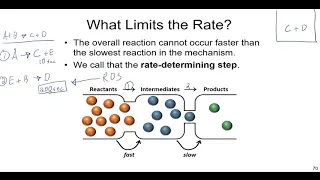
reaction mechanisms let's keep in mind several rules okay so the first rule is that the sum of the elementary steps gives the overall reaction okay so the second rule is that the slowest step in the mechanism constitutes the rate determining step okay but note however that not all reaction mechanisms have a known slowest step or rate determining step okay so Later on we'll see how we could deal with those types of cases and third the overall rate law must be consistent with the observed rate law okay so of course the proposed mechanism that we have
has to be consistent with our empirical data okay so we just have to make sure that it's consistent with the observed rate law okay so before we proceed with anything we have to make sure that we understand important things about elementary steps okay an elementary Reaction recall occurs directly as a collision between reacting species okay so this means that the orders of each reactant in the rate law is actually equivalent to the stoch metric coefficient okay so it's only in the case in which we have singl step reactions can we immediately correlate the stoch metric
coefficients as the corresponding orders for each reactant okay so we could rationalize this by thinking of the elementary reaction as a Collision right so for example we have a plus b yelding c right so this corresponds to a collision between reactants A and B to form product C okay so we know that the rate then is going to be proportional to the concentration of a okay so the greater the concentration of a the greater the chance for an effective collision between A and B okay so the same thing goes for concentration B okay so the
greater the concentration of B there's a Greater chance for an effective collision between A and B okay so putting these two things together the rate is proportional to the concentration of a times the concentration of B so instead of a reacting with another species B say that it reacts with itself okay so it's colliding with itself okay so in this case our reaction is 2 a yielding C so that means the rate of the reaction is going to be proportional to a twice okay So in other words the rate is going to be proportional to
a s okay so that's why we could write the rate law for this element step as K * a 2 the order of the reaction with respect to reactant a is equivalent to the stoom metric coefficient okay so again equating the stoom metric coefficient to the order of the reaction only applies for elementary reaction because we know that the elementary reaction corresponds to a direct Collision or transition state Between the reactants in the elementary reaction Okay so if we're now dealing with multi-step reactions okay for example if we have a net reaction of a plus
b yelding c and we know that in involves two steps okay so we can say that the first step involves a plus a yielding D and the Second Step involves D plus b yielding C to give us a net reaction of a plus b yielding C the overall rate of the reaction will be dependent on the rates of the elementary Steps okay so for so the rate for the first step here is given by K1 time the concentration of a s and the rate of the second step is given by K2 * the concentration of
D * the concentration of B all right so there's two possible cases that can happen Okay so one is that the first step is the rate determining step so meaning that it's the slowest step in these two Elementary steps okay so that means that the overall rate of the reaction is just Going to be dependent on the rate of this slow step here so the best analogy for using the rate determining step as our overall rate of reaction is given by this hourglass with multiple necks okay so the slow step is the one that has
the thinnest sort of neck over here whereas the fast step has the widest neck okay so we can see here that the flow of our sand through our hourglass is going to be dependent only on the slow step okay so the slow step is kind of like our Bottleneck okay so it overall determines the rate of the entire process okay so we could say here that if Step One is the rate determining step the rate of the reaction is just K1 * a ra to 2 all right so the second case is when things get
a little bit more complicated so case two is when a step other than the first step is the rate determining step okay so this means that the second step over here is the slow step and the first step over here is the fast step okay so Using our hourglass analogy okay so that means that the bottleneck is our slow step over here the overall rate of the reaction is now just going to be dependent on the rate of our second step over here okay so we could say that the rate of the reaction is equivalent
to the rate of the slow step okay so that is K2 * the concentration of D time the concentration of B right right but the complication with this however is that the rate of the slow step involves a Species that does not appear in our net reaction okay so this involves the concentration of an intermediate which is very hard to measure okay so it's very hard to determine the concentration of this intermediate so ideally rate lods should just be in terms of concentration of reactants so there are two methods in order to express the concentration
of an intermediate in terms of reactants and the first of these methods is the So-called pre-equilibrium method okay so this assumes that the fast step already achieves equilibrium okay so in this particular case that means our first step which is our fast step already achieves equilibrium okay so that means the reverse process occurs at a significant rate already Okay so so as we discussed earlier we know that if a reaction has already achieved equilibrium this means that the rate of the forward reaction is equal to the Rate of the backward reaction okay so the rate
of the forward reaction is expressed as K1 time a s and the rate of the backward reaction is given as the rate constant for the backward reaction K1 times the concentration of d right so we could actually solve for the concentration of D then okay so the concentration of D is just K1 * a^ 2 over K -1 and we could now input this expression for D in terms of the concentration of a in our rate Expression okay so we know that the rate of the entire reaction is equal to K2 * the concentration of
D * the concentration of B so just inputting this expression over here we can now have our rate law as follows okay so simplifying this expression we could write down the rate as the overall rate constant times the concentration of a stimes the concentration of B all right so K can be expanded into the individual rate constant components okay so K is Equal to K2 time K1 over K1 okay so another important thing to note about equilibrium by the way now that we're in this topic is that we could arrange this expression in the following
way so the concentration of D over the concentration of a s is equal to the rate constant of the forward over the rate constant of the backward reaction okay so note that this ratio over here this is pretty much just equal to the equilibrium constant expression Okay so our equilibrium constant we could also think of it as a ratio of the rate constants of the forward and the reverse reactions okay so the alternative method for expressing the concentration of intermediate in terms of reactant is the steady state approximation okay so the steady state approximation assumes
that a steady state is achieved for the intermediates okay so this means that the concentration of intermediate remains Constant because as soon as it's being produced in the reaction it's immediately being consumed so that means that the rate of appearance of the intermediate minus the rate of disappearance is just equal to zero okay so the study state approximation is actually more applicable in use compared to the pre-equilibrium method because the steady state approximation can also be used for cases in which we don't know what the rate determining step is okay So for our particular example
let's try to apply the steady state approximation okay so the intermediate in this case is d right so that means we can express the change in concentration of D with time okay so we know this to be equal to zero okay so let's look for the rate of appearance okay so let's look for reactions in which D appears so that is the forward reaction of our first reaction over here so that is k1 * a^ 2 okay so it doesn't really appear in any Other reaction okay so we need to subtract the rate of disappearance
okay so it's being consumed in the reverse of the first reaction so that is K -1 * the concentration of D and it's also being consumed in the second reaction over here okay so that is K2 * the concentration of D * the concentration of B okay so we could solve for an expression for D then okay so rearranging this expression we have K1 * the concentration of a^ 2 is equal to K -1 D plus K2 concentration of D * the concentration of B all right so solving for D this gives us K1 *
the concentration of a s over K -1 + K2 B all right so here we have our expression for the concentration of D okay so we know that the rate of the reaction is given as the concentration of D times the concentration of B times the rate constant of the second reaction okay so inputting our expression for the Concentration of D over here we now have our rate of reaction expressed as K2 * K1 * the concentration of a^ 2 over K -1 + K2 * btimes the concentration of B okay so it looks really
complicated right now right but from what we know about our reactions over here we know that this is the fast step right and this is the slow step so this tells us something about the magnitudes of our rate constants okay so in the denominator over here we Have a term of K2 * B and we also have K1 okay but since we know that the first step is the fast step okay so this tells us that K1 this is much much greater than K2 all right so this means that the denominator over here this can
simplify out with some approximation okay so the the value of the denominator is mostly dominated by this value over here K1 K2 * the concentration of B this can be considered to be negligible okay so that Means the rate of our reaction can be simplified as K2 * K1 * the concentration of a s * the concentration of B over K -1 okay so actually this equation over here this is equivalent to the expression that we got when youing the pre-equilibrium method okay but the steady state approximation is probably more useful since it's more applicable
to other cases okay so there are some cases where we don't know which step is the rate determining step okay so the Steady state approximation does not make any assumptions about which step is the fastest step okay so note that we only made that assumption in the final analysis over here okay but the pre-equilibrium method needs to have an assumption of which is the rate determining step but in this particular case over here we just assume that the concentration of intermediate is at a steady state okay so later on we'll see how we could use
a steady state Approximation to analyze more complex reactions okay but before we proceed to our special mechanisms however let's just get a little bit of practice with the steady state approximation okay so we're given this mechanism over here and we're tasked to determine the rate law okay so over here we're given that the rate determining step is this second reaction over here okay so we could base the rate of the reaction on this rate determining step okay but before Anything let's try to get the net reaction so we know that we're so we know what
we're dealing with okay so we can see here that a bunch of things can cancel out upon adding all our elementary steps okay so this cancels out this cancels out this cancels out this cancels out out so we're left with hypochlorite reacting with iodine to form hypo iodide plus chloride okay so these are our reactants okay so hopefully we'll just see these species In our rate law okay so we could express the rate of our reaction as the rate of step two which is equal to K2 * the concentration of iodide time the concentration of
hypochloric acid okay so hypochloric acid this is an intermediate okay so we could use the steady state approximation solve for the concentration of hypochloric acid in terms of our other species okay so using the steady state approximation we know that the concentration of this Intermediate is constant with time okay so that means the rate of appear rate of its appearance minus the rate of its disappearance is equal to zero okay so let's look for cases in which it appears okay so it appears in the first reaction the forward reaction here okay so we have K1
* hypochlorite okay so note that water here acts as a solvent so its concentration is very very large so we no longer include it in the rate Expressions over here okay so let's Check out other places so this is the only place where it appears okay so it's being consumed in the reverse of the first reaction so that is negative K1 time the concentration of HCL time the concentration of hydroxide and it's also being consumed in the Second Step okay so this is minus K2 * the concentration of IOD iodide times the concentration of HCL
okay so solving for H this will be K1 * the concentration of Hypochlorite divided by K1 time the concentration of hydroxide plus K2 time the concentration of iodide all right so inputting this expression into our expression for rate okay so rate this is equal to to K2 * the concentration of iodide time K1 * the concentration of hypochlorite over K1 * the concentration of hydroxide plus K2 * the concentration of iodide all right so you can make an Approximation on the value of this denominator over here so since the first reaction is a fast reaction
this implies that K1 this is much much greater than K2 okay so that means that this term over here that contains K1 dominates the denominator expression okay so we could say that this expression over here K2 * the concentration of iodide becomes negligible or zero okay so we could Approximate our rate expression as K1 * k 2 to times the concentration of iodide times the concentration of hypochloride over K1 * the concentration of hydroxide okay so actually this becomes our rate law over here okay so note that the concentration of hydroxide which doesn't seem to
appear in our net reaction doesn't cancel out in our rate law okay so we Could see that the rate of the reaction shows the dependence on the concentration of hydroxide all right since hydroxide appears in our rate law we can see that the rate of the reaction is highly dependent on ph conditions okay so this is a special case in which the rate law includes other species besides the reactants okay so just be aware that this type of rate law is possible okay okay so now let's try to look at different types of reactions in
Which we don't make an assumption about which step in the mechanism is the rate determining step okay so the first of our special mechanisms is the UN molecular reaction or the one reactant type of reaction okay so the question is what type of collisions can we have when we just have one reactant involved and how can we describe this reaction with Elementary reactions okay and recall again that we dealt with this type of reaction with our integrated rate Expressions and we considered cases in which it might be first order or second order okay so let's
look at conditions in which this type of reaction might change in reaction order depending on the conditions okay so the mechanism for unimolecular reactions was proposed by lindaman and it involves several steps okay so the first step is the activation step in which two reactants a collide with one another and the Collision results in a transfer of kinetic energy From one reactant to the other okay okay so in effect one reactant a star becomes more energetic than the other one so it becomes activated and it's quite energetic so that it could easily form the transition
state okay on the other hand we also have the deactivation step which is just the reverse of the activation step okay so it's also possible that other non-activated reactants will collide with a star leading to the transfer of its kinetic Energy and making it less energetic okay but if a star doesn't get deactivated on the other hand the next step is the breakdown of a star to form products okay so when we add all these reactions together we just get a yielding products okay so note that we don't really have an established rate determining step
in this mechanism but we can derive a general expression for the rate of the reaction using the definition of reaction rate as well as The steady state approximation okay so we know that the rate of the reaction can be expressed as the rate of appearance of product and that is based on the last step over here okay so our reaction rate is just going to be equal to K2 * the concentration of a star okay a star however this is intermediate but we can express its concentration in terms of a with use of the steady
state approximation all right okay so let's write down the change in Concentration of a star with respect to time okay so that is equal to zero so let's write down the rate of its appearance okay so it appears in the first reaction the forward reaction okay so we have K1 * the concentration of a s okay and it gets consumed in the the next two reaction so we have minus K1 * a star * a minus K2 times the concentration of a star right okay so if we solve for a star now okay so a
star this is going to be equal to K1 * the Concentration of a sar over K1 times the concentration of a plus K2 all right okay so if we input this expression now in our expression for rate we now have rate of the reaction is equal to K2 * K1 * the concentration of a^ 2 over K -1 time the concentration of a plus K2 all right so actually we have this really complicated looking rate law okay but this rate law can simplify Based on the different conditions of our system okay so let's check out
what happens when for example we have a high concentration of a all right okay so we'll we'll mainly be looking at how we could simplify the denominator over here okay so if we have a high concentration of a this means that k ne1 a is expected to be much greater than K2 all right so the implications of this statement over here is that the rate of deactivation at high concentrations of a is faster than Product formation over here okay so this makes sense intuitively because if we have a high concentration of a it's more likely
that an energetic reactant a is going to be colliding with a lot of other reactants right okay so it's expected that the rate of deactivation is going to be higher okay so once we have the statement over here we could simplify our denominator okay so that means our denominator which is K -1 a + K2 this simplifies to just K -1 a all Right okay so we could input this into our expression okay so our rate can be approximated as K2 K1 times the concentration of a^ 2 over K -1 * the concentration of a
so this simp simplifies to okay so we have rate is equal to K1 K2 over K1 times the concentration of a all right so if we have high concentration of a this means that our the order of our reaction appears to be first order okay so in effect it looks like the rate Determining step is this step over here okay so the reaction is overall dependent on the decomposition of our activated species to form our products okay so we can also do a similar analysis at low concentrations of a right okay so again we'll be
looking at the effect of the concentration of a on the denominator over here okay so if you have very low concentrations of a okay so this could mean that K1 times the concentration of a is going to be much Less than K2 okay all right so making a similar analysis the implications of this is that the rate of the activation is actually pretty slow okay so at low concentrations of a as soon as we form an activated complex it's not likely for it to start colliding with any other reactant because again we have a very
low concentration of a anyway okay so again there's going to be fewer possible collisions for deactivation okay so overall it's likely that as soon As we form an activated species it could easily break down to form products okay okay so ultimately we could simplify our denominator over here so since K1 a is much much less than K2 okay so that means our denominator expression over here this simplifies to just K2 okay so our rate can just be written as K2 * K1 * the concentration of a^2 over K2 so this further simplifies to rate is
equal to K1 * the concentration of a s all right okay so this over here this is Actually equivalent to the rate of the first step right okay so this tells us that at low concentrations of a okay so the rate determining step is the activation step all right okay so in our particular analysis of our unimolecular reaction we made no initial assumption as to which step is the rate determining step but after deriving this General expression over here for the rate law using our steady state approximation okay so we were able to Get an
expression and even analyze what the order of our reaction will be based on different conditions okay so the next special mechanism that we'll be analyzing is radical chain mechanism okay so you're probably familiar with radical chain mechanisms from your study in organic chemistry and you know that these types of reactions are very very fast reactions because they involve radical species which are highly reactive species okay so the example of A radical chain mechanism that we'll be discussing is the thermal decomposition of acet alide okay so this is described by the rice herzfeld mechanism okay so
the net reaction is as follows okay so acetal deide is going to decompose to methane and carbon monoxide okay so as with all other radical chain mechanisms the mechanism starts with an initiation step okay so this is the splitting of a species into two radical species okay and then after initiation we have our Propagation step okay so an example of a propagation step might be the reaction of a radical species with our reactant to form a another radical species plus one of our desired products and another possible propagation step is the reaction of the formed
radical from the previous step to form another product and also reform another radical here okay so this these two steps are our propagation steps and we could also have a termination step in which two radical Species react together to form a byproduct okay so all of these reactions occur very very quickly because all of them involve radical species okay so it's not very practical to say that any of these steps is a rate determining step okay so I'll be using again our strategy of getting a general expression for the rate of our reaction based on
the rate of appearance of one of our products okay so in this case let's use the rate of formation of methane okay so We can see here that methane is being formed in our second step over here okay so we could say that the rate of our reaction is going going to be dependent is going to be equivalent to the rate of formation of our methane which is described by the second step over here okay but of course when we express the rate of our second reaction over here we include a an intermediate species which
we especially know to be very fleeting in existence okay so we need to express This radical species in terms of other species okay so we'll be using the steady state approximation again okay so let's write down the steady state approximation for our methyl radical okay so that is okay so its change in concentration is going to be equal to zero okay so let's check out places where it appears okay so it appears in the first step so we have K1 times the concentration of acetal dhide okay so it also appears in the Third step okay
so we have plus K3 times the acetal dhide radical right and then it gets consumed in the second and the fourth steps okay so we have minus K2 times the concentration of methyl radical times the concentration of sahide minus the second the fourth step over here so that is K4 times the concentration of methyl radical squared all right okay so note however that our Expression for the steady state approximation for our methyl radical also contains the expression for our other intermediate the acetal dhide radical so it's also necessary to write out an expression for the
rate of change of concentration for the acetal deide radical okay so this is an intermediate so its concentration change is just going to be equal to zero okay so let's check out places in which our acetal deide radical appears okay so it Actually just appears in the second and the third reactions okay so it appears in the second reaction so we could write this as K2 times the concentration of methyl radical times the concentration of acet alahh and it gets consumed in the third step okay so we have Min - K3 * the acetal theide
radical okay so overall we have two equations then so let's call this equation one let's call this equation Two okay so a nice method then that we could use to combine these equation is just to add them together okay so we can note here that we have several terms that are similar and if we add these two equations together we could actually see that they're going to cancel out okay so we have this negative K2 term over here and we have this positive K2 term over here and and we have a positive K3 term negative
K3 term so if we add these two equations together note that they are Both equal to zero so we have Z is equal to okay so this cancels out this cancels out okay so we end up having K1 times the concentration of acetal deide minus K4 * the methyl radical concentration okay so using this equation now we could solve for the concentration of our methyl radical okay so that is going to be equal to K1 * the concentration of acet alahh over K4 all right okay so so's just move on to the first slide for
more space here Okay so again we expressed our methyl radical as equal to the square root of K1 over K4 times the concentration of acet alahh raised to2 okay so if we input this expression in the expression for our rate okay so our reaction rate this is going to be equal to K2 time the square root of K1 over K4 times the concentration of acet alide raised to 12 times the concentration of EET alide okay so this simplifies out to rate is equal to K2 * theare < TK of K1 over K4 * the concentration
of acetal dhide raised to three Hales all right so this is the overall rate law for our thermal decomposition of acet alide okay so note that we have an overall fractional order okay so this is an example of a mechanism that might lead to this fractional order okay all right so overall this will be the scope of our discussion okay so we Just discussed different special mechanisms and how we could derive an expression for the rate law okay so again we did a more General approach for determining the rate laws for these special mechanisms okay
so we didn't really assume any step to be the rate determining step initially but we generally just got an expression for the rate of the reaction based on our definitions for rate okay which in this case is the rate of appearance of Product okay and then we use the steady state approximation to derive expressions for the concentration of intermediates in terms of reactants okay so overall I'd also like to take this time to just thank you guys for tuning into our Channel okay so actually this will be the last video in our introduction to physical
chemistry lecture series okay so in the future we might have additional videos for more advanced topics okay so this video will Serve as the last video for our basic introduction to physical chemistry all right thanks again