Today we're going to talk about how to reverse hair loss. And I'm also going to get into the number one best meal if you want to grow your hair. The most common cause of hair loss is androgenic.
And I'm going to explain what that is, but that involves a pattern baldness where if it's a man, they're going to actually lose their hair on the top right here. In a female, it's more thinning hair through here. How could someone possibly grow hair on their chin but then lose the hair up here?
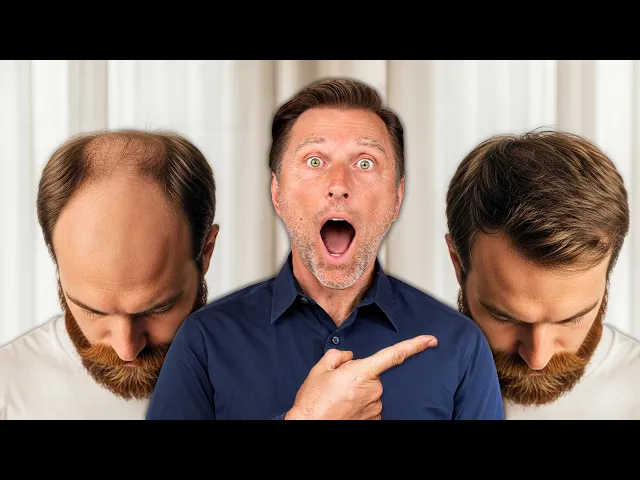
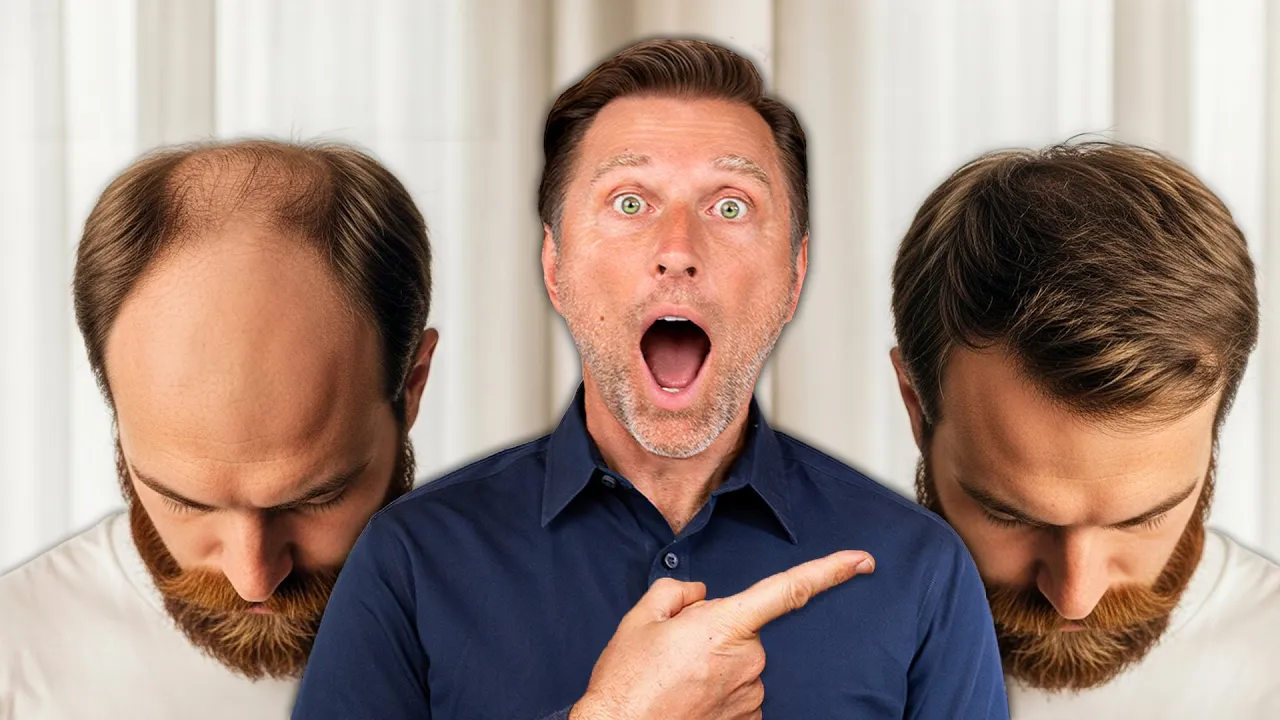
In fact, I have a perfect example of this right here. If I take this gentleman right here, you can see Oh, let's just take this off right here. He has all this hair right through here and right there, but nothing right here.
Today, we're going to answer why that is. So, let's just build a little foundation. This is one of your hairs right through here.
We have the scalp right here. And around the hair, there's something called a follicle. What is a follicle?
Follicle is not the hair. It's a little environment around the hair that has a tiny factory that helps the hair grow. And what's very unique about this follicle is it requires a tremendous amount of oxygen and also the energy factories that come along with it, which is mitochondria.
As we age, hormones do decrease. One hormone that decreases is testosterone, both in men and women. But there's another hormone, a more powerful version of testosterone that tends to go up as we age, and that's called DHT.
And quite a few different medications that help you grow your hair work by inhibiting or decreasing this type of testosterone called DHT. So they're DHT inhibitors. In your body, testosterone is converted into DHT.
So in this situation, as we get older, we end up with lower testosterone and a bit higher DHT. We need it. It actually affects our libido, but we don't need excessive amounts of it.
And if we get too much DHT, then the hairs stop growing. We get a lack of oxygen. We get more inflammation in our scalp.
We get more scar tissue because of that lack of oxygen and because of the inflammation. And once the scar tissue develops around this follicle, then the hairs stop growing and even the skin on the scalp becomes very shiny because of all the scar tissue. And so that's the basic mechanism behind this andogenic pattern baldness.
But it doesn't really tell us why this DHT is going so high. Is it just age? No.
I'm 6 years old. I have no hair loss. The gentleman you just saw is maybe a little bit older and he lost his hair years ago.
So, is this all genetics? And if we talk about the genetic piece of this puzzle, we're talking about more of this enzyme being activated. And we're also talking about just the receptor for this hormone is just more sensitive.
And this is why it's so important to understand the mechanism of all the things that can increase this DHT because even if you have a genetic problem, there's still things you can do to keep this down as low as possible. Now, the problem with using a drug to lower that is, yes, it can actually help you get your hair back, but there's some slight minor complications as far as side effects go. You start losing your libido.
You get erectile dysfunction because they're creating a major shutdown of this hormone through the entire body. What is the primary driver of DHT? Beyond getting older, beyond just having genetics that make this hormone more sensitive, what is it?
Well, the strongest driver is insulin resistance, which is not surprising because insulin resistance is a root cause to so many different health issues. If you have insulin resistance, you're going to express more of this enzyme and convert more testosterone to DHT. And on top of that, insulin resistance really affects the liver to the point where you're not able to buffer or control this testosterone like you should.
And that increases more free testosterone that then makes more DHT. And all that comes from insulin resistance. But now let's get into probably one of the most overlooked therapies for hair loss.
question is, can we just lower insulin resistance or can we just give you a natural enzyme inhibitor and mimic the effects of drugs but without the side effect? And the answer is probably not. There's something way more important and it has to do with that follicle I talked about.
What you need to fix is the follicle environment, the entire environment. Because what they can do now is they can transplant hair on the back of your head to the top or from other places in your body on the top of your head. But they only can do it if they transplant the follicle, not the hair itself, but the actual thing that the hair comes in.
It's kind of like the soil that allows the root to grow. It's an entire ecosystem. It's an environment that you have to look at.
And excessive DHT does start this cascade going. But then what happens is a whole bunch of things. You have decreased oxygen and then we have this condition without oxygen.
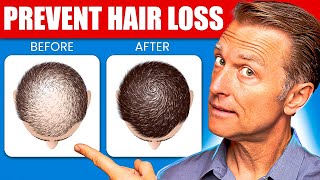
It's called hypoxia. And that can actually create inflammation. So now we have this entire ecosystem that's inflamed that then develops a repairerative process in scar tissue and then it becomes very shiny and you're bald.
One of the most overlooked therapies that is very effective is number four, mechanical stimulation of your scalp. Because what you have to do is you have to wake up these stem cells. You have to break down the scar tissue.
And there's many different methods of doing this. A lot of people do like invasive massage on their scalp. Uh but the one that really is the most effective is micro needling.
Micro needling is very similar to what I did in one of my pastures in part of my farm. I had to kind of break up the soil so then water can get in there, oxygen can get in there, the seed can go in there. Micro needling allows you to open up the scalp so it gets oxygen so it can start to repair.
So we stimulate the repair process so we can reactivate the stem cells into the tissues at the cellular level. Okay, deep in the follicle you have mitochondria. But the problem is those mitochondria are kind of broken down and are not working anymore.
So we have to stimulate the mitochondria. Partly it's going to be the micro needling, but partly it's going to be another therapy and that's called red or near infrared light therapy. This is some really cool stuff that has some massive research behind it because when you throw a light with this spectrum between 630 and 850 uh NMS, which is a wavelength into your scalp, you're basically going to help restore the mitochondria.
And they're also doing therapies right now with red light therapy for your eyes to improve eyesight because it stimulates more mitochondria. And what we're trying to do from this mitochondria is get more energy out of the mitochondria. So now we have the energy to grow hair.
A lot of the medications for hair loss inhibit that enzyme I talked about to decrease DHT except for ro gain which is a very common medication. Roane does not work by blocking DHT. Roane works by creating a vasoddilation or more circulation because in order to grow that hair, you need oxygen in your scalp.
Out of all the things that can mimic roane or at least get somewhat close to it, rosemary oil is at the top of the list. The phytonutrients in rosemary oil greatly improve circulation. They also decrease that DHT.
They reduce inflammation and they help protect the mitochondria. So, we're adding layers to this problem and we're compounding the effectiveness so we can really get your hair back. Now, if you just did number four, five, and six, I still think it wouldn't work unless you also fix the original reason why the hair uh fell out in the first place, which involves one, two, three.
So, we cannot forget to also correct insulin resistance. We must correct this. There's some really key nutrients that can help speed up the the growth of the hair.
That's zinc and vitamin D. These two nutrients, hands down, are the two most important things to stimulate the stem cells or stimulate the growth factors of that hair. And I would recommend taking no less than 10,000.
I use vitamin D3 every day. As far as zinc, I would recommend something like 30 or 40 uh milligrams. And then number three are additional u inhibitors of that enzyme.
If you wanted to add some more things, I'm not suggesting you do that, but I'm just going to tell you all the things that act as the natural five alpha reductase inhibitors. So you maybe you've heard of salt palmetto, that's a common one. pumpkin seed oil, the phytonutrient and green tea, EGCG, peppermint oil is a powerful one, and I've already mentioned zinc.
So, I'll put some links down below, but I also wanted to give you uh an idea of probably one of the best meals that you could consume to support your hair from a nutrient standpoint. And that would be liver, number one. Okay?
Of course, onions number two, because you really don't want to eat liver without onions. They kind of come together. But what's in liver that supports your hair is a very bioavailable iron called heem iron, which the hair needs.
Liver also has zinc and copper and other trace minerals like selenium. And then of course, onions. Onions are super high in corsetin, which is a very powerful anti-inflammatory.
And then we have sauerkraut. Why sauerkraut? Sauerkraut not only helps fortify the gut, but sauerkraut has like literally the most vitamin C out of anything.
It's like 700 milligrams per half of a cup. Sauerkraut has over 600 different phytonutrients, which help the hair in many different ways, including decreasing the DHT. And lastly, we can't forget pumpkin seeds because not only can pumpkin seed give you enough magnesium and trace minerals, pumpkin seeds and pumpkin seed oil also act as a pretty powerful five alpha reductase inhibitor to help lower uh that DHT.
However, at the foundation of this problem, we still have insulin resistance. This is probably what started the whole problem in the first place. And because of that, the absolute most important video for you to watch right now is how to reverse insulin resistance.
And I put this video up right here. Check it out, watch it, and apply this information.