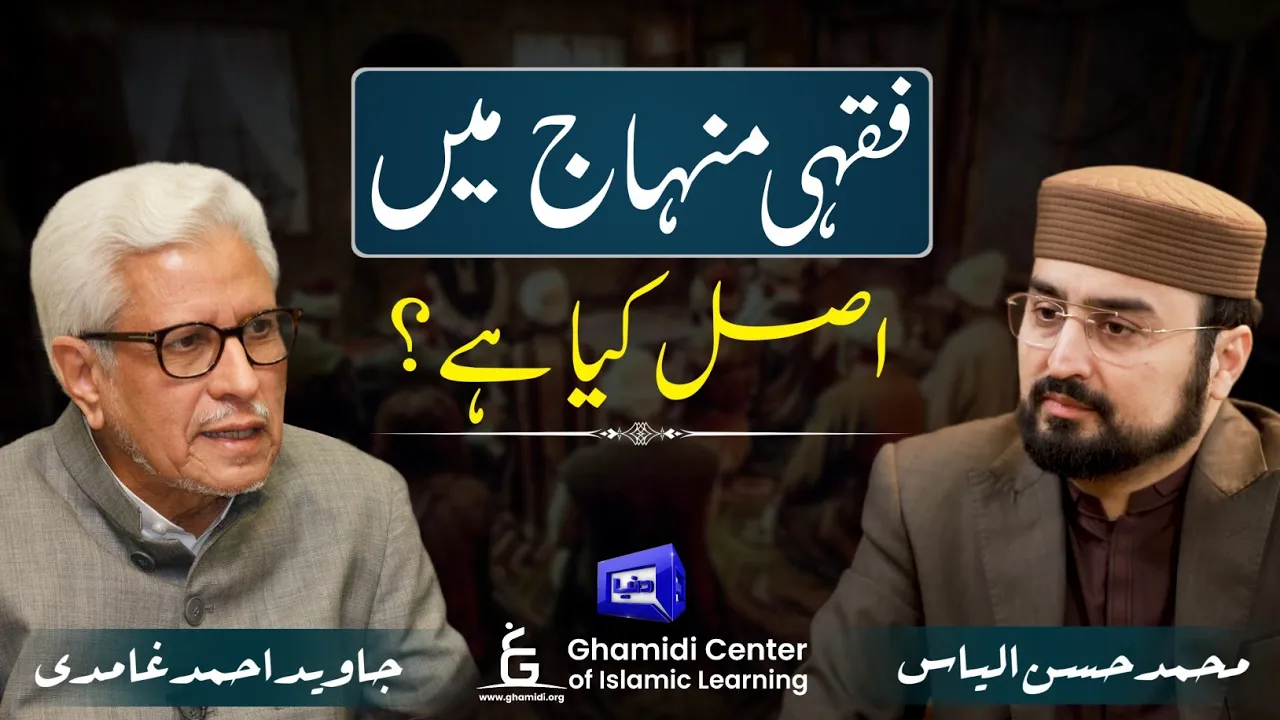
'Fiqhi Minhaaj' (The Islamic Legal Tradition). Bismillahir Rahmanir Rahim. As Salam Alaikum Welcome to the Program 'Knowledge and Wisdom'. I am Muhammad Hassan Ilyas. Dear viewers, The different Schools of Thought among us, the various interpretations to understand the religion and their methodologies, we had started to think and reflect upon them, and we had learned that the central thought in the Mystical tradition, the actual base and the foundation around which the entire interpretation gets evolved, following which we had also learned that what in Salafi tradition was considered primary? What is it that has been kept in view
in bringing into existence the entire interpretation. We will continue with that same chain of discussion, and as usual, we have with us Janab Javed Ahmed Ghamidi Sahab, Salam Alaikum Ghamidi Sahab. [Javed Ahmed Ghamidi] Wa Alaikum As Salam. [Hassan] Thank you very much Ghamidi Sahab for your time, we had discussions with you on two traditions, with reference to the second interpretation, I would ask a secondary question and would wish to take the discussion further ahead. Please tell us, you analyzed the Salafi methodology, and explained that the central status is given to Narrations, and while discussing the
Mystical tradition you said that the extraordinary urge that the elite have in them for stepping ahead to discover the reality, and to experience, we find it being displayed here, hence, if we see, the intellectuals that are there, the elite, they are quite few in the society, so, will it be okay if we say that the Salafi tradition is quite popular due to its appeal among the masses? As a common person says that he can neither think nor contemplate, it is good that someone else done this work for me, and the person whom you are naming
are the Prophet (pbuh) or the Companions, hence their understanding suffices for me, why should I get into this serious business, of contemplation or the debates among the scholars, so, if you just get hold of that rope for me, I would be through, so, the question that is presented to you is whether the Salafi tradition according to you, presents the appeal among the commons, or should it become more popular among the masses? [Javed Ahmed Ghamidi] There is no doubt that both the traditions develop a connection with the masses. The Mystical tradition, in essence, is the tradition
of the elite. i.e., the people who are not ready to be content with the point that they heard the words of a Prophet, and the knowledge he has provided to us we formed a picture of reality through it. We could understand that there is a Creator of this universe, who possess such attributes, and who has such habits, and He has expected these things from us, and these are His requisites. They say that they are not ready to be content with just this, and going much further, we should search for the real truth ourselves. Consequently, the
'Mushahida' (Observation) assumes central status for them. However, 'Mushahida' as you have rightly said, is achieved by only a few people. What is that reality, and actually what 'Mushahida' constitutes of, are they actually able to form a line of communication with the Divine Entity or the Abode of Angels or with Angels themselves, I have not made any comment about it, what I am saying is that they say so. When they say that, as a result of it, the people become satisfied with them, like Imam Ghazali had stated it, which I gave reference of, i.e., 'When this
reality opened upon me, I was satisfied with the way with which we can find the methodology to achieve absolute certainty for us'. i.e., we achieve the real faith, the level of faith which develops after having seen something from one's own eyes. How does that relate to the masses? That develops out of the 'Karamaat' (marvels) of those elders. Obviously, when the intellectuals achieve those goals, that results in some exceptional abilities being developed by them, or some exceptional things are displayed by them. Those exceptional things are stated. Special tales come into existence as a result of them.
There are many people who bear witness to it. Various common people also experience those Signs. As a result of it, even the common people develop an acceptance for it. However, this acceptance of the common people is exactly like the people among us start supporting political leaders. i.e., since this has been kept within a human being, that he keeps on searching some exemplary thing for himself. This instinct in essence has been ingrained so that a human being starts to long for Jannah. That is the most exemplary world for him. The way his own abilities develop in
a human being that would be matching with the requisites of an exemplary world, however, a human being becomes satisfied with baser things, and this has been beautifully expressed by Iqbal, 'Their unenlightened minds could seize nought else but what their eyes could see', Since such elders are present, and they claim their experiences in the capacity of intellectuals too, and then based on those Observations, some wonders worked by thems are also stated, and according to some people those things occur in their experience as well, hence, the common man also gets attracted towards it, however, his attraction is
from this perspective. i.e., he feels that the realities that he had been told with respect to the Deen, from the Prophets from which those were told or the information that were provided to me about their Companions that is a part of history, however, this Observation becomes a testimony for me. Hence, the thing that a common person achieves there is that like the intellectuals he cannot claim to have a direct observation of the reality, and he does not achieve that as well. Even the intellectuals do not tell them that this would be available to you, however,
he actually observes people who experience Observation. [Hassan] A very beautiful point. [Ghamidi] So the observation of the people who undergo that experience also satisfies them a lot. Hence, if you see, this tradition also became quite popular among the common people. i.e., all around you would find people getting associated with it. They keep talking about it in their gatherings, the recount tales of it, rather, a time also been there when every person among Muslims seemed to have made a certain 'Murshid' or 'Peer' (Spiritual Guru) for himself. An organized practice or Spiritual institution of 'Peeri-Muridi' came into
existence. Every person cannot become a Peer, i.e., he can't get included among the intellectuals, or he can't become a part of that class of geniuses, and those realities cannot dawn upon every person. So, in a way, like we have an indirect connection with the Prophet, and the Prophet too isn't existing all the time, so, that experience they come across in their own times. So, when it becomes a 'Mushahida' (Observation) for them, so, they achieve that satisfaction which the elite get when they observe the abode of Angels, or the Absolute Reality or its entifications, or when
they experience that world. Hence, saying just this much is not enough. In this tradition too or in this thought too, which we have termed the Mystical Tradition, it has a huge potential for associating the masses with it. And this is the reason you find that it has achieved overwhelming popularity among the masses in our sub-Continent too. If you approach those people and ask them whether they too had any kind of 'Mushahada', or did they also could become the source of some karaamaat? Then they would reply to you that how can we reach to such a
level. [Hassan] This happens to Godly men. [Ghamidi] This is achieved by them, however, they may come across such people in their times. i.e., this in itself becomes a source of great attraction. [Hassan] A very important point. [Ghamidi] In this case, you would say that there is a Prophet, whom Allah (swt) has selected, and Miracles also take place through the Prophet, the entity of the Prophet sees those realities, and various realities are shown to him as well. The realities which they are communicating to the people. So, here you rely on the Prophet, and in this way,
you keep yourself associated with an ancient tradition. Whatever you receive is obviously that Deen, that Guidance, that Dawah and that Message and its philosophy, its wisdom, its Shari'ah which the Prophets come along with. And here an additional thing which a common person gets is the existence of such an entity in his own times. Therefore, many people put forth this argument and even some scholars are seen to argue that the thing which a common person requires, that association which he requires, the harmony which he requires with a spiritual teacher, and the attention he requires to attain
the level of excellence, where will he find that from? In the times of the Prophet, the Companions used to source it from the Prophet, so, this thing is sourced by them from such elders, and then they tell you that look this is the transformation I had as a result of it, and we have had such a 'Mushahida' (Observation), so, in this way, a replica of the times of Prophethood, which is generally understood to have been existent in those times, the possibility grows out of their experiencing of the same situation. Then they also settle for this
thing to be explained about the personalities of the recent past. Okay, if some outstanding personality is not found at all so, they associate themselves with some shrine. So, this association or this system of Peei-Muridi', an Institution comes into existence for this, and this too lays the foundations of becoming popular among the people. However, when you negate such things, i.e., obviously, many people criticize this, they say that it does not have any reality, it is a new world, and a separate System of Thought, like the way I also say that this is a parallel System of
Thought, a parallel Deen, and the real Deen whose foundations were laid by the Prophets, and which is God's religion, that is completely a different matter, so, when such criticism when done by me or someone else, Ibn-e- Taimiyyah had done, and very renowned Scholars had been doing, some scholars of our own times do it, when such criticisms take place, it creates a sentiment in humans to refer to the real Deen. Now in order to refer to the real Deen, if we tell them to read the Quran, and get yourself associated with the Quran, understand it and
draw guidance from the Quran, so, this might make him feel that Quran is an extraordinary Book, and it has a high stature and its teachings are of the highest level, so, it won't be a simple matter for him to have proper access to it, and after all he has to get its understanding through the Ulema, like in case any other literature or poetry, or any high quality philosophical work, so, this he finds a bit difficult and he thinks that how can he have an easy access to it? So, this tendency allows Narrations to gain greater
importance. So, the point is absolutely right that if a common person wishes to keep himself associated with the Deen, i.e., he won't be ready to accept the optimism about the Mystical tradition that it can be seen as closely connected to the Deen. Won't this happen? i.e., two points of views would develop. One, that he would accept it like innumerable people have accepted it, and they think that this is the way which provides satisfaction to the people, and gets opportunities for his own rectification too, and if he wishes to elevate himself a bit further so, a
way also opens for him. And then his worldly problems also get resolved with it, and the ups and downs and the issues that confront him in the world, he gets some support and a guidance for them as well, which has been stated in an occasion by Maulana Syed Sulaiman Nadwi while having conversation with our respected and renowned Ustaz Maulana Amin Ahsan Islahi Sahab, that when a person becomes old, he starts needing some support. So, this need for support is greatest for a common person. So, when he greatly needs this support, he feels that for him
too a path is available. So, this is present there too, however, if he comes to know that he is not going to adopt this path, or this path is basically wrong, or this is a parallel System of Thought where the Deen or its Dawah of the Deen would be harmed. Or the path shown by the Prophets is the one I would choose, if he reaches this conclusion and if he wishes to associate himself with the Deen, then it is completely right that the greatest attraction he would have for would be the Salafi tradition. [Hassan] Right.
[Ghamidi] Here, something is said in attribution to the Prophet (pbuh), and a common person feels himself being associated with the personality of the Prophet, and as I said that a common person essentially gets associated with personalities, hence, the personality of the Prophet in this case become axial and central for him. And the things that this was said by the Prophet, or this was stated by the Prophet or this was done or this thing emanated from the Prophet. The things which he gets in connection to it, that give part guidance to him. Here there isn't a
superior Word like the Quran or the entire Surah, or its complete organization or the glorious literature contained in it, there is a special way of addressing, and such and such are the ways to understand it, those things are not required in that way. So, he thinks that like he has been given a prescription after having arranged in a definite order, therefore, he receives it, i.e., the point has been explained, and I have to simply follow it. And the things said are with reference to the Prophet of God, or stated in reference to the Companions, and
for this, the phrase Salafi Tradition or Salafi methodology is obviously spoken from this angle, i.e., we have had our beginning from there. They are our Salaf (Predecessors), and their words are of real importance. And I had said that this argument is also given and apparently is quite impressing, i.e., whatever would be the Book of Allah and whatever be the Deen of Allah, however, if we come to know that this is the explanation which the Prophet has given, or he has expounded it, so, what is it which can be greater than this. And the Companions, who
had initially been related to the Prophet, the Prophet has trained them directly. In this situation, there generates a tremendous interest in it for the common people, it is a fact that there are difficulties with keeping the intellectuals associated with this point of view. As the human mind, especially the exceptionally intelligent minds, they are not satisfied till the time a complete System of Thought does not evolve. [Hassan] A coherent structure must be made. [Ghamidi] Here it is not possible to formulate a System of Thought. [Hassan] As everything is different. [Ghamidi] As everything is discrete. and as
that is stated in attribution to the Prophet or in attribution to the Companions, and is stated the form of their sayings, and the people who narrate, whatever they had thought right have expressed them sometimes in a single or sometimes in a couple of sentences. As a consequence, to form a System of Thought is not possible at all. So, for the common man, there isn't a better way than this, he is used to looking in parts. i.e., if you tell him that if you are following the Homeopathic treatment, then such and such are its principles. And
these principles are completely conflicting to Allopathy, therefore, you will have to choose either of the two to go through the treatment. So, he would reply that what he is concerned about is his treatment and his ailment. As this thing has come into my experience, I follow this treatment. He is not ready to accept this kind of principled discussion. i.e., when the common man rectifies himself, by rectification I mean that when he frees himself from polytheism, or from 'Bidat' (Religious innovations), or when he decides that the Sufi (Mystical) tradition is something alien to the essence of
the Deen, it lies external or parallel to it, and it cannot be accepted, and it does not have the stamp of approval of the Deen, and there aren't any traces of it found in the times of the Prophets or the Companions, so, how can I cloak the Deen with this garment? When he accepts this point then the refuge which he finds in reality is the Salafi tradition itself. [Hassan] Ghamidi Sahab, this was an exceptional discussion, and with this the psychological requisites of human beings, it helps to understand them as well, i.e., what are the reasons
due to which a sentiment or a tendency grows among human beings. There is another secondary aspect which I request you to clarify, apparently, these two Schools are like two different highways, their essence, their objectives, mechanism and their methodology too are different. We also saw that somewhere there has been a blend of the two, for example, there were some family dynasties in the near past Ghaznavi and others too, and we find this situation in India that the Mystical as well as the Salafi tradition had been existing from there, so, some intellectuals have tried to create one
form by the fusion of both the shades, and created another collection of truths. Please tell me how is it practically possible when both are essentially different, how can there be a fusion between both of them? [Ghamidi] Human being does that. I told you that one type of mind is that unless he converts something into a School of thought, it has a beginning and an end, it follows some principles, just as a tree grows, i.e., it is a seed, there would be a seedling growing from it, it will have stems, and the fruits and leaves will
sprout from it, this is one method or a principle under which I will look at the entire issue. Those people who do not have this mentality, and a big number of people do not have this perspective, they blend together as well, it is simple for them. I had given its examples to you. i.e., a person who has a deeper understanding of the Deen, he loves the Deen and consider the Deen of Allah as his Deen, he thinks that he should stick on to the guidance of the Prophets, and I can give examples of various people
who in our own times, however, he also thinks along with it, and many people thought that the foundations which the Western thoughts have described (!), they thought that staying within the religion and continuing to love it, these can be blended together, i.e., they can be patched up to the Deen. You must have noted that many people criticize this, for example, they would say that Democracy is a complete system of thought, you cannot let in Democracy in the Deen, In our religion, we have the Caliphate System, and this too is a topic for discussion, i.e., when
we say this what does it imply, what is the thing which we can blend and what are the things we can't? What are its principles, and how do you see these things? Nevertheless, when human being blends such things like a big matter among us has took place when the Socialist Movement gained momentum and it was felt that there could be way out for the poorer section, and this authoritarianism and exploitation that exists, and the way wealth and capital plays around with people, and wealth is amassed in a few families, and when the evils of the
concentration of wealth were stated, and especially when it was told with reference to Karl Marx and this ideology that how he has analyzed and exposed the game which the Capitalist class plays. Therefore, this Socialist thought is the one way to benefit humanity. So, this became a very attractive idea. Innumerable people and people with great sincerity were influenced by this ideology, and they were religious people too, they would offer their prayers and fasts as well, some people among them were religious scholars too, and some among them were religious intellectuals and they had been working on theology,
so, you saw that they too had blended these two. In this way, both the things were joined. Therefore, the Islamic Socialism or similar such terms also came into existence. This wasn't created merely in politics, rather, it was created in knowledge as well, and based on it, the entire System of Thoughts were developed. If foe example the thought presented in name of as Nizam-e-Rabubiyat, if we study that then you will see that it wasn't anything other than having the label of Nizam-e-Rabubiyat. or religious terms were assigned to it, if you really study it, in essence, it
is an off shoot of Socialism. This is the situation which evolves with human beings, i.e., he is not very successful in keeping himself bound to his principles and methodologies. The people who are successful in it are really outstanding. Generally, a person tries to resolve a matter, i.e., the issue should be resolved. If my headache gets relief from Homeopathy so be it, and if the cure of my cancer or any other surgery related issue is better treated in Allopathy so be it. And if some prescription of a Hakim is helping me with something then too there
isn't any harm in it. So, it does a sort of concoction in such matters, this happens in the thought system too, and it happens in laws too, and exactly in the same way, it happens to the entire tradition too. [Hassan] Okay. [Ghamidi] So, you saw that it happened in all the three. i.e., there had been so many people whom we will study now, who were of the Islamic Jurisprudential or Legal tradition, however, they adopted the mystical School as well and they put the patch of both in Deen in similar fashion. They blended both with one
another. Exactly in the same way, in the Salafi School too many people took birth who didn't reject the idea to such an extent, i.e., this Mystical tradition is out and out a flawed thought, for example, what they did was the Mystical tradition has a special knowledge, a special philosophy, and it looks at this universe in a special way, they said, keep it separate, there are many things in it which is based on the study of human soul, and through it in a human soul we can develop that delicacy that love and affection which in itself
is necessary to spend life with the devotion and love for Allah (swt), so, they put a patch of the Salafi School on to it. Hence, a human being does all this, I had said this to you just now why would a person get attracted to the Salafi thought at all? i.e., leaving away the Mystic thought, firstly he would be convinced that this thought is not right, i.e., he would understand at the level of a common man that it is some alien thing. Suppose that he understands this point, however, he did not reject it fully, and
accepted it to some extent or sphere. If you talk to a common person, if he is educated enough, then he would tell you that look, we should extract good things from everywhere. "Al Hikmatu Zaalatun Momin" so, in the Mystic School among us our own rectification, our own training and to develop some love, affection and softness inside us a lot of means are available, hence the different thoughts and the different point of views, and the different Schools of thought, the patches are put of each in the Deen, and these things get blended too, and even better
examples of this are there, i.e., the people who originally belonged to the Islamic legal tradition, , though they didn't migrate to the Mystic tradition, they however put a patch between the legal and the Salafi tradition. [Hassan] Interesting, okay. [Ghamidi] In the contemporary times, many renowned scholars have taken birth, for example, if you look at the Arab world, Mufti Muhammad Abduh and likewise Rasheed Ridha is there, in our own sub-Continent Maulana Abul Kalam Azad is there, likewise Maulana Syed Abul Ala Sahib Maududi, it can be analyzed and elaborated that these renowned scholars have accepted a specific
relation between these two things. i.e., people who essentially belonged to the Islamic legal tradition, how they came near the Salafi tradition, and how they have related some of the things between the two schools of thoughts. So, this is done by humans, i.e., two thoughts are at times blended and this obviously requires great investigation so, in principle, what are the things which can be blended and which are the one which cannot be blended. What can be blended in their corollaries, can two things being so far apart be adopted without negating each other? These are the questions
which are there, hence there is no impossibility in it, that people do blend them too. [Hassan] You stated an important point that the process of blending also takes place and this happens among the entire Schools of thoughts as well, and a new situation develops too. Let us go ahead with the discussion, two traditions came under discussion the Mystical and the Salafi Schools of thoughts. Please tell us, you mentioned it just now too, and we often and on hear this, rather, the great personalities in the world of Islam, and due to whom the Muslims established their
identities, they are connected with this third tradition, the Fiqhi (Jurisprudential) tradition, what in it is viewed as central, what is the base and where does it sprout from? And what is the foundation of that thought? What the Fiqhi tradition is Ghamidi Sahab and what is central in this School of Thought? [Ghamidi] If you look at the Fiqhi (Islamic Legal) tradition, it has two periods. Its first period is when this tradition and this school was coming into existence. This tradition or this School of thought was imperative for us. You are aware that the Deen given to
us by Allah (swt) has two parts. One part of it is related to our Belief System, and under it comes morality. That which is the actual Deen, i.e., on which the complete foundations have been based in Deen, these are the two things, we accept some realities, and then in accordance to that we associate our moral senses to it. So, this brings Iman and Morality into existence. I have said this dozens of times that the Quran terms this with 'Al Hikmah', which constitutes a big part of the Deen, rather, this essentially is the Deen itself. Following
this, the Shari'ah is derived from it. i.e., the morality taught to us, or the morality which has been ingrained in traces inside us, and the Prophets expounds them further, based on that is a set of laws or Shari'ah. Those laws or Shari'ah concerns with our life. i.e., most importantly, we have adopted the beliefs, we accept Allah, we accept the Prophets of Allah, we have accepted the Angels of Allah, however, the next stage is where we have to practically do something, so, when we have to do something, the moral principles in it also take the form
of a set of laws or Shari'ah for us. Therefore, we know that the Shari'ah stated earlier to us in the Torah, that encompasses all aspects of life and places the Shari'ah as the primary position. And its repercussions were to the extent that the Deen, in essence, turned into a stranger for the people, and Allah (swt) had to elaborate it further in the Gospels through Syedna Isa A.S. So, this was present in the past too and is present among us too, obviously, Quran, the Book of Allah is there. The Shari'ah has also been stated in the
Quran as well, however, in essence, it is a Book for presenting the Dawah of Iman and morality. And it states its principles, its basics and its applications. The Shari'ah or the laws relates to ourselves, as we have to decide what is Halal (Permissible) and what is Haraam (Prohibited), what is Farz (Obligatory) and what is Wajib (necessary), which are the things to be adopted by us, and which things are to be discarded. So, this matter of rejection and adoption is related to our Aakhirah (Hereafter) too, and it has been given due importance in our Deen, it
is the directive of Allah and regard it we read in the Quran that "Mal Lam Yahkum Bima Anzalallahu Fa Ulaaika Humul Kaafirun" i.e., 'If Allah has passed some Judgement about something then it cannot be deviated in the least'. This will result in making one stand among the disbelievers. Since, such a big thing is stated about it, hence the importance the Shari'ah has among us. You are aware that this issue had been there, this was found in its full form among the Jews, and this had assumed the central status in them. The Christians rebelled on this
point itself. i.e., it is the very Shari'ah which they discarded and declared that the primary thing is the basic morality, and Syedna Isa A.S. has made us stand in such a position with regard to ethics that where we have become associated with a manifestation of God Himself. So, these things made them satisfied, and they phased out the Shari'ah for themselves, although Isa A.S. arose from among the Jews themselves. Isa A.S. was the follower of their Shari'ah, his entire life was spent in accordance with that Shari'ah. He would offer prayers according to it, he would observe
fasts according to it, and accordingly, would he perform all his activities, and all the Halal and Haram things were in them as well. And the same was present in his initial Companions too. However, post St. Paul, as per his own interpretation, the Christians were thought to be better off from it. And now after separating from the Shari'ah the Deen became acceptable. This was not possible among us, the Prophet had elaborated this, and made it clear from all aspects, and now there wasn't any more scope of another St. Paul doing that to our Shari'ah. Now this
became such a tradition that was under the glare of history, hence, this reality could not have been denied. Thus, when thinking and contemplation started in the Deen, this entire collection was made the topic. [Hassan] Right. [Ghamidi] Obviously, the people who went ahead in the capacity of the scholars of the Deen if they had interests in other subjects, for example, if a person was interested in classical rhetoric or his interest was in lexicography, or if someone was interested in syntax and grammar, and such aspects of language, that is a different matter, however, when a person was
associated with the Deen, and he became serious about understanding Deen as a System, i.e., what is it? What are its bases? What is the point at which I would refer to it? On what basis I would ascertain the worth of things in it? And then it is to be told that my actions, which are regulated by Shari'ah, how is it harmonizing with my beliefs? hence, you can call all these things as 'Tafaqqu Fid Deen', i.e., to ponder over the Deen. Hence the Legal tradition is not in the way I describe it, rather, it presents its
own interpretation of the entire Deen. And when it presents it for the entire Deen, obviously, the Quran also comes into its consideration. The Sunnah come into discussion too. Similarly, on many occasions one has to take care of Qiyas and Ijtihad too. So, these were the ways adopted in this methodology in the early stages. And you are aware of the fact that if we look at it as per its essence, then these ways should have been adopted. This is the way it should be, I am not detailing it right now, i.e., what are the things and
where were they placed, however, following that another period starts. [Hassan] Okay. [Ghamidi] And that second phase gradually turned into the real thought. In that tradition, if you ask or if you pick a book related to it where the principles have been stated, then they say that we would acquire the Deen from four points. The Quran, Sunnah, Ijma, and Qiyas. [Hassan] yes. [Ghamidi] i.e., these four things are mentioned. With regard to the Quran we know that it is the Book of Allah, and this is the status of the Quran, i.e., it should be the first to
be referred to. Exactly like this is Sunnah, the Prophet (pbuh) is God's Messenger, he is the lone source of the Deen. Whatever was done by him cannot be ignored. The same is the case of Qiyas and Ijtihad, the reason being that there are various matters about which the Deen is apparently silent, i.e., it seems that no guidance has been provided here. However, we have to nevertheless decide about the matter, and for that decision several things in the Deen itself become the indispensable requisite. i.e., the circumstances are changed, people have changed, the situation is different, something
new comes up, the need arose for an exception, or for some concession, so, for all such matters we determine what the Deen directs, so, we do it by the process of Ijtihad itself. Since, nothing directly has been said about it. Hence, the general methodology, if you look at the first phase, adopted was quite simple. i.e., referring to the Quran or the Sunnah, and 'Ijtihad' (Creative juridical reasoning). And the scheme and arrangement, the collation, what is preferred and what is not preferred, their discussions are present, however, they aren't in a form in which they can be
presented in an orderly thought process. Gradually, it adopts the form of a principle, and those principles you would get in the books of Hanafi School, or Shafa'ee School or in other Schools as well. Later on, in this modus operandi 'Ijma' gained the central status. [Hassan] Okay. [Ghamidi] i.e., if you look now in a schematic way, the way the central status in the Mystical tradition was achieved by 'Mushahada' (Observations), and in the Salafi tradition it was achieved by Hadees, do keep in mind that along with 'Mushahida', even in the Mystical tradition the entire Deen is considered
too. [Hassan] They accept the Quran and the Hadees as well. [Ghamidi] Obviously, the Quran is also referred to and the Sunnah is considered as well, likewise, Ijma (Consensus) and Qiyas too, and the people especially among the scholars who accept the Mystical tradition, and those who accepted it, like Imam Ghazali, like Shah Waliullah, obviously, they have to state the entire Deen too, and they state the Deen in the same way, and along with it they fulfill the requisites of this tradition too, however, as I said, what in it has the central status. That core status is
of the 'Mushahida' (Observation) of the Mystic. Likewise, the Quran also comes under discussion in the Salafi Tradition. The reasoning is derived from the Quran too. There are other things too which are considered. Ijma too is mentioned a lot. Ijma has a great status here too, Nevertheless, the central status is of Hadees itself. i.e., if Hadees (Narration) is existing, be it in attribution to the Prophet (pbuh) or it is attributed to the Companions, i.e., both the things play a similar role except for a slight difference of degree. And the final decision is based on it. What
is the final authority is being discussed here. So, the tradition or the thought that was established, its central status lies with Ijma (Consensus). [Hassan] What Ijma is Ghamidi Sahab? [Ghamidi] By Ijma we mean that since this Deen was revealed to Muhammad, the Messenger of Allah, and he communicated this Deen to the people, and as a result of it, Muslims were given the Quran, and as a result of it the Sunnah was established which too was transmitted to Muslims, the people who experienced the times of the prophet (pbuh) they transmitted the Prophet history too. Obviously, the
knowledge of the Prophet (pbuh) was transmitted along with it. i.e., when someone questioned, the Prophet (pbuh) has replied to it. When people saw some act of the Prophet (pbuh) and that act related to the Deen, so, they narrated it further onwards. So, all these things that were there got together, and after all this got together, so, what was its result? It was the understanding of the Deen, great scholars would take birth and they did take birth, and they take birth in all kinds of places. i.e., when Science would grow, a number of scientist would also
take birth, likewise, it would be for medical sciences, Economics, Sociology, Political science, everywhere great experts and people of exceptional talents would take birth, so, in the case of the Deen too, the people who initiated research in it, they were great people, and when great people took birth, and they started to contemplate on it, then that bore some results. i.e., one point is that they contemplated, they contemplated on the Quran or on Sunnah, these were the topics which were to be contemplated, or they did Ijtihad in some situations, consequent to it, a result was seen. There
were some Aayaat of the Quran which had great significance in terms of our belief system, or in terms of law, especially those legal matters which we had to act upon. So, an understanding developed about them. The scholars who developed that understanding, if they did not have any difference in that understanding, i.e., the people have narrated that understanding on a very large scale. There a general agreement has formed, be that from the times of the Companions, or be it from the times of the Tabae'een, or be it from the scholars of the later times, if that
agreement has come into existence, then there won't be any deviations done from it. i.e., now the Quran is in its place, Hadees in its place, Sunnah is in its place, however, what became central was that understanding which the Ulema (Scholars) are now transmitting as a tradition. [Hassan] Okay. [Ghamidi] Therefore, you note that if a research is presented, you present reasons based on the Quran, then what is it which is said in reply to it? Those who understand the Quran have taken birth now? Are they the only ones who understand the Sunnah, or has something been
revealed only to them? Then people start to scorn you, and then they start telling you that such great people who had been there have understood in this manner itself. [Hassan] Okay. [Ghamidi] Hence, at common people's level this point is stated in this manner. However, when this is stated at the scholarly level, it is said that this is a matter of 'Ijma' (Consensus). i.e., the scholars have had consensus on this point. Here Ijma is not being said in the way we say Ijma while transmitting history that an entire class of people have accepted or stated the
point. There the understanding is not under consideration. there the event is under consideration. i.e., an incident took place, we say that all Indian people narrate the point that Aurangzeb Alamgir had occupied the Mughal throne. This is the narration of an incident. Consensus happens on this too. However, this term relates to history. Among us, in this discussion regarding principles, Ijma implies that there happens a consensus of the Ulema on the understanding of some point. [Hassan] A sort of consensus. [Ghamidi] i.e., consensus on the understanding of a point. i.e., the consensus of the entire Ummah is on
the point that Quran is the Book of Allah, well, that is something else. Here it implies the understanding of some verse of the Quran, the understanding of a directive of Sunnah, or the understanding of some Hadees. If there has been a consensus on the Ijtihad done on some matter, and an innovative opinion was established and everybody agreed with it. Therefore, since the time of Companions this term started to become common that so and so matter was brought up before the Companions, they had discussed that as well, and everybody had agreed upon the point. Hence, Ijma,
in itself, became the source. i.e., in understanding as well as in the applications of that understanding. So, even in the first phase, the justification started being given for innumerable matters that this has been transmitted through 'Ijma' (The Consensus). i.e., this is such a matter which has consensus, however, when it was enquired whether this Ijma is for a Hadees of the Prophet (pbuh), then it used to become quite clear that no, it is about the understanding, and this understanding is either of the Quran, or the Sunnah, or it is with regard to a matter of application,
a rational opinion has been established. In this context, the examples of the first phase of Umar (R.A.) used to be given. In this context, examples of some of the decisions of Abu Bakr Siddiq used to be given. In this context it is said that during the times of the Companions this issue had arisen on such and such matter, and they had established such an opinion regarding it. So, the establishment of an opinion, and another is the transmission of the Deen by the Companions. [Hassan] That is different. [Ghamidi] What I am saying is that is a
totally different thing, and there too the word Ijma is used, however, that has a completely different meaning, its status is completely different, and its negation is just a conceit, no one can do that, as there the understanding of a person is not the issue. [Hassan] An incident is under discussion. [Ghamidi] An incident is being narrated, a point has been said, or a point is acted upon, or this matter happened in this way, hence, the people are reporting it in this way, and they are reporting it with consensus. Therefore, when history is transmitted, the biggest source
of it is Ijma (Consensus). That is a different Ijma. The Ijma in this case refers to the consensus of the Ulema on the understanding of the Quran, Sunnah and Hadees, or for a matter in which there wasn't any instruction in the Quran, Sunnah, or Hadees, and if an opinion was established after carrying out collective Ijtihad, then the consensus on it. So, this took place on a very large scale, i.e., if a one or two person disagree on it then "La Yu'bahu Bihi" that is not given importance. So, this assumes the central status here. Therefore, a
renowned scholar of our times stated this on an occasion that when I teach Deen to my students I ask them what would be your order of reference in Deen in case of an issue arising in it? Obviously, what would be everyone's reply to it? The invariable answer would be that they will first of all refer to the Quran, the Book of Allah, following which they would refer to the Sunnah of the Prophet (pbuh), and in case of some Narration existing in that matter, that would be referred to. This is what everyone would say. So, he
said that no, this is not the thing, the first and foremost, 'Ijma' would be referred to. This is because 'Ijma' (Consensus) cannot be violated, then what is the point in referring to other things? Hence, ijma lies central to this tradition. And the fact is that Ijma has that central status, whenever, some point is made other than this, like when we would further discuss the Farahi School, so, I will tell you that when we say something like Ustaz Imam has said this or Imam Farahi has said this, then what is the first point that has been
declared as objectionable? [Hassan] Against Ijma. [Ghamidi] That it is against Ijma (Consensus). i.e., didn't all the earlier Ulema understand this point? Didn't they think of mentioning this point? This point is stated among the masses in this manner. However, when we state this on the scholarly level, we would say that here Ijma has the central or core status, and nothing would be accepted which is against Ijma. So, now Ijma itself will decide what the Quran says? Since that decision has been made. It will be the one to decide what Sunnah had said? It will only decide
what is the meaning of the Narration, and if something has been obtained earlier through Ijma, then that is central, and around its axis everything else would be positioned and checked. That cannot be challenged, neither on the basis of the Quran, nor on the basis of Sunnah. And neither on the basis of any Narration. [Hassan] You have very beautifully separated these three traditions elaborated on their distinctiveness and their central thought and axes, I would ask you one last question as we are moving towards the end, please do tell some of the greats of this Fiqhi (Legal)
tradition, who are its followers, and when later on this tradition spread and nourished as a School of thought in the Ummah, so, who were the ones who stood with it? [Ghamidi] All our scholars belong to this tradition, all of them, i.e., either you will get traces of the first phase among them, the tradition is the same, obviously, all the great people, you see the case of Imam Ghazali, or the case of Shah Waliullah, it is not that they declare that they are not related to any Islamic Legal tradition, some among them would be a Shafa'ee
or a Hambali, or some among them would be a Maliki, all such great people, some traditions are independent too, like the tradition of Zaahiris people also associate with that tradition as well. So, whatever huge corpus of knowledge we possess all of them stand on these very traditions. Even if you see in the present times, if you go to Western countries, by Western I mean with reference to our sub-Continent, or the countries such as Morrocco and the likes, there you would find Malikis, Sha'afis, in huge numbers. And some very great scholars have been associated with this
tradition. i.e., when they contemplate on the Deen, this is the underlying principle on which they contemplate. Obviously, there are quiet a lot of disagreements among them, and they have different approaches too, it is there in Hanafis, Shaafis, Malikis and Hanbalis too. You will find it in multiple places. Somewhere something would dominate while it will be lesser in some place. Then in matters of forming a mutual harmony and in preferences, and in bringing compatibility between edicts, there would be their own ways, however, the complete corpus of knowledge with us, all great people actually stand on this
very Islamic jurisprudential tradition. Deviating from this, you will find at most a few people of the present times of the Salafi tradition who would say that they do not have any association with any Fiqhi (Legal) tradition, otherwise, all the people even of this tradition, i.e., of the Salafi tradition too, they would either belong to the Hanabila or to the Shawafi School of thought. [Hassan] You cleared this point too. Dear viewers, the time allocated for this program ends here. The three traditions have come under discussion till now. The Mystical tradition, the Salafi tradition and today we
have had an introduction to the Islamic Jurisprudential tradition. Subsequent to all this, Insha Allah, in the next session we will learn how the central status of all these three traditions are not acceptable to the Farahi School, and what lies central to the Farahi school? In this way, the tradition of that School will also come into our knowledge. The time runs out here, we shall be back in your service again. Thank you very much for your time till now. [Ghamidi] Thank you very much.