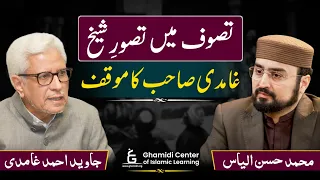
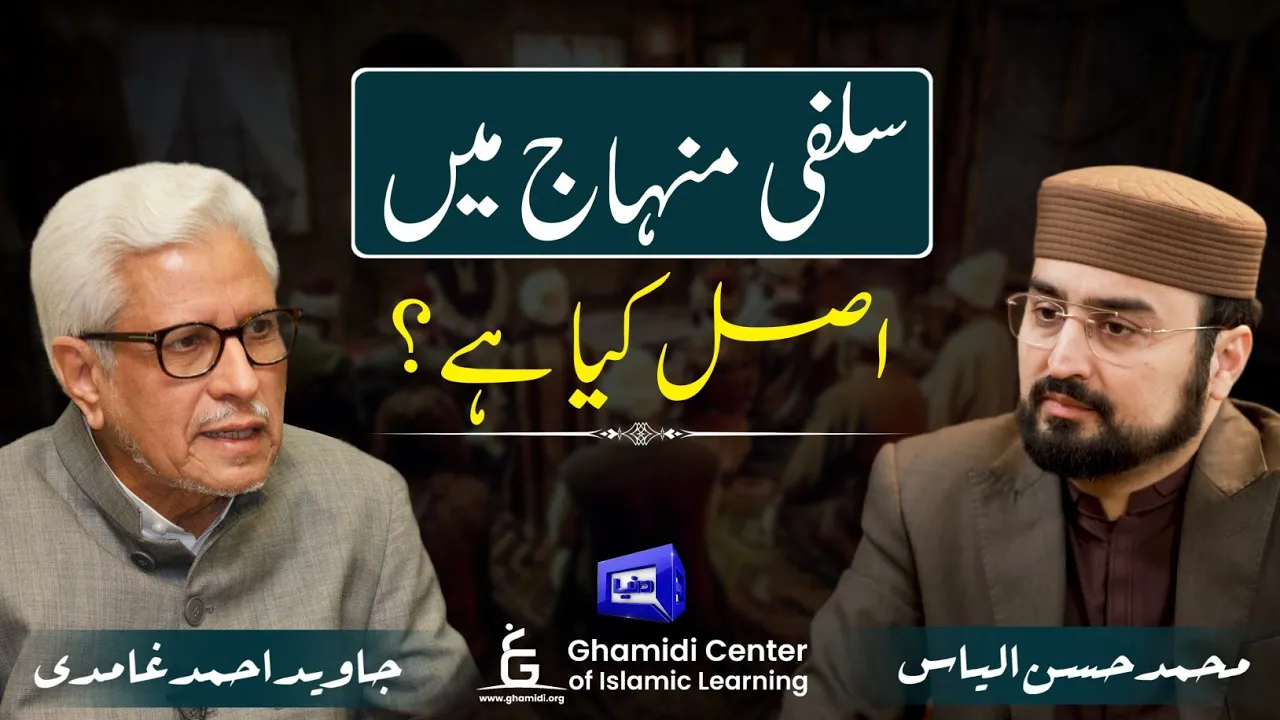
[Hasan Ilyas] In the name of God, the Most Gracious, the Most Merciful. Peace be upon you. Welcome to the program Ilm-o-Hikmat. My name is Mohammad Hasan Ilyas. Dear viewers, when we study the religion of Islam, we come across different schools of thought and these schools provide their own unique interpretation of religion. A common Muslim is quite apprehensive about the basic distinctions in these schools of thought. What is the difference in the principles and methodologies of these schools because of which different schools of thought come into being. In the prior session, we learnt from Ghamidi sahab
that there are 4 major schools of thought. For instance, we have the Sufi tradition. In the same way we have the Salafi tradition, the tradition of jurisprudence and then we have standing with them the Farahi school of thought. What are the basic principles in these schools of thought? What is their methodology which begins the process of thinking in their respective schools? We had earlier discussed Sufism. And to take the discussion forward we have with us Javed Ahmed Ghamidi sahab Peace be upon you, Ghamidi sahab. [Javed Ahmed Ghamidi] Peace be upon you. [Hasan Ilyas] Thank your
for your time. You discussed the concept of sufism at great lengths. You had thrown light at the central feature of their thought which kicks off this school of thought and an entire system comes in existence. We have learnt from you that whenever we have to understand the thought of the other, we must always try to understand his positionality and then try to analyse how they see and understand things. It is so because if we don't get into his shoes, we would never understand the reasoning behind his position. And without that every criticism would basically be
a straw-man. Let me take the decision forward. Please throw light on the genesis of the salafi tradition, What is the central feature of the salafi tradition? What is the causal reason based on which this new interpretative system comes into being? What is the basic principle, methodology and rule of this school? [Javed Ahmed Ghamidi] At this point of time, I am not going to highlight the background condition of this historical perspective. However, I may give certain indications. But in order to explicate the historical background, I would have to begin the discourse in a different manner. At
this point of time, I would like to highlight the principles which in turn influences the entire ideology. We have already discussed the mystical path. It became clear that, fundamentally there are certain qualities that create a connection between the heavens and the earth. What is the truth? We have to reach the truth at all costs. The most fundamental aspect is observation. In other words, the event should manifest itself upon my being. A certain connection should develop in my being. When such a connection develops within an individual... it is obvious that the prophetic religion is at our
disposal. It is the experimental world that will provide us with the resources to reach the truth. Experiential knowledge will observe everything from its own point of view. Consequently, you will engage with the Quran in the light of this experiential knowledge. You will engage with the Sunnah in the light of this experiential knowledge. You will evaluate your present as well you past through the same lens. You will comprehend religious hermeneutics through the same lens. In this context, I had stated that the general approach here is that religious message is meant for the whole of humanity. The
objective of the prophets is to make each and every individual, on any level, to abide by the rules of Islam. Those rules concern the next life as well as the life on this planet. When the Sufi modus operandi to reach the truth is based on the direct observation of the gentry then how should we evaluate any conflict that arises as a consequence of these. You must have observed that various methods are employed in the domain of knowledge. The method used in this context concerns itself with the relationship between the common folk and the gentry. In
other words, what the common folk desire is desired even by the gentry at some level. But for the gentry, the real basis is the foundation laid by observation. It is experience and observation that engenders a direct relationship and a genuine certainty. It is on this basis that you are able to comprehend the revelation in terms of its shape and form. It provides us the basis for making inferences. And only when you read the Quran, the hadith and the teachings of the prophets, in the light of this, then you become aware of its benefits. In other
words, it becomes clear what their rightful place is meant to be. And similarly, both the common folk and the gentry find ways to engender a connection with the Almighty as well as reach the truth. This is the rationale behind this kind of thinking in this context. It is obvious, which aspect will be decisive in such a discursive practice. It is obvious that it has been decided in this modus operandi is that the most important aspect is that of observation and experience. The knowledge you receive through observation is going to provide you with a certain station.
In simple terms, what is the balance, the basis, the scale which will be decisive? That scale is the scale of observation. And this should be the order of things. It is not an issue of refusal or affirmation. This issue concerns your understanding. It mean then you will look at religion and religous teachings within this framework. It is a school of thought in itself. It has its own terminologies. It has its own conception of tawheed. It has a unique conception of the day of judgement. By creating a mutual connection between these conceptions, you must put forth
a hermeneutics of religion. In other words, religion in this context will be understood using the same reference points. As far as the shariat and the jurisprudence of religion are concerned, such a modus operandi does not apply in such discursive planes. For the simple reason that, as Shah Waliullah stated, concerns itself with Aamatun naas. In others words, it is the people who are in millions and billions and have to become part of a system. In contrast, the bourgeois are only a few in number. The working class has to rid itself of the injustices. All of them
will be rewarded with a certain reward in the hereafter. It is obvious that such a reward would be deserving of the level they occupy. Hence, they bring about a system through the mutual connection between these elements Therefore, when they discuss such and such concepts. Take, for instance, the example of Ibn Arabi. When he discusses religious issues in his book Fatuhaat... In other words, the very things that a jurist discusses. In such situations, you do not feel a lot of unfamiliarity while reading his texts. But the moments, he starts discussing fusoos, a radically new world begins
to emerge. The same world can be seen in Fatuhaat. But in that text he manages to strike a balance between both the discourses. If he adopts a certain interpretation, he would also mention a parallel interpretation of the same issue. The same situation you come across while reading Ghazali's Ahyia. In other words, both things have thier own independent stature. Both are different schools of thought. A connection has been developed between both of them. And by determining the discursive limitations of both the schools, they have in turn begun to influence each other. In other words, how is
one school influencing another? It means that the common folk have to abide by it. And obviously the intellectuals too has to abide by it. Even the prophetic mission has laid out the guidelines that they have to be mindful of these things and they must not disobey them outwardly. This is the hidden world and it should continue as it is. Hence, a connection is developed between the two. And for that reason, when a common man encounters these things he says that there are no contradictions between these two schools. In reality, these are two different systems. Both
these systems have their unqiue benefits and each discourse has its own sphere of influence. This is how an internal connection is developed. For this reason, you will notice that the Sufi tradition and the juristic tradition do not have too much disagreement with each other. Generally, both these schools develop a mutual relationship with respect to each other. Therefore, we see in the subcontinent that a number of intellectual traditions present themselves in this manner. It means that, when such traditions teach the religious sciences, they teach the same Qur'an and Hadith. They discuss the same intellectual issues that
are discussed elsewhere. They look at the Shariah and the directives of jurisprudence in a similar manner. They are teaching the same principles and are guiding the common folk on the same topics. However, in addition, a different thing is happening alongside. It has a different style when presented at a purely intellectual level. But when the common folk are taught these things, they are told that internal peace and serenity can only be achieved this way. In such a scenario, it is obvious that the difference between the common folk and the gentry is kept intact in this manner
and it is expected from the people that they follow a certain spiritual leader to reform themselves because there they will find the light of truth, the effects of observation and an internal connection with them, and all those things will have an impact on you as well. Hence, it is a blessing and you will be a recipient of it as well. In any case, these are two different schools of thought and they work based on their own unique logic. The Salafi tradition in total opposition to this tradition, gives utmost importance as an essential component to that
tradition which is related exclusively to the Prophet and his companions. In that tradition, the case that they make is that all the things that we have received from the prophet including the Quran, the prophetic model or the sunnah; all these aspects have engendered a practical relationship with the Muslims. The Quran was not just revealed. It was not just read in the Arabic language. The Quranic injunctions has been followed to the letter. The guidance that the Quran provides has been followed by the prophet, and the companions which has lead to the genesis of a religious tradition.
What is the basic feature of this tradition? It has to do with developing a sense for comprehension and understanding. In other words, how did they understand the Quran? What methods did they employ to follow in the footsteps of the Quran. What status did they give the Quran in their methods to establish a relationship with God? And what was their conduct vis a vis the station they gave to the Quran? Where are you going to find all these things? They say that we are going to find all these things in those narrations that reach us through
proper chains of transmission. The prophet (pbuh) has been sent down as a messenger of the almighty. He has been sent down as a teacher of the Quran. Even the companions of the prophet were of service to the religion in the same sense. At first, they learnt from the prophet and only then were they in a capacity to teach others. Now, this tradition has been established. As this tradition is now established, now it assumes the status of that which is central to Islam. In other words, the order of things will be such that primarily we will
analyze what the prophetic tradition says with respect to the Quranic verses and religious commandments. And what do we mean by 'tradition'? Tradition connotes the actions or practices that the prophet followed on a regular basis it also connotes prophetic sayings or actions carried out by the companions or certain things that unfolded before the prophet and he accepted those as part of the religion. In other words, he did not object to those practices. For this reason, when this whole tradition is explicated, it is stated that this tradition will include the saying, his approval, and similarly his narrations
as well as his actions. The actions of the companions will have a similar feature. Obviously, these 3 things fall within their ambit as well. How things unfolded during their times? What measures they took for the same? The sort of things that they accepted and the ones they rejected. The things they explained and the manner in which they did that. All these things are part of the history of the prophetic period. In other words, the history that was manufactured during the time of the prophet manifests itself in the narrations of the prophet. If they are narrated
in relation to the prophet, then they are termed as Hadith. If they are narrated in relation to the companions, then they are termed as Aasaar. But, in essence, all these things are part of the history of the prophetic period. We can also include the time of the companions to this period. This was the best of times. Religion in its entirety was revealed in this period. These people hold the status of our elders. We are instructed to follow them. We will stay true to our religion if we follow in their footsteps. They have learnt the teachings
of Islam directly from the prophet. And the prophet (pbuh) is the messenger of God. We are taught to love, adore and follow the prophet. All these things are mentioned in the book of God, the Quran. Hence, this should be order in which we associate ourselves with islam. In other words, we should primarily look at how those upon which the religion was revealed followed its teachings. [Ilyas] How they perceived it. [Ghamidi] How did they perceive it who were the first hand recipients of this revelation. This should become the basis of understanding religion. Taking liberties and changing
the order of things is in now way acceptable. Hence, if you discuss an issue in the Quran, if you discuss some wisdom in the Quran, if you elaborate on it by delving deep into it, in each case, they will demand from you whether you became aware of it today only? It was part of religion right from the beginning. The prophet has read it and taught it to others. The aspects of life that it throws light on were first encountered in the life of the prophet. For this reason the real basis of religion is the tradition
It means that whatever is part of the tradition will be decisive. If you present something in opposition then you will say that the Qur'an says such and such thing and we understand such and such thing from the Qur'an. In response, they'll say that this is your understanding of the Qur'an and it falls flat in comparison to the understanding that the prophet and his companions had with respect to Islam. For this reason, the essence of Islam lies in the prophetic tradition. Hence, the order of things will not be to first of all look at the Qur'an
or to claim the Qur'an to be the final authority. Or on the basis of your understanding you will form an opinion of the Qur'an. Primarily you will look at this tradition which is a treasure in itself. This tradition is a great blessing from God. In fact, they go one step further and say that this blessing enjoys the protection of the almighty. There are some exceptional people in our tradition who we know as the Muhadisiin, who have carried out brilliant research concerning every aspect of the prophetic life and they have distinguished between those things that are
trustworthy and those that are not. Another word for Religion is knowledge. We know a fact from the prophet and we have its chain of transmission too and we have investigated the narration as well, consequently it is these sayings that will become the basis for our ascension. In other words, the order of things will be such that the narrative tradition is primary and everything else will be understood within its framework. This is the point which becomes a matter of contention. Whenever something is said against this narrative tradition, even a regular folk feels that he or she
should provide a narration in support of his argument, he should provide a reference to a certain event. The narrations pertaining to the the particular circumstances in which or in response to which, particular verses of Qur'an were revealed When was a certain verse revealed? When was a certain surah revealed? What were the background conditions? All these would obviously be elucidated first of all by the companions. The salafists conclude that since the companions have already determined the background conditions, now the state in which we receive the narrations or whatever context we think they have, the more important
thing for them are the real background conditions of the verses when they were revealed. If you listen to their discourse in its entirety, if has a fairly lasting impact on you. You see that this is the kind of discourse which occupies an important position as part of our tradition. While reading the books on narration relating to the prophet, people keenly observe this discursive practive. And for this reason, people in our part of the world have focused their attention on this discursive tradition quite a bit. If you take a look at the intellectual history of our
tradition, most attention had been paid to this treasure of knowledge. Our major scholars have compiled these narrations, written commentaries on them, investigated their relationship. They have guided us with respect to the laws pertaining to this tradition. The point is that this discourse has become a basis for interpretation of religious texts. This should become the basis for religious discourse to the final degree and it should be the basis for all our decisions, this sentiment is most prevalent in the salafi school of thought. And this is how the Salafi school of thought looks at everything. In other
words, it is not as though it is rejecting anything or it is trying to demean anything. They too consider the Quran to be the book of God. But how do we invoke the book of God? In their discursive plane, such task will be accomplished by considering it to be the central feature of the tradition. Tradition is considered the fundamental axis of our religion. You will study everything in the light of this tradition. Therefore, if you talk about the past. For instance, you talk about the Bible. You invoke the Torah and the gospel and the Psalms.
The salafis will reproach you by arguing that these books lack a chain of transmission. For this reason, they don't hold the same status. As the books revealed by God they might have some relation to the almighty but what is the the most important tool at our disposal. It is those narrations. Therefore, even in the case of historical events, if something finds mention in these narrations then that would be more reliable Thus, there are major issues where these narrations have become decisive in religious matters. For a common man...since narrations include the unfolding of a certain incident
it consists of the context in which the verse was revealed, the background conditions, an issue is summed up in a few words. There's no debate concerning the context of the event. The eloquence of language is looked over, the conditions of the discourse are looked over as well. In contrast, all these aspects are discussed in the Qur'an. These narrations are basically an end product that put before you. And the manner in which it is presented in words satisfies the common man. So, the information about religion or about events that unfolded during the time of the prophet
that a common man seeks. and it is human nature to seek knowledge of those things. on the face of it he thinks that through this tradition he is able to receive that information in an efficient manner. So, this entire discursive framework which no doubt is an invaluable treasure. if someone in relation to the prophet or the companions is stated, if the companions are teaching the Qur'an, if they are simplifying verses of the Qur'an then that obviously is an invaluable possession. So, we should analyse this treasure on its own parameters in terms of how the Qur'an
is related to them. The second scenario is where we take this discourse as the basis of our tradition and then try to understand the Qur'an with reference to it. And if you find a contradiction between your own understanding and these narrations then it is these narrations that are going to play a decisive role. It is obvious that if this is the situation then just as observation plays the key role in Sufism, similarly this discursive tradition based on the prophetic narrations plays the key role in salafism. [Ilyas] Thank you, Ghamidi sahab. In a very proficient and
detailed manner, you got the point across about the fundamental principles of salafi methodology. What is the actual modus operandi based on which everything else would be analyzed. I would like you to explicate certain secondary issues with respect to the same. In the last 2 centuries, the Salafis have come to be known as ahl-e-hadees. People associated with ahl-e-hadees call themselves Salafi. That too means that we consider Hadees to be central and look at everything within its framework. [Ghamidi] the name is self explanatory. As a religious group we are identified as Muslim. The Qur'an tells us that
this is the name Ibrahim (AS) gave us. Huva samma kumul Muslim. All prophets have followed Islam as their religion. All our traditions associate themselves with the name Muslim. In other words, Salafis, jurists, Sufis all consider themselves as Muslim. These traditions are a subset of our religion and it is for that reason that we are discussing those narrations here. We claim that we are Muslims and then we go on to verify our methodology. What does it mean to identify your own methodology? For instance, if you are associating yourself with someone else other than being a Muslim
then the most important element in that regard would be the book of God, the Qur'an. When the Qur'an itself gave a different identity to the people who went before, how did God address those people? He called them The people of the book. It means that if God gave you a different identity it was always given in relation to divine scripture. In this context, to identify a methodology or how we are going to approach things, how we would discuss a certain aspect and what will be the decisive factor, in the context of Salafis, it is the
narrations which play that role and the narrations in relation to the prophet are known as Hadith, thus, the Salafis are also known as ahl-e-hadees. It is in this sense that this methodology introduces itself and it has a sense of superiority. They feel that they have associated themselves with the message of the prophet. And the manner in which the prophet understood the religion of Islam or the manner in which it was transmitted to us becomes the foundation for us to understand this religion. Discuss any issue with them, you will notice that narrations will be decisive for
them. This will be their basis and they will argue for instance, that this is how such and such issue was discussed in 'aasaar' or a certain companion has elucidated it in a certain way. This is how it has been transmitted in relation to the prophet. And since we have this tradition to fall back to, we cannot rely on anything else. Or if something has been stated, then it won't be refuted based on a different sort of reasoning. As a result, it becomes the axis of their discourse. The name ahl-e-hadees was adopted fairly later but before
that those who would associate themselves with the knowledge of hadith were generally known as ahle-hadees. This interpretation for the general public was adopted quite later. The 2 traditions that had persisted in our culture before this one. It is obvious that this is the salafi tradition. The salafi tradition assumed a very important position within the schools of jurisprudence. For instance, Imam Shafi and Imam Hambal the two major jurists in Muslim tradition, there is a semblance between their thought and the salafi tradition. But in those schools this thought did not take the form it did in the
Salafi tradition. For instance, when Imam Shafi wrote a chapter on the explanation and elucidation of the Quranic principles, and threw light on the nature of discourse, he intimated that if we receive a certain narration with a strong chain of transmission and, at the same time, it is an isolated report, in other words, someone has narrated it in relation to the prophet, then if there is a contradiction between our understanding of the Quran and how that particular Hadith understands it, then we will make the case that it is the narration which grasps the true meaning of
that verse of the Quran. He gave an ingenious reasoning in support of his argument. He said that the language used in the Quran is such that at times the manner in which words describe things that they are purportedly referring to may be significantly different from the truth and meaning. Therefore, he has kicked off a very important debate in his book Risala on the nature of uncommon and common words. And he has argued that at various instances in the Quran when the Quran will use a common word. For instance, the Quran will use the word 'al-mushriquun'.
Now by that any and every individual could be a polytheist. But from various narrations we come to know of the real reference of this term. Even a number of signs in the Quran clarify the meaning. Now that we know that the manifest meaning of the word may not be applicable in all contexts, then it is our duty to take these narrations as commentaries of the Quran. In my opinion, the apparent contradiction between the two is unimportant. So, all these features are already part of their discourse. But with them you won't come across these methodologies in
the same way. But then gradually they deem a narration as true. And those people who have worked to take this science further like, for instance, Ibn Hazam; He made it an equal rank. He used the justification that when God says in the Quran: inna nahnu nazzalna l-dhik'ra wa-inna lahu lahafizun Surely, We, We, We sent down the Quran and surely, We, for it are indeed Protectors. Basically, this protection does not restrict itself to the text of the Quran, it also includes the elucidation and commentary on the Quran. What does the clarification and explanation of the Quran
signify? What are these applications of its references? What are its branches? They are the same that we come across in the prophetic narrations. Those narrations are part of its wisdom. And since that is the case, then if the chain of transmission of a certain narration is genuine, then that narration comes under God's protection This is the interpretation that they accepted. Although a lot of people did not accept this justification. In any case, we get a sense about the sort of reasoning and justification that this school of thought with its main focus on prophetic narrations that
I call the Salafi methodology offers. We notice that the supporters of this tradition draw everything from the prophetic narrations. They think that it is these narrations that give us a map of the religious sciences. In other words, the whole world is uncovering itself through this tradition. And the things mentioned briefly in the Quran are elaborated in the Hadith tradition. And then they give a number of examples from the day to day life of individuals. As a consequence of this discourse, there has been a blurring of the line between sunnah and Hadith. It is decided that
the main objective behind the transmission of sunnah is the transmission of the tradition of Hadith. And once we receive it through the chain of transmissions, then that becomes the sunnah. And if use the word sunnah for this treasure, it would not mean any disrespect to the prophetic tradition. In reality, this is a discourse on its attribution to the prophet. In short, the central feature, the master signifier of our tradition is this narrative tradition. And we will analyse each and every aspect of our religion within the framework of this narrative tradition. This method forms the basis
concerning the commentary of the Quran, or concerning jurisprudence, or understanding the law and its application. And since it becomes the foundation, then they are not wrong in introducing themselves as Ahl-i-Hadees. [Ilyas] Ghamidi sahab you have clarified this issue. For the sake of general knowledge, I would like to ask this question. About the Sufi tradition, we know that the tradition in the muslim world begins with Muhasibi and Junaid Baghdadi then we have Ibn Arabi, we also have the author of Qutl Kuluub Abdullah Tahir Makki. In later centuries, we find Shah Waliullah and the likes of Imam
Ghazali. These are such prominent figures. Who are the major figures in the salafi tradition? We will include Ibn Tayimiiyah in the list. Then there is Ibn Hazm and Shah Waliullhah. So, there arre certain people who belong to both the schools. Who are the major figures responsible for this methodology? [Ghamidi] As I just stated, this form of thinking began with Shafi and Hanbali thinkers. We can find proto-salafi tendencies in the thought of Imam Shafi. Similarly, we find a lot of attention has been paid to this type of thinking in the works of Imam Hanbal. And the
people whose names you just took, for instance, Ibn Taymiyah is basically a Hanbali thinker. To say that Ahl-e-Hadees do not belong to any school of thought is a very late development. In reality, people would present their perspective from within a certain tradition. But even in the Hanbali school of thought, what is it that is central to them? It is the same narrative tradition. So, the supporter or the researcher from among them will be someone who will interpret all issues by proclaiming narrations to be the central feature of religion, or through the vast treasure that has
emerged out of it or through the things that have been explained through that lens. This is the reason that the manner in which jurists cast things into a principle and then they strictly follow the same methodology until the last instance, In the case of Imam Shafi and Iman Humbal, you come across a certain methodology. And you can't argue that their methodology is purely based on narrations. There are certain rules and principles that have been determined. And in the light of those principles, we study and analyse the narrations and there is no doubt that the narrations
reach the same level there where they can become the central axis of religion. But then the same discourse gradually takes a different form and by the time it reaches the contemporary era, it changes its sequence and then we go on to say that we are not followers of any scholar and we are not part of any school of juisprudence. Rather, we should be known as Ahle-Hadees. [Illyas] Thank you Ghamidi sb, you clarified this point too. Let us take the discussion ahead. I am asking this question to understand the nature of methodology. We know that the
major criticisms that the Sufi tradition has faced have come from the Salafi school of thought. Ibn Taimiyah and Ibn al Qayyam have made some serious criticisms. And they have refuted the Sufi interpretation in its entirety. My question to you is this: the Salafi methodology for which narration is the central feature of religion; then is criticizing the Sufi school a necessary and required feature of the Salafi school? And is that the reason that that is their primary task for their first object of criticism is always the school of mysticism? [Ghamidi] We can't say that the sufis
are their primary targets but yes their most prominent object of criticism are the sufis. The nature of this criticism is such that it has drawn the attention of people towards them. And a consequence of that was the fact that Imam Ibn Tayimiah had to himself become a subject of criticism. He was slated for centuries. His criticism on jurisprudential narrations are a different debate. His criticism of Sufism, philosophy and on Islamic theology drew a lot of attention towards him. For him, the manner in which we have to understand the Quran Hadith and the religion of Islam
We know that he is a great scholar of the Hanbali tradition. In fact, who is a major scholar from the middle centuries in our tradition except Ibn Taimiyyah and Ibn al Qayyam. It is evident that he is a very eminent scholar. And we know how much an individual should adore a genuine scholar. And these scholars have received the same levels of adoration from the muslim world and even though they have had their fair share of criticism as well. And in various eras they have been a subject of criticism. In the current era, since that ideology
manifested itself at the political level and a government was established and that too in the land of Arabia. For that reason, it garnered a lot of attention and people were naturally inclined towards it. There was a time when people wouldn't even tolerate someone taking their name in the subcontinent. But then when certain eminent scholars started discussing this school of thought especially Maulana Azad who introduced this school to people in his book Tazkira in a very unique manner. It was then that the common folk started paying attention to this school. As a result they assumed a
high status. So, why do they criticize they Sufis? It is for the simple reason that only those features will become part of the religion that are embodied within the tradition. It is obvious that if they don't find a certain aspect in the life of the prophet or the companions, in that case, they would not allow for that to be presented as part of the religion of Islam and they will never accept it as the truth of Islam. Their critique will only become more pronounced. One way out for the sufi tradition here is to present their
methodology separately. But, it is obvious that the discourse uses religious verbiage. Had they not been discussing the supreme being and presented their own version of metaphysical thought. Then it could have been possible that they would not have been criticised as much as they are at a philosophical level. But once they say that their thought is the most sophesticated theorising on Tawheed and then go so far as to argue that the common people as well as the gentry should believe in the same, then it is obvious that that those who are standing within the fold of
Islam and the main principle of the Salafi tradition is to analyse things by finding their reference in the prophetic tradition, then they will definitely ask why such a discourse does not find mention in that tradition. For this reason, you will notice how particular they are on the issue of polytheism and that ought to be the case for it the sensitive nature of the oneness of God which forms the basis of religion. They are equally sensitive about issues pertaining to innovations in religion. What does Bidat mean? Those things that have no basis in religion but at
the same time you present it as religion. Naturally they will ask you this question. And tradition will be the sine qua non of their reasoning. And if a certain feature is not found in the tradition then you cannot present it as religion. In my opinion, this criticism should only have come from the salafis and that is what happened. And even in the contemporary era, most of the criticisms in the subcontinent against the sufis has come from this tradition only. And those reformers who have been analysing religion within the tradition of jurisprudence, or if they have
made some huge breakthroughs, even there you will see that this rationale becomes the basis for criticism. In other words, the fact that the prophet of God gave us this religion and since he is the one who through whom we received the religion of Islam then it is but natural that he will be the main discriminating force between what counts as religion and what does not. And how are we going to figure the religion that was given to us by our prophet. It is obvious that we will know about it through the narrative tradition. And the
tradition would either include a hadith or asar through which we would know our religion. And on the basis of the hadith, we will also try to understand the Quran. It means that the Quran corroborates and confirms, but your reasoning and justification for religion begin from within the tradition. On the other hand, if you begin from the Quran, even then you reach the conclusion that this is such and such verse of the Quran, it states such and such thing; but what is the point of this verse? Because even if you read the verse, the real issue
would not get across, I have to understand the meaning of the verse and it is the tradition which determines that. So, whether you begin with the tradition or the Quran, either way it will be the prophetic tradition of narrations that will be decisive. [Ilyas] it will be the prophetic tradition of narrations that will be decisive. Alright, Ghamidi sahab. Kindly explain another aspect of this tradition. In their methodology, the principle driving factor is the tradition, but a slogan which has become quite famous, the slogan of Adame Takliid, they call themselves nondenominational Muslim so is it a
necessary condition of this school that once you have determined that Hadith is central, then one will not conform to a person or a school of thought. They even use a very strong verbiage against it. They say that this practice amounts to Shirk fil Nubuwa. One had to basically conform to the hadith tradition or the circle that the hadith tradition had engendered which includes the companions of the prophet too and the result of their asaar as well. And if you show conformity to a certain individual instead, then that too would amount to going against the salafi
methodology. [Ghamidi] Absolutely. There is no doubt in that. If you look at it from a different angle, if you look at the initial stage after the the Quran was revealed, you will see that no one uses this terminology. Even the sufi tradition does not use the word 'taqlid'. Even the schools of jurisprudence do not use the word 'taqlid'. This is a later development. And it is absolutely correct that the principle of Taqlid had to be adopted so that those people who give legal opinions, those people who make the final judgement as jurists, the judgements be
made in accordance with the principles. And a uniformity should evolve with respect to these adjudications. There should be harmony between them. For this reason, the principle of 'taqlid' was adopted. Two kinds of reasons were provided for it. First of all, the whole society has to have an awareness when it comes to religion. And it is obvious that a society should not be engulfed in conflict and disagreement. Since, the Hanafi school of thought had assumed a political status in our part of the world. What I mean is that when the Abbasids started Hanafi scholars as the
priestly class, and when Qazi Yusuf assumed the status of the Chief Justice of the entire caliphate, as a consequence, the justice system was entirely under his authority and control. When it comes to the administration of justice, you have to take various decisions. While making these adjudications, each individual makes a decision based on some reasoning because of which a situation of law and order emerges in the system. For this reason, certain scholars were chosen. It is obvious that people were scholars who were administrating justice or were adjudicating in the capacity of judges in order that they
follow a certain principle. And to follow a certain principle means that if a certain scholar or a major hadith tradition has set some principles as to how we should study religion while following those principles they can share opinions too. It is obvious that in such a situation some people acquire highly eminent status. Especially in our caliphates, it was Abu Hanifa, who acquired a highly eminent status. In a different context, it was Imam Shafi who acquired a highly eminent status. In the western part of the world, Imam Malik acquired a highly eminent status. All these scholars
received such an eminent status. So, what does the word 'taqlid' mean? It means that since you have given such and such scholar a highly eminent status, you will not deviate from the principles that he has set forth. The objective behind this reasoning was well intentioned. Your legal system based on which the kingdom is functioning, and because of which all decisions are taken, and due to which you command people to act in a certain way should not be plagued with contradictions and disagreements. Differing judgements should not be made on the same topic. Then there is the
question of the general polupace. If they are serious disagreement with each other, that would naturally lead to a contentious relaitionship with the legal authorities. As a consequence, an administrative decision was made that the general population should also be in conformity to a certain scholar. Look at how these things are all connected to each other. You made an adjudicator conform to a certain school of jurisprudence and asked him to abide by a certain school of jurisprudence. To whom are these judgements going to be applied to? It is the common folk, of course. If there is disagreement
in the general populace on these matters, then there will be a bone of contention both in the judgement and the actions of the individual. The individual will consider such and such to be a part of religion while the judge's adjudications will be diametrically opposed to that. So, this need for conformity on both sides lead to the understanding that taqlid is a useful principle so that people live a life of order in their private lives and even the public sphere be devoid of any disagreements. In contemporary times, when an eminent scholar was asked on a public
platform whether he thinks that 'taqlid' is a religious olbigation? He said that according to him it was an administrative need. This is an absolutely correct answer. It means that from an administrative point of view, people were advised and the legal frame work was bound by one school of thought. For instance, even today we see that when the supreme court makes a decision, the rest of the courts are bound to follow the directives of the supreme court. So, if the supreme court has taken a decision and every other court is bound by it, ergo they are
following the principle of taqlid only. This is the very principle that was applicable over centuries. That if we have a system of government, if we are running a state or a caliphate in which the practice of ifta is taking place. In other words, people are voicing their opinions on religion. And if a judge is passing judgements in matters of religion then ideally there should be no disagreement or contradiction between ifta, the judge's verdict and the person for whom the verdict is passed. Rather, this system should remain in harmony from top to bottom. And this is
a basic logical requirement to be part of a single system that works on a unitary principle. This is how this discursive tradition came into being. However, if the Hadith tradition is central to religion then how can we accept taqlid? [Ilyas] These two will be in opposition. [Ghamidi] It can't be possible. It is possible that a hadith may come up which stands in opposition to the position of the imam you are in conformity with. As a result of the work of the researchers on Hadith, now we have collections of hadith at our disposal. There is a
general consensus with respect to these books of hadith. We have books like Bukhari and Muslim or Imam Malik's Muatta are the initial collections that were compiled as books of hadith. These are the kind of books that have influenced Muslim minds to a large extent. These books are written in relation to the prophet. Or for that matter, the books of Asaar. For instance, the Musanaf or other books of similar stature. So, when you saw that they are the aasaar of the companions or the Hadith are narrated in relation to the prophet, all these aspects led to
the general impression that we are meant to follow the footsteps of the prophet. Since we have received the prophetic hadith, so it should be clear to us everything else holds a secondary value. And the scholars about whom it was said that the likes of imam Malik or imam Abu Hanifa should be followed. However, even those imams were making a similar case. They used to teach others that they are trying to understand the Hadith of the prophet of God and why should those hadith not be followed? So, we should go back to the basics and try
to understand religion through the prophetic narrations. As a consequence, Sufism was scorned by the salafis because they can't justify their basics from the Hadith tradition. And similar, if something stated in the Hadith tradition turns out to be different from the schools of jurisprudence then the question arose that since the Hadith of the prophet has come to the fore, why should any attention be given to anything else. However, It is obvious that this form of thinking had certain consequences. The fact of the matter is that, in the Hadith tradition everything was following a certain logic and
the discourse had an order to it. However, when you adopt this methodology like the salafis did, there are chances that you might circumvent the principles that were central to the canonisation of the Hadith tradition. You might conveniently pick and choose the Hadith narrations. Even now, the people who rise as the pious ones use the books of hadith to justify their position. There is no better way for reformation than this for the regular folk. If you tell a common man that such and such hadith was narrated by the prophet or the companions, they will gladly accept
those narrations. Even the level of discourse is fairly simple in the Hadith tradition. So, the result is that a number of aspects whose function has been set after serious investigation by our jurists too become a subject of criticism. It is possible that after a very elaborate investigation and research, the jurists would have reached the conclusion that such and such thing is Sunnah or such and such thing should be given the status of nafal or such and such thing has the status of istehbaab. And you read a certain hadith and you deem the same thing as
obligatory. The schools of jurisprudence are very particular in assigning a role to a certain aspect of religion within their system. We will see that when we discuss legal jurisprudence. Although this tradition was not like that in the beginning, but this has become it's methodology over time, and so this incoherence in it was inevitable. Therefore, you will see that there is no rule upon which an order could be outlined in the salafi tradition. Instead, it becomes a compilation of branches through which certain principles are later deduced. [Ilyas] You have thrown light on a very important topic.
We will take our discussion forward. Today we learnt about the salafi tradition and what counts as the central axis of religion for them. As Ghamidi sahab said, it is the tradition of narrations that is central to them. The whole religion will be analysed and studied based on the tradition of hadith. Next we will look at the schools of jurisprudence and in addition we will look at the Farahi school and its central components, its status and its methodology We will discuss all these things. We are out of time. We will see you again. Thank you Ghamidi
sahab for your time.