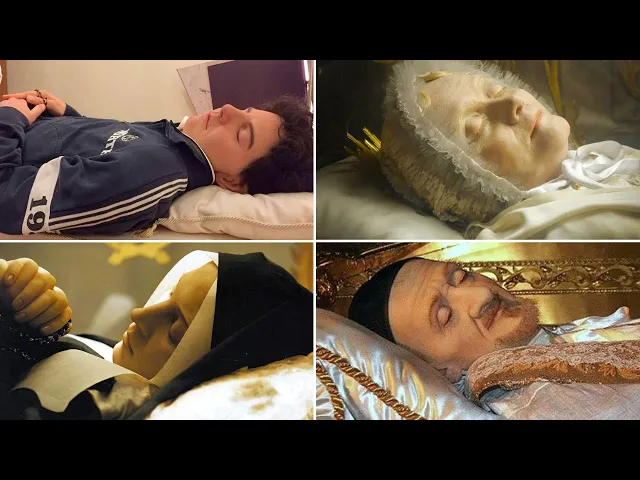
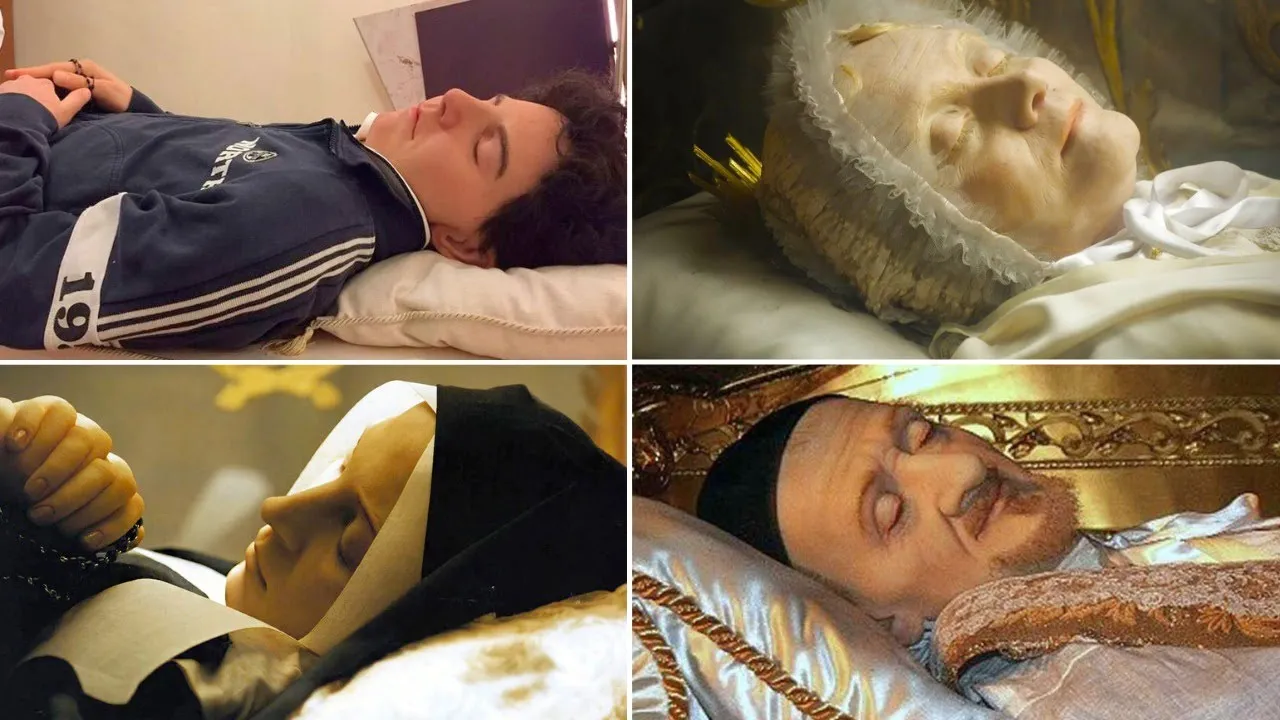
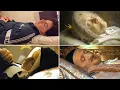
March 1,879 Nevers, France. When they opened Bernardet Subarus's coffin 30 years after her death, what they saw defied all logic. The skin still soft, the lips rosy, the hands flexible as if she had fallen asleep the night before.
The doctor responsible for the exumation wrote in his report, his voice choked. I cannot explain what I have before my eyes. That young shepherdice who saw the Virgin Mary in the grotto of Lurards rested intact, preserved by a force that science could not name.
A silence that screamed louder than any words. God acts where he wills. Since the earliest Christians, something extraordinary happens with certain servants of God.
Their bodies do not rot. They remain whole, fresh, sometimes perfumed. And this is not rare.
There are hundreds of documented cases over 2,000 years, examined by doctors, studied by scientists, witnessed by multitudes. St. Catherine of Bolognia died in 1463.
More than 500 years have passed. She is still seated in a glass chair in her chapel in Italy. Anyone can see her.
The serene face, the delicate hands resting on her lap. The nuns who care for the place say they have never needed to do anything to preserve her. She simply remained.
St. John Viani, the holy cure of ours, was exumed in 1904, 45 years after his death. They found his body completely preserved.
Today he rests in a glass ern in France and the faithful pass before him in silence touched by that presence that seems to whisper holiness leaves marks even on the flesh. St. Rita of Cashia deceased in 1457.
St. Francis Xavier died in 1552 on a deserted island in China. St.
Clare of Aisi. St. Vincent Depal.
Blessed Emldda. The list is long. And each name carries with it a mystery that science recognizes but cannot decipher.
Now, it's important to understand there is an enormous difference between the incorrupt bodies of the saints and the mummies we know from history. In ancient Egypt, the pharaohs were intentionally mummified. Internal organs were removed, cavities filled with herbs, the body bathed in oils and wrapped in bandages.
It was a process that took 70 days. Tuten Common's mummy found in 1922 was over 3,000 years old. Impressive, no doubt, but it's not a miracle.
It's human technique. The incorrupt bodies of the saints underwent none of this. No imbalming, no chemical treatment.
Many were buried in conditions that should have accelerated decomposition. damp tombs, broken coffins, waterlogged earth, and even so they remained intact. There is no natural explanation.
And this happens so constantly and numerously in the Catholic Church that one can consider this phenomenon as a divine seal of the authenticity of the faith. When they open these tombs decades or centuries later, what they find goes against everything we know about death. bodies that should be dust, bones that should be undone.
And yet there is the person whole, recognizable, often with an expression of peace that impresses even the most skeptical. St. Bernardine of Sienna was exposed for veneration by the faithful for 26 days.
26 days. Any cadaavver under these conditions would already be in advanced decomposition. But when they finally buried him, the body was intact.
St. Catherine of Genoa remained in the tomb for 18 months. When they opened it, the shroud was damp and rotted, but her body fresh, intact, as if she had been buried the day before.
9 months after her death, St. Teresa of Avila was exumed. The coffin had broken.
She was covered with earth, her clothes dirty and decomposed, but the body showed no sign of putrifaction. On the contrary, it exhalded a sweet perfume of flowers. Witnesses swore that scent came from no oil, no chemical preparation.
It was something that emanated from the flesh itself. St. Francis Xavier, St.
John of the Cross, and St. Pel Balon resisted something even more impressive. corrosive substances that were thrown on their bodies, quick lime, acids, things that should destroy any organic matter.
And even so, they remained preserved. Padre Peio, who died in 1968, was exumed in 2008, 40 years later. His face was preserved, the beard still visible, the body recognizable to those who knew him in life.
The medical experts who examined him found no traces of advanced decomposition, only that strange permanence that defies our certainties. But there's more. Many of these bodies not only remained intact, they exhaled supernatural perfumes.
St. Katherine Derichi, St. Philip Ner, St.
Gerard Magella, St. Gma Galgani. In the first half of the 20th century, a specialist was sent to the convent of the blessed martyr Mary of the Angels in Spain to try to identify the nature of the perfume coming from her body.
He had to confess it resembled no perfume of this earth. Pope Benedict I 14th in his work on the beatification of the servants of God wrote something important that the human body does not smell bad after death is possible. But that it exhales a sweet, persistent odor, pleasant to all this is above its natural powers.
It must be attributed to a superior cause, one must think of a miracle. There are still cases where these bodies remained soft and flexible for years. St.
Catherine of Bolognia had a body so pliable 12 years after her death that she was placed sitting in the position she remains in to this day. There was no cadaavveric rigidity, no hardening, only that strange docility of flesh that should be dead. Other saints persspired precious liquids, blood, oil, water.
St. Mary Magdalene Depatzi, St. Nicholas of Tolantino, St.
Agnes of Montipuliano, St. Camilis Delis. The oil that flowed from the body of blessed Clare Gambaorta who died in the 14th century continues to pour from her hands and feet to this day.
Another extraordinary case is that of St. Charbal Makllo, a Lebanese religious. 4 months after his death, they exumed his body.
It constantly emitted blood and water similar to the open side of Christ on the cross. and the amount of liquid that came from his body far exceeded the normal amount of liquid found in any living human being. There were also supernatural lights.
St. Guthlac of resigns was seen enveloped in brilliant light for several minutes. St.
John of the cross, St. Anthony of Strong Cone, St. Joan of Leonac.
But perhaps the most impressive was again St. Charbell. A light shone intensely over his tomb for 45 consecutive nights.
It was witnessed by several villagers including Muslims. This led to the excumation of the body revealing the phenomena that are observed to this day. Why does God preserve some bodies and not others?
The church has never claimed that incorruptibility is definitive proof of sanctity. There are saints whose bodies decompose normally. Holiness is in the soul, not in the flesh.
But these signs are not accidental. They remind us of something we easily forget. The human body is not disposable.
We were created body and soul in the image of God. And in the final resurrection, this body will return glorified, incorruptible forever. The incorrupt bodies of the saints are like harbingers of this small windows open to eternity.
They tell us death does not have the last word. St. Bernardet spent years sick, suffering from asthma and bone tuberculosis.
She died young at 35, consumed by pain. But that body that suffered so much remained intact as if God wanted to show that suffering united with Christ is not waste. It is seed of glory.
St. John Viani slept 2 or three hours a night. He spent the whole day in the confessional, hearing sinners carrying the weight of souls.
He ate little, prayed always, lived in total detachment. When he died, his body was exhausted, but it did not dissolve. It remained there, silent witness to an entire life given to God.
If these stories touch your faith, if they make you stop and think about eternity, subscribe to the channel. By doing so, you help us continue sharing these truths that traverse centuries and remain alive because they come from God. Of course, the church does not automatically accept all reports of incorruptibility.
There are many saints whose bodies were preserved by request of ecclesiastical authorities for veneration by the faithful. Even in cases where preservation occurs in a surprising way, the church adopts a cautious approach. It only issues a final verdict when events cannot be explained by human science.
This same attitude of prudence should be recommended to all the faithful without allowing themselves to be contaminated by the skepticism of the world. Always remember the purpose for which God works these wonders to lead people to faith in his divine son and in his holy church. When the faithful visit the sanctuaries where these incorrupt bodies rest, something happens.
It is not morbid curiosity. It is reverence. It is recognition.
Before those serene faces, those hands that once prayed the rosary, held the crucifix, blessed the poor, people kneel, they cry, they pray, they ask for intercession. Because there is someone who conquered, someone who crossed through death and reached the other side. Someone who now lives fully in God but left here in this world a visible palpable sign that everything Christ promised is true.
The incorruptibility of the saints is not magic. It is not superstition. It is incarnate theology.
It is the gospel made flesh literally. It is God telling us with the delicacy and strength that only he has. I take care of my own.
I preserve what is mine and what is mine is not lost. May these incorrupt bodies remind us every day that holiness is possible, that eternal life is not a beautiful idea but a reality that awaits us and that it is worth it.