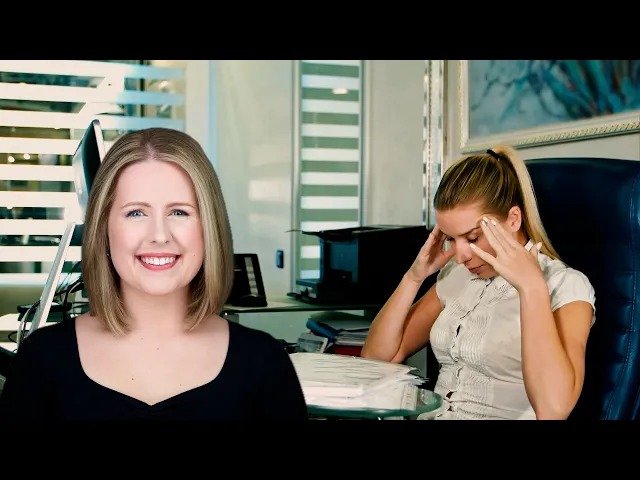
A phenomenon is happening on the job. Let's bring in workplace expert and author Elizabeth Lutardo. First, there was quiet quitting.
Now, there's quiet cracking. What's happening? What is quiet cracking?
>> So, this new HR term quiet cracking means that on the outside you feel fine and you're doing well, but at work you're kind of emotionally crumbling and you're burning out in silence. This is the first we've heard about quiet cracking. Is it not wellnown?
>> The data suggests it is pretty severe. And I think the reason that no one is talking about this is everyone has accurately gauged this economy as weird. And people don't want to appear like they don't like their job, they're not engaged, they can't do their job.
So, we're collectively putting on this front that it's all fine and dandy even when it's not. >> What are some signs of quiet cracking? You probably know in your gut if you're quietly cracking signs like being absolutely depleted at the end of the day.
You may start to take out that emotional resentment on your spouse, on your kids, on your community. You may feel absolutely no energy for projects that used to excite you. These are all signs that maybe something's not quite right at work.
>> How can a manager identify that something's going on? >> Well, emphasis on the word quiet. The signs are subtle.
To me, the most obvious signs are a change in behavior. Someone who used to raise their hand for things and they don't anymore. Someone who used to proactively give feedback and they don't anymore.
Not necessarily the onset of bad behavior, but the absence of what you're used to. >> If the person is feeling stressed or burned out, what should that employee do? >> What I would suggest is microtransparency.
What I mean by that is small moments where you can say, you know what, I'm not at my best today or I can't give 100% to this right now because of X, Y, and Z priorities. These small glimpses into the truth do make a significant difference over time. You don't have to have this big emotional reveal, but small moments of authentically saying, "I'm not at my best.
" Those can help you feel more connected to the people around you and give others permission to do the same. >> Does this hit certain demographics harder? We know that burnout is a universal experience.
Having said that, what we we also know is that screen time, time away from your community, isolating, those tend to skew youngers and those behaviors make it worse. So, I think the quiet cracking phenomenon is hitting everyone, but the way we're dealing with it is making quiet cracking hit Gen Z the most. >> Thank you, Elizabeth, for bringing this to our attention.
>> Thanks for having me today.