good day ladies and gentlemen welcome to our class again this is ss031 ss031 uts or understanding the south and still this is sir e professor erland de vera plan your online facilitator for your class and today our discussion will be focusing on the material self cogito ergo consume or consumer culture and the material itself if you uh happen to see this one you see kogito ergo consumed this means um you are what you buy this is coming from uh this was actually taken from renee the card kogito okay you are what you buy again our
discussion for today is all about the material self consumer culture and the material self and here are our learning outcomes number one we will establish the nuances of the material self number two we will elaborate on the interrelationship between consumer culture and the material self number three we will identify the different perspectives through which the material self is seen number four we will determine the importance of the interplay of signs and symbols in the broader context of consumer culture lastly we will examine the self against the different concepts and ideas relating to its material aspects
as we begin our discussion on the material itself have your parents ever bought something say for example a designer set or table from your local shopping mall and returned home only to realize how all the furnitures in your living room look so old and dusty in comparison so what your parents did was to run back to the mall to buy other items say for example a base or a new rod perhaps a new curtain to complement okay the designer center table the one that they newly bought if your answer to both is yes then okay
if your answer to both is yes then the so-called diderot effect which is one of the most commonly experienced phenomena of consumption out there has already taken hold of them again that is what you call the diderot effect now the deidre effect was first articulated through an essay entitled regrets on parting with my old dressing gown by 18th century french philosopher denis didro these phenomenon says one innocent purchase can actually spiral into an endless cycle of complementary consumption okay such is this way of consumption in shaping an individual's desire to streamline the material self meaning
it does not actually stop with buying a new pair of something because it would also extend to what buying a perhaps a new pair of shirt or maybe a new pair of watch to tie it all together now in its widest possible sense according to william james a man's self is the sum total of all that he can call his and that's the reason why here in ss31 we will be including the material self as part of understanding who we are as part of understanding our selves again according to william james in its widest possible
sense a man's self is the sum total of all that he can call his now let's look first at the material self hierarchy of course when you speak of the material self hierarchy we will start first with the body which is the most important next one is the clothing the next one is family and then you have the house and then the last one is what we consider as other properties again this is the material self hierarchies now for 19th century philosopher william james an individual selfhood can be broken down into several fragments with the
material self being worn aside from the physical body which is considered the central constituent unit of the material self because we need our body okay in order to be reflective of the concept of the material self this facet of the self also includes one's closest relatives and is all is also inclusive of one's material possessions according to hermann lotzey in his work microcosmos each time we get to wear garments of varying kind is a chance for us to bring into relationship with the surface of the body and inject with them the very consciousness of our
personal existence whenever we buy say for example our clothes new clothes okay or a new pair of shoes we bring those clothes new clothes and the new pair of shoes into a relationship with the surface of our body thus injecting the very consciousness that ourselves is actually existing okay that is how he tries to actually navigate the uh okay or of course in the material self-hierarchy next to the body clothes and family in the materials of hierarchy are the properties say for example a house that one gets to acquire through time now the accumulation of
such comprises the empirical self's wealth okay when we say empirical meaning it's the experiential self-swap the things that we experience in life say for example you own yaman or yuma properties and it's thus perceived as most intimately ours because it is made possible by our labor now that you are still students perhaps intimately yours because it was made possible by your labor but perhaps and you feel like that those things are intimately yours because you worked hard for it now in short the purchase of an item is not just considered an investment it is not
just investment in the monetary sense but also from the standpoint of the materials of why because we develop an attachment and most of the things we buy because we accord the same to the resources that enables us to accomplish the transaction for example young parents this rationalizes our feeling of sadness upon losing some of our personal belongings that's the reason why william james again in the phase of material loss accordingly he said considers this as the shrinkage of the personality when we say shrinkage of the personality this is what happens okay when we lose what
we have or what we own the reason why we die a little every time we lose some of our possessions why because why because it has become a part of who you are right because we feel like we have lost something about it it's not part of our physical body but it has become a part of who we are okay and it has become a part of our personality that's the reason why we feel like we die a little every time we lose some of our possessions according to benjamin barber he said consumerism has attached
itself to a noble identity politics in which a business itself plays a role in forging identities conducive to buying and selling but the reality is when we buy something we actually forge our identity because in the economy okay modify a well-known apparition it says necessity is the mother of consumption when we say necessity these are the things which are necessary in order for us to live in order for us to survive these are not wants because when we say once these are things that we can live without okay you say necessity is the mother of
all consumption again when we say essentials like food and clothing are bought and so shelter and in our every waking moment we transact for goods and services say in supermarkets and malls we give away what is essentially the material manifestation of our labor which is our money in exchange for items we are made aware of these items through commercial advertisements now back then our ideas about consumer items are picked up from print and tv however because of the advent of social media information and goods and services are now able to reach us at a much
faster rate you talk about facebook ads you talk about youtube ads and whatnot in effect advertisers need only to strategically tap into our smartphones the irrefutable fact is this consumption okay consumption has become so pervasive that it has become a second nature to all of us part of our identity even particularly in the new normal where people are quite afraid to go outside what do we do we go online shopping and consumption has become so online that it's become also second nature to all of us part of our identity even now the role of products
and services in our lives are now above their literal purpose for they have become the means through which we express our lifestyle however on the flip side not every society puts premium on material consumption because there are still agrarian societies where basic subsistence is the way of life food is not so much bought as they are planted and eventually harvested meaning they are after the simplicity of life they don't really care about having a lot of material stuff meaning they are not very much materialistic all they wanted to do is to survive day to day
existence they're not after splurging they're not really after buying a lot of stuff there again there are still some societies which are like that particularly in the provinces now these stands in stark contrast with many contemporary cultures particularly in the west which removes focus on austerity or simplicity while increasing emphasis on buying and buying and buying now let's proceed with our discussion now on the signs the semiotics or the semiotics of consumption let's face it our everyday interactions are always governed by signs and symbols even outside linguistics which is the study of language and literature
we still encounter systems of codes from which we try to decode and draw meaning okay let's proceed now according to ferdinand this is or meanings are based on conventions and are by nature arbitrary thus words are considered unmotivated signs with no fixed definitions essentially present always is what we call as the signifier when we say a signifier it could be a phrase it could be a sound or an image a picture and the signified or the concept or abstraction attached to the signifier now the relationship between the two is never stable and can change over
time either synchronically meaning at a given point or diachronically meaning over a relative period of time now let's look at the concept of the semiotics of consumption on the next slide at least according to ferdinand the cesar now here you can see the signifier okay you will see here the signifier and then you have the sign and then you got the signified here when we speak up the signifier it talks about the physical existence of an object so you talk about the sound the word or an image when you speak of the sign it speaks
of the object or the thing and the signified is actually the mental concept when you see the sign or the object apple it could either be a fruit which is an apple and when you think of an apple it could be fresh it could be healthy it could also be linked with the concept of temptation or you say an app the apple of the eye meaning say for example a teacher spread or when you think of an apple perhaps it could be a brand of a computer okay so you see here the concept of the
signifier the sign and the signify now in addition meanings assigned to words are said to be relational that is one cannot be defined in complete isolation from the other say for example the meaning of the word terrorist can only be clarified if compared and contrasted with similar ones how about guerrillas freedom fighters or para militaries now this is what we call as the paradigmatic chain a continuum of words with identical functions that can serve as substitute for each other though some may not be as neutral when used now let's talk about symbols now symbols are
frequently seen as being imbued with very specific historical or cultural significations depending on one's social cultural or social political background now the foundations of subjectivity are determined by a person's linguistic status okay how broad the understanding of an individual about language is or by the dominant discourse or discursive practices in his or her immediate context now here we have two concepts okay we have the concept of denotation and the concept of connotation now denotation which means object language is defined as the literal interpretation of a word or the literal interpretation of something while when we
talk about connotation these pertains to culture specific meanings and ideologies to give an example on your screen right now you will see the word dog now when you say you are a dog okay in its denotative meaning which is the literal meaning that means you are literally a canine right but when you use the the phrase you are a dog or the sentence you are a dog okay in its connotative sense that suggests that you are ugly or morally detestable so that's the difference between the concept of denotation which is again the literal meaning of
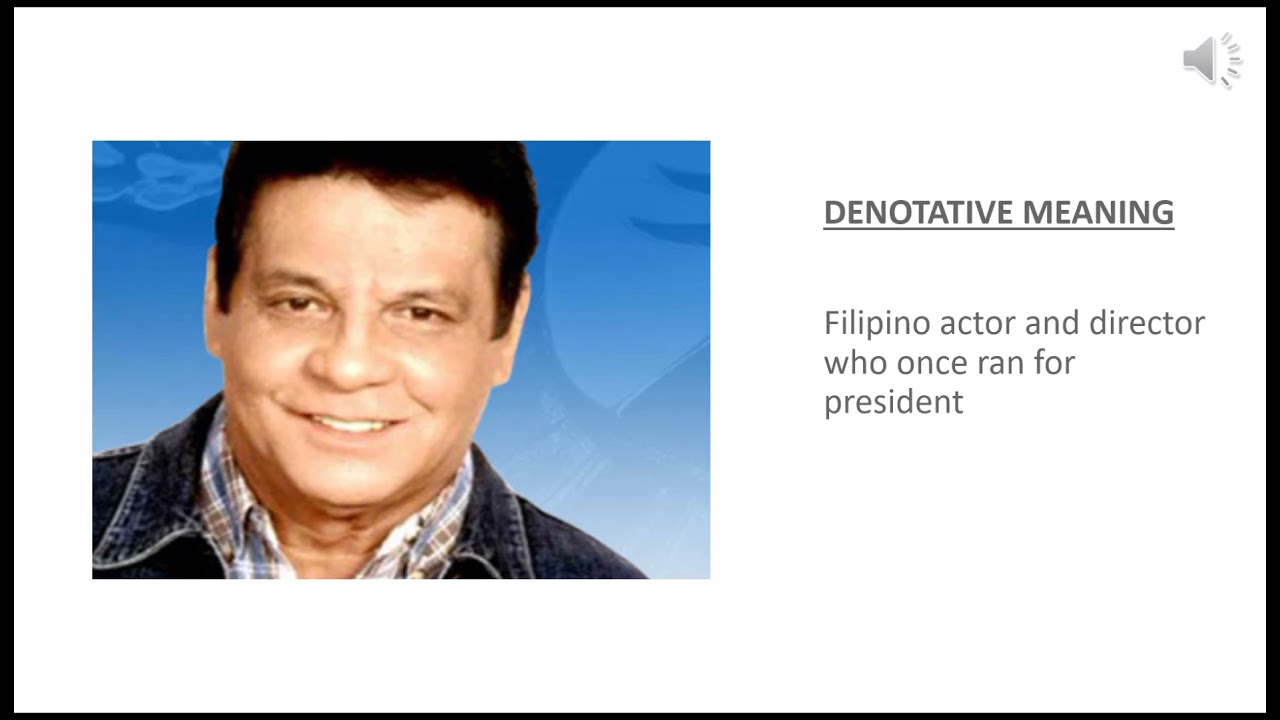
a concept or a word and the concept of the connotation which is the implied or culturally suggested meaning of the word here we have another example fernando paul jr right late uh king of philippine cinema now the denotative meaning or the literal meaning of fernando fo jr is that he is or he was an actor and a director who wants run for president of our country but when you talk about the suggestive or the cultural meaning of fernando vol jr it has come to mean the idol of the masses and the champion of the poor
meaning he became the physical embodiment of righteousness and justice okay i hope is already clear how we try to differentiate the meaning between genotative and quantitative meaning now advertisers often strive to pedal to the public not just consumer goods but also the ideologies and mystifications that they carry with them according to barts now in doing so habitually say through the frequent airing of commercials on tv the connotations become the natural common sense reality products now next we have the five stages in philip cutler's buyer decision process how does a consumer decide what to buy so
we have the five stages the first one is needs arousal or needs recognition the second one is information search the next one is evaluation of alternatives the fourth one is purchase decision and the last stage is the post purchase behavior or the post purchase feelings what do these stages mean let's look at the first one which is means arousal or needs recognition here the buyer has a need to satisfy or a problem that needs solving okay so there is a problem okay or a need to satisfy perhaps you're thinking how can i resolve this problem
perhaps okay i need to buy a new pair of shoes that is when the second stage okay in the process comes in which is the information search where buyers begin to look around to find out what's out there in terms of choice right say for example you go through lazada or shopi okay or alibaba okay you go through those um online sites okay online shopping sites to look for to search for information okay about the different choices okay that you have at least in buying a new pair of shoes now that's the second stage which
is the information stage the third stage is the evaluation of alternatives now sees the evaluation of the available alternatives this is when the buyer decides upon a set of criteria by which to assess each alternative it could be what it could be your budget okay that's the evaluation of alternative say for example you want to buy a new pair of shoes but then again you don't really have enough money to buy so you will opt to buy what a cheaper pair of shoes okay so you check upon the different alternatives say for example you go
through an online shopping site like lazada sometimes so you try to check on the different alternatives okay that's the third uh stage which is the evaluation of alternatives the fourth one is the purchase decision this is when buyers make the final choice of what to buy and from whom to buy it okay this is the stage when the buyer makes a decision on what to buy and from whom to buy it and after buying after purchasing a certain commodity the last stage comes in which is the post purchase behavior or feelings this is the process
where the product or uh the service being consumed by the individual or business okay the process continues even after the product is purchased because you think of the feeling after being able to buy a particular commodity say for example you were able to buy a new pair of shoes online and then it painted a deliverance and it was already delivered in your house and then that's when you tried to feel okay how how does it feel to have a new pair of shoes which is actually not so much quality okay say for example class a
bilimo or sometimes a but then again you feel very much satisfied so you talk about the post purchase behavior of an individual this is also the reason why in many online shopping sites right so were you satisfied where you'd be satisfied so that's a part of the post-purchase of behavior or feelings on the flip side of it john calvin a known theologist said that if we are only to pass through earth we ought to undoubtedly make such a use of earth's blessings as well rather assist then [ __ ] in our journey as i said
a while ago john calvin is a protestant theologian who argued passionately against the catholic doctrines espousal of asceticism when we speak of asceticism it is a lifestyle a radical simplicity a lifestyle of austerity often characterized by mental and physical discipline why is john calvin very much against the concept of living a lifestyle of radical simplicity because for him it is through the consumption of material goods that people can truly fulfill god's desires however he emphasized though that the material consumption and wealth accumulation should be done in moderation because for him a person's hard work justifies
his or her consumption what do you do with your income right it is only right for you to spend somehow your work um your income because that's the product of your labor that's the product of your work right the rich are assumed to be industrious lot whose wealth was willed by god the same logic applies to the poor people who perhaps the reason why they are poor is because they do not work as hard so their eventual deprivation of the divine beneficence or what we call the divine wealth are said to be disturbed meaning that's
the reason why god willed for them to be wealthy while the poor the reason why they are poor because they do not work and they so deserve to be poor because they do not work on the other side we know of karl marx who said that no production without a need but for him consumption reproduces that need we know of karl marx as the father of marxism now the marxist thought has positioned consumer culture within the capitalist economic model some academic disciplines believe in the consciousness determines society however for karl marx it's the society that
determines class consciousness the irony though is that the consciousness of the proletariats and when we talk about the proletariats this is the working class he believes that the consciousness of the proletariats or the working class is heavily decided for them by the wealthy people or the ruling class okay and the ruling class prevents the working class or the proletariats from developing class consciousness again when we talk about the proletariats these are the workers who have no means of production of their own but are thus forced to sell their labor power to buy stuff and pay
their bills on the other hand when we speak up the ruling class they centralize power okay to itself and performs the majority of political functions in a given society what is a class consciousness by the way this is the self-awareness of individuals belonging to a specific class which is used in this context as the workers collectively becoming more conscious of their rights and their ideological to the ruling class now we know karl marx as the father of communism now communism is very ideal in many sense but somehow the idealism of communism um can be understood
because somehow it is giving so much a voice to the proletariats or the working class what is the best way to do this according to karl marx the best way for people to be equal is to overthrow the capitalists and what provide and give all the wealth of the wealthy people or the ruling class to all the people so that everybody would be equal but that could not be so right because and another thing is that the downside of of the that concept is that possible so even though the concept of marxism or communism is
very much ideal it could not be so in the real world impossible that's the reason communism okay somehow dissipated in a way in our his history say for example you talk about china which was formerly a communist country but right now it is not considered as a communist country though there are still traces of communism in china at the moment now the marxist perspective also speaks of the concept of fetishism this is a rather primitive belief and it has its roots in anthropology that inanimate objects can be imbued with god-like powers and then you have
the concept as well of commodity fetishism which pertains to how certain goods are given high monetary value with no regard for the labor that went into their creation effectively such goods become fetishized commodities stripped of their human essence the danger here is that many people might then view said goods or products as if they harbor intrinsic value in not themselves even without human agencies labor in capital societies is often imposed and non-voluntary okay definitely it's not voluntary because uh in capitalist societies it does it's like that under such conditions individuals work to afford gratifying commodities
but never for its own sake thus work becomes completely separate from the individual as it contains little to no need satisfying value these leads to workers apathy and eventual alienation from one's labors because labor is devoid of intrinsic importance to the self the worker turns to consumption for it is only through it that they experience enjoyment the material itself to summarize our discussion according to william james is centered on the physical body with emphasis on one's material possessions the things that we buy okay everything that we own and the family to which one belongs now
these figures in quite prominently within the broader context of consumerism or consumer culture which tells of how consumption is normalized in a given society and not only normalized in a given society but consumption has been commercialized in a given society these naturally affects identity formation you become what you buy as our material possessions and preferred lifestyles slowly become extensions of who we are and that wraps up our discussion on cogito ergo consume consumer culture and the material itself again this is ss031 understanding the self and this has been sir e thank you for joining us
in our discussion today till next time mr yoga now signing off