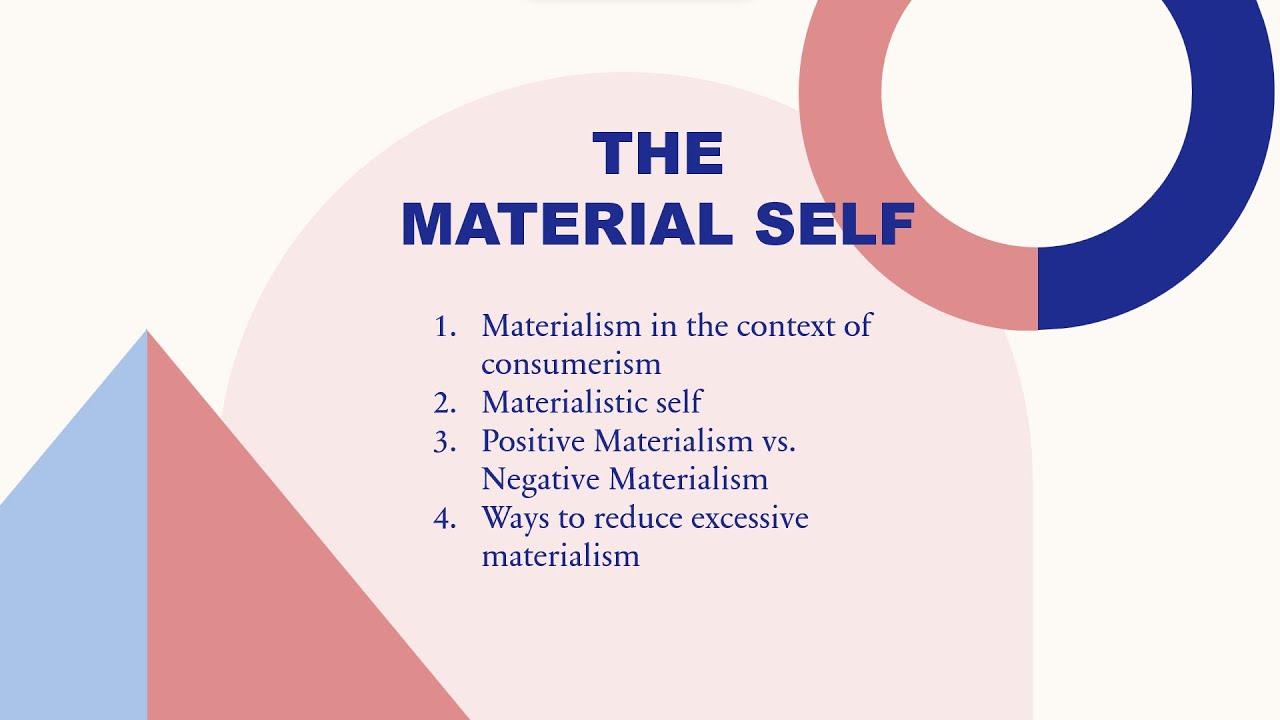
okay for today we are going to talk about material self also known as economic self and we're going to discuss concepts such as materialism and consumerism and what can we do in order to have more control over our behaviors okay so here are some guide questions to start this discussion okay look at this the first one is if a miracle happened and the problem that you have disappeared overnight so think of any problem you're experiencing right now and for some reason while you were sleeping a miracle has happened and your problem is now gone or
it was solved the question is how would you know that it was solved and what would be different okay and this is a question that psychologists typically use and you know what a lot of people will will they won't even think about it in detail and they would immediately say that perhaps when i wake up i would have won the lottery or i would have i would have three million in in um in my money or in my in the bank and with that all my problems would be solved so by saying that i'm not
saying to you that that should be your goal but rather i want you to know that there are a lot of people who try to pursue materialistic and financial desires and they think that it would solve all of their problems and sometimes it do but sometimes even though you don't have financial problems you deserve for more because you think that it would bring happiness again we have raised a lot of questions in psychology such as does money bring happiness and some would say yes but some would say no well now let's try to get the
perspective of what we call positive psychology okay so to bring that to bring that into the discussion i will raise the next question to you so if you win the lottery how happy would you be okay to make it better let me ask you on the scale of one to ten how happy would you be if you have won the lottery perhaps you would say 10 okay and there's no problem with that because that's a normal response to such situation however let's change the question ten years after winning the lottery how happy would you be
on the scale of one to ten you know what a lot of people would still say that there happened happiness will remain high however research ends in positive psychology and well-being would say that it's not as high as we predict why because eventually we get used to that kind of happiness and it's no longer new to us that's why our level of happiness declines it goes back to its normal level say for example your normal level of happiness is six you think that after 10 years of winning the lottery your happiness would still be a
10 however research in psychology would say that it will go back to six why imagine yourself being rich for 10 years then you will be used to that kind of of lifestyle and you will no longer see anything new with it okay so am i telling you that you should not desire um to be rich or you should not desire to have a lot of money well i'm not saying that to you but rather what i'm saying is that don't think that it's the only source of happiness okay why look at this third question do
you like to have a lot of do you want to have new gadgets do you want to have a new phone or a new laptop or do you want to have um do you want to have the latest gadget in the market right now okay so think of this situation compared to the previous generation we have more gadgets now and we think that more gadgets equals higher amount of happiness or the happier we are so if we're going to follow that line of reasoning we're going to say that perhaps this generation is a lot happier
compared to earlier generations because back then they don't have cell phone and right now i enjoy using my cell phone hence they're not as happy as i am right now okay so there's nothing wrong with such assumption but guess what coming from positive psychology it was discovered that we are not happier in comparison to people back then even with all the gadgets some would even say that our level of happiness is lower in comparison to them why because the more you acquire the more you desire for greater things and what we're talking about is what
we call materialism and consumerism and materialism doesn't only exist with material things but rather it may also exist in your desires for example you desire to have high grades it's not important if you learn nothing it's not important if if you did not really learn that much what's important for you is to have high grades i'm not generalizing i know that there are people listening to this lecture who would prefer to learn than having high grades but in my experience as a professor i know that most of the students would prefer to have high grades
because it would either make them happy make them feel superior or make their parents happy again coming from the perspective of positive psychology it would make you happy at first but eventually you will get used to it what if you're a top student your parents will get used to your high performance that if you lose or if your performance decline your parents will be unhappy but think about it you're performing well you're just being unhappy because you're comparing your life to other people materialism okay and materialism doesn't bring happiness according to the study of well-being
by the way i've been talking about well-being since earlier well-being is the psychological term for happiness or psychology or optimal psychological functioning or psychological health okay and there are a lot of studies that materialist individuals are less happy compared to non-materialists and what do i mean people who aim for non-material things such as fulfillment such as helping such as gratitude they are happier compared to those who think that they will be happy with the latest gadgets they will be happy with money they will be happy with higher grades sometimes we think that if we have
everything that we wish for in life then we're going to be happy to live happily ever after however 5 years 10 years from that change in your life your happiness will go back to its normal level and that's a phenomenon known as hedonic adaptation and if you're from the philosophy feel the philosophy you do know what hedonism is it's about pleasure so basically what psychology is saying is that your level of happiness from pleasure will go back to normal or in layman's term when you get used to things you're not as happy as you use
to be okay because of your materialistic desires okay hence we should not be we should not confine ourselves with materialistic desires and we should not engage in a lot of social comparison because you only have to compare yourself with your old self okay and the more social comparison you engage in the more unhappy you become and we're going to talk about that once again when we get to the digital self and right now i'm going to ask the question in advance does facebook make us sad okay so now let's proceed like what i've been telling
to you since earlier positive psychology shows that we are not statistically happier compared to previous generations because materialism does not make us happy but rather it makes us unsatisfied with what we have because with materialism you continue to ask for more okay you get used to to your cell phone then you want a better cell phone and materialism is close to consumerism okay and later on we're going to talk more about consumerism okay and going back to one of my questions earlier i'm going to rephrase it based by asking a new question let's put it
this way if you win the lottery will you quit your work okay and that is a question from industrial psychology and guess what they found out in in in you industrial psychology they found out that even though people win the lottery they would still say that they're going to continue working because they get some sort of fulfillment at work in other words we're not only motivated by money but there are other things that we look for at work or in life okay say for example as a teacher i'm not only motivated to wait for my
monthly salary i'm also motivated to continue becoming better and to see my students succeed as a manager you're not just motivated to go to work because of the salary but you're also motivated to work because of the sense of fulfillment that you get by mentoring your colleagues teaching the younger workers believe it or not i would assume that most of you are not yet working but you will understand what i'm saying when you are already working what if you earn a lot but what you're doing is so demeaning say for example i will pay you
to send hate messages in facebook or to post negative comments in facebook i know that there are people who do that for a living but the question is until when are they going to do that eventually they will look for some some other sorts of happiness because they will discover that it is not only money that they are after okay so the bottom line is this do not pursue the wrong source of happiness and it's not it's not something materialistic but rather look for something fulfilling and what is that later let's talk about maslow's theory
now coming from materialism let's now move on to consumerism okay so consumers are often viewed as victims of greedy companies so we think that the companies are the ones that are making us purchase their products and they are greedy however take note that we also have free will okay so learn not to patronize greedy companies who try to make a living out of your materialism okay try to be more critical of these companies try to reflect first before buying something that you're not going to need you're not going to need um in the near future
so are you go for example are you going to buy the same product that is being released every year for the same price however here's a catch they release even though they release a product every year they're not changing anything with that product but they still charge the same hence for example you've been getting the same type of cell phone every year just to know that you're keeping up with others okay but in reality you're just fooling yourself and you are helping these greedy companies okay in their in their mater in their own materialistic desires
okay so think about it first do you really need to purchase that or are you merely doing that just to please others or just to impress others take note that we have free will okay and with this free will let us use it responsibly to support companies who are more responsible who are not greedy companies who do something for a cause are companies that make it that where that makes product that are really worth buying okay so let us not support greedy companies you also need to think about it carefully if you're trying to buy
something reflect first is this a need or a one because certainly not everything that you want that everything that you see online is considered a need sometimes it's just a one it's not a priority okay and i want you to become aware that this is how needs differs with wants we have various needs according to maslow physiological when we say physiological this is the need for food the need for water the need for air etc and once we have we have been able to acquire these needs we move on to safety needs that's when you
purchase your own house that's or if you just think about it do i really need a new house or or is that something that i can delay okay or there are other ways to fulfill your safety and security needs did you know that in the workplace insurance is also considered as a safety a way to satisfy your safety needs because in case that something happens at least you are safe or you are stable another way to fulfill your safety need is by having a stable work so a lot of people were not able to fulfill
their need for safety and security if their work is not stable or if they work on a contractual basis that's why we want companies to sign their their employees with a regular contract so that we can help more people to feel more stable in their source of income okay then after that we aim for love and belongingness needs so this is when you when you have established good relationships with people and you become friendly with your workmates or with your or with your classmates and then eventually once you have these needs you eventually moved on
to move on to esteem needs and how do we fulfill steam needs for me it's a bit dangerous because sometimes it's team needs may come from inside sometimes it comes from the outside and sometimes our way of fulfilling our steam needs may be unhealthy okay and when we say steam needs this can be say for example award certificates learning going to graduate school attending a certain training or being the top student okay sometimes it can also be considered a steam need for you to have the latest gadgets however think about it it's your way of
fulfilling your needs healthy or unhealthy then eventually you would learn how to self-actualize when you when we say self-actualization in layman's term this is becoming what you really want to be or what you're meant to be say for example becoming your um dream um becoming your dream self or your ideal self like if your ideal self is to become the best to become the best professional that you can be then you should be then you are now self-actualizing a person is self-actualized if he or she has a full use or he or she can maximize
his or her talents or potentials and if you're going to read the theory of of abraham maslow his criteria in saying that you are actualized or not materialistic but rather for him a person is self-actualizing in different manners and most of them are spiritual or they are a quest for fulfillment say for example a person who is actualizing is someone who help others someone who doesn't um doesn't step on others or someone who doesn't demean others someone who doesn't take advantage of others someone who appreciates things someone who appreciates life okay so i discussed this
in our lecture for you to know that there are various ways to fulfill your needs and wants and there are certain needs or wants that you can delay because you want to prioritize something that is more important that's why that's why there are people who can delay delay getting the latest gadget if they don't have enough money to survive for the month that's why there are people who can delay going to graduate school if their family needs them for their safety needs okay and that's how we apply mass laws hierarchy of needs now this time
with by being aware that we can be materialistic and we can have consumerism as a lifestyle i would like to inform you of the different strategies that people may use to take advantage of your lifestyle and you should be aware so that you won't be exploited or you won't be impulsive in your decisions the first thing that i want to share with you is the foot in the door phenomenon which is used by a lot of companies okay say for example you will just be surprised that you bought the latest set of um you bought
a latest set of books from a certain publisher and then you realize that there's no need for such or say for example you bought the you bought extras for a laptop say for um for example you bought some new speakers or you bought some cables that you don't really need that's because of the foot in the door phenomenon so what's the put in the door phenomenon if if someone does this to you at first they make you agree with small requests okay say for example imagine this situation you're walking in the mall then someone approaches
you and tell you that they're selling something for 100 pesos and because of that you were amazed that they sell something for a low price so you enter their store to inquire for more then eventually you will just realize that and the bill that they're giving you i've they offered you a lot and they made you say yes to a lot of things and then your final bill is around 3 000. imagine 3 000 is has a lot of difference compared to the initial request which is 100 pesos so there are people who are trained
to do this okay they can make you agree on something even though they can make you purchase something that you don't even need because at first they made you agree on a small request then we have the tendency on on agreeing even on other requests and we don't notice that these requests are getting bigger or heavier okay so at first i will just sell you one gadget but i will tell you that you cannot really use this gadget without purchasing this if you buy this i can include this in the package and i can sell
this for you to you for only 200. or if you want you can purchase this other package and then if you purchase this it has a lot of freebies and you can get this get this for just 500 and you will save 300 for doing so so you keep on saying yes and saying yes and saying yes until eventually you will realize that you have said yes to a lot of things and you don't know how you got to that scenario how did they end up here how did they end up buying a tv that
they don't even need they started with a promotion for for some new speakers okay so that's the foot in the door phenomenon and this is not only used in in marketing but this is also used in say for example asking for favors sometimes they can also be used in tricking people here in the philippines we have what we call the buddha gang wherein they will they will ask you to give them money and then eventually you will realize that you're losing a lot of money there are people who would say that they've been scammed and
they don't know that they've been scammed because they would say that they were code and uncode hypnotized however from the viewpoint of psychology we don't believe that hypnotism works in that way hypnotism cannot make you do things against your will you can only be hypnotized we can only make you do things if at first you agree on we agreed on something okay so that's a topic for another day so what i'm saying is that you're not being hypnotized by these scammers but rather they are just using their foot in the door the foot in the
door phenomenon they make you agree on something and then they will request for one more time then you're going to agree again and then you're just going to ask the question how did they end up here so your assignment is think of a personal experience wherein you experience the putting the foot in the door phenomenon or you can just search on the internet of some of the biggest examples of scams that is fueled by the foot in the door phenomenon other than that we also have what we call the door in the face phenomenon this
is the opposite of the foot and the door in the door in the face phenomenon you make a an extravagant request that is so observed and then because you know that you will be rejected you are now proposing another request that is reasonable look at this example on the right person a told you can i borrow a hundred dollars and then you say that no i don't have that much but then he would say okay but can you make can i borrow ten dollars and then you let him borrow that amount but let me ask
you if he didn't ask you for one hundred dollars are you even going to let him borrow ten dollars so sometimes this is another strategy that people use they make crazy requests that we're going to reject so that our reasonable requests can be accepted our their reasonable request can be gratified they make us feel guilty for saying no so they make a reasonable request and we're going to say yes to such say for example you're looking for um you're looking for something in the mall and the price is 1000 and you learn that in this
package they have a lot of inclusions that you're going to save a lot and then you're going to say that no i don't have 1000 right now i only have 200 so is it okay if i just buy this one instead of buying the entire package and then you end up with a new object or a new um product that but come to think of it are you even going to did you even plan on purchasing that product or were you just guilty that's why you bought it so the message from this discussion is before
saying yes to something be aware of the different strategies that they're using because there are a lot of things that affect consumer behavior such as sales such as um promos okay that are not really think of before you purchase something think about it do i really need this or am i just guilty or am i just persuaded that's why i'm doing this okay knowing all of these things i want to close the discussion with these messages so the first one is that knowing that you have free will and you are not and you are not
being forced in purchasing things you just feel guilty that's why you purchase those things i want you to exercise more intellectual independence okay and be aware that consumerism controls your life and as much as possible if you think that something is not necessary something is not even needed ignore advertising because advertisements have have feeds on consumerism that's why and materialism as well that's why we are being succumbed into the different strategies and we want to purchase things that we don't even need and consume less and live more invest more on experiences than on material things
because like what i've been telling to you since earlier materialists are less happy okay and try to look for other types of happiness and you that's the type of happiness that you get when you help people when you pursue your passion when you when you um try when you do your hobbies for example studying reading okay and that's not the type of happiness that money can give us all the time and this is not to say that money is something bad or evil but rather know um or know how to wisely spend your money okay
because there are things that are more important than others so that's it for this discussion and thank you for listening