welcome to lesson one on the instruments of Canada's foreign policy we will learn about what's called liberal or pearsonian internationalism this is the first lecture it gives you an idea of the pacing of the focus you can see the captions do not correctly translate what I am saying PowerPoints captions are very poor and it would take me too much time to fix the captions instead we will use YouTube I will export this to YouTube channel and you can watch it in English or any language that you like YouTube is responsible for the correct caption I am not what I say and what I show you on the PowerPoint is what will be tested not the incorrect captions below let's launch into our first mainly historical lecture we're going to begin with the golden age of Canadian diplomacy so we're going back to the 1940s and the 1950s and the reason for that is because of the influence of Michael Pearson or Lester Pearson that was his official name Mike Pearson and he was the under Secretary of State for external Affairs we used to call the Department of Foreign Affairs the department of global Affairs and before that was the department of external Affairs so I'm just mentioning that because he was the most senior Diplomat for a very long time and then he became the leader the official leader of the opposition so he headed the liberal party for many years and then finally he was elected prime minister in 1963 right after the Cuban Missile Crisis until 1968. so you can see he wrote three volumes of Memoirs which are all very interesting and then you can see some pictures there of him including a statue so the golden age is so important that that statue is featured in front of the parliament in Ottawa and there are so many Canadian diplomats that were hailed around the world of course they were all men but at that time men went to work in the 1940s and 50s and women there were no women diplomats which is extremely interesting in hindsight so who were the male diplomats that were so famous there were many of them Ascot Reed who wrote quite a few books later John Holmes wrote many books George ignati if I'm going to show you a book Norman Robertson was quiet but he was very senior Arnold Heaney whom I'll show you a minute a picture of Odie Skelton Hume wrong and basil Robinson whom I had the honor of interviewing many years ago so here's a picture of Lester Pearson at the on wearing the bow tie which he often wore and then in the middle was the secretary uh uh I'm sorry what am I saying Anthony Eden from the United Kingdom and Dean Atchison on the right so he was the Secretary of State for the United States so this is a very senior meeting here are some more pictures you can see Lester Pearson laughing up at the top back row and you can see in the middle various people including John Foster duddles Dulles in the middle CD Howe very famous diplomats is another picture so you can see you're getting the idea of Pearson enjoyed himself he talked about baseball he was a happy guy everyone enjoyed being with him there's Dwight Eisenhower the Prime Minister and then the prime minister of Canada Louis San wrong before Stephen Baker then one final picture here of Arnold Heaney who was the under Secretary of State when he was just coming out there of parliament in 1949 after the war and Pearson the Golden Age and it led finally to uh Pearson at the United Nations getting the Nobel Peace Prize which I'm going to talk to you about his uh his eye again a 1952 the president of the um Security Council the rotating U. N security Council so why did the Golden Age end there are a lot of reasons there was of course uh the rise of the superpower rivalry in the beginning of the Cold War but there was also the rise of other middle powers like Canada so other countries like Brazil and India and Mexico came to the foreign Canada fell down in comparison to them we also had the Marshall Plan maybe we'll have a Marshall Plan 2.
0 for Ukraine I've just written an article on that in the hill times but it's the idea that we would re-impose the Marshall Plan and have one for Ukraine so why did it succeed billions of dollars went into France and Germany and into the other smaller powers there was also less reliance on International institutions like the UN as there is today who was famous I mentioned some of them but another famous Diplomat was George ignati of pictured here who was a very much into peace his son Michael Ignatius ran for prime minister so George was fluently bilingual in Russian and in English there's Pearson again bowtie so what were the main accomplishments there in hindsight probably the establishment of NATO at that time with 12 members and the imposition of the Canadian Article 2 which asked for economic and social collaboration and cooperation so they really emphasized article two John Foster Dulles did not want to insert it into the Washington treaty but in pressure by the Canadian diplomats who were so good at what they did brought that in now in hindsight it's Article 5 which I've talked to you about that is so important we also had under in the Golden Age the establishment of U. N peacekeeping forces so I'm going to talk to you more about that the blue helmets we need to return back to the Suez Crisis and it seems people keep saying right now oh the Ukraine crisis and the Korea crisis could we have a crisis two crises could we have a Taiwan Straits crisis so what they're referring back to is two crises way back in 1956. one was over the Suez Canal the Suez Canal shaped shapes and controls the flow of oil so it shortens the X the export of oil from the Middle East to Europe and to the United States the problem was that Egypt planned to build a huge Dam called the Aswan Dam it's now built and the United States and the United Kingdom suddenly withdrew their financing of the of the dam so this made the leader of Egypt very very angry and so he decided to nationalize that the dam which was too risky so here's the Suez Canal you can see it is going between the Red Sea where is my pan uh here we are and uh going into the Mediterranean Sea to get out to Europe and this is a picture of it from from the from not space but fairly High the Suez Crisis happened at the same time as the Union of Soviet Socialist republics the former Russia now the Russian Federation invaded Hungary and they invaded in 1956 with pretty well no notice just like this invasion of Ukraine crisis so it came as a complete surprise you can see that President Eisenhower and the U.
S Secretary of State whom I just showed you John Foster Dulles in the state department were taken by surprise they decided uh what to do well they did not realize that the French and the Israelis and the United Kingdom were secretly meeting to discuss a detailed timetable without telling their NATO allies of what they plan to do they plan to to invade so Israeli forces crossed the canal and they attacked Egypt on October 29 1956. so this came as a complete surprise to everyone there were negotiations that the U. N meanwhile these great Powers were negotiating or were secretly planning to attack Egypt there's a picture of the canal again and some pictures from the 1950s of the different coalitions and so on the U.
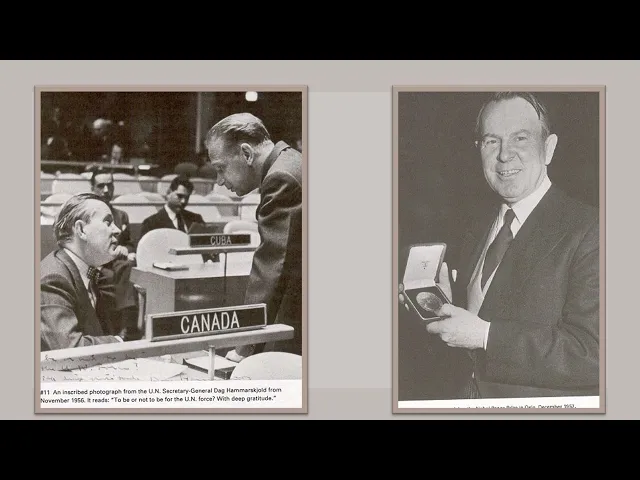
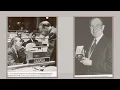
S officials and the Canadian officials recognize that the Israeli attack had a lot of implications it wasn't just Israeli but it was also nine Kingdom in France it could turn the Arab world against the West it would Aid the USSR in terms of propaganda it would divide NATO and it would undermine the other nations so they were very shocked that even though they were having these negotiations that the United Nations the United Kingdom France and Israel had lied about their intentions what to do Pearson I put a picture of him thinking thinking thinking thinking he can see that there's four huge shifting things to remember here first of all cooperation among among the United Kingdom and France Canada's mother countries so the United Kingdom and France were were our mother countries then and cooperation with the United States our closest neighbor and a super flower was threatened so he's thinking about the shifting superpower and middle power alliances and he's concerned obviously he's worried NATO can fall apart he had tried to put NATO together the United Nations which he worked on for so long was also being undermined and threatened by this the Commonwealth which Canada was a part of and continues to be a part of the English-speaking world ruled at that time by the queen Queen Elizabeth this could also be divided and to add to it add to the crisis the USSR attack USSR attack on Hungary was a problem so in 1956 it looked as if the West Was going to Simply allow the USSR to use Force to settle disputes just like today where the West has Allied strongly against the Russian Federation and even in Europe despite gas shortages and despite problems the West is Allied so Pearson was idealistic he was What's called the liberal internationalist and that's why Canadians are seen as different from Americans because of our liberal internationalism I'm going to explain this in more detail because you are the inheritors of that philosophy which competes against the USSR idea of invasion and the Russian idea of invasion and the use of Armed Force ideas were lauded Pearson received the Nobel Peace Prize in 1958 actually I've got to correct that because because he he for his behavior in 1957 but he got it in 1958 and he helped establish the United Nations emergency Force the general who helped him was Elm Burns he was a Canadian General and he was in charge of UNIF one so there's Dad camera schools he was killed later he was a great poet as well so there you can see Dad camera School talking to Lester Pearson about what to do and there's Pearson holding his Nobel Peace Prize metal the U. S to States Department was involved behind the scenes and this is according to different accounts by Pearson and the U. S ambassador to the United Nations Henry Cabot Lodge Lodge had the draft from the United States state department of the idea of a Pearson peace of a peacekeeping force and he realized that Pearson could possibly put it out on the U.
N General Assembly stage so he had the draft he saw Pearson he said the U. S would be very gratified if Canada would sponsor the resolution Pearson speedily read it quickly made up his mind saw the hidden meanings and hooks and he sponsored it in the U. N General Assembly so according to Henry Cabot Lodge I have never seen a man in a forum pick up and comprehend a complicated thing of far-reaching implications and then get recognized and get the floor and propose it immediately so here I ask you did he deserve the prize yes he put in place an idea it had been circulating for a long time since the 1940s but he put it in place an idea whose time had come and that's what we're going to be talking about today is the ideas that you have in your toolbox because you may get the opportunity at some point to put your idea in place in the idea you have in your toolbox you may get the Pierce you may get the Nobel Peace Prize you might become Prime Minister imagine that so here you can see Lester Pearson with a Trudeau and uh Diplomat and a politician greatly admired all around the world there are more books I mean imagine more books so many books written on you oh let's talk about some other lessons that Pearson didn't really want to talk about as much but these are lessons from the Vietnam War from the 1960s Canada was involved in into China that was the old name for Vietnam way back since the 1950s and the Geneva conference but those International commissions just did not work so Canadian opposition to the War Began to rise in 1960s in the 1960s but in 1965 due to the U.
S bombing of the Vietcong which was the group in Vietnam that was fighting and the U. S bombing of North Vietnam which was terrible so Pearson's famous speech at that time is called his Temple University speech and it departed from his usual policy of quiet diplomacy you saw how he worked behind the scenes at the U. N and at NATO and negotiated quietly he was an advocate of quiet diplomacy so here's a picture this famous picture of an absolute assassin killing which was in the newspapers and there's a movie there's many movies you can watch on the Vietnam War that's from a movie so Kirsten's speech in the middle of the Vietnam War was quite surprising actually he did it in the president's own backyard and he was very critical he said that there should be a pause in the bombing in the interests of peace and negotiations and a ceasefire so Canada's ambassador to the United States Charles Ritchie who wrote many books later was summoned to an angry meeting with the U.
S president Lyndon Johnson and an advisor who was also quite famous with George Bundy at count David there the U.