All right so hello everyone this is a lecture primarily for beginners but not really this is crash course in debating but it's also Advanced argumentation for beginners let me explain David and I um my best friend uh formulated a lecture that we designed for high school students when we first gave this lecture Series in Hong Kong and we thought together how could we ever condense the most Important topics that we could ever make or that a debater needs in order to grow very quickly in this Sport and if there are any three concepts that I
would say any debater should focus on improving and get better at as they continue to train more and more and get familiar with more and more emotions it would be the topics of framing contextualization and layering and so I decided to condense it even further For uh any high school student even if you're are a beginner even if you're a novice even if you've never been in the sport of debating at all um and I hope that if you watch this video or go through even just the middle part of it or even one session
of it or one module of it I hope that you could take the simple lesson that debating is not really that complicated it is a science it's an art it's a performance but inevitably it's all just critical Thinking and a process of unpacking what the debate is really about and of course I hope that that's a skill that's Universal for anyone um not just for those that want to get deep into competitive debating and not even just for those that are in British parliamentary debating which I specialize in but but for those that are here
in debating just for the activity and the immersion of what it is like to think like a debater all right so there Are three parts for this presentation and lecture today the first is going to be on what Advanced Debaters would call framing but what I would call for this lecture as simply as asking the right questions or reading the motion it's important to read the motion properly it's important to understand what is going on in the debate and realize that it's not just as simple as X or Y but it's also something more than
that second I'll be talking about how you Frame your arguments which you would also identify as contextualization or setting the debate explaining what is going on where the debate takes place and what are the conditions in which the comparative of of the debate is set and then lastly um I'll be talking about making specific characterizations which is what I would call a lesson on layering which is detailing the reasons as to why something is more Likely to be true not just to be true all the time but because debate exists in the vast majority of
cases it is unlikelihood which is why we argue things to be more likely than not so again before we go into the nitty-gritty of each and every module I want to preface all of this lecture by simply explaining that when we are going through a motion when we are unpacking what the debate is about we are doing The exercise of critical thinking we are asking what do we need to accomplish so that we could persuade the judge that we are winning this debate and and to do this we employ certain heris sixs we employ certain
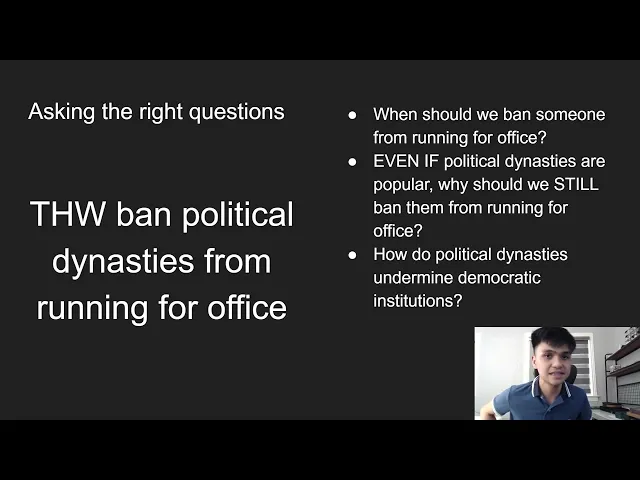
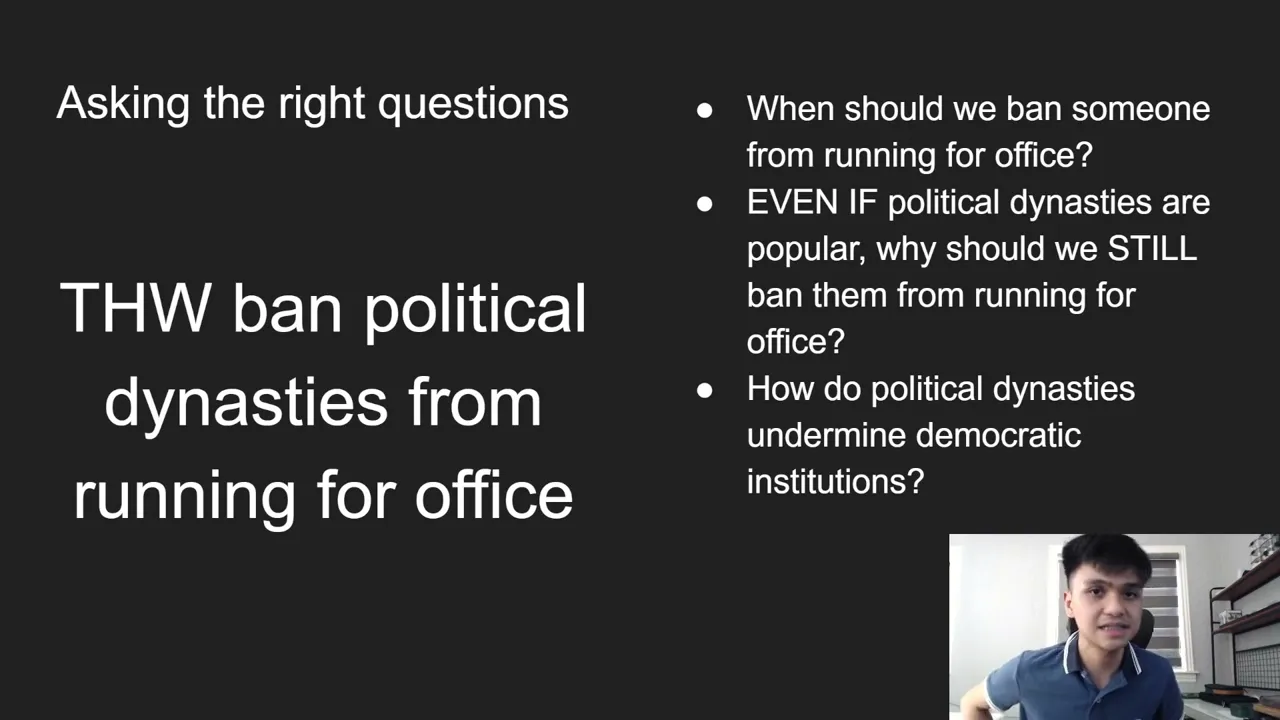
critical thinking strategies and and that is what we are presenting in today's presentation because there is a science to it there is a process to it and and that is what we want to work with so firstly it's important that we ask the right Questions any debate you will be presented with a motion and the motion will ask you to State whether something is true or to do something and argue as to why a certain policy should be implemented or why something is good for a certain consequence or whatever for this motion if it were
this house would ban political dynasties from running for office we would ask ourselves the question of first what is a political Dynasty intuitively you would know that A political Dynasty is a family of politicians or a political family that is in power you might go further and explain and characterize that this political family might likely be entrenched in power or embedded in power for a very long time or has been embedded in power for a very long time and you would argue in this debate if you were government side or proposition side that you do
not want them to run for office that you think they should be Banned for running for office and it's not just that the debate is they are bad politicians which could be one of your arguments but it is also that they should not caign at all that they should not even be on the ballot box and so when we are unpacking how we should argue this motion you might intuitively come along a set of reasons as to why political dynasties are probably bad you might say that they are likely to be corrupt because they associate
with Themselves and they entrench themselves in power over and over you might also argue that political dynasties um prevent other politicians from running for office because they're very very popular because they're they have name recognition because of their last name uh and because a lot of individuals um do not see why any opposition party should take over them and so you might start off your question your questioning process with asking when should we ban Someone from running for office and I hope that this question should already interrogate your first argument because your first argument was
premised on oh they're they're just corrupt they're just bad they are not productive for our government and our democracy because they always want to gain more and more power they always win elections because they are popular but that in itself is not a reason as to why we should um ban someone for running for office do we Just ban someone for running for office just because they are bad politicians do we ban someone for running for office just because they are um corrupt that's not really the main question we are asking here because opposition would
run an argument in this debate or they have the opportunity to run an argument in this debate and it's not just any argument it's a very strong argument that democracy is not always about Whether politicians will be good or will definitively be the best at making the best policies for the entire country but it's about whether they feel that a politician repres presents them best and often times if that overlaps with individuals that have name recognition that are popular that they voted over and over again in past Generations as previous administrations that they trust because
their lived experience can never be approximated by anyone else because You cannot vote on their behalf then the spirit of democracy truly is that you should allow someone to vote and that vote should stand and so our first argument on politicians being of course corrupt or political dynasties being corrupt and entrenching themselves in power is not accurate yet we must specify the question and so we might ask another question to deepen our first question instead of just asking when should we ban someone for running for Office we'll ask the question even if political dynasties are
popular why should we still ban them from running for office and here you might unpack an even deeper reason that you're challenging yourself to reach that again it's not a debate on whether political dynasties are good or bad or whether they are corrupt or not but it is whether even if they are good or bad or whether or not they are good or bad whether or not they are corrupt or not What are the conditions in which we should promote democracy or not or in this condition or in this debate whether or not someone running
for office promotes Democratic representation more or not and I hope now we've revealed What the deeper question of this debate is or in advanced language it's the question of what is the true comparative in this debate what is the debate really about and the question of the debate is is it Legitimate for us to undermine someone's vote to stop someone the public from voting for a political Dynasty and power for the sake of protecting some value of democracy right it sounds kind count kind of counterintuitive we're undermining Democratic legitimate votes in favor of protecting democracy
and that's the question we might want to ask here we might ask the question how do political dynasties undermine Democratic Institutions we might argue at government side that opposition makes the fundamental mistake and assumption that just because people vote on politician and political Dynasty into power that they always want and always consent to that particular political Dynasty to always win elections over and over again to control government in all of its spheres over and over over again and so if we can demonstrate that this vote Undermines one future votes of future Generations because political dynasties
incapacitate opposition movements and two because they fail to fulfill their own promises in their campaigns and they suppress Democratic representation by hijacking and controlling electoral cycles and campaign processes then we can demonstrate that they undermine the very Democratic institutions that elect them into power and so here of course there's So many beautiful arguments you can make here that now we've revealed that hey it's not just about a political Dynasty being corrupt or not but it's about incidentally how a political Dynasty because of their corruption right number one we could argue that they hijack campaign process
proc and financing processes because all the money goes towards them and they Flood information and even disinformation campaigns during Electoral processes such that they undermine every other candidate that runs for this office so it is structurally the case that no other candidate can win this election because they don't get enough screen time because of this political Dynasty entrenching themselves in power in the campaign process number two during the administration in which they are in all office they concentrate power political parties on themselves creating Super majorities by continuously forcing other candidates to always align with them
because they concentrate appointments on the family members they always appoint cabinet members and uh individuals who run state-owned Enterprises etc etc to continuously allow themselves to gain more power and more money and then lastly the future elections become harder to contest because of the previous two reasons that we've Demonstrated now again I want to highlight for all of the beginners out there whether or not you reach the advanced level argumentation of just giving the many reasons as to how they undermine Democratic institutions the point of the question or the point of this exercise is we
want to be very interrogative with our questioning process we want to un pack what is the deepest argument we need to reach what is the true debate what is the true Comparative we are asking and here the simple question we started off with on whether political dynasties are good or bad or when we should ban someone from running for office allowed us to reach the eventual question of how do political dynasties undermine those Democratic Institutions and so we don't really need to scrap all our arguments or our initial ideas of course we're still running the
argument and idea that political dynasties are corrupt but We're not making that the center point or the main the core question that we are asking or answering in this debate instead we are utilizing our initial idea and we're reframing it we're re repackaging this question under a more precise and more core question of for the debate which is how do political dynasties undermine those Democratic institutions let's do some examples I hope this is fine with everyone um we're going to do a modu and then we're going To go into a brief set of examples to
demonstrate what we wanted to learn here and then we're going to keep on going here over and over again so I'll encourage you now at this point um once I pose the motion and I ask the initial questions to pause the video at a certain point and then we're going to go into the answer or how you would process it yourself so for example if the first motion or the first exercise where this House supports nationalism of course from our initial you know the initial question we were asking or initial exercise we know that the
debate is simply not about whether nationalism is good or bad we know that it is not about whether nationalism is good or bad instead we want to ask a deeper question we might first ask an initial question of course we might ask the initial question why is nationalism important or why do states use nationalism or how do They form nationalism how has nationalism become relevant over time and of course you might generically argue that nationalism is important because of national identity because of unity because nationalism promotes a common identity and you you might think to
yourself yeah this is a great argument of course it must be something about whether national identity is good or bad right you might make the argument that being part of a nation is great Being part of a state is great being part of a country is great having a nation a government to align with is great we follow the same laws we elect politicians under the name of our country we segment ourselves against different countries under our name we protect ourselves on that basis and of course that is a great way to formulate your argument
but I would argue it's currently imperfect it's currently Incomplete and this is because the way you are reading the motion is too superficial right remember debate is always comparative debate is arguing whether something is good or bad under specific terms and conditions or in debate language under a certain metric a while ago we were not just arguing whether iCal dynastes are good or bad in general but we argued whether they were good or bad in the context of democratic representation and in the context of Promoting Democratic institutions as the way we formulated our argument so
here we want to look for that metric we want to ask more questions to unpack what that metric is and here you might think okay what is the best opposition argument that they could possibly run and they might run several types of arguments they might run an argument that says oh nationalism is very extreme nationalism is very extreme it's very racist it leads to Isolationism it leads to discrimination it leads to an Us Versus Them narrative that says that if you are not American if you are not Filipino you do not deserve to be part
of our nation and thus you are lesser you are deserving of less rights you cannot vote in our political process and therefore that is why you must be given less privileges in our democracy and opposition might of course argue that this is of course they're very very bad they argue that it Leads to the Discrimination of minority groups that it leads to a segmentation that some people because of ethnicity because of race are privileged because of nationalist discourse that promotes that to be the case or they might argue that you know it it impedes on
the process of a common human identity because now oh certain National identi entities are privileged and seem to be more important than others like for example um developed Nations uh try and Hijack um Global processes because of how they say that oh um a White Man's Burden is simply more important of obligation structure that we must pertain to as as opposed to the developing world for example and the nation states that are formed in these places so it's still based on on discrimination otherwise that it nationalism instead impedes on that process so if you were
government side you're Asking the question now okay all right we want the unity argument we want the national identity argument but we want it to respond to the opposition case in both instances of whether or not they say that they want a common human Identity or whether they want to you know um reference and represent minority identities like smaller identities that are also discriminated in both cases remember opposition's argument is that nationalism impedes on That process because of extremism and and discrimination and all of those things so now we've now unpacked the deeper question in
this debate pause the video here if you haven't reached it yet really think about this for a moment all right if you've paused it now I'll give you the answer now the question is not whether nationalism is good or bad in general but the question is whether nationalism as a means of Collectivizing is preferable to other Collective identities that would have formed absent nationalism and here you would now argue that absent nationalism it is quite easy for every Regional group every group that is in power whether it it be states on the basis of white
majorities and econom IC power in class or on the basis of geographic isolation on the basis of those Same easy to defer to characteristics on ethnicity race religion those Collective identities are easier to pertain to absent nationalism because of how easy it is to exploit those asymmetries that will always exist on either side of the house and so you would argue now that nationalism compared to any of those Collective identities is the easiest and most compromising collectivizing identity that unifies the population because of a Nation in an ideology that is created through history through struggle
through common problems and common Traditions common cultures that we strive to always align with and now because you've asked this question we now know how to make this argument we now know that the argument is not just on unifying populations but it's unifying them at the expense of them deferring back to even more violent and More discriminatory Tendencies of other Collective identities that would have formed otherwise and now of course this responds to both cases of opposition you respond to the fact that nationalism in fact in fact impedes on the process of global identity and
your response to that is that nationalism doesn't do that it actually moves us closer to that Global identity because absent nationalism it Defers back to the most raw and easier to defer to Collective characterizations and Collective identities that are more violent and more discrimin and on the other hand of course nationalism is the is the solution to the problem of those same things all right and now of course whether or not you're an advanced debator that is able to explain this and how this is done you know in respect in response to colonialism um with
respect to how National identity is formed through the processes of like let's say um uh history making history writing education systems maybe to the extent historical revisionism or even in the process of creating a Common Language and and all of those other things whether or not you detail it in that particular way yet the first thing you wanted to go for is that you wanted to identify the true comparative and of course here the true comparative immediately was that Nationalism um actually resolves those problems rather than enables it to be the case and and that's
the core contention in this debate second let's say the motion was this house opposes organized religion now here again I hope you're getting the hand of the exercise here the debate is not whether organized religion is good or bad nor is it about whether religion is good or bad it is about whether organized religion or religion is good Under specific terms and conditions under a particular context and here of course you might start off with a very superficial question you might ask where whether organized religion has promoted more good in the world or not or
you might even ask a more characterization based question you know it doesn't really matter whether you start with a good question or not you just want to start with a question that You could work with you might ask another question on what is organized religion you might answer organized religion is a hierarchy it is a hierarchy structure it is how religions have organized under larger communities of people created doctrine that they have codified for many many years because of the institutionalization of religious structures and also because it allowed themselves to cement themselves and gain Power
through let's say financialization concentrating money and resources and chartiy organizations or also through Simply Having um structures of hierarchy and power like having a pope having a a leader a religious leader an elder and being able to dictate those terms and conditions of how the religion should dictate its rules and processes moving forward throughout history because of that power and accountability structure that they allow themselves to pertain To so here you might have started with that question you might have defined organized religion and now you want to make an argument that says that you know
organized religion is bad right of course you might say that organized religion is is definitely very discriminatory because it's bad for let's say minority groups it uh impedes in the process of um allowing people to Define um what is valuable to them because someone else defines that for Them and you might do all all those other things right all the other simple reasons as to why religion might be bad or organized religion might be bad the question of course does not simp please stop there the question has to accommodate the core contention that opposition also
might engage the debate with and of course opposition might also agree with some of the reasons why religion might be bad right religion can sometimes be oppressive religion can Sometimes be very hard to access and religion might not always be good for everyone all the time right religion might not always be good for the world all the time right so it's kind of it feels like there's so so many multiple debates going on so if we want to specify one argument and one metric that we could angle our argument towards right you don't want to
just make a general argument that tackles everything you want to make an argument that Tackles a particular contention and one of those contentions might be right opposition argues in this debate that religion can be bad religion can be discriminatory religion can fail to represent the needs of people so this debate is not on whether or not religion does that or not but it is about whether organization promotes that to be the case or the process of organization allows that to be the case and so here I hope if you've paused the video and Thought about
this emotion already now you've unack okay now this debate can be about whether organized religion undermines personal faith or not do or organized religion promote a personal faith or not does it allow individuals those that would have otherwise been inclined to seek religious emotional healing and emotional purpose on either side because religion could be important in that sense does it allow that enable It to be the case or does it undermine it to be the case such that they are moved away from religion and here at government side now you could specify the argument further
now your argument is not just that it discriminates minorities it's not just that it's bad and it promotes conservatism but it's that organization because of let's say what I was saying earlier the process of creating strict doctrine that you should adhere to that Cannot be contested by anyone in the future with other interpretations or or the process of having a community and a religious hierarchy and and and someone that is very privileged in power to dictate what is correct in the religion or not to to represent the will of God or the will of religious
elders and religious um Divine people and divine figures you would argue that that itself makes it harder for hard and harder for individual members of that religion to Always relate to particular aspects that are more more attuned to the signs of the times and and the daily struggles that they face because future Generations continuously face different problems different belief systems and that that that and and then religion is not equipped to evolve with those processes or with those identities that are continuously Changing so the argument again is not in a vacuum of whether religion was
bad in general in that context but what we now we angling it towards the process of evolving identity we're angling it towards the process of personal faith and how someone changes and so now we've made a more specific contentious issue in the debate that opposition now has to respond to now opposition if they were just to run the argument that oh religion is unifying And it's great for community in general now even if they've had a better argument than the initial formulation that religion could be good in general right they did it in terms of
community now that argument would still not be enough to respond to your argument on personal faith and on evolving identity so I hope you're realizing here that debates are continuously evolving so long as you ask more specific questions and and when you ask specific questions To to reach the core contention of the debate it allows you to identify what the true comparative is again in advanced language this is a true comparative it is identifying where the debates most contentious aspects lie next last example for this module let's say the motion was this house believes that
states should intervene to slow down the development of generative AI of course I hope everyone here knows what generative AI is generative AI Includes chat GPT or includes other um technologies that employ language learning models and of course um different degrees to which artificial intelligence is improving or not so of course um the debate here as we have continuously identified is not on whether generative AI or AI is good or bad nor is it whether the development of generative AI is good or bad and nor I hope you are also getting the hang of it
it is not also only whether slowing down The development of generative AI is good or bad in general right I hope you're getting the hang of it the debate at its most contentious core is always about whether States intervening to slow down the development of generative AI does more harm than good and so and I I don't want to go through all of the nitty-gritty of everything that we've done gone through initially you could pause the video here and go Through that now but now I hope as a beginner debater you've already identified now we
could ask a question of does the intervention of States promote better development of generative AI or does it not promote better development of generative AI let me start off with a super superficial argument okay now you might start off the question of oh um generative AI does it disrupt industries does it worsen job Losses does it actually lead to a better transition into a newer labor market in the future right of course you might argue that uh generative AI disrupts all those jobs people lose a lot of jobs and the other side might say that
oh no but you could change those jobs you could rescale and retrain them and then maybe one side of the debate is asking a specific question that says oh no um if we slow down the development of generative AI it might allow us To promote a slower regulatory process in which the state could intervene to Res skill and retrain a lot of the workers that would have otherwise lost those jobs and that's a fantastic argument already by the way if you reach this point you're already like better than most Debaters in the world right I
want you to note this is already a fantastic argument but we cannot stop there we cannot stop there it's not only merely on whether slowing down allows Regulatory institutions to intervene and make it better but it's whether States would do this productively or not and here you might ask the question on does State intervention promote better regulatory control over de the development of generative AI or not and here here you might say a brilliant argument this is the most brilliant argument in my opinion for this type of debate that on one hand opposition may say
the Intervention from States is unproductive because they pick and choose certain monopolies that they would protect right that they would control because of creating barriers to the industry of other institutions that cannot enter because of the slower development process of generative AI so those that are already existing players they control more and more and hold more and more of that market share and so it Becomes harder and harder for us to regulate these institutions but if you were government responding to this brilliant argument you might even say and contest that it is exactly the rapid
development of generative Ai and the lack of State intervention that promotes those same monopolies and oligarchies that are created as a consequence of Rapid disruptive development and it is only when States as regulated by let's say public pressure and accountability Mechanisms of government institutions that we are able to bind agreements and conditions with existing players in the market so that they would be beholden to what we say are the terms and conditions that are dictated by our state institutions and public institutions so from just the superficial argument on generative AI causes disruptions of jobs we've
specified it we've done the first layer of specification saying that it's about rapid versus slow development and Then we've specified that even further about whether State intervention promotes better slower development or better rapid development as a consequence right and of course I'm not giving you the answers yet here I just want you to keep on thinking about how you could develop the argument and and and develop those questions over and over again because later on as you advance in your debate career I hope this exercise for this particular motion Because this is this is admittedly
a very very difficult motion I hope as a beginner debater you're already realizing that when you attain more knowledge on what generative AI is how States intervene like oh they do it through protectionist mechanisms they do it through intervening in intellectual property rights they do it through um taxes and other tax incentives and other um Insurance programs and state welfare institutions all those other things Right those mechanisms are less important right now like right now in your development process they are less important right now compared to identifying that the debate was not merely about generative
AI being good or bad and if you've already reached this portion I hope you're already giving yourself a path on the back this is already fantastic this is already excellent you're doing really really good so we're going to proceed let's go On to the second module the second module um this this is entitled framing your arguments but again I wanted to note for beginner Debaters that um a while ago what we were already doing is we're already framing the debate we were already framing the debate framing is just explaining what is the debate right why
it is important that this is the debate so while ago we have the frame this is the debate it is about undermining democracy for political Dynasty motion it is about um whether it undermines Faith personal faith for religious institutions and organization and it was also about whether slow or rapid development is promoted in this particular way if states were to intervene right but now we want to frame the argument framing our argument within the frame of the debate and I again I want to pause and just throw away all the complicated terminology but just say
That what we are doing here is contextualizing we're just saying where what the debate is where the debate takes place all right so when we are contextualizing the debate we are just explaining why something is important why an argument we have presented is important in this debate so if the demotion was um this house regrets the glorification of Genius again if you have done the first module we now know that the debate is not just About whether genius is good or bad nor is it about whether the glorification of Genius is good or bad it
is about whether the glorification of Genius under a particular context is good or bad or under a particular metric is good or bad and so let's say you were to run the argument that the glorification of Genius undermines narratives of hard work right of course that's a great argument it's a Fantastic argument why would we reach this argument we've reached this argument because you've asked the question that oh The Narrative of Genius is a narrative that competes with other narratives and one of those narratives might be The Narrative of hard work like how we promote
more perseverance and more grit in our students within the educational System and so you might argue that it undermines The Narrative of hard work it is mutually exclusive to The Narrative of hard work you might say schools reinforce a fixed mindset of intelligence and schools fail to prioritize non- Geniuses that work hard of course this is a great argument right you might argue and explain why this is the case for many reasons you might say oh schools reinforce a fixed mindset of intelligence because because um they say That genius is a is a fixed characteristic
you either have it or you don't they they test you at an early age they check your IQ and because your IQ is really really high and because IQ is natural and is usually biological and it's something that you cannot attain and change very very easily when you're when you're at a young age as a consequence those that are selected to be Geniuses and promoted to be Geniuses and given the privileges in schools as Geniuses they are reinforced to be int ENT and smart the best of the best in schools and so all our educational
resources often times are identified and and and utilized to promote these particular individuals so it's a great argument already that this is bad because it promotes that fixed mindset and those non- Geniuses as a consequence feel that they even if they work hard enough they simply are not smart and so they're demotivated over And over again the now we haven't yet done the framing The Next Step here is the framing for why the argument is important right I mean the argument can be true but it it might not really be debate winning because right now
as is you know opposition could just say this is we we agree this is okay you know Geniuses promoted more and you know non- Geniuses it's okay that they're not prioritized because you know the Opposition might argue that Geniuses deserve a lot of these privileges because you know they they they they will be lagging behind if they were in normal classes and non- Geniuses of course we don't want to give them all the Privileges anyways because they can't handle excellent and intelligent classes right of course right this is conceded like this is quite easy for
opposition to argue and they could argue all the other things about why this is Good because of innovation you know because we want to use utilize our resource more efficiently and they might even argue that this is good in general right so we want a frame we want a metric we want to prove that this argument is very very important or is the most important thing in this debate so let's say this since parents will still encourage their children to do to do well on either side it is better that they do it under a
narrative Of hard work as opposed to a narrative of praising genius because hard work encourages progress and self-belief which we would argue to be more important in this debate then Innovation then all of these other things that opposition is arguing why are we saying this why why did we need to say this we needed to say this because it's quite easy for the debate of the glorification of Genius to be boggled down by a lot of things right People might say oh you know The Narrative of Genius promotes tiger parenting or the you know without
The Narrative of Genius people will be bad parents and all of that stuff right they they might have all those red hairing arguments or even like the red herring arguments I was telling you earlier like it's okay to privilege Geniuses or it's okay to privilege like or or to not privilege non- Geniuses because you know we want to scale the difficulty According to how they are but all both of those debates miss the point of what we are doing in this argument they missed the point that parents are well-intentioned on either side but and and
schools may be well intentioned in either side schools can be well-intentioned if they're segmenting difficulty right they could also be well intentioned if they are um you know helping students with hard work and all those stuff so the debate is not On whether schools are good or bad or whether parents are good or bad but it is whether a narrative of hard work as opposed to praising genius engenders or promotes this type of progress and self-belief more because self-belief is the best way in which we could continuously allow people to participate within Educational Systems so
that we could would have a self- sustaining educational System and that is how we promote more inclusivity we promote more growth among all of our students and so that we could continuously bring out the best from all different students you might ask at this point like a simple question right how do we debunk this argument now that government has done this type of argument well I hope now you're realizing like just for response purposes like of course this Isn't the responses lecture but right now I hope you're already realizing as a beginner debater the way
to respond to this argument is either to respond to the framing right the framing of hard work encourages progress and self-belief and that a n the debate is on a narrative of hard work versus praising genius or whether like this actually happens like you might say A Narrative of Genius doesn't promote a fixed mindset A Narrative of Genius is Actually compatible with a Narrative of hard work and then you could provide reasons as to why that might be the case or you might argue that you know A Narrative of hard work is simply not that
important because we would argue that promoting Innovation might be more important for XYZ reasons and of course that's valid but the point of this exercise again is that if you are going to make an argument you want to prove it To be the most important within the frame that you are presenting and so the way to do that is to always tie back tie back to your previous argument tie back to what is important tie back back to your metric let's go into some examples if that's fine let's say the motion was this house would
allow prisoners to vote now of course again we know that the debate is not on whether having prisoners voting is good or bad nor is It on whether like you know the right to vote is good or bad in general right let's go immediately to a more contentious question cuz I don't want to be boggled down by the first exercise let's say you've identified the question as is is it more relevant for us to consider how prisoners have undermined the rights of other people or whether they should be Deserving of the right to vote because
that might be the debate government might argue that prisoners have a right to vote because they are disadvantaged people right like they were they voted they they committed crimes as a consequence of economic conditions that were out of their control and and of course they shouldn't be punished more and more because of the actions that they've committed but of course that that's a good argument right like Identifying the social injustice that happens here you might even say that the states have failed them right but this argument is not necessarily Universal right this argument doesn't apply
to all prisoners it doesn't apply to the most battle hardened prisoners that have really committed egregious crimes against other people and of course you haven't identified a clear trade-off yet that this should outweigh the the fact that they've Caused a grievance against another individual like you could accept that the state has done Injustice against them and you could accept that they might not have wanted to commit the crime over and over again and they might not commit a crime again and again in the future but opposition could still run a valid argument that says that
for this particular period in which they are in prison they should be stripped of their Rights like their right to Mobility that we take away from them because of the fact that they took away rights from others and people who are victims often times are completely incapacitated of their ability to be able to um represent themselves because either they've been physically incapacitated they've been harmed their life has been changed in a way that could never be repaired and and of course this is a this is a damage that is irreparable and they could Exaggerate this
etc etc they could talk about all these problems and how that right can never be taken back and that is why we should have a retributive system of justice which is why we could take away the right to vote their political representation like I think like a very strong opposition argument here is that if you've gone from that Baseline level you could evolve that argument within the frame of How It's about public goods Right like how the right to democracy the right to voting is a vote towards a better Society a vote towards what you
idealize to be the world or or a better state right you vote because we all have a common understanding of what the better state is or or what a better life is for our community and so because someone has violated the public interest by committing a crime it is clearly identified that they have sacrificed and Given up their right to vote because of how they have endangered that public interest and that's that that's a more advanced excellent version of the argument of opposition and so if you are government and you're framing your argument let's say
you were making the argument that the right to vote is like innate to human dignity right and all that other stuff you want to frame the argument with respect to the tradeoff with Respect to the trade-off of that public interest and that public good and so here what I would say is the following so pause the video here if you've already reached this point and you haven't really thought of a clear answer yet what I would say here is that we agree that the right to Mobility is taken away because you have violated the public
interest and that you have committed a crime Against another individual and that is why we deem that to be the case when you are in prison but the problem of the Assumption of opposition is that they say that just because you are in prison your vote is inherently antagonistic to the interest of the public we would argue that being in prison is fundamental to their identity at this Particular moment in time that they are also part of what constitutes the public interest that their lived experience makes up that public experience and that furthermore that criminal
justice and the laws in which we have voted those punishments to be the case those penalties to be the case are founded on an innate accessibility to all human Human Experience including those that have been aggrieved and including those that are the perpetrators of these crimes because they understand the experience of being imprisoned the most and so even if they have AG grieved another individual it is fundamentally incommensurate if you were to take away the right to vote of prisoners because you are completely alienating one aspect of Criminal Justice Justice that they are most able
To give their political opinion on and that is why it is more inate that is why it is more approximate compared to some vague public interest or public good that opposition assumes to be the case that these prisoners presumably vote against and so I hope that now what we're doing in this argument is that we're approximating we are narrowing down our value system right a while ago our value system was like on Like right to vote innate human dignity versus public interest and criminal justice and then we've unpacked it like we've unpacked what is criminal
justice we've unpacked it in terms of the common good and public interest and victims and we've also unpacked it in terms of Criminal Justice for those that are in prison like Rehabilitation and all those other things and then now we've unpacked it even even further we've unpacked to say that it is about which rights are More approximate accessible when someone is voting when someone is voting right is part of their lived experience and so government is arguing that it's more approximate that their experience in prison should not be alienated compared to the experience of victims
and the public interest because the the vote that is being alienated is the vote of one person and of course opposition here responds by by saying that aox proximity right is not the best Standard for judging this debate opposition May argue that it's not merely about whether or not those prisoners can approximate what is good for their own lives but it's on whether or not we want a society where they are able to represent themselves in this particular way and of course that is a in my opinion that's a more advanced debate and and it's
again I want to identify Here it's even for beginner Debaters it is still a very very good debate that you've already identified it until this point like doing this is already like 75% of the battle one in my opinion like making the arguments is the easiest part after this all right let's see the motion was this house supports the decline of traditional television so again uh this is the last exercise for the this particular second module I hope we've Already gone through the exercise over and over again and we've already gone through the boats and
logs at this point we now know the debate is not just on whether traditional television is good or bad nor is it on whether traditional television um is good in a particular context or not right let's play around with the question here it is more so on whether the decline of traditional television has done more harm than good in a particular context and so in at This point I hope you've already begun to ask here that okay now I know the debate is not on just like whether the shows on TV are good or bad
right like government May argue about like um TV is like propaganda TV has like outdated stuff and then opposition May argue that oh no um social media which government might argue be do a comparative because it's like the the about the internet and all mainstream social media afterwards opposition May Argue that like oh social media is also flawed in many ways and like you know television might be a more controlled space that is like easier for people to identify with like they might say social media is like more overwhelming and it has Echo Chambers and
television is like relatively more um mainstream and and more democratic and more accessible to the public in a particular way but but that debate alone is it's it's too it's too superficial and very hard for you to Identify what is the debate about and so if you've already reached a point at this level where you're saying that oh the decline of traditional television has competed with um with with um social media and the decline of traditional television allowed for more access to the internet and media streaming on the internet in a way that made traditional
television even better and even more Accountable then that's a really really great argument already the next step is to just frame the argument to be important so let's try and do that let's say the argument that we would run here is that um with the Advent of Internet social media and media streaming it is the extraction of data and extraction of information that has allowed individuals to Better Express their preferences online and also find media that pertains to their political beliefs and their entertainment Wishes the most and so you'll argue why that's the case of
course it's quite easy to argue why algorithms are very good at pertain your preferences the next question is why that is important and so here the framing you might say is and you could Pause the video before this is that the reason to why your preferences are important is because a world where the decline did not happen is a world where traditional TV and only a few monopolistic or oligarchic players in the market including the state including particular media Moguls have essentially a control over how you think and this autonomy is a Precondition for political
decision- making for your preferences because whether or not you are stuck with certain ideologies and whether ideologies are good or bad it is the process of you feeling that you are choosing the things that you want that is more important to this debate and that is why having a plethora of choices having all of these this access that is facilitated through the mass data extraction and algorithms of social Media that made it easier for people to contest traditional TV sources to undermine that power to undermine the monopolies and oligarchies that were present so that other
entrance in the competitive media Market could counterbalance that narrative that was in place and so because people's preferences are most important people's autonomy is most important here in the way in which they design their Preferences we prefer it to be done under a model of social media and and and preference seeking measures as opposed to a model of traditional television which wherein the echo Chambers created under traditional television are simply much worse I hope you realized that this argument is framed to be spectacular right in this way because we're specifying it's about preferences autonomy because
even if opposition runs The argument that oh no social media is very exploitative as well social media takes a lot of data there's like data privacy problems and all those other things and and if opposition runs the argument that like oh um there are also Echo Chambers in social media as well right government's argument is essentially preempting this government is saying yeah we can also have some eoch Chambers but that's not the debate The debate is on whether the process of reaching these the the these particular Echo Chambers is good or bad and we would
argue a world with traditional television having the essential corporate Monopoly on all of these different types of processes is one in which is less is less accountable to the way in which people's preferences are sought after so it's more authoritative it's more um undemocratic and it's less Representative of what they actually want and what they actually believe in and so having a plethora of choices a multiple seeking competition is better for most people okay so that's the way I would approach this last argument or or this last motion for this particular exercise um let's say
that we're doing another one uh let's say the last motion example that we would do is this house refers a world where humans do not have a biological need for sleep and let's Say so of course it's a very wild motion it's very very strong strong motion and whe whether or not you're into like arguments on whether sleep is actually good or creative or productive for you and all this other stuff I want you to try and think about this exercise let's say you were government side right um and so Opposition is probably like someone
that listens to this lecture and opposition knows the true comparative and they identify one particular aspect of this debate opposition argues that on both sides of the house labor structures will be very very very exploitative no matter what and so opposition will argue that a world where you do not have a biological need for sleep is a world where people will be overworked more and more and More and he will argue that this is very very very bad and exploitative because there is no biological ceiling that prevents and counterbalances against the worst excesses of corporate
manipulation and labor exploitation so opposition argues that sleep is a great means to promote that counterbalance because sleep is it's it's very clear clearly defined like eight hours 6 hours for people every night and it is relatively Universal for Everyone and that is why we need this break we need this rest for people in the world so opposition would argue that this is relatively more important than let's say an argument at government side which argument which might be that government is saying that oh a world without a biological need for Steep is going to be
very very productive for the world like super productive like you have more work so I hope you understand at this point at high level even if it's Beginner level Debaters arguing this it's it's very very high level right government is arguing that it's a highly productive Society opposition is arguing that even if they're a highly productive Society it is a more exploitative Society for more people so if you're government you want to frame your argument in a way that responds to the opposition but to frame it to show that your metric is more important than
the opposition's metric On labor exploitation so you might say you might say that yeah we agree again you can pause here and then think about this later we agree that corporations would still want to be exploitative on either side of the house that they will continuously want people to work more and more on either side of the house but this debate is less so much about whether the counterbalance of sleep exists or Not but it is about whether or not the extra time that people have outside of the biological need for sleep can be exercised
in favor of workers rights and we would argue that having the biological need for sleep as your cealing on opposition disables you from trying to leverage yourself against these corporations because now you have less time to protest you have less time and less demand like uh you have you have Less um leeway to exercise your um restraint against these institutions because you are working less on net compared to our model and because our model precisely because it has no ceiling of how much people should work and how much people should sleep that is exactly where
workers are able to leverage the amount of work that they are utilizing every single day and Those and that work right because of the how much they are embedded Within These corporations how much they can leverage this collectively among different workers at many points in time it becomes harder and harder to lay them off and it also becomes harder and harder for you to exploit them because the work they do will likely be more and more productive as we have proven in our argument right so I hope you realize we've we've transformed a very brilliant
Argument already into one that is brilliant and responsive we've responded to the meat of opposition's argument by saying that productivity is the best way to Now counter labor exploitation and opposition misses the point that workers rights is only mediated by how productive and how much leverage each worker has and that is exactly why our argument is prior to theirs right that's how you could argue that right I hope you I hope you enjoyed That particular exercise because I think it's also very very exellent and demonstrative as well we're going to the last portion of this
particular lecture um the last module for this lecture it's still a pretty chunky one but I I just want to highlight that what we've demonstrated so far in this lecture today is that we have said that you know debates are not just black or white debates are not just about the x or y but it's also about Unpacking particular metrics about what the debate is about and then framing your particular arguments relative to that core contention why it is most important right so a while ago we did it just with the example of how productivity
responds to labor exploitation and in the prisoner example we also did it in terms of how um democracy and the right to vote is a precondition for a better Criminal Justice System Right so here what we want to now do is execute the argument we want to actually prove the argument to be the case the theoretical underpinning or the theoretical basis for this particular portion is that debates again the beginners can listen to this part as well and remember this for the rest of your career debates are never just about the black or white debates
are not just about what happens all the time right you know debates are rarely just about The facts because the facts are usually agreed on on either side right the debate is always about likelihood if it's always about proving something to be more likely than not and so the way you prove something to be more likely than not is by giving reasons as to why that is the case and one process for why that how you can demonstrate that is by simply detailing those reasons and giving more specific characterizations as to why Something is the
case this is for your Arguments for even characterizations within characterizations like let's say a characterization of a stakeholder or a particular process and mechanism or or just for anything like how the debate is presented so let me give an example a superficial one before we go into this particular example in the slide if you were to say that a library is productive let's say that's the Argument the claim is a library is a productive place to go to you want to give multiple reasons as to why a library is a productive place to study you
might say number one it's because there's a rules based structure that makes it to be the case that it is a quiet place and therefore a productive place because there's a librarian that will penalize you if you were very very loud in a library and people follow that rule that's a very good reason because You've given a structure that says that people follow rules this is a rule and that's why people will make it a productive place to study number two you might say it's a productive place to study because there are a lot of
resources in a library like there's a lot of research materials you can search the internet in a library and there's a lot of um long-standing uh historical documents that are accessible in a library that are not accessible Anywhere else uh and so um you could say that because you have so much access to information and knowledge in a library it's quite good for your productivity Journey you could research for your papers could research for all these things and that that that reason more importantly is independent of the first first reason right a librarian can still
exist and that would still make it a productive place even if there were no books even if the library were a little Bit louder but there were still lots of books it could still be argued to be a productive place and then lastly you could say a library is a productive place because like a library has a social Norm or people go to a library because they want to study and so people's self people regulate one another because when they go there they have the expectation that everyone will study and be quiet and so compared
to like uh the outside or a Cafe or um the outdoors or a park people are usually quiet and they self-correct so even if there's no librarian they will still be quiet even if there is no book accessible they will still be quiet and they will still be productive so what's the point guys the point of this exercise is we want to show something to be true most of the case most of the time and so that is what we are doing with our arguments you want to make it harder to respond to by detailing
the Reasons as to why that is the case of course um you don't need to do this all the time but in general for beginner Debaters my recommendation is you should do it most of the time because it gives you the discipline and it trains you to remember that there there there are not just one source for why an argument is true there are multiple sources for why an argument or characterization is true and later on as you develop your career as you become More advanced you identify and remember oh how do I improve this
argument and and what are the most important reasons I should use and utilize for my speech and then later on that's when you develop the intuition how to do that let's say the motion was this house believe that social media is done more harm than good and of course at this point we know that it's not about whether social media funnily enough it's not just about whether it's just good or Bad in general but it's about whether social media is good in a particular context or not and so let's say you're making the argument that
social media has become extremely addictive and you've framed it to be the case that addiction is a very very bad thing that we have to consider this important in this debate because if you are addicted to a certain resource it makes it harder for you to identify other things that are happier in your life because you are Structurally not able to pursue that habit that could have otherwise made you happier outside of social media so if we can prove that something is addictive then that is when we win so you could prove it to be
the case as to how it has become extremely addictive you could say number one Newsfeed algorithms recommend you content that you will watch more number two there is social pressure to always be online on social media and number three there is so much ease at Which social media can be used and then of course you could detail that even more each and every one of that you could illustrate that and give all of the reasons as to why this is the case like Newsfeed algorithms recommend you content that you will watch more you could explain
how algorithms get more and more of your data the more and more you watch the more and more the algorithm knows and the more and more the algorithm knows You the more content it recommends that you will always want to watch and this cycle repeats and repeats and repeats so so that you will always be addicted Pro first point proven number two um people compare themselves against other individuals so they always seek for validation they always seek for approval from others and there's an incentive mechanism in social media because they want to seek out likes
they want to seek out um more and more engagement with More and more of their followers and their users and so uh because they see other people in social media do this as well alongside them and there's a competitive incentive to do so they always feel pressured to always go on social media even if they're not an influencer so everyone always feels the need to go to social media there's an inclination even if they otherwise would not want to and so you'd argue that that is how it contributes to addiction and Then lastly uh because
technology makes it the case that it's all integrated in your apps all integrated in your phone and it's quite easy and becomes easier and easier for people to always access social media because of how it integrates with every part of your daily life uh and so all these reasons make social media addictive I hope that you're learning at this point that what we are doing here when we are proving something to be more Likely to be the case is that we are demonstrating that there are multiple sources for something to be the case and when
we look out for those sources our heuristic must always be okay um is this a powerful source is this something that is connected to the argument and um if I say this does it meaningfully meaningfully make the argument more powerful or less powerful and I hope that as you realize that you know you Don't really need a million reasons for why something is true you just need very few powerful reasons usually two or three as to why something is very very strong and so um at this point as beginner Debaters the critical thinking process like
like the most rigorous engineered part of thinking is this part everything we've said before this framing strategy contextualization in my opinion is more strategy development of intuition really Critically thinking what is the debate like that is the most difficult part this part in my opinion is the easiest part to train because it's just about engineering engineering more reasons producing more reasons and I hope you don't stress yourself too much on this because it's quite easier for you to get the hang of this as you get familiar with more and more motions become more and more
familiar with the world because I know everyone knows this to be true at Some level everyone here knows that social media is addictive because of these reasons and so it's quite um intuitive that you could also practice that more and more let's do it for some examples H let's do it for some examples to cap off this presentation let's say the motion where this house would allow corporations to run cities and you are running the argument that corporations are going to be very very efficient Compared to political institutions in running those cities uh so you
want to give the reasons as to why governments are structurally less efficient than corporations right I mean I I want you to remember at this point right that we've already framed that efficiency is the most important thing in this debate let's assume that we've already framed that um the true comparative of this debate is that you know we want that Representation is only um fulfilled at the point in which the city is very very productive and very very efficient so we've already done all that good hard work and now we just want to prove that
corporations are more efficient so number one you might say that corporations are more efficient because of their concentration on the bottom line and profit because they have a clear direct incentive to do so compared to governments wherein they Have multiple priorities competing at the same time and that is why it is very very difficult for them to always be very uh direct and very strategic with how they utilize projects number two corporations exist more long-term compared to political institutions and political governments because there are election Cycles structurely to be the case and campaigns disrupt long-term
projects whereas corporations they have like board of directors have longer Tenure because they're invested for a very very long time and because corporations the identity stays the same and their bottom line and operations and clear capacity stays the same and then lastly you might argue that um government institutions face a lot of red tape and a lot of government bureaucracy and approval processes compared to a corporation which is more aligned with um just seeking for approval through the hierarchy that is Predesigned like having a CEO that responds directly to fulfill the needs and obligations of
a board of directors and that board of directors votes on resolutions directly over over again and so the decision-making process is more itemized and more efficient in a corporation relative to a political institution or a government which is relatively more boggled down by more and more of these institutions that are overlapping with different interests and People that are always changing occupation all the time so of course at this point um quite I hope you're realizing it's it's just the game of producing more and more reasons we just want to keep on getting the hang of
this and that's what we want to do let's do it again let's say the motional house regrets the commercialization of self-care and of course Vis A the first two examples and the first two modules we know that the debate is not whether Or not selfcare is good or bad whether or not commercialization is good or bad in general but now we want to identify let's say the argument was the commercialization of self-care um impedes on a better understanding of what self-care is and so you want to argue as to how this becomes the case so
number one we let's think about different institutions and different structures that contribute this to be the case what is commercialization we Know commercialization is about um commercial institutions we know it's about um profit about transactions it's about how people uh want to make it more and more mainstream to the public and more and more digestible to the public so let's think about different sources for how that might be the case number one um in the argument that it impedes in a better understanding of self-care number one we might say that influencers and on social media
they Have an incentive to be viral to oversimplify to continuously um uh gatekeep the UN understanding of um self-care that their communities of influencers only not to themselves and they have a competitive incentive for this to be the case because they want them they want people to buy their products by their mentorship programs um for their own definition of what self-care is So of course this contributes to the argument because we're saying that virality oversimplification all of these things through transaction and buying it all through facilitated of the institution of influencers and social media inevitably
Waters down what self-care is because of more and more people competing on the definition of self-care and and and even making it more commercial and and more expensive for People to understand and access what selfcare is that's one that's just one reason influencers and social media undermine selfcare number two you might say that oh um the commercialization of self-care also involves um how institutions um continuously try and Market self-care as uh as something that can be bought Rather than something that is fostered in their homes or something that they can already have access to because
commercialization implies that people want to make a profit out of it so while earlier we were talking about how they Market it like on social media now it's about the pricing aspect on it and how they sell it to more and more people right like how they want to create products that are self-care based that when you you buy it you already feel That you're fulfilling one step of the process of reaching self-care and so you might argue at opposition that yeah you might feel a bit more fulfilled but this is not a true fulfillment
for a lot of people because the commercialization of self-care impedes on that process because people don't have enough money all the time and then of course that's later on in the argument but you're already identifying here that because it's expensive because it's very very Highly marketed and highly gekk kept people still don't understand what self-care is and then of course you can provide more and more reasons of course that's up to you at this point but at this point we've already identified two very good ones on influencers and also on the commercialization and corporate process
of selling it let's do another one the last one last example for this entire presentation let's say the let's say the Motion was this house believes that marriage is incompatible with feminism and at this point you might have already reached the true comparative of saying that oh it's not about whether marriage is good or bad or whether marriages are going to be good whether they're fulfilling like you know some marriages can be very bad some marriages can die early some marriages can die very late it's not even whether States should promote marriage or not right
it's also Not about whether feminism is good or bad right it's about whether marriage can align with fundamental values of feminism and so you might argue at government side that this debate is about whether feminism uh sorry uh this debate about whether marriage um enables Freer choice and more empowerment more economic empowerment political empowerment social empowerment for Women and so if we were to make the argument that marriage fundamentally undermines undermines economic empowerment for women you might say it in a few ways number one because the um social aspect of marriage is one in which
it is inherently Inseparable from Many religious institutions that oftentimes are also patriarchal and have also delegated and framed religion As one in which many of the decision-making process should be done and handled by a man and so because socially this contributes in the way religion most likely manifests in the real world many of the economic decisions in marriage are also done on that basis as well so we've tied a social institution to the economic argument that we are making number two you might say that marriage even if States try and make laws that distribute Rights
in marriage the problem is that many states um historically have been represented by many male institutions and political leaders that have been male strong men even in conservative countries authoritarians or even in Democratic countries those that are male dominated as well or even if not they're also built from historical institutions and property that have also been delineated on the basis of economic empowerment for Men like just the gender pay Gap or also even the fact that um men have owned a lot of property more than women because it is because of inheritance and because of
um previous gender inequalities that have also compounded over time so here you'd argue that marriage does not facilitate redistribution marriage actually enables the exacerbation of these process because now because men already own most of the property in those marriages um they also hold a lot More power because marriage affirms that to be the case because it doesn't uh encourage women to own more property because now it's conjugal property as a consequence so most of the time the leverage still favors men and then of course there are multiple more reasons you could do here economic empowerment
on like the fact that marriage um structurally leads to Having more families and children and often times because the women are expected to work in the household more than the men and the Norms are not changing most of the time men will always earn more of a living wage compared to women and that is why the distribution of economic resources in marriage would also not be done in an asmet in in a symmetric way all of these other things contribute only to the argument on economic Empowerment if you are opposition at this point I hope
you realize that in this battle game of engineering so many reasons you have to continuously build right I hope you realize that now at this point you the the the Strategic move for you is not to only like um battle each and every reason but even in a beginner level you already want to know that the core question that the argument is asking is Whether marriage facilitates better economic redistribution or does it enable economic inequality and so you would respond by simply saying that no we don't think that those inequalities compound over time we think
for example many states have allowed for laws to be reformed and marriage as an institution has become more egalitarian and so conjugal property actually does enable Fair economic decision- making and so we think that's good you could also argue That more household decisions are being made by men in a vast majority of marriages and that is why we cannot argue to be the case that marriage all the time disables economic empowerment that's one way you could respond the other way you could respond is simply by saying that we think that feminism is not merely about
only whether past economic empowerment has been disabled right whether Injustice happened or not not but whether marriage Is a better institution than anything else and of course that's an entirely different debate right whether marriage given the social pressure that will discussed on either side allows that to be the case on facilitating better economic empowerment or not or women empowerment or not so of course this is the last um exercise I wanted to give for this particular presentation but I wanted to end this particular segment and this Particular um module only by saying that I hope
that you don't get lost in building all the reasons debate can get addicting because you just have to build a lot of reasons sometimes right and you know you might want to spam it but that's not what we're doing here I hope that if you have really really thought through the motion if you have really really thought through what you want to argue and what you want to really prove In a debate then I hope at this point you've realized that it gets harder and harder that you don't need to just build more reasons you
want to build more reasons that specifically align with the core contention that you wanted to address and and I think that is where I think debating really does have its layers have its layers of difficulty so whether you're a beginner debater whether you're an intermediate one or an advanced one I Hope that this presentation has taught that you know debating is such a deep extremely complex sport that while it is so so so comprehensive in what it tackles everything it does it also is remarkably simple and and the Brilliance of contentions true comparatives framing it
all comes from really really really asking what the debate is about and then that's that's that's what I hope you have fun in doing like there's a joy to the process there's a Joy in improving a joy in getting it all done um I've been debating for a long time and I wanted to make this lecture just as a starting point for a lot of people to really get into the hang of what debating and what de thinking of debating is going to be like and this is just only one small tidbit of the process
or in other words it actually is everything about the process this is all good and I hope I you I hope you enjoyed debating and and good luck whoever sent You this video um please please spread it to more people uh and thank them as well and don't forget to subscribe and also enjoy the rest all right that's that should pretty much be it for today's presentation thank you everyone have a wonderful day bye-bye