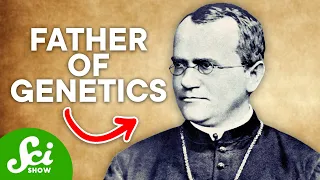
Hi curious and inquisitive, Did you know that the father of genetics was a monk and then abbot? Did you know that the great discoverer never knew the importance of his discovery? Did you know that this discovery went unnoticed for 35 years?
I'm JJ Priego, this is science Science, and video today you are going to put the hair like barnacles . . .
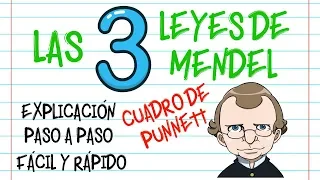
Gregor Johann talk about the great Mendel, and we will, of course, hand . . .
Isaac Asimov You know . . .
in this channel always we see that the known is finite, the unknown infinite. . .
Well, you want to know more? Well, let's look around. INTRO In 1900, three scientists, converged at the crossroads of research: each one of them, without prior knowledge of the work of the other two, had found the rules governing the inheritance of physical traits by living beings.
The three men were Hugo de Vries, Dutch; Carl Correns, German, and Erich Tschermak, Hungary. All three were ready to announce to the world his discovery, but not without browsing before, various scientific publications, and check if there were previous work in this field. And here, his astonishment was huge .
. . hallucinated in colors!
And, they found an incredible article, of one Johann Gregor Mendel, in a copy a dark publication, thirty-five years. Mendel had observed in 1865, all phenomena, all three scientists, They are preparing to exhibit in 1900. And what do you think did the three scientists?
¿Overall, it was an article I forgotten anyone He knew . . .
? Well, the three made the same decision, and with honesty, which is one of the glories of scientific history, they abandoned all pretense of originality, and called the attention, the discovery of Mendel. I mean .
. . they despite his great works .
. . got no medals .
. . no no .
. . is the Mendel put .
. . The three, they simply present their work as mere confirmation.
Mola ¿eh? But c'mon . .
. the beginning . .
. we will make history as JJ likes . .
. Gregor Johann Mendel, born in 1822, in Bruenn, Austria. The city is today called Brno, and belongs the Czech Republic, but at that time belonged to the Austrian Empire.
Mendel was born into a peasant family. And his life went quiet, without great avatars, except of course his great discovery. It was first monk and later abbot at the monastery of Augustinians Mendel had two hobbies, statistics and gardening, and the combination of both took good match.
Go if you got! And, since 1857, and for eight years, he began to grow peas. Carefully, he selfed several plants, making sure, that the seeds thus obtained, only inherit characteristics from one parent.
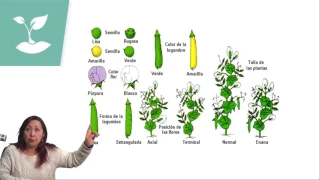
Patiently, he was collecting the seeds produced by each self-pollinated crop She planted one by one, and studied the new generation. He found that if planted seeds of dwarf peas grew only dwarf peas. And the seeds produced by this second generation, also gave dwarf peas exclusively.
Say . . .
that dwarf pea plants reproduced "faithfully" . . .
Instead, the seeds of large pea plants, not always behaved that way. Some of them, about a third of which grew in the garden, faithfully they reproduced, and gave large plants in all generations. But not in the rest, which was the majority.
The seeds of some of them gave large plants, while other begot dwarf plants. And these seeds, always produced three times more of the former than the latter. Obviously, there were two kinds of large pea plants: those reproduced faithfully and not.
Mendel then took another step. He crossed dwarf plants with large plants that are faithfully reproduced. The seeds, would now be the product of two unequal parents.
What would happen? Were descendants dwarves v other large? Well, no; every one of those "hybrid" spawned a large plant seeds.
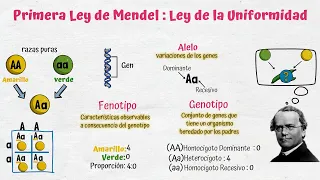
It seemed that the characteristic of dwarfism was gone. Mendel, then selfed, each of the hybrid plants, and studied the results: descendants, were all the kind of cheating reproduction. A quarter of the seeds, begot, dwarf plants faithful reproduction; other quarter, resulted in large plants faithful reproduction; and the remaining half, begot large plants unfaithful reproduction.
It is clear that large plants unfaithful reproduction, shelter itself both characteristics, the large plant and dwarf plant. When both characteristics were present, only it revealed the size big, it was therefore "dominant". But dwarfism, although it was "recessive" and not visible, was still there, and appeared in the next generation.
Mendel and found his "first law of inheritance. " He also studied the inheritance of other features, and developed the corresponding rules. But Mendel was just an amateur, and failed, that no major scientific He was interested in his work.
He published an article in a small local newspaper, and nobody, nobody, nobody, nobody paid Attention. And so it went unnoticed for thirty-five years. Mendel died in 1884, without continuing the work that was done in 1865, and unfortunately, without recognition of their work.
Science founded by Mendel, now called "genetic" day. A science, which can not will be more fashionable . .
. If Mendel saw it with his own eyes he would freak . .
. And, in Lately, is evolving exponentially . .
. Today . .
. it is possible sequencing, whole genome of a human, or other biological organisms, at a speed surprising, but also you can edit and modify or exchange genome sequences genomic, and who uses a text corrector, with almost perfect accuracy. In addition, genetic look both to the past and the future.
The study, for example, the distribution of inherited blood groups, reveals to some point routes that followed the primitive man in his migrations. Moreover, genetic of microorganisms it has a great importance. How is inherited, capacity to perform certain chemical syntheses, in various fungi and bacteria, it has revealed biochemical, exact paths on which are formed, certain substances chemical body.
Think about that for a work of this kind received the Nobel Prize, doctors GM Beadle El Tatum. Not to mention, the doors have opened to medicine, from the appearance and deepening genetics. Progress in improving human health, and disease prevention, are expanding the scope of professionals health sciences, and optimizing the living conditions of people.
Come on . . .
I wish Mendel, had known anything about this . . .
And, da worth thinking, the truth that a man who discovered something important, did not know I never admired which it is today in the scientific world . . .
How you have fallen curious and inquisitive? What do you like this story? Did you know some Mendel?
What do you think the attitude of the 3 scientists? Are you interested in genetics? You can put me in your comments.
I read them all . . .
Ahhh, and part of him like the video, subscribe and campanita . . .
I recommend these two videos . . .
In one, I speak of the very dangerous massive solar storms, a phenomenon, for our technological society and on the other, I speak of Louis Pasteur, and the greatest discovery doctor of history, let two great videos . . .
And nothing, you can also me follow Easypromos TV and Stories of History. And remember, knowledge is a essential for survival requirement. Many thanks.